The UK’s Promised War on Kleptocracy: Reinforcements Needed

Putin’s invasion of Ukraine has created a new-found resolve among the world’s financial centers. They are now committed to seizing the money Putin and oligarchic cronies have stolen from the Russian people and hidden in their territories. Given the enormous media attention on where it is stashed (examples here, here, and here), that may sound straightforward.

It is not.  Even bad guys have rights, and as Radha Ivory reminds, that includes the right to their property. To confiscate the assets Putin and cronies have squirrelled away outside Russia will require proof that (a) no matter what ownership records show, the assets really do belong to one of them and (b) the assets were acquired with the proceeds of corruption or other criminal activity.

London has been one of the premier destinations of dirty Russian money. James Mather, a barrister of the U. K’s Serle Court, explains below what the British government must do to fulfill its pledge to confiscate every shilling of stolen Russian money hidden in its territory.

The gloves have come off in the United Kingdom’s effort to cleanse itself of ‘dirty money’, or so we are told.  To signal its commitment, the UK government has sped up new legislation, but its contents seem unlikely to advance matters very far.  There is amendment of the legislation for Unexplained Wealth Orders (totemic but misunderstood powers that are of quite limited practical use) and new requirements to register the beneficial ownership of property (as always easily evaded by clever structuring or simple lies).  What has really been lacking all these past years is harder to legislate for: the adequate enforcement of the asset recovery laws that exist. 

Continue reading

Guest Post: Did Putin Invade Ukraine to Expand State Corruption?

Today’s guest post is from Matthew Murray, currently Adjunct Professor at Columbia University, who previously served as U.S. Deputy Assistant Secretary of Commerce for Europe, the Middle East, and Africa.

When President Putin began Russia’s expanded military invasion of Ukraine on February 24, the imprisoned Russian anticorruption activist and political opposition leader Alexey Navalny was on trial once again over fabricated charges of embezzlement. Though Mr. Navalny faces another 15 years in a penal colony, he seized the opportunity during his February 24 hearing to publicly state his opposition to Russia’s war on Ukraine. “This war between Russia and Ukraine was unleashed to cover up the theft from Russian citizens and divert their attention from problems that exist inside the country,” he said.

Mr. Navalny’s statement reflects a deep understanding of the causes of war. Throughout history rulers have started wars to divert and distract attention of their citizens from growing domestic problems and restiveness. And this pattern fits the Russian situation well. In recent years, Putin’s popularity has declined due to failure to modernize Russia’s economy, his flawed management of the Covid-19 pandemic, and—not least—the corruption of his regime and his inner circle. Indeed, last February, when Russian courts initially sentenced Navalny to over two years in prison, tens of thousands of Russian citizens from 109 cities across the country went to the streets to demonstrate against Putin’s rule. In ordering the invasion of Ukraine, Putin may well have been seeking to divert attention from failures at home, including his autocratic control of the political economy for the benefit of himself and the Russian oligarchy.

But it’s more than that: Putin’s aggression may also be aimed at legitimizing his rule at home by installing a new state-sponsored oligarchy in Ukraine. He may be seeking to kill the idea, which took hold in Ukraine during the 2014 Revolution of Dignity at the Maidan. The Maidan Revolution started when Ukrainians took to the streets of the Maidan in central Kyiv to protest then-President Victor Yanukovych’s sudden decision to reverse the nation’s course to join the European Union and engage in free trade with the world’s largest economic bloc. But the Maidan Revolution was not just about one decision or one administration. The Maidan uprising was a revolution against the system of corrupt rule of Yanukovych and the oligarch class that was choking the nation’s potential—and it was also about the idea: the idea that every individual should have the freedom, the right, and the path to fulfill their human potential. This idea fundamentally threatens Putin’s personal authority and autocratic rule. As Ukraine’s reformers have begun to take concrete steps to embed this idea in independent institutions, they set an example for Russian citizens, who may be inspired by Ukraine’s example to demand that their government suppress official corruption and respect for human rights. Continue reading

New Podcast Episode, Featuring Oksana Huss and Joseph Pozsgai-Alvarez

A new episode of KickBack: The Global Anticorruption Podcast is now available. During the ongoing emergency in Ukraine, as Russia’s unprovoked military aggression throws the region and the world into crisis, my colleagues at the Interdisciplinary Corruption Research Network (ICRN) and I are going to try as best as we can to feature on our podcast experts who can shed greater light on how issues related to corruption relate to the war, the larger political context, and the international response. In this episode, I had the opportunity to speak to two ICRN members: Oksana Huss, a research fellow at the University of Bologna, and Joseph Pozsgai-Alvarez, Associate Professor at Osaka University. Our conversation begins with Oksana explaining Ukraine’s transformation since the Maidan Revolution in 2014, particularly democratic and anticorruption reforms under President Zelensky’s administration, and the cultural, political, and economic threat that developments in Ukraine posed to Russian elites and the Putin regime. Joseph then discusses Russia’s use of so-called “strategic corruption” to extend Russian influence in the West. Then, after recognizing the heroism of the Ukrainian army in slowing the Russian advance, our conversation turns to the impact of sanctions on Russia and Russia’s political and economic elites, and the extent to which cracking down on the dirty money may help counter Russian aggression. You can also find both this episode and an archive of prior episodes at the following locations: KickBack is a collaborative effort between GAB and the Interdisciplinary Corruption Research Network (ICRN). If you like it, please subscribe/follow, and tell all your friends! And if you have suggestions for voices you’d like to hear on the podcast, just send me a message and let me know.

Transparency International Ukraine’s Call on International Companies to Stop Working in Russia

Transparency International’s Ukraine Chapter (on whose Board I serve) recently posted the following message on its social media accounts, which I am reposting here:

📢 We call for international companies to stop working in Russia and stop financing the war in Ukraine.
Economic sanctioning of Russia is already imposed by governments of the EU, US, Canada and other countries. However, fighting Putin’s aggression is not only the matter of national governments. International businesses have to make their contribution.
☝️ Every tax penny that international companies pay to the Russian budget costs Ukrainians lives. This money is being spent for weaponizing the Russian army, which attacks both Ukrainian military and civilians.
😢 Over four days 352 civilians were killed, over 1600 wounded. Russians hit apartment buildings, daycare facilities, buses with civilians and ambulances. Hundreds of thousands of people are forced out of their homes to stay alive.
Supporting the russian regime is unacceptable for companies that value human lives.
Facing financial risks connected with dismissal of the Russian market is nothing in comparison with reputational losses.
🙌 You can also tell businesses that you are against their work in Russia!
🔹 We prepared a list of well-known companies so you could address them publicly https://bit.ly/sbir_companies
We will update it
🔹 And with regard to some of the companies, we have explicitly explained how doing business in Russia affects the civilian population https://bit.ly/sbir_photos
🔹 Select the company that you would like to appeal to and tag it in posts on Twitter, Instagram and Facebook. For example,
@CompanyX, your taxes in #russia goes for the shelling of civilians in Ukraine. It’s time to stop doing business there, isn’t it?
Templates of the text for such posts you can find here: https://bit.ly/sbir_texts
The more people we are, the louder our voice is! Join us💪

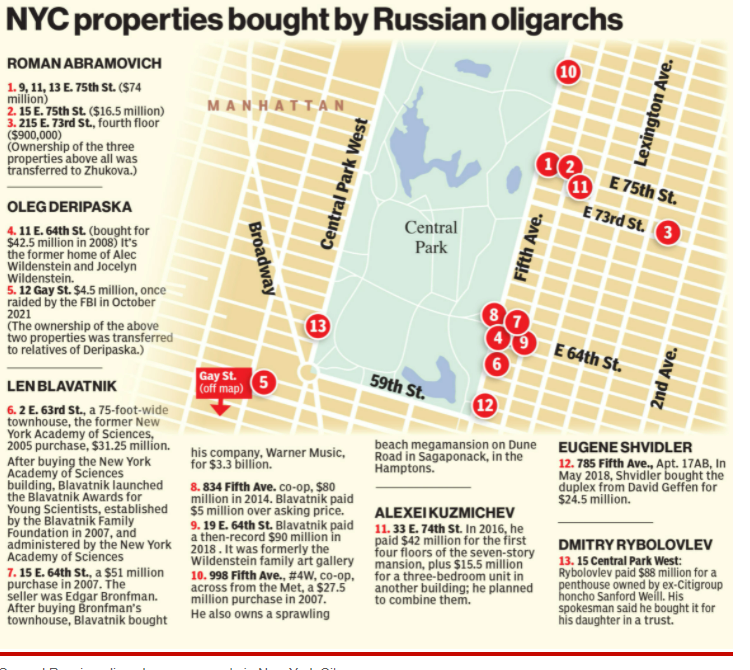
New York Real Estate Owned by Putin’s Buddies

Source: Jennifer Gould, Here’s where Russian oligarchs and their families own property in NYC, New York Post, February 27, https://nypost.com/2022/02/27/heres-where-russian-oligarchs-and-their-families-own-property-in-nyc/

Several media reports suggest sanctioning Putin’s supporters won’t be that easy because their ownership is hidden under layers of corporate vehicles. As Jennifer Gould’s story in the New York Post shows, thanks to the work of many investigative reporters and NGOs. we do know where many of Putin’s buddies have stashed their wealth in the Big Apple. Click here for a similar guide to London properties TI-UK has drawn up.

Nigerian Human Rights NGO Denounces Prosecution of Corruption Whistleblower Olanrewaju Suraju

This blog has several times reported on Nigeria’s prosecution of corruption whistleblower Olanrewaju Suraju (here, here, here). His “crime:” Helping expose massive bribery in the nation’s oil sector.

Fortunately, for both Mr. Suarju and the citizens of Nigeria, Nigerian civil society is standing behind him, demanding the farcical prosecution cease. Below is the most recent show of support.

Legal Defence & Assistance Project or LEDAP, a prominent Nigerian human rights NGO denounces the prosecution and calls not only for the government to immediately drop the charges against Mr. Suraju but investigate those behind this perversion of course of justice.

LEDAP condemns the prosecution of anticorruption crusader, Mr. Olanrewaju Suraju, Calls for investigation of Mr. Suraju’s corruption allegations in the Malabu Oil Scam.

LEDAP strongly condemns the prosecution of Mr. Olanrewaju Suraju, the chairman of the Human and Environmental Development Agenda (HEDA) for his allegations of corruption against the former Attorney General of the Federation, Mohammed Adoke, in the Malabu oil block allocation scam. Mr. Suraju has consistently made public massive bribery and abuse of power against Mr. Adoke and other foreign companies, for which some are currently facing criminal charges in Italy.  Rather than investigate the allegations raised in Mr. Suraju’s many petitions, the Attorney General has elected to prosecute him, undermining the so-called anti-corruption agenda of the regime.

Continue reading

A Brief Note on Russia’s War Against Ukraine

Russia’s invasion of Ukraine (or, more accurately, the dramatic escalation and expansion of the invasion that Russia already started eight years ago) is horrifying. As I type this, Russian forces are moving against Kyiv, and Ukrainian defense forces and reservists are preparing to defend their capital city against overwhelming odds, while the Ukrainian army elsewhere in the country is doing its best to resist Russian advances from all directions. I have nothing useful to say about this terrible situation. I am not a military analyst, an expert in geopolitics, or even terribly knowledgeable about aspects of this crisis closer to my own areas of expertise (such as questions regarding the efficacy of sanctions the West is imposing, or could impose). I’m just a professor, not terribly well known outside my fairly narrow areas of academic specialization, who runs a blog about anticorruption. But this morning, I can’t really think of anything else to write about.

Maybe at some point I’ll be able to collect and organize my thoughts and say something coherent about how this war relates to the global fight against corruption. There most certainly is a connection–probably several connections–even though corruption/anticorruption is only one part of the story. For now, let me just share scattered thoughts and reactions: Continue reading

Guest Post: The Keys to the Success of Transnational Investigative Journalism

Today’s guest post is from Professor Liz Dávid-Barrett, the Director of the Centre for the Study of Corruption at the University of Sussex, and Slobodan Tomić, Lecturer in Public Management at the University of York.

Over the last decade, investigative journalists have broken a series of blockbuster stories on financial secrecy and illicit financial flows. These clusters of stories have typically been based on, and named after, leaked documents and data from law firms, financial institutions, or government agencies: LuxLeaks (2014), SwissLeaks (2015), the Panama Papers (2016), the Paradise Papers (2017), the FinCEN Files (2020), the Pandora Papers (2021), and, most recently, Suisse Secrets (2022). One of the remarkable things about each of these cases is that they involved not a single story or series of stories by a single media outlet in a single country, but rather were the product of a transnational collaboration of a network of investigative journalists. It has always been the case that investigative journalism has been a vital tool for exposing and deterring corruption. But what we seem to be seeing now is the emergence of a transnational coalition of journalists that is sufficiently agile, dynamic, and capable of working across borders to be a match for the perpetrators of grand corruption, money laundering, and other forms of organized crime.

Indeed, these transnational networks of investigative journalists can be seen as a new institution of global governance. Yet their emergence presents a series of puzzles. How have they overcome the difficulties that plague law enforcement when they try to act transnationally? How have journalists learned to trust one another in handling sensitive data, and to have faith that their colleagues will hold off on publishing until the agreed date? In addition to questions like these, the emergence of transnational networks of investigative journalists raises a broader question: What does this new form of global governance add to our collective efforts to tackle grand corruption?

With support from the UK government’s Serious Organised Crime and Anti-Corruption Evidence (SOC ACE) programme, we have been investigating these questions, principally through interviews with investigative journalists in Latin America and the Balkans who have participated in these networks. Our research has highlighted three important features of these transnational journalistic networks. Continue reading

Why Didn’t the Disclosure of the Beneficial Owners of Real Estate Make a Difference?

Anticorruption advocates have long thought that real estate and money laundering go together like a horse and carriage. At least in the United States. With a little help from a friendly lawyer, a corrupt official or other big time criminal has until recently been able to use an anonymous shell company to hide their money by buying a luxury mansion or pricey condominium. Because the real estate registry listed the company, not the crook, as the owner, the real owner’s identify was hidden. From law enforcement, the media, and civil society.

In 2016 the U.S. government made a start on ending this abuse. It began to require the disclosure of the beneficial owner of any corporation which paid cash for properties in cities where real estate purchases were likely used to hide stolen money.  Initially, and as expected, the new rule seemed to have the desired effect: all cash purchases of real estate appeared to drop significantly — indicating a gaping loophole in the antimoney laundering laws had been plugged.

But the first paper published by the Anticorruption Data Collective finds to the contrary.  Authors Matt Collin of the World Bank and Brookings Institution, Florian M. Hollenbach of the Copenhagen Business School, and David Szakonyi of George Washington University report the rule had no impact “on the number of, the total price volume, or the share of corporate all-cash purchases in targeted counties.”  Indeed, they could find “little difference in the patterns of corporate all-cash purchases versus a ‘placebo’ outcome that should not be affected by the policy.”

Beneficial ownership disclosure is a favorite reform of anticorruption advocates. One that would seem to have an obvious, immediate salutary effect. Why didn’t it here?

The authors offer two reasons, and suggest there could be others. Their paper demands careful attention. One because of the implications for beneficial ownership disclosure rules, and second, and more importantly, because it shows how important it is to carefully assay anticorruption reforms. Their paper is here and comments are welcomed.  And GAB looks forward to more work by the Anticorruption Data Collective.

Taking on the Demand Side of Foreign Bribery: How U.S. FCPA Settlements Can Facilitate Foreign Prosecutions

Laws like the U.S. Foreign Corrupt Practices Act (FCPA) target what is sometimes referred to as the “supply side” of transnational bribery transactions—the firms and individuals of offer or pay bribes to foreign officials in order to secure a business advantage. But what about the demand side? All too often, the government officials who demand or receive these bribes escape accountability—even when the bribe-paying firms are forced to pay substantial penalties for FCPA violations. Years ago, some U.S. Department of Justice (DOJ) prosecutors floated the theory that bribe-taking officials could be charged as abettors to, or co-conspirators in, FCPA violations, but that theory, though legally plausible, failed to gain traction in the courts. On occasion, the DOJ has prosecuted bribe-taking foreign officials for money laundering. And more recently, Members of the U.S. Congress have introduced a new bill, the Foreign Extortion Prevention Act (FEPA), which would make it a crime under U.S. law for a foreign public official to seek, demand, or accept a bribe. FEPA’s chances of enactment are uncertain (the vast majority of bills fail, after all); moreover, even if enacted, FEPA’s impact may be circumscribed by the practical and political difficulties of arresting and trying foreign public officials, particularly those that do not have any contact with U.S. territory.

What about the bribe-taking public official’s own government? Shouldn’t that government take the lead in prosecuting its own public officials when they behave corruptly? There would be a nice symmetry—and a great deal of practical advantage—to a system in which the supply-side government (say, the United States) goes after the bribe-paying company, while the demand-side government goes after the bribe-taking public official. But often this doesn’t happen: In the majority of cases where the U.S. government imposes FCPA sanctions on a company for paying bribes in a given country, there is no parallel or subsequent prosecution by that country’s government of the corrupt officials involved.

Sometimes the explanation is political: the public officials involved are sufficiently powerful and well-connected to escape domestic accountability in their home countries, even when their misconduct is known. That’s a big problem, and one that statutes like FEPA are designed to address. But there’s another reason that demand-side governments often fail to hold their own officials accountable: a lack of capacity and an associated lack of evidence. In a great many cases, even when a bribe-paying firm settles an FCPA case with the US government, and in doing so admits to certain facts and provides evidence about the misconduct to the DOJ, the demand-side country government does not receive sufficient evidence to identify, let along prosecute, the corrupt officials involved—either because the company did not supply that information to the DOJ, or the DOJ did not turn that information over to the demand-side official’s government. True, FCPA settlement agreements are usually public, but the official statements of facts in these agreements are often not sufficiently precise and detailed to give a foreign enforcement agency what it needs to make out a case.

The U.S. government can and should fix this problem. Doing so would not require new legislation. Rather, it could be accomplished through a straightforward and easily implementable change in DOJ policy. Continue reading