Leveraging Blockchain to Combat Procurement Corruption

Procurement corruption–including things like bid rigging, shadow vendors, and the steering of public contracts to politically connected firms—is an enormous worldwide problem, costing taxpayers up to $2 trillion annually. New technologies, though certainly no panacea, may offer new techniques for combating this sort of corruption. One such technology is blockchain.

Blockchain, most famous as the foundational technology for cryptocurrencies such as Bitcoin, is a “distributed ledger technology” (DLT)—a tamper-proof record of activities that are time-stamped and verified by a distributed network of computers. DLT creates a trail of information which allows for the full traceability of every transaction and stores a chronological list of transactions in an encrypted ledger. Transactions are bundled into a secure and identifiable block and then added to a corresponding chain. The blockchain is maintained and verified by the distributed crowd, eliminating the need for hierarchy and any centralized authority or middleman. And while blockchain is best known for its role in making cryptocurrencies feasible, it also has a range of other applications, including anticorruption applications. For example, Tanzania has utilized the technology to weed out “ghost workers” from the public sector, ending the monthly outflow of 430 billion Tanzanian shillings (approximately US$195.4 million) in salaries to fake employees who exist only on paper. Nigeria’s customs service has also used blockchain technology to store information on financial transactions and share these transactions across multiple computer networks.

Blockchain technology could also be used to combat common forms of procurement corruption, particularly those that involve after-the-fact tampering with submitted bids and supporting documentation. Such a system would work as follows: Continue reading

The Case for Engaging Religious Leaders in Anticorruption Efforts

The Kenyan Ethics and Anti-Corruption Commission (EACC) recently launched a somewhat unconventional initiative: an anticorruption Bible study guide. The EACC collaborated with the Evangelical Alliance of Kenya and the Fellowship of Christian Unions to first publish the guide in 2008, but in September it launched the guide’s use in a formal event with the Inter-Religious Sector. Though the EACC has worked with religious leaders from across traditions in the past, this guide is limited to the Christian faith. (Roughly 85% of Kenyans identify as Christian.) Intended for use in small group studies, the guide has 12 lessons divided into three sections: understanding corruption, developing values, and responding to corruption. Each lesson contains an introduction, discussion questions rooted in Scripture, a memory verse, and a final point of reflection. The EACC Twitter account declared that the study guide “is intended to help Kenyans interact with the Bible and discover God’s position on corruption and his direction on living a corruption free life.” And as the guide’s forward explains, “we believe that this fight will benefit from a much greater impetus if we use places of worship as the vanguard platform of advocacy against corruption in Kenya.”

Many in Kenya are not so sure. The decision to invoke God in the fight against corruption was met with skepticism and outright derision on Twitter and local media. (See here, here, and here.) Critics argued that the anticorruption Bible study guide would be ineffective (and therefore was a waste of resources), and also that anticorruption advocacy should be grounded in general morality, not religion. And it is hard to ignore the hypocrisy of religious groups and leaders speaking out against corruption given their imperfect records. (See here, here, and here). Furthermore, the collaboration between a government agency and religious leaders in producing this guide raises concerns both about the separation between church and state and about whether scarce government resources are best spent recruiting religious organizations into the anticorruption fight.

These criticisms are overblown. Working with religious stakeholders—and framing ethical arguments in religious terms—is a powerful and legitimate tool in the anticorruption movement’s arsenal, and activists should not shy away from using it. Religious leaders and organizations make particularly effective partners in anticorruption efforts for several reasons: Continue reading

2018: Five Great Reads on Corruption


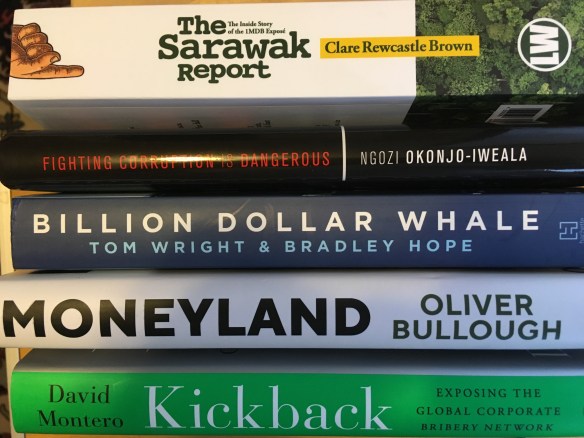
Twenty eighteen produced many fine analyses of corruption and how to fight it. The five books pictured above, four by journalists and one by a former Nigerian Finance Minister, are among the best.  Combing in-depth reporting with thoughtful analyses, all merit a place on corruption fighters’ book shelf. Continue reading

Guest Post: The Importance of Integrating Anticorruption into Military Capacity-Building Programs

Today’s guest post is from Associate Professor Åse Gilje Østensen of the Royal Norwegian Naval Academy, and Sheelagh Brady, Senior Analyst at SAR Consultancy:

In developing countries faced with security challenges—such as armed conflict, insurgencies, or widespread violence—foreign donors often offer capacity-building programs to strengthen local security institutions. However, many of these capacity-building programs do not consider corruption or incorporate anticorruption measures within their design. And when donors do consider corruption in military capacity-building programs, they typically focus narrowly, and short-sightedly, on safeguarding program funding, with little apparent concern beyond that. The view seems to be that one can build military or police capacity first, and then (perhaps) deal with corruption later, or even leave anticorruption efforts entirely to organizations and agencies dedicated to this purpose.

This approach is likely mistaken. As documented in a recent case study from the U4 Anti-Corruption Resource Centre, Capacity Building for the Nigerian Navy: Eyes Wide Shut on Corruption?, capacity-building efforts in weak states with pervasive corruption can stimulate corrupt or even criminal activity, which may result in more of the insecurity that these efforts are supposed to reduce. As the U4 report notes, “capacity building can strengthen the abilities of corrupt actors to devise corrupt schemes, as the skills and equipment provided may be used to ‘professionalise’ corrupt practices.” Donors and policymakers therefore need to see corruption as a critical concern at the top level of foreign and security policy across countries, and make anticorruption a key component of the design, implementation, and follow-up of military and police training.

In contrast to more ambitious and comprehensive security sector reform programs, capacity building programs seek to achieve modest improvements in capabilities, usually by providing training, mentoring, and/or equipment. Yet while modesty in terms of goals may be useful, donors may be tempted to think that the limited scope of capacity-building interventions implies limited risk. Yet a host of problems can arise when anticorruption measures are not incorporated into capacity building. Most obviously, when adding particular skill sets or strengthening the operational capacity of corrupt security institutions, security personnel may improve their ability to divert resources from their intended purposes. Worse still, building selected capacity without addressing corruption could mean bolstering the segments of the security apparatus involved in facilitating or carrying out criminal activity. It is hard to know just how big of a problem this is, but there are indications that capacity building very often is provided to corrupt security sectors. For example, several studies have found the Nigerian Navy to be heavily involved in facilitating illegal bunkering, oil theft at sea, and piracy in the Gulf of Guinea (see here, here, here, and here). At the same time, the Navy is a partner to two capacity building programs sponsored by the U.S. military’s Africa Command (AFRICOM): the Africa Maritime Law Enforcement Partnership (AMLEP) and the Africa Partnership Station (APS). Neither of these programs implements measures to prevent corrupt actors in the Navy from using their newfound skills and better technology to fuel insecurity and crime. More generally, according to the Security Assistance Monitor, in 2016 alone the United States provided over $8 billion in arms and training to 50 of the 63 countries that Transparency International (TI) has rated as a having a high or critical risk of corruption in their defense sectors.

How can anticorruption efforts be made part of capacity-building programs? The first step is to recognize that corruption can undermine the results of security assistance programs, and to avoid compartmentalizing “security” and “corruption” as two unrelated issues. After recognizing this fundamental point, one can design and implement sensible anticorruption measures, tailored to the particular circumstances, in particular the informal power distributions and incentive structures that determine who gains from corruption and how. And before implementing capacity building programs in the first place, donors should carefully consider whether those programs will translate into institutional improvements or will instead create “capital” that may be attractive to corrupt actors, subversive forces, or disloyal individuals.
Guest Post: An International Anticorruption Court Is Not a Utopian Dream or a Distraction

Today’s guest post is from Richard Goldstone, a former Justice of the Constitutional Court of South Africa who also served as the first chief prosecutor of the United Nations International Criminal Tribunals for the former Yugoslavia and Rwanda, and Robert Rotberg, the President Emeritus of the World Peace Foundation and former professor at the Harvard Kennedy School of Government.

In a 2018 Daedalus article, Senior United States District Judge Mark L. Wolf explained that “The World Needs an International Anticorruption Court (IACC)” and charted a course for its creation. In a recent post on this blog, Professor Alex Whiting characterized the IACC as a “utopian” dream and possibly “a distraction from more effective responses to the worldwide scourge of grand corruption.” Notably absent from the post is a description of what the other effective responses to combating grand corruption might be.

In contrast to Professor Whiting, we found Judge Wolf’s original proposal for an IACC compelling. Therefore, we joined him in establishing Integrity Initiatives International (III). Continue reading

How We Did It: the U.S. Congress’ Exposure of the Grand Scale of Global Corruption

 Over the past two decades the U.S. Senate Permanent Subcommittee on Investigations has laid bare how Gabonese President Omar Bongo, Chilean dictator Augusto Pinochet, Equatorial Guinean President Teodoro Obiang, and a gaggle of friends and relatives of the leaders of Mexico, Pakistan, Nigeria, Angola, Saudi Arabia, and other countries conspired with large, prestigious banks to hide the enormous sums they stole from their nation’s citizens.  Financial Exposure, the new book by subcommittee investigator and later staff director Elise Bean, recounts how Democrats and Republicans united not only to document egregious cases of grand corruption but to enact legislation making banks’ complicity in future cases a crime.

Americans depressed by the rancorous polarization now gripping Congress will find her book a welcome reminder that Democrats and Republicans can work together to advance the public interest.  Scandals involving money laundering by banks in other nations, most recently Denmark’s Danske Bank and Latvian bank ABLV, should prompt non-Americans to send their parliamentarians a copy of Ms Bean’s book.  Below Ms. Bean offers a few morsels from the book to whet readers’ appetites.    

There isn’t room here to recount all the subcommittee’s anti-corruption investigations, but a few examples will illustrate what they showed and what results they produced.

Citibank Private Bank.  Corruption was the subject of a key investigation by the subcommittee in 1999, which was led by then subcommittee chair Republican Senator Susan Collins of Maine. Rumors were flying then that the United States had become the preferred banker for corrupt foreign officials around the world. Working with Democratic Senator Carl Levin of Michigan (my boss), the subcommittee elected to zero in on so-called “private banks,” banking units that opened accounts only for wealthy individuals with at least $1 million in deposits.

The inquiry ended up detailing four accountholders at Citibank Private Bank: Raul Salinas, brother to the then president of Mexico; Omar Bongo, then president of Gabon; Asif Ali Zardari, then known for his marriage to Benazir Bhutto, former prime minister of Pakistan; and the sons of Sani Abacha, recently deceased president of Nigeria.  Senate hearings exposed how Citibank had not only accepted tens of millions of suspect dollars from the accountholders, but also created offshore shell companies to hide their identities, helped them secretly move millions of dollars around the globe, and continued servicing them even after learning of corruption allegations. Continue reading

Guest Post: The Nigerian Foreign Minister’s Vilification of Switzerland and the Diplomacy of Asset Recovery

Today’s guest post is from Dr. Matthew Ayibakuro,director of research and policy at the Africa Network for Environment & Economic Justice (ANEEJ).

On Tuesday, 11 September 2018, Nigeria’s Foreign Minister, Geoffrey Onyeama in a speech delivered at the opening of the 2nd International Conference on Combatting Illicit Financial Flows organized by the Presidential Advisory Committee Against Corruption (PACAC), called out Switzerland for being an accessory to the looting of the country by the former Head of State, Sani Abacha.

He further decried the difficulties faced by Nigeria in repatriating the infamous Abacha loot from Swiss authorities, referring to the process as “daylight robbery”.  For stakeholders working on issues of asset recovery from Nigeria and in foreign jurisdictions, these comments give room for some concern.  The potential impact of statements like this in the short and long-term can impede the progress made by the asset recovery regime in Nigeria over the last couple of decades.  There are obvious reasons for this. Continue reading

Guest Post: Towards an African Voice on Anticorruption

Today’s guest post is from Selemani Kinyunyu, Senior Policy Officer for Political and Legal Matters at the African Union Advisory Board on Corruption. The views expressed in this post are his own.

The African Union (AU) has declared the year 2018 is the African Anti-Corruption Year, and the fight against corruption was a central focus of the 31st Summit of the AU, which was held this past July 1 and 2 in Mauritania. The Summit, along with other recent developments, have made clear that there is an emerging African voice on this issue, one that emphasizes certain issues of pressing importance and that articulates a distinctive perspective on these issues. The AU Summit in particular highlighted four notable issues: Continue reading

Lights, Camera, Integrity? From “Naming and Shaming” to “Naming and Faming”

“Can a reality TV show discourage corruption?” This was the recent attention-grabbing headline of an article in The Economist about Integrity Idol, the brainchild of the NGO Accountability Labs. It was started in Nepal in 2014, and has since spread to Pakistan, Mali, Liberia, Nigeria, and South Africa.

The format of the show is simple. Citizens are asked to nominate civil servants whom they believe display the highest standards of honesty and integrity. These nominations are then reviewed by a panel of judges comprising local and international experts, who select five finalists. Videos are then produced, each around 2-5 minutes long, containing excerpts from an interview with the finalists and their superiors, colleagues, and subordinates, along with glimpses into their work lives. (See here and here for examples). These videos are disseminated among the citizenry via traditional and non-traditional media. Citizens vote for their favorite, and the “Integrity Idol” is crowned.

This isn’t the first time a non-traditional cultural medium has been used to spread an anticorruption message. Other approaches, including museums, TV dramas, music, and poetry  have been discussed on this blog previously (see here, here, here and here). Thanks to Integrity Idol, reality TV can be added to the list. That might seem a bit surprising. Reality TV has a (deserved) reputation for depicting an over-dramatized, intentionally provocative, and often manipulated caricature of real life. One hopes that no one would cite Real Housewives of New York as a reliable source for understanding the lives of real housewives in New York! Integrity Idol is different: it is an intentional effort to draw attention to real stories of real people, and often the unaltered stories of these people are compelling in and of themselves. The vision of Accountability Labs and its founding director, Blair Glencorse, is to “support change-makers to develop and implement positive ideas for integrity in their communities, unleashing positive social and economic change.” Continue reading

Fighting Corruption in Nigeria

Nigeria continues to enjoy pride of place in the global discourse on corruption.  A Google search for “Nigeria corruption” brings up more than 53 million entries led by a lengthy Wikipedia article on the subject. Matthew’s bibliography lists over 100 books, monographs, and scholarly articles on corruption in the country which analyze everything from its colonial roots to how and why it is endemic to what can be done to tame it.  This blog has ruminated on matters ranging from why the head of the Economic and Financial Crime Commission was replaced to whether the then newly-elected President Muhammadu Buhari was serious about fighting corruption to outgoing First Lady Patience Jonathan’s impatience with the thought something was untoward in her receiving “small gifts” totaling $15 million while her husband held high office.

Two current papers by authors with very different backgrounds, one a former U.S. intelligence analyst, the other a former Nigerian professor and incoming head of the Nigeria’s corrupt practices commission, continue the discussion.   Both agree corruption is pervasive and that it has done much harm to the state and its citizens.  Not surprisingly perhaps, given who they are and where they sit, they offer quite different assessments of where the country stands in the fight against corruption.  In Real Challenges of Fighting Corruption in Nigeria, remarks delivered to the Corruption Hunters Network (CHN) June 25, Professor Bolaji Owasanoye, nominated to chair the Independent Corrupt Practices and Other Related Offences Commission, radiated optimism, ticking off a series of reforms that have made a difference and predicting more progress is on the horizon.  By contrast, the tone of a July monograph for the Carnegie Endowment for International Peace by Matthew Page, the former Nigerian analyst for the U.S. intelligence community, is decidedly pessimistic.  When it comes to what can be done, he offers nothing beyond a scheme to help policymakers make sense of the dizzying variety of forms corruption in the country takes.

My money is on Owasanoye and not just because I had the opportunity to hear him deliver his talk. My reasons for optimism about Nigeria’s fight against corruption are several. Continue reading