Pressure Growing on OECD Antibribery Working Group to Review Italy’s Noncompliance

As a party to the OECD Antibribery Convention, Italy is bound by international law to investigate any Italian citizen or company alleged to have bribed an official of another government. In pursuing a case, the treaty requires that Italy “not be influenced by considerations of national economic interest. . . or the identity of the natural or legal persons involved.”

Successive Italian governments have ignored the no favoritism requirement. Economically important and politically influential Italian firms have regularly escaped punishment on the flimsiest of grounds: €10.5 million paid to a foreign public official’s cousins called not a bribe but a “consulting fee,” €197 million to well-connected insiders termed a “lobbying fee” (here).

Italy’s most recent breach of its treaty obligation: the refusal to appeal the acquittal of oil giant and partially state-owned firm Eni for paying a $1.1 billion bribe to Nigerian officials. A case where the evidence of wrongdoing was overwhelming (here); the trial court’s acquittal reeks of judicial incompetence or worse (here); and in an extraordinary, unprecedented move that will surely deter future foreign bribery cases, the prosecutors are themselves being prosecuted for pursuing the case (here).

That economic considerations or political pressure might dissuade a government from enforcing its foreign antibribery law was not lost on the drafters of the Antibribery Convention. To guard against it the included an article requiring the parties to submit to a “program of systematic follow-up to monitor and promote the full implementation of this Convention.”  That follow up takes the form of a periodic review of compliance by the Antibribery Working Group, a committee consisting of a representative from each treaty party with a senior diplomat chairing.

On its website the Working Group stresses its commitment “to global engagement on anti-bribery.” Italy’s flagrant treaty violations have sparked anticorruption activists to take the group on its promise of a global dialogue. Last October more than two dozen of them asked it to review Italy’s compliance (here); in a tightly reasoned 47-page submission this June a coalition of civil society groups laid out the case for considering Italy’s (non)compliance (a request later amended to overcome the reason the chair gave for putting off review – amended submission here).

Most recently the Federación Latinoamericana de Fiscales, a federation of national associations of prosecutors from Latin American states, has written to the court hearing the Italian prosecutors’ case to emphasize that the proceedings are “undermining the sense of security and institutional trust that all prosecutors must have” to faithfully discharge their duties (here).

Past time for the Working Group to act.

Formal Review of Italy’s Compliance with OECD Antibribery Convention Requested

In a June 5 submission to Kathleen Roussel, Chair of the OECD Working Group on Bribery, three NGOs have asked the group to find Italy has failed to prevent political interference in a case where, in the face of overwhelming evidence, Italian oil giant Eni, Shell, and accomplices were acquitted of paying a $1.1 billion bribe to acquire rights to Nigerian oil field license OPL-245 (here).

As a party to the OECD Antibribery Convention, Italy pledged that the investigation and prosecution of foreign bribery cases would not “be influenced by considerations of national economic interest. . . or the identity of the natural or legal persons involved” (article 5). In their submission, the NGOs list 60 different instances where politics, Eni’s nationality, or both compromised the case. The evidence includes:

  • Admissions by Italian officials Eni associates conspired with state officials to “pollute” the OPL 245 investigation
  • The current trial of Eni’s former chief legal counsel for his alleged role in the plot
  • The termination of the OPL 245 prosecutions on overtly political grounds
  • The disciplining and criminal conviction of the two First Instance court prosecutors on charges that an independent judicial expert has described as “questionable conjectures

The complaining NGOs are Corner House Research of the United Kingdom; Hawkmoth, a Netherlands-stichting; and Nigeria’s HEDA Resource Centre.

The Working Group on Bribery is responsible for monitoring compliance with the Convention, and the NGOs’ submission is now circulating among its members. The Convention remains a signal commitment in the global fight against corruption.The Working Group should act promptly and decisively to see Italy observes its commitment to eradicating foreign bribery – no matter the political implications or the bribe payor’s identity.

Conference on Global Capitalism, Trust and Accountability

Can democratic governments hold global capital accountable? What are the consequences if they fail?  

These are the questions that will be examined at an April 4 and 5 conference at Stanford University. Among the issues speakers will address are the law and politics of corruption, opacity and illicit flows, and corporate misconduct and the law.

The live streamed event is being organized by Stanford’s Program on Capitalism and Democracy and is co-sponsored by its Graduate School of Business and the Center on Democracy, Development and the Rule of Law of the Freeman Spogli Institute for International Studies . In addition to academic authorities, speakers include Judge Jed Rakoff, Kenya corruption fighter John Githongo, TI USA Director Gary Kalman, and Italian prosecutor Fabio de Paquale.  

Registration and program details here.

Italian Prosecutors’ Criminal Conviction For Not Disclosing Information in OPL-245 Bribery Case Called A Travesty of Justice

“Questionable conjectures” and “illogical reasoning” produced a decision which “does not correspond to the reality or the nature of the crime.” That is how Italian legal scholar Nello Rossi explains the conviction of prosecutors Fabio de Pasquale and Sergio Spadaro for their failure to disclose information to Shell and ENI during the trial of the two for paying massive bribes to secure the rights to Nigerian oil tract OPL-245.

Writing in the January issue of a leading Italian law journal (original; translation), the former judge, Deputy Chief Prosecutor, and High Council of the Judiciary member excoriates the November 11 judgement by a trial court sitting in Brescia (here), showing it to be the result of an unprecedented, unrealistic reading of the governing law together with misstatements if not down-right misrepresentations of the facts.

In finding the prosecutors guilty of failing to perform an official act, the court ruled the law requires prosecutors to automatically turn over to defendants all material received from any third-party before or during trial no matter its credibility or relevance. That the two decided to secretly withhold the material, the court said, showed they knew withholding it was a crime. To buttress its decision, the court added that the material’s disclosure would have affected how the judges in the bribery case assessed the evidence.

Rossi’s meticulous analysis of the court’s decision eviscerates each of these contentions.

Continue reading

Italian Court: That ENI Bribed Nigerian Officials for Rights to OPL-245 Based on “Multiple Reliable Sources”

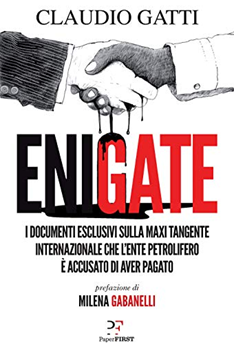
A courageous Italian judge has affirmed that the evidence showing oil giant ENI paid massive bribes for rights to Nigerian oil block OPL-245 is reliable. Judge Francesca Giacomini ruled in December that ENIgate, a book reporting the bribery scheme, was based on “multiple reliable sources.”

In her opinion she not only dismissed ENI’s lawsuit that author Claudio Gatti and publisher Il Fatto (“the Fact”) had defamed the company by claiming it had paid bribes but ordered it to pay defendants’ legal fees as well.

Saying OPL-245 was secured through bribery isn’t what makes Judge Giacomini courageous. The bribery has been a matter of public record for over a decade (here).

The judge merits the accolade for having the fortitude to say so in the face of the fecklessness and likely downright corruption of her judicial colleagues (here). On even more evidence than she had before her, three of them exonerated ENI, its executives, and accomplices of all bribery charges with the flimsiest of reasoning (here). Even more scandalous, in a separate case a fourth found the prosecutors guilty of a crime for how they chose to present the case.

That case rests on an imagined set of facts and an unprecedented interpretation of Italian law (here). Is it too much to hope that the court hearing the appeal show the same courage as Judge Giacomini?

Time for English translation?

Key excerpts of Judge Giacomini’s ruling in English, courtesy of Google and Microsoft office translation programs, below.  Full text of decision here.

Continue reading

Guest Post: Italy’s Misguided, and Possibly Illegal, Repeal of the Abuse of Office Offense

Today’s guest post is from Roberta De Paolis, a post doctoral fellow in Criminal Law at the Sant’Anna School of Advanced Studies of Pisa.

For nearly a hundred years, the Italian criminal code included an “abuse of office” offense. Public officials committed this crime when, in the course of performing their duties, they acted in a way that was otherwise unlawful or entailed a conflict of interest, and in so doing secured a monetary advantage to themselves and/or inflicted monetary damage on others. For example, if a public official rigged a public procurement auction, steering a government contract to a relative or friend, that public official would not only have violated the rules on competition procedures, but would also have committed the crime of abuse of office. But the crime could apply more broadly. For example, if a local official denied a citizen a building permit for self-interested reasons, the official may have committed the abuse-of-office crime.

On its face, the abuse of office offense seems like a potentially powerful anticorruption tool. But it had proved to be controversial. Many, including Justice Minister Carlo Nordio, claimed that the crime was too vague, and potentially too broad. For example, in many small Italian towns, many people—particularly at the elite level—know each other socially and often have family ties, and as a result many decisions that local politicians make could be characterized as helping their friends or relations or otherwise involving a conflict of interest. Consider a mayor who announces a tender for public construction project, and the best bid comes from an acquaintance of the mayor. If the city government accepts that bid, the local political opposition could report the decision to the authorities and assert that the mayor abused her office by favoring an acquaintance in the tender procedure. As a result, according to critics of the abuse-of-office offense, many local public officials were discouraged from implementing socially valuable public works projects, out of fear of ending up under criminal investigation. The critics also pointed out that, despite the large number of prosecutions for abuse of office, these prosecutions rarely produced convictions: the most up-to-date statistics report that about 5,000 criminal prosecutions for abuse of office resulted in only nine convictions. This is suggestive evidence that many of the investigations were meritless, and possibly politically motivated tools of harassment.

That, at least, is what critics of the law argued, and this past August, those criticisms carried the day: Parliament voted to repeal the abuse-of-office offense. But was that the right decision? Many experts say no. Notably, the President of Italy’s National Anti-Corruption Authority, Giuseppe Busia, asserted that repealing the abuse of office offense leads to impunity in cases of conflict of interest like favoritism in public competition or tenders. Similarly, a spokesman for the European Commission claimed that the repeal of this law “decriminalizes an important form of corruption and may have an impact on the effectiveness of the European fight against corruption.” (Indeed, it is worth noting that 25 of the 27 EU countries have criminal laws prohibiting abuse of office.) Supporters of the repeal respond that these concerns are overblown because other provisions of the criminal code, as well as Italian administrative law, still apply to the egregious cases. But that is not obviously true, and, worrisomely, the repeal of the criminal abuse of office offense has not been counterbalanced by the introduction of new administrative offenses to address the problematic conduct. Continue reading

The Fight Against Corruption Is at Stake in Milan

That’s how former French magistrate and renowned corruption fighter Eva Joly sees current developments in Italy. Two prosecutors there face prison for actions taken during the bribery trial of Italy’s largest company.  Writing in the Argentine opinion journal Clarín, Mme. Joly explains that the charges have nothing to do with their conduct and everything to do with a justice system where score-settling and the protection of Italian companies has supplanted the goal of truth and justice (Spanish original here; English translation here).

The saga begins with prosecutors Fabio de Pasquale and Sergio Spadaro opening an investigation into allegations oil giants Shell and Eni paid a $1.1 billion bribe for rights to Nigerian oil field OPL 245. With overwhelming evidence of wrongdoing on the public record (here, here), the two expected they would be trying a cut-and-dried case of foreign bribery.

Even before the trial began, however, it was clear that that was not to be. The first signs: revelations of ties between the chief trial judge and a lawyer close to ENI together with a surprising lack of interest by the Italian press in the largest bribery scandal on record. During the trial, a string of rulings highly favorable to the defense heightened suspicions the fix was in. But the acquittal still came as a surprise given the massive evidence presented coupled with the flimsy reasoning the court advanced to justify its verdict (here).

Adding to the surprise was the Italian media’s new-found interest in the case. Stories claiming the trial had been a waste of public money and questioning what Italian prosecutors were doing prosecuting Italian companies for bribing foreign officials began appearing in several outlets, the same ones where ENI was a major ad buyer.

Not to risk an appellate court would undo their handy work, those behind the trial’s outcome saw to it that the state counsel appointed to appeal the acquittal was one whose public comments on the case tracked the criticisms in the press (here). She then took the extraordinary step of refusing to pursue an appeal, meaning the trial court’s acquittal remains the final word.

Those responsible for quashing one case against ENI apparently feared there was always a risk some other pesky prosecutor didn’t get the message. Hence the orchestration of the conviction of de Pasquale and Spadaro for failing to disclose exculpatory information to the defense, a case with no precedent in Italian law based on a factual claim belied by the trial record.

If the convictions are not overturned on appeal, it’s not only the future of two talented magistrates that will suffer. As Mme. Joly says, the credibility of the Italian judicial system and the future of the fight against corruption, in Italy and far beyond, will suffer as well.

Open letter to OECD Antibribery Convention’s Working Group on Italy’s Noncompliance

In a world where the fight against corruption remains an uphill struggle, the OECD Antibribery Convention is a signal achievement. The 38 members of the OECD, the world’s richest nations, have bound themselves to make it a crime under their domestic law for any person or entity subject to their jurisdiction to bribe an official of a foreign country. What was once common practice by large multinational corporations is now subject to stiff fines for the corporation and prison sentences for their executives.

To ensure their commitment is more than just words on paper, convention parties regularly review each other’s compliance. But as this blog has reported, recent decisions by the Italian judiciary and the Italian government now threaten the enormous progress made in curbing foreign bribery (here, here, and here). Italy’s compliance is being discussed this day by the group charged with reporting on compliance with the Convention. In the letter to group members reprinted below, current and former corruption prosecutors, investigators, academics, and activists urge the group to hold Italy to account for its noncompliance.

The letter remains open for signature. Those who wish to add their names should do so by submitting a comment to this post.. Italy’s noncompliance must remain at the top of the international agenda to fight corruption.

We the undersigned anti-corruption experts and practitioners are writing in the context of discussions about Italy and its resistance to recommendations contained in the Working Group’s (WG) 2022 Phase IV report on Italy. 

We wish to inform you of our immense concerns about Italy’s performance pre and post the Phase IV report issued by the WG.  In particular, we would point you to the following:

Continue reading

Breakthrough in the Use of Artificial Intelligence to Fight Corruption

Whatever peril or promise the future of artificial intelligence holds, Brazilian, Colombian, and Italian researchers show it is a powerful tool for targeting corruption investigations.

Each year Colombia and Italy let thousands of contracts for goods, services, and public works, and each year some percentage is awarded thanks to bribery, conflict of interest, or other corrupt behavior. Each year Brazil’s central government transfers millions of dollars to the countries’ 5,500 plus municipal governments, and each year employees of some governments steal a portion.

Corruption is discovered through audits or whistleblowing, but a significant percentage goes undetected. The work done in Brazil, Colombia, and Italy shows how AI helps governments to deploy their investigative resources to boost the odds of finding a much larger percentage.

Continue reading

Civil Society to the U.S.: Repair the Damage Italy Has Done to the OECD Antibribery Convention

Eni and Shell’s acquittal by an Italian court of foreign bribery threatens to undermine one of the major advances of the fight against corruption: the OECD Antibribery Convention. Italy and the 43 other wealthy nations parties to the Convention pledge to investigate, prosecute, and punish nationals who bribe officials of another government.  

The trial court’s acquittal of Eni, Shell, and four individuals of paying Nigerian officials over $1.1 billion in return for the rights to OPL-245, a lucrative offshore oil field, shocked those following the case. The bribery evidence on the public record was overwhelming. Rumors that the acquittal was bought immediately began circulating. When the prosecutor announced she would not to appeal the acquittal, the rumor mill went into overdrive and put the question Italy’s commitment to the Convention squarely on the international agenda.

And if a G-7 country backs away from it, how long before other parties follow? Especially when, as in Italy, one of their major companies is in the dock?

Below is a letter from a broad coalition of civil society groups, and the lawyer who represents Nigeria in foreign bribery cases asking U.S. Attorney General Merrick Garland to open a case against Eni and Shell for bribing Nigerian officials.  As the authors explain, because Eni and Shell are both subject to Foreign Corrupt Practices Act, when the allegations involving Nigeria first surfaced the U.S. had initiated an investigation. After Italy signaled it was also investigating the companies, the U.S. deferred and closed its case.  Now that Italy has utterly failed to see the case through, they urge the U.S. to pick up the ball. 

Dear Mr. Attorney General:

Urgent action required by US to defend the OECD Anti-Bribery Convention: The Department of Justice must reopen its investigation into Eni and Shell

Continue reading