Conference on Global Capitalism, Trust and Accountability

Can democratic governments hold global capital accountable? What are the consequences if they fail?  

These are the questions that will be examined at an April 4 and 5 conference at Stanford University. Among the issues speakers will address are the law and politics of corruption, opacity and illicit flows, and corporate misconduct and the law.

The live streamed event is being organized by Stanford’s Program on Capitalism and Democracy and is co-sponsored by its Graduate School of Business and the Center on Democracy, Development and the Rule of Law of the Freeman Spogli Institute for International Studies . In addition to academic authorities, speakers include Judge Jed Rakoff, Kenya corruption fighter John Githongo, TI USA Director Gary Kalman, and Italian prosecutor Fabio de Paquale.  

Registration and program details here.

Opportunity for Civil Society Organizations Concerned with Corruption to Provide Input to 4th International Conference on Financing for Development

The UNCAC Coalition, a global network of close to 400 civil society organizations in over 120 countries committed to furthering implementation and monitoring of the UN Convention against Corruption, urges CSO’s working on corruption to provide input to the 4th International Conference on Financing for Development (FFD4).

UN Member States will there decide how to resource the pursuit of the Sustainable Development Goals, international development, and support reform of the international financial architecture. 

The Conference will take place from 30 June to 3 July 2025 in Spain. The consultation that will inform the negotiations is open until 15 October COB EST (find more details below).For corruption to feature prominently as a cross-cutting issue, it is crucial that as many civil society organizations and other stakeholders as possible make their own submissions.

Continue reading

Invaluable Guide to Fighting Corruption — at a Bargain Basement Price

Mark Pyman and Paul Heywood’s Sector-Based Action Against Corruption: A Guide for Organizations and Professionals is not for everyone. If your goal is to improve a nation’s CPI score, attack grand corruption, or realize some other broadly stated, national level objective, stop here.

But if, as the authors explain, you “need to acquire competence in recognizing, analyzing and dealing with corruption” in a particular organization or process, and if you believe that “corruption Is as much a management issue as it is a political one,” download it immediately. (And thank whoever made this must-have book open-source.)

Pyman’s and Heywood’s careers both combine hands-on work helping government agencies and corporations curb corruption with serious engagement with the learning on corruption. And it shows. From the rigor they insist be brought to bear to specify identifiable, tractable corruption problems (corruption due to a non-meritocratic civil service is not one; conflict of interest in hiring is) to the disciplined approach they present for selecting the best measures for remedying them.

They break the process for “recognizing, analyzing, and dealing with corruption” into four steps labeled SFRA:

Continue reading

Government Leaders Should Watch Who Watches Them Wearing Their Pricey Watches

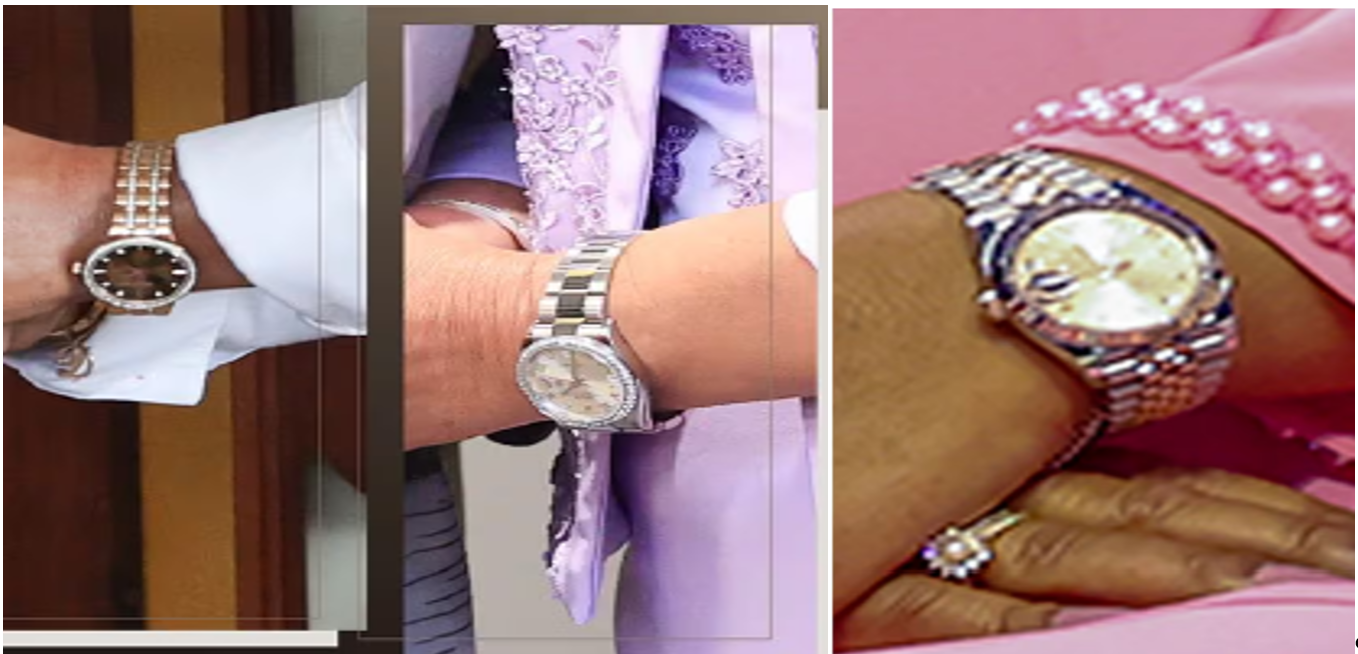
Peruvian President Dina Boluarte is the latest government leader to be ensnarled in a corruption flap thanks to a penchant for high-end time pieces. Before her it was the then-Prime Minister of Croatia Ivo Sanader (here) and after him the then-Thai Deputy Prime Minister Prawit Wongsuwan (here).

Like them, she apparently believed wearing a different expensive watch on different occasions was part of the job of running a country. And like them, her luxurious taste was caught on camera. Photographs show her at one or another function modeling watches that in toto cost more than $500,000.

From the collection of Peruvian President Dina Boluarte. Source: Presidential Flickr account

Just as with the Sanader and Wongsuwan flaps, photos of Boluarte’s watch collection prompted uncomfortable questions: Why didn’t she report the collection on her income and asset declaration form as required by law? And how could she, like them a longtime government employee, afford such a pricey collection?

Despite Sanader and Wongsuwan’s lame explanations –“I didn’t know I had to report them.” “Oh wait, they aren’t mine, I just borrowed them.” – the exposure of their unexplainable wealth cost them nothing more than civil society reproaches. Whether Peruvian authorities will accept Boluarte’s similarly flimsy explanations remains at this writing to be seen.

Beyond the reminder that some government leaders are incurably venal, these serial watchgates offer lessons. For leaders enamored of fancy timepieces, report them on your income and asset disclosure form or keep them up your sleeve when a photographer is nearby. For anticorruption agencies, there is a less flippant, more important lesson.

Continue reading

Look it Up: Two Invaluable New References Books on Corruption

The learning on corruption has exploded over the past two decades plus. Where once one scratched around for material on subjects like conflict of interest, the measurement of corruption, and whistleblower protection, a plethora of books, articles, reports, monographs, and, yes, even blog posts are available today on these and other once recondite topics. Great news for specialists and students. 

But bad news for those who aren’t. For policymakers, reporters, citizens, and other non-experts who need to know the basics about a corruption-related topic for a parliamentary debate, a story deadline or what-have-you but don’t have all day, or days, to read up on it.

Until recently they were at the mercy of an internet search engine. If they were lucky, one of the first entries that came up provided a useful summary of the learning. Or maybe it was misguided or out-of-date. Or, as now happens more frequently, maybe the search engine produced a hallucinogenic note, text generated by a large language model that sounds authoritative but the content of which is anything but.  

Now, thanks to two recent publications, the days of hoping a search engine or a LLM will provide a short, reliable introduction to a key corruption related concept are over.

Continue reading

For Goodness Sakes, Buy this Man a Cup of Coffee!

If you don’t know whom this post’s headline is talking about, you don’t know who Ray Todd is.  And if you don’t know who Ray Todd is, you don’t know about the eponymously named raytodd.blog.  And if you don’t know about the blog, you don’t know about what I think is the single best aggregator of news and information on corruption, money laundering, economic sanctions, and related topics. 

From a blurb flagging FATF’s recent evaluation of Albania’s money laundering regime to a note on GAB contributor Frederick Davis’ important new Columbia Journal of Transnational Law article “Judicial Review of Deferred Prosecution Agreements: A Comparative Study,” to a link to an English language summary of the just released 2021 annual report of the French Anticorruption Agency, you are missing out. On a lot. Ray’s blog is indispensable source of news for those in the anticorruption community.

All he asks in return is that readers occasionally make a small contribution.  Enough to buy him a coffee. Given the blog’s value added, he deserves much more.  But hey readers, how about starting by financing his morning java?    

Will China’s Property Tax Reform Be a Catalyst for Corruption?

In China, most residential property owners do not need to pay real estate taxes. In 2011, China initiated property tax trial programs in Shanghai and Chongqing, but even here, the taxes applied only to a few types of properties (newly purchased second homes and high-value properties, respectively) and the tax rates under these trial programs were quite low, and based on a property’s transaction price rather than its current appraised value. But this is about to change. President Xi Jinping’s administration sees a property tax as a key tool to achieve its goal of “common prosperity,” and last October, the government announced a major property tax reform, which is to begin with a five-year pilot program implemented at the local level in selected subnational jurisdictions. Under this reform, most residential property owners will need to pay property taxes, though local governments will have broad discretion to decide on the scope, rates, and collection procedures (see here and here).

Most of the debate about this dramatic change to China’s tax policy have focused on whether the proposed property tax can stop rampant speculation in the housing market and help redistribute wealth. Some commentators, though, have suggested that the new property tax might also help advance President Xi’s anticorruption campaign, because (it is argued) the tax will force greater disclosure of businessmen and government officials’ property ownership. But that hope is misplaced. In fact, the evidence so far suggests that the property tax reform might actually create more opportunities for corruption.

Continue Reading

Defining Corruption: What Do Readers Say?

Recent posts have treated readers to a discussion of what corruption means.  Professor Rothstein suggested coming at it from its opposite and offered “impartiality” so corruption would mean the absence of impartiality or bias. [Note: I had flubbed Prof. Rothstein’s view in the original text as per his comment below.] Professor Johnson argued that at its core corruption is about an imbalance of power and suggested tying the definition to notions of “justice.” Transparency International’s “abuse of entrusted power for private gain” was also examined.

I think it time for GAB readers to be heard. Rather than asking which one of these definitions they prefer, or whether they have another candidate, however, I thought it more interesting to see how a definition of corruption helps them judge actual conduct in the real world. 

Below are six cases where at least some have alleged corruption was afoot. What say, GAB readers? Do any of the cases described below involve corruption as you define it?

A yea or nay on each in a comment to this post will suffice. Extra credit for explaining how one of the definitions proffered helped you decide. Lifetime subscription to GAB at the current rate to the best entry or entries. How each played out in court and in the court of public opinion will be revealed in a future post.

Case 1. To defeat a motion of no confidence, Vanuatu’s Unity of Change government offered two MPs parliamentary appointments in return for withdrawing their support for the motion.  Another MP was offered the position of Minister of Health, and a fourth Parliamentary Secretary to the Minister of Fisheries. All four accepted the offers, and the government defeated the motion. Bribery?

Continue reading

On Corruption

Taking a break from his GAB duties, our indefatigable editor-in-chief Matthew Stephenson provides readers of Liberties, a leading American journal on culture and politics, a tutorial on corruption. GAB readers will not want to miss it. For in less than 10,000 words, his essay not only make sense of the (tens of? hundreds of?) millions of words written on the topic but provides corruption fighters an order of battle.

Citing passages from the Hebrew Bible and the great Indian text on governance the Arthaśāstra, Matthew reminds that corruption has always been with us and always tolerated — if only grudgingly. What’s new is the extraordinary international consensus that has formed over the past quarter century to end that toleration. Matthew explains how that consensus developed and the opposition it has had to overcome. From those who argue that in some societies corruption is culturally acceptable, from those who believe corruption fosters economic development, and from those think nothing can be done to combat it.

He calls each of these claims a “quasi-myth,” for each contains a kernel of truth, just enough to make a debater’s point. He crushes each, with the cultural determinate one quoting Edmund Burke’s pithy response that the claim of “geographical morality” simply doesn’t stand up to scrutiny.  

The research on corruption has exploded over the past two decades. Matthew’s bibliography is now at 720 pages! He seems to have read every one of the articles, for he brings their findings to bear on the pros and cons of the various solutions that have been proposed — “wise king,” “moment of crisis,” “long slog” — interweaving stories how Denmark, Sweden, and the United States overcame entrenched corruption. He admits that taming corruption is no easy task, especially where it involves persuading corrupt elites reform is critical (“bit like trying to convince turkeys to support Thanksgiving”), but he concludes that while history shows the cancer of corruption can never be fully eradicated “progress against this chronic disease of the body politic is possible, so long as those engaged in the fight do not lose heart.”

The full text of Matthew Stephenson, “Honey and Poison: On Corruption,” Liberties, Summer 2021 is here.
A Closer Look at Corruption, Hamas, and Violence in the Gaza Strip

The recent violent clash between Israel and Hamas followed a pattern that has become depressingly familiar since Hamas won control of the Gaza Strip in 2006: Hamas instigates violence towards Israel and its civilians; Israel responds with military strikes targeting Hamas’s weaponry infrastructure, but since Hamas has intentionally embedded itself in Gaza’s civilian population, Israel’s strikes inevitably claim innocent lives. The question whether Israel’s response was proportional or excessive saturates the news and media. Eventually the two sides reach a tentative ceasefire, the violence subsides, and attention turns elsewhere—until the vicious cycle repeats.

Most readers, whatever their views on the underlying moral and legal issues, are likely familiar with this pattern. But what does this have to do with corruption? Quite a bit, actually. 

Continue reading