Belgian and Uzbek Governments Profit from Termination of DoJ’s Kleptocracy Unit

Central Asia Due Diligence and the Uzbek Forum for Human Rights have identified the latest fallout from the Trump Administration’s destruction of American institutions devoted to fighting global corruption. The governments of Belgium and Uzbekistan have each pocketed $108 million in stolen assets that should have gone to the people of Uzbekistan.

In this just released paper, the two human rights NGOs explain how the demise of the Department of Justice’s Kleptocracy Asset Recovery Initiative allowed the two governments to ignore provisions in the UN Convention Against Corruption and the principles of the Global Forum on Asset Recovery that together bar assets stolen by a corrupt official from being kept by the government of the country where the official stashed them or returned to the official’s corrupt cronies.

Lawyers for the Initiative had designed a sophisticated process (details here) to see the $216 million in bribes to former Uzbek first daughter Gulnara Karimova found in Belgian banks DoJ would go to the UN trust fund overseeing development programs in Uzbekistan. With the Initiative’s demise, the Belgian and Uzbek governments apparently saw no reason they should not divvy up the money between them.

So thanks to the Trump Administration, Belgium, one of the world’s wealthiest countries, is now $108 million wealthier, and Uzbek’s leaders, several Gulnara’s accomplices, now have $108 million to spend keeping themselves in power. Meanwhile, the citizens of Uzbekistan, GDP per capita $3,500, scrape by.
An Assessment of the Swiss Return of Stolen Assets to Uzbekistan

The return of assets stolen by corrupt means is “a fundamental principle” of the United Nations Convention Against Corruption, and the Convention mandates that its now 191 state parties “afford one another the widest measure of cooperation and assistance” to ensure states victimized by corruption recover the proceeds of the crime wherever they are located (article 51).

Easy enough to state the principle. And easy enough to implement where the victim state’s leaders are democratically chosen, committed to advancing citizens’ well-being, and corruption is under control. But what if those conditions don’t hold? What if the same kleptocrats who stole the assets are still in power? Even if the crooks have been purged, so long as autocrats run the government, what guarantee is there that the assets won’t simply enrich the current powerholders? Or worse yet, fund measure to further repress their citizens?

As my friend and former Soros Foundation colleague Alisher Ilkhamov describes in the current issue of Central Asian Due Diligence (here), Switzerland is working through these issues as it begins to return to Uzbekistan the several hundred million dollars the former president’s daughter Gulnara Karimova stole. Uzbekistan’s government is a step above where it was when Gulnara set the record for shaking down foreign investors, but a budding democracy it is not. By a long shot.

Alisher describes the conditions Switzerland attached to the return of a first tranche of $131 million in 2022, how they were implemented, and how that experience should inform the recent agreement between Switzerland and Uzbekistan to return another $182 million. His assessment will be of value to policymakers everywhere wrestling with the return of stolen assets to states that fall far short of democratic, good governance norms.

Sri Lankan Bill on Proceeds of Crime and Corruption Damage Actions

A distinguished group of Sri Lankan judges and lawyers recently released draft legislation to recover the proceeds of crime and compensate corruption victims. Prepared at the request of Justice Minister Wijeyadasa Rajapakshe, enactment of such a bill is one of conditions of the $2.9 billion International Monetary Fund loan to stabilize the economy and restore economic growth.

While the proposed legislation exceeds the IMF requirement, providing for both criminal and non-conviction-based forfeiture of the proceeds of any crime, its overriding significance is it offers means for recovering the hundreds of millions if not billions of dollars corrupt officials have stolen from Sri Lankan citizens. The bill also establishes administrative procedures for compensating those injured by the corrupt act that generated the confiscated assets and granting anyone harmed by corruption the right to bring a civil action for damages.

The bill is accompanied by a clearly written report spelling out its provisions and explaining their rationale. A very nice diagram illistrates how the various freezing, seizure, and confiscation provisions will operate. Those in other nations struggling to write their own asset recovery or victim compensation legislation will find much of value in the Sri Lankans’ effort. (Text of bill with report and diagram here.)

At the same time, the bill is still in draft. Its authors welcome comments and critiques from Sri Lankans and international observers. Comments can be sent directly to the Ministry of Justice. Or GAB will be pleased to forward them to the appropriate personnel.

UPDATE. GAB just learned that Transparency International Sri Lanka has also posted a request for comments on the bill along with a brief explanation of the bill importance and the need for public input in English, Sinhalese, and Tamil here. The link includes an address to which comments can be sent.

November 2 OSCE Webinar: Asset Recovery and the Concept of Social Reuse

The OSCE Polish Chairpersonship and the Office of the Coordinator of the OSCE Economic and Environmental Activities are holding a series of three webinars on the contribution of the OSCE in preventing corruption and promoting transparency and good governance as part of resilient economic recovery.

The first webinar is entitled:  Innovations in Asset Recovery in the OSCE: The Concept of Social Reuse was held today November 2, 2022, 3:00 to 4:15 pm CET via Zoom webinar.

Opening remarks 

Ms. Courtney Austrian, Deputy Chief of Mission, United States Mission to the OSCE 

Ambassador Igli Hasani, Co-ordinator of OSCE Economic and Environmental Activities 

Ambassador Alena Kupchyna, OSCE Co-ordinator of Activities to Address Transnational Threats 

Speakers: 

Mr. Tristram Hicks, OSCE Asset Recovery Advisor 

Mr. Andrea D’Angelo, Senior Project Manager, Balkan Asset Management Interagency Network (BAMIN) Secretariat  

Ms. Melika Sahinovic, OSCE Expert on Social Re-Use in BiH 

Moderator: Prof. Anita Ramasastry, Special Representative of the OSCE Chairmanship on Combating Corruption 

Asset recovery is a powerful anti-corruption tool ensuring that stolen assets and proceeds of criminal activities are given back to societies and victims of crime.  It remains one of the most effective ways to disrupt serious and organized crime as organized crime groups survive and thrive through illicit financial gains. 

Since 2019, OSCE has been implementing a cross-dimensional project that aims at building the capacities of national authorities and civil society organizations (CSOs) in Southeast Europe and improving regional collaboration in the seizing, confiscating, managing and re-using of criminal assets. Phase II of the project that has just been launched has also been extended to Eastern Europe (Moldova and Ukraine). The project adopts a comprehensive approach to asset recovery and includes three areas of intervention: i) financial investigations, asset seizure and confiscation; ii) asset management; and iii) asset re-use. 

Details for connecting —

Continue reading

The Maldives: No Safe Haven for Oligarchs’ Yachts

Contrary to recent reports (here, here), Russian oligarchs’ yachts harbored in the Maldives are by no means safe from confiscation. As a party to the United Nations Convention Against Corruption (UNCAC), the Maldives has made bribery, embezzlement, and money laundering crimes under its domestic law (here).  Pursuant to article 46, it pledges “to afford [other UNCAC parties] the widest measure of legal assistance in investigations, prosecutions and judicial proceedings” to enforce their laws against bribery, embezzlement, and money laundering.

These provisions put the oligarchs’ yachts at risk of confiscation in two ways. 

One, Maldivian authorities could initiate an action under the domestic antimoney laundering law. Given the evidence on the public record, there is certainly reason (what American law terms “probable cause”) to believe that the yachts were acquired with the proceeds of a crime, likely embezzlement from the Russian state. (Remember, there need not be a conviction for embezzlement in Russia or elsewhere to launch the related prosecution for money laundering.) The yachts’ presence in the Maldives appears to be more than sufficient grounds for its courts to assert jurisdiction under article 13 of the penal code and therefore to issue a “freeze” order which would prevent the yachts from pulling anchor until a final decision on a seizure action issued.

Alternatively, Maldivian courts have the power under UNCAC and domestic law to issue a freeze order at the request of another UNCAC party.  A country where one was built, for example, could open a case to see whether the shipbuilder was paid with the proceeds of a crime, a money laundering offense, and request that the Maldives prevent the yacht from leaving until its case were concluded. 

Some say will say that whatever the law, the Maldives is a small island nation without the guts to stand up to Russia.  Not so. During the UN General Assembly debate on the resolution denouncing Russian aggression, the government not only backed the resolution but its ambassador left no doubts where its stood: “The Maldives has always taken a principled stand on violations of the territorial integrity of a sovereign country, [a] position based on a bedrock belief in the equality of all States and unconditional respect for the principles of the United Nations Charter.”

Others will be claim that confiscating the oligarchs’ yachts is not possible legally for ownership is obscured by layer upon layer of shell of corporations headquartered in countries.  But those layers can be stripped away by the determined efforts of police and prosecutors, a determination surely stiffened by magnitudes given the yacht owners’ complicity in the appalling events daily unfolding in Ukraine.

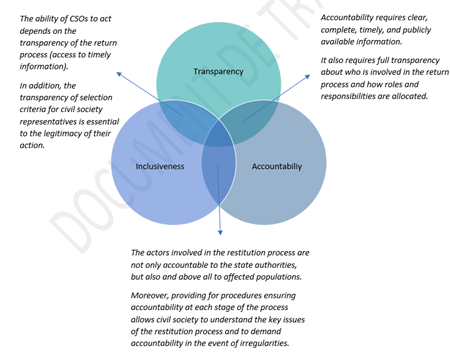
Proposed Method for Assessing the Transparency, Accountability, and Inclusiveness of the Return of Stolen Assets: Comments Requested

France recently enacted an asset repatriation law enshrining GFAR-inspired principles of transparency, accountability, and inclusivity. Now that the principles are law, the French chapter of Transparency International has set out to ensure they are observed in practice.

To that end, it has developed a method for evaluating the return process on each of the three dimensions using indicators for each as shown in the diagram.

The organization plans to publish its methodology, alongside concrete examples from past restitution processes of good and weak practices, as a handbook. Publication is now scheduled for the beginning of October.

TI-France welcomes feedback and comments on its methodology. Click here for the French version of the paper explaining it and here for the English translation. The group would be pleased to receive thoughts and suggestions by September 10th.  They should be directed to Sara Brimbeuf and Rahima Zitoumbi at sara.brimbeuf@transparency-france.org and rahima.zitoumbi@transparency-france.org.

Guest Post: A Response to Commentary on the FACTI Panel Report and Recommendations

Today’s guest post is from Bolaji Owasanoye, the Chair of Nigeria’s Independent Corrupt Practices and Other Related Offenses Commission, and a member of the UN High-Level Panel on International Financial Accountability, Transparency and Integrity (the FACTI Panel).

A few weeks ago, Professor Matthew Stephenson published two posts on this blog (see here and here) that offered some reactions to the report and recommendations of the UN High-Level Panel on International Financial Accountability, Transparency and Integrity (the FACTI Panel), on which I served as a member. I want to first thank Professor Stephenson for his serious discussion of the report. Critical engagement on the Panel’s recommendations is very welcome, and indeed Panel members are keen to continue engagement with researchers, policymakers, and the wider public in order to accomplish our shared purpose: strengthened systems for financial integrity. Now isn’t the time for the lowest common denominator approach but instead for governments to be ambitious and thus unlock the large resources currently being drained aggressively from public finances.

Professor Stephenson generously concluded that “the FACTI Panel has done us all a useful service by providing a document that can serve as the focus for discussion and debate over this vitally important topic.” That said, on a few recommendations he called for more detail, and on an even smaller number he found what he considered as faults with the recommendations. It is on only some of these final few, and within my own area of expertise, that I want to respond to points Professor Stephenson raised. In particular, I want to explain my understanding of the Panel’s thinking in three areas: standards for settlement in bribery cases, strengthening asset recovery, and the use of escrow accounts.

Continue reading

Commentary on the FACTI Panel’s Report and Recommendations (Part 1)

This past February, the United Nation’s cumbersomely-named “High-Level Panel on International Financial Accountability, Transparency and Integrity for Achieving the 2030 Agenda”—which, thankfully, everyone simply refers to as the FACTI Panel—released its report on Financial Integrity for Sustainable Development. The report (which was accompanied by a briefer executive summary and an interactive webpage) laid out a series of recommendation for dealing with the problem of illicit international financial flows. Though the report states that it contains 14 recommendations, most of these have multiple subparts, which are really distinct proposals, so by my count the report actually lays out a total of 35 recommendations.

I had the opportunity to interview one of the FACTI panelists, Thomas Stelzer—currently the Dean of the International Anti-Corruption Academy—for the KickBack podcast, in an episode that aired last week. Our conversation touched on several of the report’s recommendations. But this seems like a sufficiently important topic, and the FACTI Panel report like a sufficiently important contribution to the debates over that topic, that it made sense to follow up with a more extensive analysis of and engagement with the FACTI Panel’s recommendations.

Of the 35 distinct recommendations in the report, eight of them (Recommendations 2, 3B, 4A, 4B, 4C, 8A, 11A, and 14B) all deal with tax matters (such as tax fairness, anti-evasion measures, information sharing among tax authorities, etc.). While this is an important topic, it is both less directly related to anticorruption and well outside my areas of expertise. So, I won’t address these recommendations. That leaves 27 recommendations. That’s too much for one post, so I’ll talk about 13 recommendations in this post and the other 14 in my next post.

I should say at the outset that, while some of my comments below are critical, overall I am hugely grateful to the members of the FACTI Panel for their important work on this topic. The Panel’s report should, and I hope will, prompt further discussion and careful consideration both of the general problem and the Panel’s specific recommendation. Part of that process is critical engagement, which includes a willingness to raise concerns and objections, and to probe at weak or underdeveloped parts of the arguments. I emphasize this because I don’t want my criticisms below to be mistaken for an attack on the Panel or its report. Rather, I intend those criticisms in a constructive spirit, and I hope they will be so interpreted.


With that important clarification out of the way, let’s dig in, taking each recommendation in sequence.

Continue reading

New Podcast, Featuring Thomas Stelzer

A new episode of KickBack: The Global Anticorruption Podcast is now available. In this week’s episode, I interview Thomas Stelzer, who is currently the Dean of the International Anti-Corruption Academy (IACA), and who recently served as a member of the United Nations High-Level Panel on International Financial Accountability, Transparency and Integrity for Achieving the 2030 Agenda (a mouthful of a name, which is why this distinguished group is usually referred to as the FACTI Panel). After Dean Stelzer opens our conversation with a discussion of his own professional background and interest in corruption, the interview turns to the FACTI Panel’s report, published this past February, and the report’s recommendations for combating illicit international financial flows. (In addition to the full report, which runs to 49 pages not including annexes and references, FACTI has released a shorter executive summary, as well as an interactive web page.) I asked Dean Stelzer about several of the report’s recommendations that seemed especially pertinent to the fight against grand corruption, and he gamely responded some of the questions and concerns that I raised about certain aspects of the report. In addressing these issues, Dean Stelzer emphasized the importance of more and better research on the topic of illicit financial flows, as well as the need for sustained efforts to ensure effective implementation of reforms such as those that the FACTI Panel outlined. You can also find both this episode and an archive of prior episodes at the following locations: KickBack is a collaborative effort between GAB and the ICRN. If you like it, please subscribe/follow, and tell all your friends! And if you have suggestions for voices you’d like to hear on the podcast, just send me a message and let me know.

Three Measures to Put Corruption Enablers Out of Business

The most common way corrupt officials hide money is by stashing it in an “offshore vehicle.” The “vehicle” will be a corporation, trust, or other legal person. It is termed “offshore” because it will be organized under the laws of another country. Stolen funds and assets purchased with them can then be listed in the name of the offshore entity.

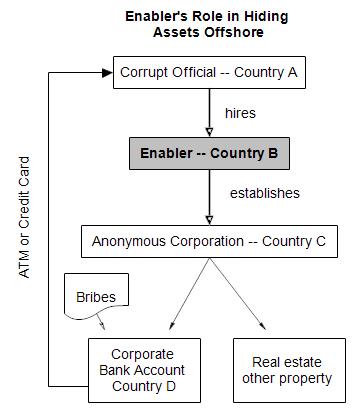
To create an offshore vehicle, the official will turn to someone with expertise in creating offshore entities and disguising their ownership: a lawyer, accountant or other professional who knows corporate and trust law and how to use it to hide the owner’s identity. The anticorruption community has dubbed these intermediaries “enablers,” for they enable corruption by providing corrupt officials with a way to enjoy the proceeds of their corruption.   A typical scheme is shown in the diagram below.

An official in country A wanting to hide assets first hires an enabler.  Although the enabler could be a professional in country A, hiring one located in another state makes it that much harder for local authorities to uncover wrongdoing. The enabler, shown in the diagram as located in country B (most often a wealthy country), then creates the offshore vehicle.  The enabler could have created the vehicle, in this case a corporation, in the enabler’s own country.

 But again, to make it harder for investigators to trace assets, the enabler will usually form the vehicle in still another country, here labelled C. As the diagram shows, to further frustrate efforts to track money flows the anonymous corporation (or shell or letter-box company — the terminology differs in different jurisdictions) will then open a bank account and buy real estate and perhaps art works or other personal or moveable property in still a fourth country.

Continue reading