How Anticorruption Enforcement Can Undermine Antitrust Amnesty Programs, and What To Do About It

One of the most important law enforcement techniques that has emerged in the last few decades to combat cartels (anticompetitive collusion between competitors) is the use of programs that promise automatic amnesty to the first member of a cartel to self-report the illegal enterprise. These amnesty programs enable law enforcement authorities to gather the evidence they need to build strong cases against other members of the scheme, and, perhaps more importantly, these amnesty programs destabilize cartels—and might even deter their formation—by taking advantage of the incentive that individual cartel members have to cheat on each other. Since the 1990s, after the success of the amnesty program pioneered by the Antitrust Division of the U.S. Department of Justice (DOJ), antitrust amnesty programs have been replicated in many jurisdictions, leading some to declare a “leniency revolution” in competition law.

But the existing amnesty programs have a weakness They usually only offer protection for violations of antitrust laws, leaving even the firm that self-reports the antitrust violations potentially liable for other unlawful conduct that the cartel members engaged in as part of their anticompetitive scheme. And many of these anticompetitive schemes turn out to involve corruption, especially in the public procurement context. Cartels often bribe the official in charge of the procurement process, because a corrupt official can monitor and punish defections from the cartel, facilitate the exclusion of non-aligned competitors, and ensure an equal distribution of cartel profits. A firm that hopes to take advantage of an antitrust amnesty program might have to report all of this to qualify for amnesty, as often the programs require, as a condition for amnesty, reporting on the involvement not only of other cartel members, but of any public officials who may have facilitated the collusive conduct. But the fact that a self-reporting cartel member is not guaranteed amnesty from prosecution for corruption or other associated wrongdoing (such as money laundering) complicates the operation of antitrust amnesty programs, because this lack of guaranteed amnesty weakens the incentive of cartel members to self-report in cases where the cartel has engaged in bribery. The problem is especially pronounced when the penalties for bribery are much more severe than those typically imposed in cartel cases.

This is less of a problem in jurisdictions where anticorruption and antitrust authorities are departments of a single agency, as with the US Department of Justice (DOJ). But in many other jurisdictions, such as the EU, Brazil, and Mexico, competition law enforcement—and administration of the antitrust amnesty programs—are handled by enforcement agencies that do not have authority to prosecute corruption cases. From a potential self-disclosing company’s perspective, this poses a challenge: Disclosing participation in a bribe-paying cartel to the competition authority may also trigger an enforcement action by the separate agency responsible for prosecuting corruption, meaning the company will have to negotiate with both agencies, with the anticorruption agency not bound by the antitrust amnesty program. Indeed, in many countries anticorruption agencies may not have the same authority as antitrust agencies to grant leniency to self-reporting companies. In Brazil, for instance, though an antitrust amnesty program has been in place since 2000, settling corruption cases only became possible in 2014. In Mexico, the antitrust amnesty program was created in 2006, but a program for self-reporting bribery cases only entered into force in 2016. In both countries, although there is an established process for settling corruption investigations, there is no immunity provision for self-reporting; a discount in the applicable fines is often the best a firm can hope for. And even when both the antitrust agency and the anticorruption agency have authority to settle and grant leniency, the mere fact that a company knows it will need to enter into two or more separate negotiations increases the uncertainty and costs associated with self-disclosure, undermining the effectiveness of the amnesty program.

How should this problem be addressed in those countries where merging authority over antitrust and anticorruption enforcement in a single agency is not feasible or desirable? There are several possibilities:
Continue reading

New Podcast Episode, Featuring Paul Heywood

A new episode of KickBack: The Global Anticorruption Podcast is now available. In this week’s episode, ICRN members Nils Köbis and Anna Schwickerath interview University of Nottingham Professor Paul Heywood about a range of topics, including the ways in which corruption subverts justice, how Transparency International’s Corruption Perceptions Index helped put corruption on the global agenda, what academic researchers in this field have been doing too much (“admiring the problem”), and what new an dbetter questions scholars should be investigating in order to figure out how to combat corruption more effectively.

You can find this episode, along with links to previous podcast episodes, at the following locations:

KickBack is a collaborative effort between GAB and the ICRN. If you like it, please subscribe/follow, and tell all your friends! And if you have suggestions for voices you’d like to hear on the podcast, just send me a message and let me know.

Who Owns a Bribe? And Why It Matters

A public servant who accepts a bribe can do with it as he or she pleases. Put it in a bank, sell it, give it away, or even bet it at the roulette table.  What if the bribe-taker is caught, though, and government wants to recover the bribe?  Does it matter what the bribe-taker did with it? It does, and greatly, especially for large bribes stashed in another country — precisely the cases the U.N. Convention Against Corruption addresses.

Article 57(3) of the convention requires the state where the proceeds of a bribe are discovered to return them to the state seeking them if the requesting state “reasonably establishes its prior ownership” of the bribe. If the recipient stashed the bribe in Singapore, the United Kingdom, or another common law country, the requesting state is in luck. If, on the other hand, it was squirreled away in a civil country, the requesting state is likely not so lucky.  It all depends upon the quirky national laws governing who owns the proceeds of a bribe. Continue reading

Just How Damning Are the Lava Jato Leaks? Some Preliminary Reflections on The Intercept’s Bombshell Story

[Note: My thinking on the issues discussed in this post has evolved somewhat. For the update, see here.]

Two days ago, The Intercept published a collection of dramatic reports (here, here, and here) regarding the long-running Brazilian investigation into high-level corruption. That investigation, known as the Lava Jato (Car Wash) operation, which began as in inquiry into money laundering and associated offenses at the Brazilian state-owned oil company Petrobras, has led to the prosecutions and convictions of scores of powerful business leaders and senior politicians—including, most notably, the conviction and imprisonment of former President Luiz Inacio Lula da Silva (known as Lula). That conviction prevented Lula from competing in the presidential election in 2018, an election that was one by far-right candidate Jair Bolsonaro. Anger on the Brazilian political left over Lula’s conviction, as well as the impeachment and removal of his successor Dilma Rouseff, has provoked accusations that the Lava Jato operation is really a right-wing conspiracy, and that the Lava Jato task force—the special team of prosecutors led by Deltan Dallagnol—and Sergio Moro, who presided over the most significant Lava Jato trials, including Lula’s, are politically biased enemies of the Left who are engineering a kind of coup d’etat through the judicial system. Many people, both in Brazil and internationally (me included), have pushed back against these accusations.

The Intercept’s recent reports assert that the critics were right all along. The evidence for this consists mainly of a huge quantity of data (texts, emails, and video and audio recordings) from a cell phone—almost certainly Mr. Dallagnol’s, based on the fact that all of the reported exchanges involve him. The Intercept has published a set of stories (some in English, some in Portuguese) based on a small portion of this material, mainly text message exchanges; the reporters emphasize that more is likely to emerge as they and other journalists review more of the leaked/hacked data. The big story here is that, according to the Intercept’s reporting, these text messages provide evidence of serious ethical breaches, particularly by then-Judge Moro, as well as evidence that the prosecutors knew their case against Lula was not strong, and, most damningly, that the task force prosecutors were motivated by partisan antipathy toward Lula and his party (the Worker’s Party, or PT), despite their claims to the contrary.

What to make of this? The news is clearly bad for the Lava Jato operation, the task force, and those of us who have supported the operation and defended it against various accusations and attacks. The question I want to address here is: Just how bad is it? My tentative answer is that, while the Intercept’s reports reveal some very upsetting, disappointing, and in some cases likely unethical conduct, the leaked text messages quoted in these first reports are not as damning as either the Intercept or other preliminary reports have made them appear. In this post (which will be longer than usual), I’ll try to work through the various allegations and associated texts and do my best to assess which revelations are most serious, which least so, and where we really need more evidence before making even a preliminary judgment. Continue reading

“Ghost Money”: Assessing the Risks of State-Sponsored Bribery

Back in 2014, the New York Times reported that the Central Intelligence Agency had been paying the office of then-President of Afghanistan Hamid Karzai tens of millions of dollars in cash for more than a decade. Afghan officials termed these payments “ghost money,” a convenient term that I adopt here—though some might simply call it bribery. This case was hardly unique. Indeed, the practice of engaging in state-sponsored bribery in the interests of national security appears to be a longstanding and global one: Over last half-century or more, the CIA has reportedly made cash payments to heads of state from Angola to Zaire in exchange for favors.

U.S. officials have defended this controversial practice. One former CIA operations officer even went so far as to say that state-sponsored bribery serves a productive role in the anticorruption fight: where the CIA is asked “to monitor the level of corruption in a place like Afghanistan,” “it only makes sense that U.S. operatives would have to talk to, and if necessary, bribe those involved in the corruption to find out what is going on.”

Yet even if one sets aside the question of whether ghost money itself presents the same normative concerns as regular bribery by private parties (an issue previously discussed on this blog), ghost money raises more problems than it solves for the anticorruption fight. In particular, the U.S. practice of making ghost money payments in places like Afghanistan likely has three significant adverse collateral consequences: Continue reading

The OECD Convention’s Article Prohibiting the Politicization of Foreign Bribery Enforcement Is in Desperate Need of Clarification

Article 5 of the OECD Anti-Bribery Convention provides that the policing of foreign bribery by Convention Parties shall not be influenced by (1) “considerations of national economic interest,” (2) “the potential effect upon relations with another State,” or (3) “the identity of the natural or legal persons involved.” Collectively, these mandates are known as the “Article 5 factors.” Article 5 is intended as a safeguard against the politicization or instrumentalization of foreign bribery laws. It is therefore vital to impartial foreign bribery enforcement, as well as to the integrity of foreign bribery enforcement generally.

The most well-known instance of an alleged Article 5 breach is the United Kingdom’s decision in 2006 to stop investigations into bribes paid by BAE Systems to public officials in Saudi Arabia. Then-Attorney General Peter Goldsmith argued that this decision was justified because the investigation could have damaged national security interests, as Saudi Arabia had threatened to end counterterrorism cooperation with the UK if the investigation continued. Goldsmith expressly denied that terminating the investigation for this reason constituted a breach of Article 5 because, as he put it, the decision to join the OECD Convention didn’t mean that the UK had “agreed to abandon any consideration of national security. [The Convention] certainly doesn’t say that and I don’t believe that’s what we could have intended or any other country could have intended.” The UK’s decision to suspend the BAE investigation, though challenged in court, was ultimately upheld.

More recently, the OECD has called attention to two other potential Article 5 breaches. First, an OECD news release stated that Turkey’s Article 5 compliance was in doubt due to inexplicably low level of foreign bribery enforcement, which the release suggested might be partly due to improper economic or political considerations. Second, another OECD news release raised concerns that Canada may have breached Article 5 by cancelling investigations into allegations that SNC Lavelin had bribed Libyan officials—a decision that observers believed was motivated by a desire to protect Canada’s national economic interests.

While it is encouraging to see the OECD adopt a more assertive approach to recognizing Article 5 breaches than it has in the past, these statements serve as stark reminders that there is not really an effective means for enforcing Article 5. And unfortunately, the uncertainty surrounding the meaning of Article 5 complicates the task of achieving Article 5 compliance. Continue reading

Guest Post: How a Social Movement Changed Spanish Attitudes Toward Corruption

Today’s guest post is from Elisa Elliott Alonso, who works at the OECD Water Governance Program:

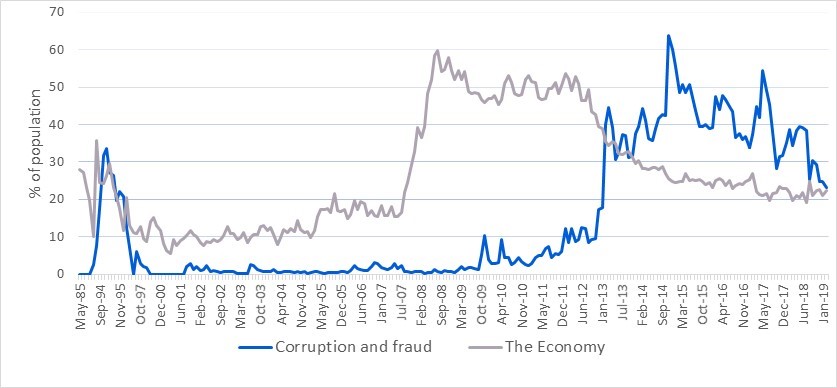
The graph below chronicles the percentage of Spanish Citizens who named the economy (grey line) and fraud/corruption (blue line) as one of the three most important problems facing the country, during the period leading up to and following the economic downturn of 2008. Unsurprisingly, after the Spanish economy crashed, some 50% of the citizens of Spain noted that the economy was one of the most important issue affecting them, and this concern remained predominant for the next three years, though it started to decline a bit after 2011. As for corruption and fraud, prior to the crash concerns about these issues hardly registered, except for a brief spike in 1993, an uptick came in the immediate aftermath of a slew of highly publicized corruption scandals, and dissipated quickly) Even after the 2008 crash, concern about corruption rose only slightly increased from 2008 to 2012. That big change came in 2013, when the news broke that important members of the conservative PP party were allegedly involved in the Gürtel case, one of the most serious recent corruption scandals to rock Spain. More interesting is the fact that Corruption has remained a top concern of Spanish citizens ever since. There’s been a bit of tapering off since concern over corruption reached its peak in late 2014, but more than 20% of Spanish citizens still list corruption as one of the country’s most serious problems, roughly the same number of name the economy.

Why is this? Or, to put the question more generally, what kind of changes need to take place within a collective society’s ethos in order to bring about engaged citizen awareness and opposition to corrupt activities? Continue reading

Guest Post: Expert Interviews on Corruption Control in Latin America

Today’s guest post is from Columbia University Professor Paul Lagunes, who this year is also a Visiting Fellow at Rice University’s Baker Institute for Public Policy:

Elections in Latin America are freer and fairer than they used to be, and, with rare exceptions, political power in the region is no longer monopolized by a single individual, junta, or party. From Chile to Mexico, legal reforms have promoted higher levels of government transparency and citizen participation. But in spite of these improvements, the region continues to grapple with systemic corruption. Not only are individuals asked to pay bribes by lower-level government officials, but scandals such as Lava Jato (“Car Wash”) in Brazil, La Estafa Maestra (“The Master Fraud”) in Mexico, and La Línea (“The Line”) in Guatemala have revealed grand corruption at the most senior levels, making the fight against corruption a top priority for the region.

Prompted by these concerns, I contributed to organizing a conference at Rice University’s Baker Institute for Public Policy on corruption control in Latin America, which has already been featured (with links to the conference videos) on this blog. Some of the conference panelists stayed long enough that we were able to interview them about their important work. Tony Payan, my colleague at the Baker Institute and an expert on U.S.-Mexico border issues, agreed to conduct the interviews.

The videos of these interviews are now publicly available, and are well worth viewing for those interested in hearing a diverse range of perspectives on the corruption challenges currently facing Latin America. In this post I will provide links to the interviews as well as a brief summary of their content. (There’s also an online website, where you can find all the interviews, here.) Continue reading

Managing Anticorruption Compliance Under the EU’s General Data Protection Regulation

Lawyers and businesses today are concerned with data privacy issues like never before—not only because of the mounting number of data privacy scandals, but also because of new regulations, most importantly the EU’s General Data Protection Regulation (GDPR). The GDPR, which was adopted in 2016 and became applicable in May 2018, reformed the entire personal data protection system in the EU by setting new rules of data protection and privacy. Moreover, the GDPR applies not only to entities that operate within the EU, but also to all entities established in the EU when operating outside the EU, as well as to entities established outside the EU when they are offering their goods and services inside the EU or monitoring individuals from the EU. The GDPR thus has global reach, as well as stringent penalties for violations.

The GDPR has implications for many different fields, and anticorruption is no exception. This is especially true for corporations conducting internal investigations of possible bribery by firm employees or agents, and when conducting due diligence on potential partners. Much of the data collected in these corporate investigations will include “personal data” as defined and regulated by the GDPR. For this reason, some commentators have warned that the effect of the GDPR on traditional corporate anticorruption investigations will amount to “a collision of galactic proportions.”

That may by hyperbole, but it is certainly the case that the GDPR will impose important new obligations that influence how companies handle anti-bribery compliance issues, both in the context of internal investigations and in the context of due diligence. Continue reading

The Orban Effect, or Why the EU Needs to Take a Hard Line on Anticorruption Backsliding

After Viktor Orban’s election to the Hungarian premiership in 2010, he set Hungary on a course to become an “illiberal democracy.” As part and parcel of that vision, Orban began to increase corruption in Hungary, building a new class of oligarchs (including his family and friends) dependent on crony capitalism. Indeed, Orban’s Hungary is now one of the most corrupt states in Europe (see here, here, and here), with government and EU funds regularly misappropriated, wasted, or flat-out stolen. And while one must always be careful about drawing strong conclusions from changes in a country’s Corruption Perception Index (CPI) score, it’s certainly notable that Hungary has dropped 10 spots on the CPI ranking since 2011, the first full year of Orban’s rule. These developments are not only worrisome in and of themselves, but many worry that Orban’s approach—not only his far-right politics, but the entrenched oligarchic corruption he has fostered—might become normalized not only in Hungary but throughout the region.

That worry is well-founded. Orban’s ideas have not been contained to Hungary. The spread of the “illiberal state” and of corrupt quasi-authoritarian oligarchy has precipitated a crisis across Europe. What should international actors—particularly the EU—do in response? Two things:

Continue reading