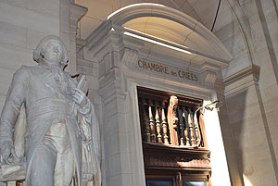
The Obiang Trial: Lessons from a Decade-long Legal Battle

The trial of Equatorial Guinean Vice President Teodorin Nguema Obiang before a French court for what is in effect kleptocracy is by any measure a giant step forward in the fight against grand corruption.  Indeed, it is such a significant milestone that GAB has, thanks to the Open Society Justice Initiative’s Shirley Pouget and Ken Hurwitz, provided readers in-depth reports of how it is unfolding (here, here, here, here, here, here).

Criminal trials are the result of a long and complex process meant to protect a defendant’s rights, and frustratingly, these human rights safeguards provide wealthy defendants, no matter their guilt, with many opportunities to derail a case.  In Teodorin’s case, not only does he have apparently limitless resources to spend on lawyers to pursue every legal defense to the nth degree, but the government of Equatorial Guinea, a family enterprise run by his father, has gone to extraordinary lengths to keep Teodorin from facing justice: naming him an ambassador to try and create a defense of diplomatic immunity, claiming that property he bought is state-owned and thus immune from legal challenge, and even filing an action against the French government in the International Court of Justice.

As Shirley and Ken draft the next installment in their series, this is an opportune time to stand back and examine how these many obstacles were overcome.   How did it come to pass that a senior official of the government of Equatorial Guinea is being held accountable before a criminal court in Paris for the wholesale theft of his nation’s wealth?  And more importantly, what can be done to ensure the Obiang trial is no fluke?  That the hundreds, if not thousands, of public officials who have stolen massive amounts from the people of their countries also find themselves in court answering for their crimes.

Thankfully, a fine paper answering these questions is now available. Authored by French attorney Maude Perdriel-Vaissière, a critical actor in shepherding the Obiang case through the French legal system, it recounts how a small, dedicated band of civil society activists overcame the many legal and political obstacles to bring Obiang before the bar of justice.  Continue reading

Anticorruption Bibliography–July 2017 Update

An updated version of my anticorruption bibliography is available from my faculty webpage. A direct link to the pdf of the full bibliography is here, and a list of the new sources added in this update is here. As always, I welcome suggestions for other sources that are not yet included, including any papers GAB readers have written.

State-Level Anticorruption Commissions: What the U.S. Can Learn from Australia’s Model

Australia does not currently have a dedicated national-level anticorruption agency (ACA), though the question of whether to create one has been on the table since 2014 (see here, here, and here). Yet Australia has plenty of experience with ACAs—at the state level. Australia’s first, and still most prominent, state-level ACA was the Independent Commission Against Corruption (ICAC) in New South Wales (the state including financial capital Sydney), which will mark its thirtieth anniversary next year. The ICAC, led by an independent commissioner, has independent investigatory powers over almost all state-level government officials and is charged with both exposing public sector corruption and educating the public about corruption. Queensland and Western Australia followed suit with their Corruption and Crime Commissions, established in their current forms in 2001 and 2003 respectively. The states of Victoria, South Australia, and tiny Tasmania all instituted independent agencies in recent years as well. Even the 250,000-strong Northern Territory resolved to start its own ACA after several high-profile scandals, and the Australian Capital Territory (the Canberra-sized equivalent of Washington, DC) has discussed creating its own anticorruption body. The permeation of Australia with state-level agencies is essentially complete.

Thus, in true laboratories-of-democracy fashion, Australian states have tried, solidified, and publicized the model of creating an independent investigatory group focused on the issue of corruption. Could U.S. states do the same? Easily. Should they? Yes, for at least three reasons:

Continue reading

Improving Mutual Legal Assistance: Lessons from Asia

Back in 2014, Rick called for further analysis of mutual legal assistance (MLA) processes and potential reforms that would promote responsiveness to MLA requests in anticorruption cases (and others). As a follow-up, I wanted to highlight the findings of a recent report from the Asian Development Bank (ADB)/Organization for Economic Cooperation and Development (OECD) Anti-Corruption Initiative for Asia and the Pacific. The report, entitled “Mutual Legal Assistance in Asia and the Pacific: Experiences in 31 Jurisdictions,” provides examples of various obstacles to effective MLA, which I have sorted into two general categories: legal and practical. Continue reading

Guest Post: Encouraging Signs for a Possible U.S. Legislative Crackdown on Anonymous Companies

Gary Kalman, the Executive Director of the FACT Coalition, contributes today’s guest post:

A little over a year ago, the International Consortium of Investigative Journalists (ICIJ) released the Panama Papers, a treasure trove of information and a window into the world of financial secrecy. In some ways, much of what the Panama Papers revealed was already well known. Previous estimates put the amount of money hidden in offshore secrecy havens somewhere between $8 trillion and $32 trillion. In 2015, The New York Times published an impressive five-part series on the use of anonymous shell companies to purchase prime real estate in New York City. Prior to that, the U.S. Justice Department filed a lawsuit (which they just won on June 29th) to force the forfeiture of New York property secretly owned by the government of Iran in direct violation of economic sanctions. And so on. Yet it is hard to deny the captivating intrigue of the specific stories in the Panama Papers involving Russian kleptocrats, world leaders, athletes, movie stars, and others.

The big question is: more than a year later, did anything change? As I recently observed, there are indeed encouraging signs around the world, particularly in Great Britain, several EU member-states, and some developing countries such as Ghana. What about the United States? After all, with U.S. transparency laws ranging from weak to non-existent, there is little need to go to Panama to launder one’s dirty money. While Delaware gets the most notoriety, no state collects information on the true (“beneficial” owners of corporations. In fact, in its recent assessment of the U.S., the Financial Action Task Force, an international anti-money laundering body, noted that for all the progress the U.S. has made, the lack of beneficial ownership transparency remains a glaring weakness. And in the past, when some U.S. legislators – most notably former U.S. Senator Carl Levin (D-MI) – pushed legislation to require states to collect beneficial ownership information, the proposed bills never received so much as a hearing.

That may be about to change, and anticorruption advocates should take note. Continue reading

Day Six of the Trial of Teodorin Obiang

GAB is pleased to publish this account and analysis of the 6th day of the trial of Equatorial Guinean Vice President Teodorin Nguema Obiang by Shirley Pouget and Ken Hurwitz of the Open Society Justice.

On day six of his trial for actions arising from theft of public monies, Teodorin’s lawyers offered several legal defenses.  The most bizarre, and the one most strenuously advanced, was that in Equatorial Guinea theft of public funds is not a crime if the thief is a senior government official.  Teodorin was a government minister at the time he stole the money, and according to his lawyers, there was no law in Equatorial Guinea that made it a crime for a minister to steal public funds.

The defense also tried to lob a procedural bombshell into the proceedings.  It claimed that the way French courts have interpretred bribery as a predicate offense for money laundering is unconstitutional.  This constitutional objection, a Question Prioritaire de Constitutionalite, could have been lodged early in the proceeding.  Raising it so late in the case, would, if the court accepted the defense request, postpone the trial proceedings for many months. 

Continue reading

Argentina’s Draft Bill on Corporate Criminal Liability for Bribery: Some Striking Innovations on Sanctions

A few weeks ago, I had the good fortune to be able to attend an event at the University of Buenos Aires (co-sponsored by the New York University Law School), that focused, among other things, on a new draft bill, currently under consideration in the Argentinian legislature, that would impose criminal liability on corporations and other legal persons for corruption-related offenses. I’m largely unfamiliar with Argentina’s legal system, so I was very much an outside observer for this discussion, but there were a couple of things about the draft bill that struck me as interesting and worthy of attention from the wider anticorruption community. (Apologies for not providing a link: I’m working off a hardcopy of an unofficial English translation of the draft bill, which I can’t find on the web.)

A lot of the provisions in the bill are fairly standard, though in many respects the bill is quite aggressive. For example, Article 3 makes parent companies jointly and severally liable for sanctions imposed on their subsidiaries (without any requirement to show that the subsidiary was an agent of the parent), while Article 4 imposes successor (criminal) liability in all cases of merger, acquisition, or other corporate transformation. In both these respects, the draft Argentinian bill imposes more sweeping corporate criminal liability than does U.S. law. Also, like U.S. law, the Argentinian bill (in Article 2) would make corporations criminally liable for the actions of its officers, employees, and agents.

But what most caught my attention were the draft bill’s provisions on sanctions: Continue reading

Corruption as a Jurisdictional Barrier in Investment Arbitration: Consequences and Solutions

As has been explored on this blog and elsewhere, corruption is a controversial topic in investor-state arbitration disputes. First emerging as a defense by states seeking to avoid liability, multiple tribunals have refused to enforce arbitration contracts tainted by corruption (see World Duty Free v Kenya and Plama Consortium v Bulgaria). Corruption has also been used as a cause of action by investors claiming unfair treatment (see Yukos v Russian Federation and here). The unclear incentive effects of corruption in arbitration proceedings have been analyzed from different angles—whether it provides countries with perverse incentives that might encourage corruption or instead buttresses anticorruption principles and promotes accountability.

Unfortunately, less attention has been paid to the procedural step at which tribunals discuss corruption. In the past ten years, an increasing number of tribunals are evaluating evidence of corruption at the jurisdictional stage of arbitration rather than at the merits stage. Those readers who are not lawyers (and even those who are), may be wondering, “Who cares? Why does it matter if corruption is treated as a ‘jurisdictional’ issue as opposed to a ‘merits’ issue?”

Actually, it matters a lot.  Continue reading

Planning and Zoning Board Corruption: Finding the Missing Whistleblowers

My last post looked at the constant, pernicious corruption and conflict of interest in local land use planning decisions in the United States. Despite shocking stories and a handful of high-profile investigations and prosecutions (see, for example, here and here), little comprehensive work has been done to address the potential for corruption in planning and zoning decisions, even when warning signs abound. Instead, most instances of corruption in land use planning decisions remain undetected, perhaps because the seemingly small stakes make it unlikely that external investigators will scrutinize these decisions too closely.

Yet potential whistleblowers surely see or suspect bribery, conflicted dealings, or other malfeasance in land use planning. Reforms should make it easier for those individuals to come forward, as well as make it more likely that their reports will lead to action. Ideally, these measures would recognize the particular characteristics of land use decisions, such as the challenges posed by the large numbers of local officials involved in planning and zoning. Here are a few suggestions for how to encourage simpler, more consistent reporting:

Continue reading

Guest Post: Using Open Data To Combat Corruption—Moving Beyond the Hype

Robert Palmer, the Director of Partnerships and Communication at the Open Data Charter, contributes today’s guest post:

In order to tackle corruption effectively, one first needs to understand the networks that link government officials, businesses, and professional intermediaries, and then work to either dismantle these networks or at least ensure that these webs of connections are not exploited to enrich individuals and undermine good government. Fortunately, these clandestine networks often leave traces in government-held databases, such as company registers, land title deeds, asset disclosures, and other official records. That’s where open data can be helpful. When the government provides easily accessible public information, it makes it easier for government officials, journalists, and citizens to follow financial flows, understand who’s providing government services, and to spot suspect behavior. And that’s why there has been so much enthusiasm about the open data in the anticorruption community. In 2015, for example, the G20 anticorruption working group announced a common approach saying that “Open Data can help prevent, detect, investigate and reduce corruption.”

Yet what’s happening on the ground isn’t living up to this hype. Part of the reason is that, as the Web Foundation and Transparency International found in a recent study of five G20 countries, many countries have made only limited progress toward meeting international commitments on open data. But even where open data is available, relatively few organizations are actually using open data to expose and combat corruption. There are, of course, exceptions, including Global Witness, the data journalists at Organised Crime and Corruption Reporting project, and accountability groups such as BudgIT. Yet the potential for open data to help fight corruption remains largely unrealized.

To help address this shortcoming, the Open Data Charter has spent the last year pulling together a guide for how to use open data to combat corruption. The guide lists 30 types of datasets that could help expose and combat corruption if they are released in the right way, as well as key data standards to ensure consistency and quality between different countries. Of course, the underlying assumptions here are that the types of data listed in the guide can be collected and released by governments in the ways the guide advises, and that there are anticorruption actors who can process this data in ways that are helpful in exposing or preventing corruption. In order to probe these assumptions, the Open Data Charter has teamed up with the Government of Mexico to “road-test” the guide. This will include working out which of the 30 datasets in our guide the government already publishes, which further ones can be released, and how to engage potential users. We’re interested in understanding how if data is released in the right way, users such as journalists, law enforcement, and civil society can process the data and then use it to have an impact on corruption.

Our approach to this piece of work is guided by a real desire to learn what works: what’s helpful to the government and what’s helpful to external stakeholders who want to tackle corruption. We hope to be able to report on our initial findings over August. If you’re interested in learning more, please get in touch with me: robert [at] opendatacharter.org. In the spirit of transparency and collaboration, the guide itself is open to comment here.