Day Four of the Trial of Teodorin Obiang, Part II

GAB is pleased to publish this account of the second part of the 4th day of the trial of Equatorial Guinean Vice President Teodorin Nguema Obiang by Shirley Pouget of the Open Society Justice Initiative.

As detailed in an earlier post, five witnesses testified June 26, 2017, in support of the corruption charges laid against Equatorial Vice President Teodorin Nguema Obiang.  Teodorin called but a single witness in his defense: Simon Mann, an assistant to Teodoro Obiang Nguema Mbasogo, who has been President of Equatorial Guinea for the past 38 years and also happens to be Teodorin’s father.

Mann came into President Obiang’s employ by a strange route.  Hired by a Lebanese businessman to overthrow Obiang, he was captured and jailed.  Mann explained that Obiang later pardoned him and then hired him as an advisor.  When the court asked if he was still employed by Obiang he replied:

“They pay my expenses as well as a per diem.”

He denied, however, that he was being paid to testify. Continue reading

Tracking Corruption and Conflicts of Interest in the Trump Administration–July 2017 Update

This past May, we launched our project to track credible allegations that President Trump, as well as his family members and close associates, are seeking to use the presidency to advance their personal financial interests.Just as President Trump’s son Eric will be providing President Trump with “quarterly” updates on the Trump Organization’s business affairs, we will do our best to provide readers with regular updates on credible allegations of presidential profiteering. Our July update is now available here. The most notable new highlight in the new material concerns two developments related to housing subsidies: First, while President Trump’s proposed budget proposed slashing funding for most housing assistance programs, it conspicuously exempts a program that provides payments directly to private landlords–a program from which Trump directly profits due to his ownership stake in a New York housing development that receives subsidies under the program. Second, President Trump appointed an event planner with close ties to his family (but no prior experience in housing policy) to a senior government position responsible for disbursing federal housing funds in New York and New Jersey, where the Trump Organization has substantial real estate holdings.

(Note: While we try to sift through the media reports to include only those allegations that appear credible, we acknowledge that many of the allegations discussed are speculative and/or contested. We also do not attempt a full analysis of the laws and regulations that may or may not have been broken if the allegations are true. For an overview of some of the relevant federal laws and regulations that might apply to some of the alleged problematic conduct, see here.)

Day Four of the Trial of Teodorin Obiang

GAB is pleased to publish this account of the 4th day of the trial of Equatorial Guinean Vice President Teodorin Nguema Obiang by Shirley Pouget of the Open Society Justice Initiative.

Monday, June 26, was the fourth day of trial of Equatorial Guinean Vice President Teodorin Obiang on charges amounting to kleptocracy.  After three days of skirmishing about procedural issues, the court finally heard testimony in support of the charges.

court room *Roberto Berardi, who had been in business with Teodorin, told the court that after confronting Teodorin about allegations of corruption leveled by the U.S. Department of Justice he was jailed and held in solitary confinement for almost three years.  The reason, he believes, was to prevent him from talking to U.S. authorities.

*Delfin Mocache Massoko, whose on-line news site Diaro Rombe chronicles the Obiang family’s business dealings, told the court that he and many of his sources had been told “they will pay” for exposing the Obiang’s corruption to the world.

* Tutu Alicante León, an Equatorial Guinean exile who runs EG Justice, detailed the brutality and repression Equatorial Guineans face and deprivation and extremen poverty they live in thanks to the Obiangs’ crimes.  At the court’s request he explained how any assets the court ordered seized from Teodorin could be returned to the country in ways that would benefit its citizens.

* Pedro German Tomo, another Equatorial Guinean exile, testified that when Teodorin was Minister of Agriculture and Forestry he forced logging companies to pay 10,000 francs per square meter of board logged to a company Teodorin controlled and later, when Teodorin took responsibility for infrastructure, any company winning a construction contract had to pay a 10 percent commission to the same company.

* Daniel Lebegue of Transparency International France explained to the court why his organization felt it had no choice but to bring this case against Teodorin.  He said TI-France had consulted extensively with TI chapters in Senegal, Mali, Niger, Nigeria, Namibia, Kenya and Tanzania before lodging the complaint: “we wanted to go hand in hand with our colleagues from the African Chapters and be sure that our action was right.”

What follows is an account of each witness’ testimony.  No recording or transcript of the proceedings was made.  To GAB’s knowledge, Mme. Pouget’s account of the witnesses’ testimony will therefore serve as the only record.  Anyone who believes there is an error, or who wishes to provide additional context, is urged to post a comment below.    Continue reading

China’s Anticorruption Campaign Adds Popular Culture Entertainment Into its Toolbox

A TV series called In the Name of the People, featuring China’s current fight against high-level government corruption, has gone viral in China. Dubbed the Chinese House of Cards, the show reached an 8% TV viewing rate (the highest in 12 years) and by the end of April 2017, had been watched over 20 billion times across major Chinese online video platforms. The show is widely acclaimed for its quality production, intriguing storylines, and, more importantly, for its bold, vivid depiction of the ugly side of China’s political and social reality. Shows like this are not merely entertainment: popular culture, including TV shows, can be an important tool in the fight against corruption.

Continue reading

Guest Post: Paris Court Rules That a US FCPA Guilty Plea Precludes Subsequent Prosecution in France

GAB is pleased to welcome back Frederick Davis, a lawyer in the Paris office of Debevoise & Plimpton, who contributes the following guest post:

Overseas bribery and similar crimes can often be investigated by prosecutors in more than one country. But does (or should) the resolution of a criminal investigation in one country—say, through a negotiated resolution—bar subsequent prosecutions in other countries for the same underlying conduct? In earlier posts, I have explored some recent rulings that address aspects of this debate over so-called “international double jeopardy” (see here, here and here). A recent decision of the Paris Court of Appeals added an interesting new element to this debate. Faced with a classic situation of parallel prosecutions, the Paris Court held that an individual who had pleaded guilty in the United States for violations of the U.S. Foreign Corrupt Practices Act (FCPA) could not be prosecuted under French anti-bribery law—not because of the standard international double jeopardy principle, but rather because, according to the Paris Court, the US proceedings deprived the defendant of the right to defend himself protected by the European Convention on Human Rights (ECHR).

The facts of the case are simple: an individual entered into a written plea agreement with the U.S. Department of Justice (DOJ), in which the defendant agreed to plead guilty in a US court to FCPA charges, on which he was subsequently sentenced. He was separately bound over for trial in France under French anti-bribery laws, apparently for the same underlying conduct.  In affirming the dismissal of the French prosecution, the Paris Appellate Court’s reasoning proceeded in two steps: Continue reading

In Accordance with a Comprehensive Scam: Bribery and Conflicts in U.S. Land Use Planning

Corruption in land used decisions is widespread. Quid pro quo exchanges are relatively common, as are conflicts of interest, especially in small communities. In 2011, Transparency International released a report on land use that found “[a]round the world more than one out of 10 people reported paying bribes when dealing with ordinary land issues.” The United States is far from immune. Consider just a handful of recent examples: The City of Boston has asked for help from the FBI in its approach to corruption, particularly corruption in zoning boards. In 2008, the Chicago Tribune ran an eight-part series on corruption in Chicago real estate decisions. An earlier case revealed that an Indianapolis city official with sway over the zoning board regularly asking for bribes. The former mayor of Charlotte resigned after bribery accusations, including taking cash for influencing zoning decisions. And in a recent review, Minneapolis found that conflicts of interest are common in its planning and zoning boards.

What makes land use planners so susceptible to corruption, even in countries, like the United States, that are not usually thought of as suffering from endemic bribery? Part of the problem concerns the institutional set-up. In a typical U.S. community, there will often be a Planning Commission, responsible for approval of individual site development or demolition plans, oversight of subdivisions, and review of the area’s Master Plan for zoning and development. (For some insight into what these meetings might look like, the City of Syracuse, New York makes its applications and minutes available online.) The community (city or county) would usually also have a Zoning Board of Appeals or Zoning Board of Adjustment—tasked with creating a Master Plan, reviewing zoning ordinance changes, and providing special permits or variances from zoning requirements.

The risk factors associated with this approach to land-use decisionmaking include excessive autonomy, complexity, and delay:

Continue reading

Incorporating Corruption and Accountability into Public Health Education

Corruption is a serious threat to achieving global health objectives. As Professor Taryn Vian pointed out, corruption increases the cost and decreases the availability of medicines and medical equipment, creates barriers to health services, enables the spread of fake medicines. As I argued in a previous post, corruption also undermines the trust in government that is essential to dealing with public health emergencies. The importance of training and educating public health professionals on how to identify and understand problems of corruption in health, along with how to incorporate anticorruption strategies into programs and institutions, would therefore seem quite obvious. Yet the core public health curriculum at leading graduate institutions generally does not include a serious discussion of corruption and its impacts on public health. There are exceptions–Professor Vian, for example, teaches on this topic in her courses at Boston University’s School of Public Health—but for the most part corruption appears to be absent from public health course catalogs.

It’s not clear why this is the case. It may be that there is a shortage of professors who are knowledgeable or willing to teach on the topic, or perhaps most graduate students do not see the value in enrolling in such a course, especially if they have not witnessed corruption firsthand. Whatever the reasons, the end result is that students graduate from public health programs with little knowledge about the causes and consequences of corruption in the health sector, the reasons why good governance is so important to health care systems, the best ways to prevent, detect, and report cases of corruption. This is a problem. Public health education can and should place greater emphasis on corruption (and related topics like good governance and accountability), for three main reasons: Continue reading

Day Three of the Trial of Teodorin Obiang

GAB is pleased to publish this account of the 3rd day of the trial of Equatorial Guinean Vice President Teodorin Nguema Obiang by Shirley Pouget and Ken Hurwitz of the Open Society Justice Initiative.

court room

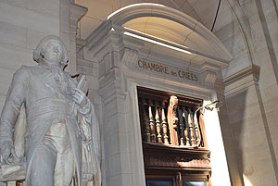
Much of the third day of Teodorin’s trial was taken up with a lengthy, and highly misleading, “explanation” by defense counsel of United States of America v. One White Crystal-Covered “Bad Tour” Glove And Other Michael Jackson Memorabilia, a civil forfeiture action the US Department of Justice filed and later settled that involved property Teodorin owned in California.  The Paris hearing began at 1:30 pm, Wednesday, June 22, with the three judges filing into the august Chambre des Crieés of the Tribunal Correctionnel of Paris.  The Presiding Judge asked the civil parties and the defense counsel to comment on the background to the case she had reviewed the preceding day.  While the civil parties’ counsel had little to say, the defense had much to say — little of which was accurate. Continue reading

Guest Post: Timor-Leste Needs a New National Anticorruption Strategy

Jonas Guterres, who previously served as an Advisor to the Anti-Corruption Commission of Timor-Leste, contributes today’s guest post:

Corruption in Timor-Leste is a chronic disease that can infiltrate almost all aspects of human life and all sectors of society. A number of mechanisms have been put in place within the nation’s legal framework since its restoration of independence, culminating in the establishment of the Anti-Corruption Commission (the Comissão Anti-Corrupção, or CAC) in 2010. However, the prevalence of corruption remains high. There are a number of factors which explain why the anticorruption efforts to date remain far from ideal. Continue reading

Is China’s Anticorruption Crusade Reaching a Turning Point? Towards What?

In April 2014, a post on this blog claimed that the People’s Republic of China’s anticorruption campaign was reaching a turning point, and suggested that the campaign might be “significantly curtailed” in light of troubling signs of economic slowdown and strong pushback from other senior Party leaders. This prediction seemed reasonable at the time, yet more than three years later, the campaign shows no signs of winding down: Reports on senior government officials’ downfalls or corrupt fugitives’ repatriation from overseas still hit headlines on an almost daily basis. A recent development, however, does suggest that China’s anticorruption campaign might be reaching a different sort of turning point—turning from a near-exclusive emphasis on aggressive enforcement to institutional reforms that address the root causes of corruption.

Continue reading