Is the West Being Too Critical of Corruption in Ukraine? The Debate Continues

A couple weeks back I posted a commentary on an interesting debate over the West’s approach to promoting anticorruption in Ukraine. On the one side, Adrian Karatnycky (the Managing Partner of a consulting firm that assists international clients with government relations in Ukraine) and Alexander Motyl (Professor of Political Science at Rutgers) published a piece arguing that the West’s approach to promoting anticorruption was misguided, for two reasons: First, because (according to the authors) there was too much focus on punishing individual wrongdoers rather than on institutional reform, and second because the emphasis on the failings of the Ukrainian government (and the wrongdoing of individual Ukrainian officials) was undermining a reformist government, and would likely lead Ukrainian voters to embrace populist demagogues. On the other side, Daria Kaleniuk (the executive director of a Ukrainian civil society organization called the Anti-Corruption Action Center) countered that the only reason the Ukrainian government has made any progress on anticorruption reforms is because of pressure from the West, and that holding individual wrongdoers accountable is essential to making progress on this issue and restoring the faith of the Ukrainian people in the institutions of government.

My own take was that Ms. Kaleniuk is likely correct that individual accountability, though not sufficient, is a necessary component of an effective anticorruption strategy; Karatnycky and Motyl’s implicit argument that Ukraine could make headway on the corruption problem without an effective system for holding individual wrongdoers accountable, as long as the country pursues “institutional reforms” (like privatization and de-monopolization), struck me as both facially implausible and inconsistent with what we know about successful anticorruption reforms elsewhere. Karatnycky and Motyl’s second point, about “messaging,” struck me as harder. On the one hand, it’s true that emphasizing only problems and failures and shortcomings might breed cynicism, frustration, and possibly political instability. But on the other hand, exposing corruption may be the only way (or at least the most effective way) to mobilize public opinion to address some very real problems.

I probably wouldn’t have returned to this topic (about which, I can’t repeat enough, I lack genuine expertise), but Mr. Karatnycky and Professor Motyl published a rejoinder to Ms. Kaleniuk last week that I think merits further commentary. The new piece makes a number of separate points, and I won’t touch on all of them. But if I had to sum up their central argument, it would go like this:

Don’t be too critical of the ruling elites—even if those elites are pretty corrupt, and even if the only reason they’ve done much of anything about corruption in the past is because they’ve been pressured or shamed or coerced into doing so. If you’re too mean to them, they might lose the support of the people—and what comes next might be much worse.

That summary, which I admit is a bit of a caricature, might seem unfair. But I don’t think it is. Indeed, I not only think it’s an accurate distillation of Karatnycky and Motyl’s main argument, but I actually think that it’s an argument worth taking seriously, and in some circumstances might even be right. But I’m skeptical it’s right in most cases, and I remain to be convinced that it’s right about Ukraine. Under most conditions, I think it’s probably wrongheaded and dangerous to say that we shouldn’t criticize a government for failing to tackle corruption or try to expose the corruption of individual politicians out of a concern that doing so might undermine the legitimacy of the government.

So, before I proceed, let me make clear that my caricature—“Don’t say mean things about the kinda-corrupt-but-kinda-reformist incumbents”—really is a fair distillation of the argument. Here the key passages from Karatnycky and Motyl’s most recent piece: Continue reading
The Urgent Need for Innovation in India’s Public-Sector Appointments Process

A public sector job is one of the most prized forms of employment in India, for a variety of reasons including prestige, attractive entry-level pay, a multitude of employment benefits, and unparalleled job security. The selection process is governed by a constitutionally-mandated scheme involving competitive examinations, and the competition for places is maddeningly intense, with millions of aspirants vying for a handful of vacancies; many candidates spend years “waiting” to clear the exam. The competitive examination system for public service appointments dates back to a 19th-century effort by the British Imperial Civil Service to crack down on corruption and patronage; after independence, India choses to retain this selection method, for similar anticorruption reasons. But it hasn’t worked: despite “merit-based” appointments, the Indian public service has remained plagued with corruption and bribery—and all too often, as in the recent  multi-billion-dollar scams that hit Indian public-sector banks, public officials are at the heart of criminal conspiracies.

Common explanations for the persistence of corruption in the Indian civil service are the relatively low pay of government jobs (notwithstanding the benefits and perks), as well as the excessive size of India’s public sector overall. Both points are valid, but we also need to consider problems with the selection process itself. Worryingly, research has suggested that the Indian public sector attracts corrupt candidates (see here and here), which contributes to the persistence of a culture of corruption in the civil service. Two reforms to the current selection system could potentially help reduce this problem: Continue reading

What Happened to Hong Kong?

Hong Kong has long been held up as one of the leading examples of a jurisdiction that successfully tackled systemic corruption. Up until the 1970s, Hong Kong had a reputation as one of the most corrupt cities in the world, with bribes solicited in the open and the police force considered to be “the best force in the world that one could buy with money.” But the creation of the Independent Commission Against Corruption (ICAC) in 1974 marked the beginning of a new era, and dramatically changed the situation after only a couple of decades of sustained anti-graft efforts. In 1996, Transparency International’s Corruption Perception Index (CPI) ranked Hong Kong as the 18th least-corrupt among the 54 countries/regions surveyed, putting it on par with Japan (17th) and the U.S. (15th), and Hong Kong has stayed near the top of those rankings ever since.

But with Hong Kong’s reversion to Chinese sovereignty in 1997, fears began to emerge that a “slow invasion of corruption from across border” would take place. In the first two decades after the handover, not much changed, at least not in the international corruption perception rankings. But in the last few years, such fears have been rekindled. Consider a number of troubling cases:

Continue reading

Guest Post: More on the Hazards of Public Beneficial Ownership Registries–What Stephenson and Others Miss

Today’s guest post, from Geoff Cook (the CEO of Jersey Finance), continues an ongoing debate an exchange we’ve been hosting here at GAB regarding the desirability of public (as opposed to confidential) registries of the ultimate beneficial owners (UBOs) of companies and other legal entities. This exchange was prompted by a piece that Martin Kenney, a lawyer specializing in asset recovery in the British Virgin Islands, published on the FCPA Blog, which criticized the UK’s decision to mandate that the 14 British Overseas Territories create public UBO registries. Mr. Kenney’s post prompted reactions from Rick Messick and from me. Our critical reactions stimulated another round of elaboration on the critique of the UK’s decision, with a new post from Mr. Kenney and another from Mr. Cook. I subsequently replied, explaining why I did not find Mr. Kenney’s or Mr. Cook’s criticisms fully persuasive. Mr. Kenney responded to that post earlier this month, and in today’s post Mr. Cook contributes his critical reactions to my response: Continue reading

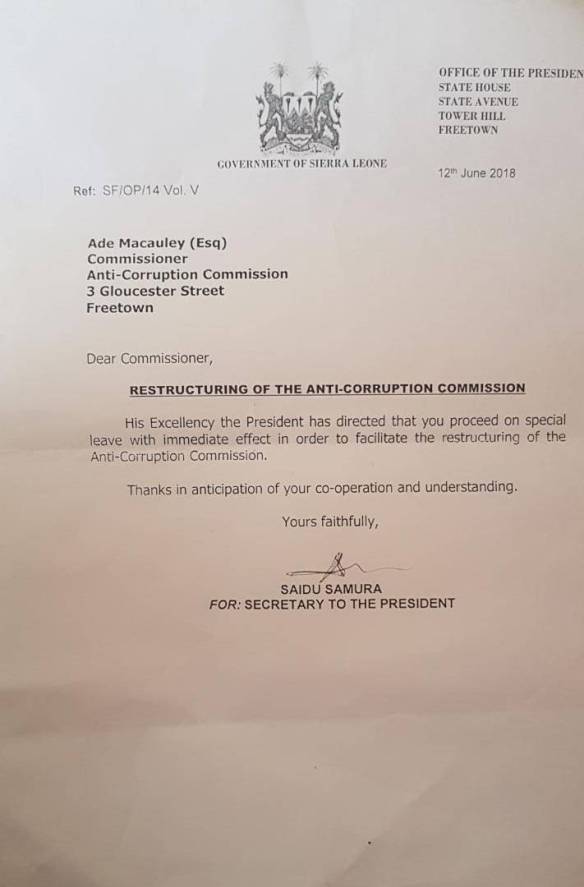
You Are Reorganized! Sierra Leone President Bio’s Ingenious Way of Firing the Anticorruption Commissioner

Leaders fearful that a corruption investigation is closing in on them or colleagues have Sierra Leone President Julius Maada Bio to thank for coming up with a most ingenious to rid himself of the pesky head of his nation’s anticorruption agency.  While the anticorruption law bars presidents from summarily firing the anticorruption commissioner, requiring first a tribunal to find him or her unfit to serve and then two-thirds of the parliament to agree, President Bio neatly cut through this cumbersome red tape with the following missive his aid sent Anticorruption Commissioner Ade Macauley —   Restructuring letter

Continue reading

Guest Post: More Transparency Is Needed to Fight Grand Corruption in the Pharmaceutical Sector

Today’s guest post is from Till Bruckner, the founder of TranspariMED:

In the pharmaceutical sector, public agencies are routinely handing over billions in public money to private companies for products whose value they cannot accurately assess, because the vendors control the flow of information generated by clinical trials. (Even the purchasing price is often kept secret, but that is another story.) If we observed this sort of opacity in the public procurement sector, it would immediately raise red flags. If public contractors were taking billions from governments in exchange for products of dubious quality that the governments cannot assess, the anticorruption community would be–rightly–up in arms. But for the pharmaceutical industry, this is business as usual.

Consider, as one particularly egregious example, what can only be described as an $18 billion heist of public money by a pharma company. In 2006, governments around the world began stockpiling Tamiflu, an anti-retroviral drug, due to fears that outbreaks of bird flu (and later swine flu) could turn into a lethal global pandemic. The evidence available at the time suggested that the drug was safe and effective at reducing the symptoms of influenza. In total, 96 counties accumulated enough Tamiflu to treat 350 million people. Then, in 2009, a doctor noticed that the results of eight clinical trials of Tamiflu were missing from the public record. (Worldwide, around half of all clinical trials have never reported their results.) After a struggle lasting four years, independent scientists finally got the company to turn over the relevant data from these trials—and concluded that the drug did little, if anything, to help patients.

This example is especially egregious, but it is not otherwise exceptional. Amazingly, comprehensive information on the safety and effectiveness of drugs is not only inaccessible to independent scientists, but also to government agencies. When a drug company applies for a marketing license, it has to submit detailed documentation from every relevant trial to regulatory agencies such as the U.S. Food and Drug Administration (FDA). Regulators review these submissions, called Clinical Study Reports (CSRs) – and then promptly lock them away in their confidential archives. This is especially frustrating for scientists working for health technology agencies, who are tasked with assessing the cost-effectiveness of different drugs but are often unable to access CSRs. To date, only the European Medicines Agency systematically releases (some) CSRs.

Politicians have tried to bring transparency into the sector, but the laws they pass often remain unenforced. In the United States, the 2007 FDA Amendment Act made it compulsory for companies and universities to publish the summary results of some clinical trials on public registries. (Summary results are a kind of “executive summary” of a clinical trial; they are far shorter and less detailed than CSRs, but still better than nothing). In 2015, an investigation by STAT News found that pharmaceutical companies routinely violated the law. The law stipulates a fine of up to $10,000 for every day a result is overdue. In theory, Big Pharma has already racked up over $25 billion in fines. In practice, the FDA has yet to collect a single cent. In the European Union, a similar regulation exists, but there too it remains unenforced by national agencies. In Britain, a 2013 parliamentary inquiry called for greater transparency, but its recommendations were largely ignored.

Last December, a coalition of four health integrity organisations issuing a wake-up call for governments to finally get serious about clinical trial transparency. Transparency International Pharmaceuticals & Healthcare (PHP), TranspariMED, Cochrane, and the Collaboration for Research Integrity and Transparency (CRIT) released a study that documents in detail how opacity in the sector harms patients, prevents public health agencies from making informed decisions, wastes public health funds, slows down medical progress, and exposes shareholders to substantial risks. The study also shows that clinical trials can be made significantly more transparent without introducing new legislation. Public research funders could demand that grantees report the results of publicly funded trials. Regulators could make continued market access conditional on companies agreeing to make CSRs publicly available. And in many cases, simply enforcing the rules already on the book could make a huge difference – and the costs of enforcement could easily be covered by imposing fines for noncompliance.

The medical research community has long called for greater transparency in medical research. The AllTrials campaign, which calls for all clinical trials to be registered and fully reported, has attracted the support of over 700 groups, including the American Medical Association and dozens of patient groups, and TranspariMED is currently building a broader coalition to push for greater transparency in the sector. It’s high time for the wider anticorruption community to join the fray.

Defining Declinations: A New Enforcement Action

In recent years, the US Department of Justice (DOJ) has, with increasing frequency, been resolving alleged violations of the Foreign Corrupt Practices Act (FCPA) with formal declinations (that is, a statement that the DOJ will not prosecute the corporation). Indeed, the possibility of resolution through declination is a centerpiece of the DOJ’s new Corporate Enforcement Policy (CEP). Under the new policy, the DOJ will presumptively grant a declination to a corporation implicated in potential FCPA violations, so long as the corporation voluntarily reports the possible FCPA violations to the government, agrees to implement internal remediation measures, and disgorges any ill-gotten gains. (When that last condition applies, the resolution is a “declination with disgorgement.”)

But what exactly is a “declination”? One would think that the answer would be straightforward, but it turns out to not to be so easy. Typically, declinations have been thought of in the negative, meaning what they are not: prosecutions. Generally, U.S. prosecutors have the discretion to decide whether to bring an enforcement action against a party that may have violated the law. If the DOJ decides that it is not in the interest of justice or otherwise worthwhile to pursue a given case, then the DOJ has “declined” to prosecute. However, in the FCPA context (and possibly other contexts as well), a formal “declination” should be thought of as something more than simply a decision not to prosecute. And that distinction turns out to have practical consequences for the types of penalties a formal “declination” can legally support.

Continue reading

Will the Swiss Government Condone Gross Human Violations in Returning Stolen Assets to Uzbekistan?

The Swiss take pride in their nation’s uncompromising defense of human rights. Its diplomats offer unwavering support for the rights of the oppressed in international fora; its NGOs provide generous support to human rights defenders around the world, and as home to the United Nations Human Rights Council and other UN human rights agencies, Geneva is the center of the global discourse on human rights. But if recent press reports are to be believed (here [German] and here [English]), the Swiss government may be ready to ignore gross human rights violations perpetrated by the government of Uzbekistan.

The issue is part of the struggle over how to return the several hundred million dollars that Gulnara Karimova, daughter of its recently deceased dictator, stashed in Switzerland with the help of lackeys Gayane Avakyan and Rustam Madumarov. The monies are allegedly bribes international telecommunications companies paid Karimova to operate in Uzbekistan.

The Uzbek government is seeking their return while Uzbek civil society argues that because the government is so corrupt, the Swiss government should follow the precedent established in a Kazakh case and return the monies directly to the Uzbek people.  If the Swiss government does not, and does return the money to the Uzbek government, it will be forced to condone grave human rights abuses Avakyan and Madumarov have suffered at the hands of the Uzbek government. Continue reading

Brazil: A Model for International Cooperation in Foreign Bribery Prosecutions

Much ink has been spilled celebrating the extraordinary crackdown on corruption in Brazil over the past few years (including on this blog). Headlined by the massive Operation Car Wash (Portuguese: Lava Jato)—in which officials received nearly $3 billion in bribes to overcharge Petrobras, Brazil’s state-controlled oil company, for construction and service work—high-profile corruption investigations have swept through Brazil, threatening to upend its reputation as a bastion for unchecked graft. Although corruption in Brazil remains a serious problem, the extensive investigations have worked to elevate the nation as an inspiration for countries looking to address their own corrupt political systems and hoping to become “the next Brazil.”

In addition to the headline-grabbing investigations targeting the upper echelons of the Brazilian government, Brazilian authorities have also worked closely with U.S. authorities investigating bribery activity in Brazil, leading to significant penalties both under Brazilian law and under the U.S. Foreign Corrupt Practices Act (FCPA). This is a significant development, because it demonstrates the possibility for close collaboration on cross-border bribery cases between a developed country (usually on the “supply side” of transnational bribery cases) and a developing country (on the “demand side”). Commentators have complained that too often supply-side enforcers like the United States take an outsized role in transnational bribery cases, with the countries where the bribery takes place doing too little. Other commentators have cautioned that an increase in prosecutions by other countries, in the absence of some sort of global coordination mechanism, may lead to races to prosecution or to over-enforcement. China’s nearly $500 million fine of British pharmaceutical giant GlaxoSmithKline in 2014 for bribing Chinese doctors and hospitals was emblematic of these fears, providing an example of an aggressive, unilateral approach to demand-side enforcement – while putting DOJ in the unfamiliar position of pursuing FCPA violations as a cop late to the scene.

Through its recent enforcement actions, Brazil has provided a different model. While there have been successful joint enforcement actions in the past—such as the Siemens case—the recent series of coordinated U.S.-Brazil actions exhibit how developed and developing countries can work together in anti-bribery enforcement, sharing in the investigative responsibilities, negotiations with companies, and even the financial returns.

Continue reading

Guest Post: The Taxi Driver Paradox–or How Descriptive Social Norms Shape Corrupt Behavior

Nils Köbis, a post-doctoral researcher at the Center for Experimental Economics and Political Decision-Making (CREED), University of Amsterdam, contributes today’s guest post:

Whenever I am traveling and take a taxi, I try to strike up a conversation with the driver. The beauty of this situation is that both sides can be really candid. The length is typically short, and chances are you will never meet again. The chat usually kicks off with some small talk about sports, weather, and food. Once warmed up, I have often asked: “What do you think is the biggest problem in your society?” So far, the most common answer has been corruption. And my taxi-driver-based anecdotal evidence is consistent with large  international surveys. Notwithstanding the old canard that people who live in corrupt societies generally tolerate corruption as normal and natural, ample empirical evidence (and my taxi drivers) suggests that this is not true: People widely despise corruption, especially in countries riddled with it. Yet on several occasions the very same taxi driver who has been ranting to me about corruption has stopped by a traffic police officer—and willingly paid a bribe to avoid a ticket.

What explains this apparent paradox? The most frequent explanation for why a person outraged by corruption would nevertheless pay a bribe is that “everybody does it”—as the Nigerian novelist Chimamanda Adichie nicely puts it, “If we do something over and over again it becomes normal. If we see the same thing over and over again it becomes normal.” This notion of normality plays an important role in explaining why corruption is sometimes the exception and sometimes the rule. Scholars who research social norms differentiate between injunctive norms, which concern whether a given behavior is acceptable, and descriptive norms, which indicate whether the same behavior is common. This distinction might help to explain the taxi-driver-paradox: People might often bribe because everybody else is doing it, even though they think it’s wrong. Continue reading