The Romanian Government Opposes the Appointment of Laura Codruta Kovesi as European Public Prosecutor. That’s Why She Should Get the Job.

There’s so much bad news in the anticorruption world these days that it’s hard to keep up. But I’ve recently been reading up on the ongoing debates in Europe over the selection of the first European Public Prosecutor, and I think this issue deserves some discussion, and even more attention from the anticorruption community in Europe and around the world.

Here’s the quick background for those who aren’t familiar with this issue: Back in 2017, 20 EU Member States agreed to create a new institution called the European Public Prosecutor’s Office (EPPO), headed by a European Public Prosecutor, with authority to investigate and prosecute (in national courts) offenses connected to the EU’s financial interests, such as fraud or embezzlement involving EU funds. (22 EU countries have now agreed to participate in the EPPO system.) The EPPO is scheduled to begin operations in late 2020 or early 2021, and the EU is in the process of selecting the first EPPO head. The three finalists are a Jean-Francois Bohnert of France, Andres Ritter of Germany, and Laura Corduta Kovesi from Romania. Ms. Kovesi had been considered a frontrunner, and still might secure the post, but her candidacy is under attack from her own government. Indeed, it seems that intense lobbying against her by the Romanian government is what led the Committee of Permanent Representatives in the European Union to back Bohnert for the job, though the European Parliament’s Committee on Civil Liberties, Justice, and Home Affairs voted to support Kovesi. The selection process is still ongoing, and it’s not clear when a final decision will be made. For those getting cold feet about Kovesi, though, it seems that the opposition of her home government is a significant reason.

In my view that’s not only wrong, but backwards. The Romanian government’s no-holds-barred, all-out attack on Kovesi is one of the best arguments for appointing her. I don’t know enough about the candidates to have a considered view of which of them, all else equal, would do the best job heading the EPPO, but assuming that they are all basically well-qualified, the Romanian ruling party’s panic over the prospect that Kovesi might get the job is exactly why she should be appointed, for two reasons:

  • First, the fact that government of one of the most corrupt countries in the EU—one with the greatest theft and misappropriation of EU funds—is terrified that Kovesi might get the job, but apparently fine with either of the other two choices, is strong evidence that she’ll be more effective. After all, if we were selecting the city police chief, and we found out that the local mafia boss strongly objected to candidate A, but was fine with candidates B and C, that seems like a point in candidate A’s favor, not a strike against her. (And if you think it’s unfair to compare the government of an EU member state to an organized crime family, well, read on.)
  • Second, the Romanian government is conducting a fairly blatant attempt to misuse its justice system in order to interfere with an EU decision process, in the context of a corrupt and increasingly illiberal ruling party. The EU is already struggling to deal with backsliding in Hungary and Poland, and it needs to show that it won’t be bullied or manipulated, and that if Member States want to be treated as good EU citizens, they need to comport with basic norms.

Now, given that I just made those statements with what sounds like great confidence, and the rest of this post may adopt a similarly confident tone, I should immediately add the caveat that I am not an expert on Romania, I’ve never been there, I don’t speak the language, and all I know about the situation, as the old saying goes, is what I read in the papers. So if you want to say I don’t know what I’m talking about, fair enough, you have a point. But I’ve been reading a lot about this, and what I’ve read seems both sufficiently scary, and sufficiently clear, to merit comment. Moreover, I think the Romanian government’s strategy relies in part on non-experts feeling like they don’t really understand what’s going on, so that it starts to feel like that, in the face of conflicting narratives (a sort of he said/she said), it’s best just to avoid controversy by supporting a “safe” choice for EPPO head. We’ve got to resist that impulse. Appointing someone other than Kovesi may seem like the safe choice, but that’s exactly why Kovesi is the right choice. Continue reading
Passports for Sale: Why We Should Worry about Golden Visa Programs

In 1984, the government of the small Caribbean island state of Saint Kitts and Nevis had a bright idea for attracting foreign capital: the country would grant permanent resident status to any foreign national who invested a sufficient amount in the country. The idea caught on, and now dozens of countries around the world—including not only small island states, but also major developed economies like the United States and the United Kingdom—have so-called “golden visa” programs. Golden visa programs have proven especially attractive during times of economic hardship, as demonstrated by the spread of these programs across Europe in the wake of the 2008 recession. These European programs are especially notable, as getting a visa in one country in the Schengen visa zone provides access to the other 25 as well. Some states—including EU members Austria, Bulgaria, Cyprus, and Malta—even offer investors outright citizenship, rather than simply residency status, in exchange for sufficiently large investments. And due to pre-existing visa waiver agreements, these “golden passports” may allow access to other countries as well. Those with Maltese passports, for example, can travel to the US visa-free.

According to a recent Transparency International-Global Witness report, in the last decade alone, countries with these sorts of programs have “sold” (that is, traded for investment) more than 6,000 passports and nearly 100,000 residency permits. Yet these policies have always been controversial, and are becoming more so. Canada terminated its golden visa program in 2014 (though it continues in Quebec). Last June, the Trump Administration demanded that Congress either terminate or reform the US investor visa program. And the UK abruptly announced it would suspend its program on December 6th, although it reversed course six days later.

Part of the reason for the growing disillusionment with golden visa programs is that their supposed economic benefits haven’t lived up to expectations. Rather than stimulate economic growth and job creation, the investments used to qualify for golden visas are often passive, such as government bonds or real estate. In Portugal, for example, 95% of total investment has been in real estate—6,141 investments compared to just 12 in employment creation. Real estate investments not only offer limited benefits, but may also distort housing markets. In the US, investments have been, in the words of US Senator Chuck Grassley, funneled towards “big moneyed Manhattan interests” rather than “direct investment to rural and high unemployment areas.” Hungary even managed to lose money on its program—$221 million—as it offered investors discounted bonds that were then fully repaid after five years with an additional 2% interest.

But the bigger problem with golden visa programs is their potential to both facilitate and stimulate corruption and money laundering. This problem, which was highlighted both by the TI-Global Witness report mentioned above, as well as another report from the European Commission, takes several forms. Continue reading

Proposed US Legislation Can Solve the Art World’s Money Laundering Problem

The plan was simple: a wealthy client wishing to launder the proceeds of a stock manipulation scheme could do so through a Picasso painting. His accomplice would be Matthew Green, the owner of a prominent London art gallery and son of one of London’s most powerful art dealers. The client would purchase the painting using the illegal proceeds, own the painting for some time to avoid suspicion, and then sell the painting back to Green, who would transfer the original payment back to the client through a US bank—to “clean the money.” It was completely foolproof, except that the client turned out to be an undercover FBI agent.

Why a painting to launder the money? Because the art business is impenetrable by outsiders: it’s a world limited to highbrow art connoisseurs, dealers, and wealthy collectors, where the prices are whatever they want them to be. Here, $9.2 million, although the painting failed to sell at a much lower price estimate years before. And as the defendants in the Green case explained to their client, the art business is “the only market that is unregulated” by the government. It seems that the players in the art world make up their own rules, unchecked by any authority, making this elusive quality of the business the perfect “hotbed” for corrupt activity.

In May 2018—possibly in response to the February 2018 indictment in this case—legislation was introduced in US Congress to tackle the money-laundering problem in the art business (previously described on this blog). The Illicit Art and Antiquities Trafficking Prevention Act (Act) would cover art and antiquities dealers under the Bank Secrecy Act (BSA), which requires financial institutions and other regulated businesses to establish anti-money laundering programs, keep records of cash purchases, and report suspicious activity and transactions exceeding $10,000 to government regulators. This legislation has, perhaps unsurprisingly, been vigorously opposed by the art industry. But the objections to the proposal do not withstand scrutiny:

Continue reading

Guest Post: The European Commission’s Response to “Golden Passport” and “Golden Visa” Programs

Today’s guest post is from Anton Moiseienko, a research analyst at the London-based Centre for Financial Crime and Security Studies of the Royal United Services Institute.

 Investor citizenship and investor residence programs, known colloquially as “golden passport” and “golden visa” schemes, have a less than sterling reputation. Much of the disapproval comes from anticorruption organizations like Transparency International and Global Witness. Those two organizations published a joint report last year that criticized these programs for offering a “safe haven” to figures associated with corruption.

The European Union has also expressed concern about these programs in several of its Member States. For example, back in 2014 the European Parliament adopted a resolution that accused some Member States, in particular Malta, of an “outright sale of EU citizenship [that] undermines the very concept of European citizenship.” And this past January the European Commission published a report on golden visa and golden passport schemes that will do little to improve their battered reputation. The Commission report raises a number of worries about these programs, and expresses particular concern about golden passport programs, since citizenship in an EU Member State automatically confers EU citizenship with its attendant rights, including free movement.

There are at least three ways in which golden passport and golden visa programs threaten to undermine the fight against corruption. Continue reading

The Consequences of Zero Tolerance

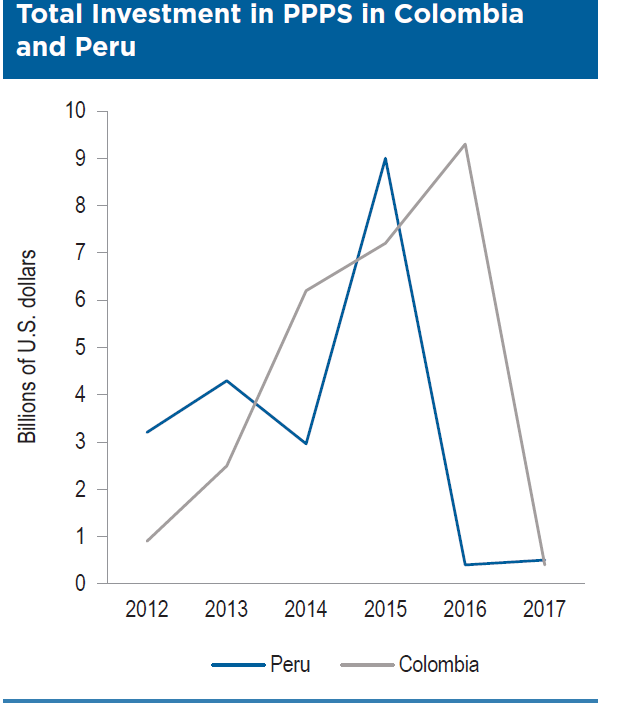
The chart above shows what happens when policy is based on a slogan. In this case “Zero Tolerance.” Procurement rules in both Peru and Colombia require that any public contract tainted by corruption be terminated immediately. As the Brazilian investigation into construction giant Odebrecht unfolded, it became clear that many projects to build highways, power plants, and other infrastructure projects in the two countries had been corruptly awarded.  Authorities in both countries then did what the law told them they must: cancel the contracts.

Most large infrastructure contracts in Peru and Colombia are in the form of Public-Private Partnerships (PPPs), and the immediate termination of a PPP can be enormously costly.  Not only to the firms that paid bribes to secure the contract, but to lenders, suppliers, and the hundreds of other contractors on the project who had no knowledge or involvement in the bribery scheme.  The greatest costs are likely be felt by the citizens of Colombia and Peru.  For as the chart shows, the consequence of zero tolerance is a halt to new spending for roads, power, and other essential facilities as investors and project developers shy away from the risk future contracts will be terminated for the tiniest of infractions by anyone associated with the project.   

Colombians and Peruvians may today be proud their governments are so tough on corruption neither one will tolerate a speck of it in any contract for infrastructure.  Tomorrow citizens of the two countries may have a different view: when power shortages mean the lights won’t come on and the failure to build new roads and maintain old ones produces horrendous traffic jams.  

Last week the World Bank hosted a presentation by Inter-American Development Bank staff where the issue of why “zero tolerance” is a good slogan but a bad policy was examined and means for addressing infrastructure corruption without producing the results shown in the chart was discussed.  A paper the IDB presenters recently published, the source of the figure above and the basis of their presentation, is here.   A video of the session here.  

Video: Baker Center Conference on Controlling Corruption in Latin America

A few weeks back I was lucky enough to attend a mini-conference hosted by Rice University’s Baker Institute for Public Policy entitled “A Worthy Mission: Controlling Corruption in Latin America.” The conference featured an opening keynote address by Yale Professor Susan Rose-Ackerman, with a brief response by BYU Professor Daniel Nielson, followed by two panels. The first of these panels (which I moderated) focused on anticorruption prosecutions in Latin America generally, and featured Thelma Aldana (who served as Attorney General of Guatemala from 2014-2018, and is rumored to be a likely presidential candidate), Paolo Roberto Galvao de Carvalho (a Brazilian Federal Prosecutor and member of the “Car Wash” anticorruption Task Force), and George Mason University Professor Louise Shelley. The second panel, moderated by Columbia Professor Paul Lagunes, focused more specifically on corruption control in Mexico, and featured Professor Jacqueline Peschard (former chair of Mexico’s National Anticorruption System), Claudio X. Gonzalez (the president of the civil society organization Mexicanos Contra la Corrupcion y la Impunidad (MCCI)), and Mariana Campos (the Program Director at another Mexican civil society organization, Mexico Evalua).

Video recordings of the conference are publicly available, so I’m going to follow my past practice of sharing the links, along with a very brief guide (with time stamps) in case anyone is particularly interested in one or more particular speakers or subjects but doesn’t have time to watch the whole thing. Here goes: Continue reading

The Bolsonaro Administration is Quietly Reducing Transparency in Brazil

Right-wing populist Jair Bolsonaro was inaugurated President of Brazil on January 1, 2019. As a candidate, Bolsonaro promised that his regime would break with the large-scale graft of Brazil’s former leaders and would ruthlessly pursue the corrupt and bring them to justice. At the end of January, Justice Minister Sergio Moro released, with much fanfare and press attention, a sweeping anti-crime legislation package that addresses both white collar crime and violent organized crime, and that incorporates some, though not all, of the anticorruption measures proposed by Transparency International. So does this mean that the Bolsonaro Administration is following through on its promise to make the fight against corruption a major priority, and to end the culture of impunity that has shielded Brazilian political elites?

Alas, no. While the anti-crime package (and other high-profile pieces of legislation, like tax reform) have been highlighted by the administration and attracted most of the media attention, less prominent yet equally consequential pieces of legislation related to corruption are being passed with little to no warning or public debate. Here are two examples of major events that have occurred within the first month of the regime that should give anticorruption scholars and the international community pause in their evaluation of the Bolsonaro government’s fight against corruption:

Continue reading

Kyrgyzstan’s Elimination of Immunity for Ex-Presidents is No Win for Anticorruption

Last October, the Supreme Court of Kyrgyzstan ruled that Kyrgyzstan’s law granting legal immunity to ex-presidents was unconstitutional on the grounds that Article 16 of the Kyrgyz Constitution makes all people equal before the law. Because the Kyrgyz immunity law was one of the broadest and most protective in the world, those of us who care about corruption might cheer this ruling as a win in Kyrgyzstan’s fight against corruption. However, viewed in context, the ruling portends problems for Kyrgyzstan’s nascent democracy and may even be counterproductive in the fight against corruption itself.

Many countries have ex-presidential immunity regimes. The downside of such laws—which exist throughout Central Asia and in countries as diverse as Burundi, France, and Uruguay­—is that, by making it difficult or impossible to prosecute a former president, these laws eliminate one of the most important deterrents to executive corruption. Kyrgyzstan’s law was especially problematic in this respect, as the immunity granted to ex-presidents was unusually broad—covering not merely conduct related to the former president’s exercise of her or his official duties, but any act committed during the term of office, with no exceptions even for high treason or other grave crimes. The Kyrgyz immunity law also protected an ex-president’s property, and it blocked searches and interrogation in addition to prosecution, thus stymying investigations even where the ex-president was just a witness. For these reasons, getting rid of the immunity law might seem like a step forward in the fight against corruption.

However, laws that grant immunity to ex-presidents also have an upside, especially in authoritarian states or fragile democracies. These laws may ease and encourage peaceful political transitions, because with no threat of prosecution, a sitting president may be more willing to peacefully cede power. One might therefore be worried about the impact of the Supreme Court’s decision on Kyrgyzstan’s fledgling electoral democracy. Those worries would be well founded given the political context in which the Supreme Court rendered its decision.

To understand why requires understanding recent events in Kyrgyz politics, and in particular how the Supreme Court’s invalidation of the ex-presidential immunity law appears to be part of a larger campaign by the current President to suppress political opposition led by his predecessor:

Continue reading

Guest Post: To Combat Corruption, Argentina Must Insist on Meritocratic Hiring in the Civil Service

Today’s guest post is from Professor Ignacio A. Boulin Victoria of the Universidad Austral School of Law (Buenos Aires, Argentina) and Fulbright Scholar Eliana Kanefield.

Currently, over 3.9 million people work for the public sector in Argentina, constituting nearly 27% of Argentina’s workforce—the third-highest proportion in Latin America and the Caribbean (after only Barbados and Trinidad & Tobago), and well above the regional average of 18%. Working in the public sector in Argentina has substantial advantages, including strong employment security (it is extremely difficult to be fired from public sector positions in Argentina) and substantially higher salaries than comparable jobs in the private sector. It’s thus unsurprising that the competition for public sector jobs is fierce. To take just one example, when the Province of Mendoza created 114 new public sector positions, there were more than 30.000 applicants.

While there is nothing inherently wrong with the multitude of advantages public sector workers enjoy, this system gives rise to a structural problem: the system largely serves politicians’ friends and family. Officially, entry into the public sector is governed by a set of robust requirements and competitive examinations. But this is a façade. In reality, most people who get a job in the public sector do so because they have the right connections. They are usually friends, relatives, or members of the same political party of the person doing the hiring. An example of the clear disregard for the standards and systems in place is that, as of 2017, only 2% of senior management public sector employees had passed the “demanding” entry examinations and requirements designated by the government, and only 6% of these positions were filled through an open and fair recruitment procedure (compared to 90% in Chile). From 2015 to 2017, the proportion of senior public sector management positions filled by people who met the official professional requirements mandated by the job description decreased from 32% to 18%, while the proportion of these professionals who had education beyond a high school degree decreased from 72% to 66%. Admittedly, some of the public servants hired outside of the regular process do have the right qualifications, but even in those cases there’s still the inherent unfairness that potential applicants without connections don’t have the opportunity to compete for these jobs.

This failure of meritocracy worsens Argentina’s corruption problem, in three ways: Continue reading

Swedish Court’s Stunning Acquittal of ex-Telia Executives for Bribery

A Stockholm District Court’s acquittal of three former executives of Swedish telecom giant Telia of bribery shocked the global anticorruption community and has smirched Sweden’s reputation as a clean government champion (original decision; English translation).  Despite overwhelming evidence, the court refused to find the three guilty of paying Gulnara Karimova, daughter of the then president Uzbekistan, over $300 million in bribes for the right to operate in the country.

E-mails showed defendants directed the money to a Karimova shell company, hid their dealings with her from Telia’s board, and knew paying her violated American antibribery law. (Telia subsidiary’s Statement of Facts in the U.S. prosecution.)  Though defendants argued Karimova had no official role in telecom licensing, the evidence showed her father had given her de facto control of the telecom licensing agency.  Perhaps most damning, the court had the sworn statement Telia made in settling the FCPA case arising from the bribery. It there admitted “Executive A . . . a high-ranking executive of Telia who had authority over Telia’s Eurasian Business Area” and “certain Telia executives” had been the principals behind the bribery scheme (Statement of Facts,  ¶s 12, 17, 19, 26, 30, and 34).

The court defended its acquittal of Tero Kivisaari, apparently Telia “Executive A,” Lars Nyberg, CEO when the bribes were paid, and the lawyer who counseled them on two grounds. One, the prosecutor had not provided “hard evidence” of bribery, and two, even if he had, the law then in effect did not reach defendants’ conduct.

Google’s translation of the decision is rough (mutanklagelser, Swedish for bribery, is rendered as “manslaughter”) but not too rough to see through the court’s skewed findings of fact and flimsy legal reasoning. Continue reading