French Court Convicts Equatorial Guinean Vice President Teodorin Obiang for Laundering Grand Corruption Proceeds

GAB is pleased to publish this account and analysis by Shirley Pouget and Ken Hurwitz of the Open Society Justice Initiative of the decision in the criminal trial for money laundering of Equatorial Guinean Vice President Teodorin Nguema Obiang. Their earlier posts on the trial are here, here, here, here, here, here, here, and here.
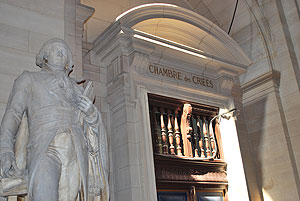
court roomIn the first ever peacetime conviction of a high-ranking, incumbent office holder by the court of another state, a Paris criminal court has convicted Equatorial Guinean First Vice President Teodoro Nguema Obiang Mangue of laundering monies from corruption in Equatorial Guinea in France.  The historic decision, announced by the 32nd Chamber of the Tribunal Correctionnel de Paris on Friday, October 27, was tempered by the reality the court faced in finding a senior official of another country guilty of violating French law.  While it unconditionally awarded Transparency International – France, which as a “civil party” helped investigate the case, €10,000 in moral and €41,081 in material damages, and ordered seizure of much of the €150 million in assets Teodorin holds in France, it suspended (sursis) the three- year prison sentence and €30 million fine it imposed on Teodorin so long as the VP stays out of trouble for five years.   It also stayed the part of the asset seizure order confiscating the obscenely extravagant 101-room property on Avenue Foch Teodorin owns pending the outcome of proceedings before the International Court of Justice where, as explained in a previous post, the EG government is claiming the assets belong to it rather than to Teodorin.

The President of the Tribunal, Mrs Benedicte de Perthuis, detailed the reasoning supporting the ruling in a 45 minute oral explanation accompanying the judgement.  She explained that the three judge court rejected all Teodorin’s procedural and substantive defenses, including a claim asserting Teodorin’s immunity from criminal prosecution on the basis of his position as  First Vice-President of Equatorial Guinea.  She noted on the latter that his nomination as First Vice-President had conveniently occurred after his indictment by the French Courts, and the Tribunal ruled that his new functions could not be equated to those of a Head of State or Minister of Foreign Affairs (officials who, under ICJ precedent, would indeed enjoy immunity from this kind of a prosecution).

The verdict sends a clear message that grand corruption and the related offense of money laundering are no longer risk-free enterprises in France.  Continue reading →
Guest Post: Transparency International UK’s Pledge Tracker–Amateur Research or Different Objectives?

Last week, GAB Editor-in-Chief Matthew Stephenson published a post sharply criticizing Transparency International UK’s new “Pledge Tracker,” which evaluates how well countries are living up to the pledges they made at the May 2016 London Anti-Corruption Summit. GAB is delighted to have the opportunity to publish the following reply from Robert Barrington, the Executive Director of Transparency International UK:

“A slapdash, amateurish collection of arbitrary, often inconsistent judgements, unsupported by anything that resembles serious research.” Not since I was taken to task over an undergraduate essay by an eminent professor at Oxford have I had work for which I was responsible receive quite such a stinging critique.  On that occasion, I could not escape a sense that my world view differed from that of the professor, and that—irrespective of the detail—was the root of our misunderstanding.

So is Professor Stephenson’s assessment of TI-UK’s Pledge Tracker merited? Here is my overall assessment: he is right on some but not all of the detail; he is wrong on most but not all of the big picture. At the root of the difference is the question of whether this is an index in which countries are compared with each other according to a consistent global standard, or whether it is the presentation of individual country assessments by local civil society organizations of their own country’s progress against their own country’s commitments. Continue reading →

Guest Post: Refining Corruption Surveys To Identify New Opportunities for Social Change

GAB is delighted to welcome back Dieter Zinnbauer, Programme Manager at Transparency International, who contributes the following guest post:

Household corruption surveys, such as Transparency International’s Global Corruption Barometer (GCB) are primarily, and very importantly, focused on tracking the scale and scope of citizens’ personal bribery experience and their general perceptions about corruption levels in different institutions. More recently, the GCB has branched out into questions about what kind of action against corruption people do or do not take, and why. The hope is that better understanding what motivates people to take action against corruption will help groups like TI develop more effective advocacy and mobilization strategies.

In addition to these direct questions about why people say they do or don’t take action against corruption, household surveys have the potential to help advocacy groups in their efforts to mobilize citizens in another way as well: by identifying inconsistencies or discrepancies between what people’s experience of corruption and their perceptions of corruption. The existence of these gaps is not in itself surprising, but learning more about them might help advocates craft strategies for changing both behavior and beliefs. Consider the following examples: Continue reading →

Guest Post: If You Were a G20 Leader for a Day…

Maggie Murphy, Senior Global Advocacy Manager for Transparency International, contributes today's guest post:

Remember the big headline from the recent G20 Summit in Hamburg, about what leaders are going to do to tackle corruption head-on?
No, we don’t either. Corruption remains a bit of an afterthought in G20 thinking on progressing the G20’s objective of “strong, sustainable, balanced and inclusive growth” (page 14 of the most recent Communiqué), despite the almost plaintive opening line in the current G20 Anti-Corruption Action Plan that “[r]educing corruption remains a top priority for the G20.”
Corruption should be preoccupying for G20 leaders. In the last 12 months alone, the presidents of G20 members South Korea and Brazil have been impeached (and Brazil’s current president is also facing corruption allegations) and the former Argentinian president was indicted for corruption.
Despite the lack of public emphasis on fighting corruption, the G20 does have well-functioning G20 Anti-Corruption Working Group (ACWG). The ACWG meets three times a year, works to biennial Action Plans, and advises G20 leaders on where to channel their energy in tackling corruption. The ACWG touches on a wide range of topics, from asset recovery, to open data, to the illegal trade in wildlife. The ACWG adopts principles, issues individual country guides, conducts self-assessments, and develops good practice, research, and toolkits on certain issues. The 60 documents the group has developed since 2010 can be found on a helpful but hidden website compiled by the German Ministry of Justice.
But we don’t hear much about the ACWG's work, even less its impact. Clearly it needs a shake-up.
As new G20 host, Argentina should lead the development and adoption of a new biennial Anti-Corruption Action Plan. But that would be simply more of the same. Is it time for the G20 ACWG to have a rethink? Continue reading →

Guest Post: UK Bribery Prosecutions and the Rule of Law

Mat Tromme, Project Lead & Senior Research Fellow at the Bingham Centre for the Rule of Law, contribute today's guest post, which is based on discussions at a recent Bingham Center-Duke Law School FCPA Roundtable:

In the latest sign that the UK’s Serious Fraud Office (SFO) it is flexing its prosecutorial muscle, the SFO recently opened a case against British American Tobacco, and in June convicted four senior executives from Barclays Bank for conspiracy to commit fraud. This adds to the SFO’s growing list of "successes," such as cases against the ICBC Standard Bank, Tesco, and Rolls Royce. It also raises some important questions (which aren't new), on the one hand about the means used to prosecute bribery, and on the other about the extent to which ongoing economic considerations such as Brexit might put an end to what appears to be good momentum.

Despite the SFO's "wins," some critics are disappointed with the Rolls Royce deferred prosecution agreement (DPA) and questioned whether the SFO is sufficiently aggressive in prosecuting corruption. This view follows concerns that the Rolls Royce case failed to meet the interests of justice and illustrates how big companies are let off the hook where the prosecution of bribery is concerned. Such concerns echo criticisms that DPAs in the United States, which pioneered their use, undermine the rule of law by letting individuals avoid prosecution, and by allowing this area of law to develop outside of the public eye and with very little judicial oversight. This leaves the lasting impression of a two-tiered criminal system by promoting a “too big to jail” culture. DPAs, it is also been argued, undermine both the deterrent effect of the law and incentives to self-report. Continue reading →

Guest Post: The Obiang Trial Suggests Innovative Approaches To Fighting International Corruption

GAB is pleased to welcome back Frederick Davis, a lawyer in the Paris office of Debevoise & Plimpton, who contributes the following guest post:

Over the past two months, the French Tribunal de Grande Instance in Paris (the principal trial court) heard evidence in the case against Teodoro Nguema Obiang Mangue (known as Teodorin), on charges of corruption and money laundering, among other allegations. Teodorin is the son of Teodoro Obiang Nguema Mbasogo, the long-time – and notoriously corrupt – President of Equatorial Guinea, a resource-rich country that also has some of the most widespread poverty in the world. Yet Teodorin, who is currently Vice President , owns vast real estate in Paris, a private jet, a yacht, and a fleet of vintage and modern automobiles, among his other known assets. This case has been discussed extensively on this blog (see here, here, here, here, here, here, here, and here), but it’s useful to recap how the case came to trial in the first place:

The case against Teodorin was primarily the result of diligent efforts by NGOs, including the French anticorruption group Sherpa and the French chapter of Transparency International (TI). In 2007, Sherpa and others filed a complaint with the Public Prosecutor in Paris alleging that the ruling families of Equatorial Guinea, Angola, Burkina Faso and the Republic of the Congo held assets in France that were not the fruits of their official salaries. After a brief investigation, the Public Prosecutor dismissed the claims. Several of the NGOs, joined in some instances by citizens of the countries in question, then used a French procedure known as constitution de partie civile to cause a criminal investigation by an investigating magistrate (juge d’instruction). This effort was opposed by the Public Prosecutor. A Court of Appeals initially upheld the prosecutor’s position and dismissed TI’s intervention, but in an important 2010 ruling, the French Cour de Cassation (Supreme Court) ruled that TI was a proper partie civile authorized to instigate the criminal investigation. Ultimately Teodorin was bound over for trial, now with the support of the Public Prosecutor (as well as the continued active participation of TI and other NGOs). A decision is expected in October.

The procedures that brought Obiang to trial are interesting because they highlight four important differences between French and US criminal procedures, and more generally illustrate several legal deficiencies, in countries like the United States, that often hinder the worldwide fight against transnational corruption: Continue reading →

The Obiang Trial: Misstatements of Facts and Law in the Defense’s Closing Arguments

GAB is pleased to publish this account and analysis by Shirley Pouget and Ken Hurwitz of the Open Society Justice Initiative of the final arguments of Equatorial Guinean Vice President Teodoro Nguema Obiang’s lawyers at his Paris trial for what is in effect kleptocracy.

court roomTeodoro Nguema Obiang Mangue’s trial concluded July 5, 2017, with closing arguments by his defense counsel. The trial marks a major milestone in the struggle to ensure accountability for grand corruption, even when committed by those at the highest political levels.  A spicy mixture of high principle, juridical gravitas, and sophisticated argumentation on intricate issues of pressing urgency in the real world, the trial also contained moments of wrenching emotion and undignified, even scandalous, claims and insinuations.

The final day was devoted to arguments by Teodorin’s lawyers: Emmanuel Marsigny, Equatoguinean jurist Sergio Tomo, and Thierry Marembert.  In sum they claimed i) that their client didn’t steal enormous sums of money from the people of Equatorial Guinea, ii) that even if he did, the theft wasn’t illegal under Equatorial Guinean law, and iii) that even if he did steal the money and it was a violation of EG law, a French court did not have the right to try him for it.  Their arguments mixed misleading and often downright false statements of the evidence with strained and fanciful interpretations of the law, all seasoned with dark suggestions that the trial was about race and politics rather than the massive theft of resources from the citizens of Equatorial Guinea.     Continue reading →

The Obiang Trial: Prosecutor Seeks 3 Years Imprisonment, Large Fine, Asset Confiscation  

GAB is pleased to publish this account and analysis by Shirley Pouget and Ken Hurwitz of the Open Society Justice Initiative of the concluding arguments the civil parties and the prosecution made at the trial of Equatorial Guinean Vice President Teodorin Nguema Obiang.

The July 5th proceedings in the Obiang trial opened with the court rejecting the defense request that it be allowed to pursue its claim that the prosecution was unconstitutional.  It closed with the state prosecutor asking the court to find Teodorin guilty, sentence to him three years in prison, fine him €30 million, and confiscate all of his assets located in France.  In between the two civil parties – CORED, a coalition of Equatorial Guinean political parties, and Transparency International-France – presented their arguments in support of conviction.  Continue reading →

Guest Post: How Will Nationalist Election Outcomes in the US and UK Affect Foreign Anticorruption Enforcement?

Professor Rachel Brewster of Duke Law School and Mat Tromme, Project Lead & Senior Research Fellow at the Bingham Centre for the Rule of Law, contribute today’s guest post, which is based on discussions at a recent Bingham Center-Duke Law School FCPA Roundtable:

In the past year, we have twice seen voters make a significant turn toward nationalism. In June 2016, in a move that was largely motivated by protectionist views, the UK voted to leave the EU, and in November, the United States elected Donald Trump, who campaigned on an “America First” promise. What do these developments mean for US and UK enforcement of their respective laws against overseas bribery (the Foreign Corrupt Practices Act (FCPA) and UK Bribery Act (UKBA), respectively)? Many worry that, insofar as government leaders view anticorruption laws as harming their country’s international competitiveness (a dubious assumption), then nationalistic fervor can lead to weaker enforcement. This is a reasonable concern in both countries—but a more careful analysis of the situation suggests uncertainty is greater in the UK than it is in the US.

Continue reading →

Guest Post: Encouraging Signs for a Possible U.S. Legislative Crackdown on Anonymous Companies

Gary Kalman, the Executive Director of the FACT Coalition, contributes today’s guest post:

A little over a year ago, the International Consortium of Investigative Journalists (ICIJ) released the Panama Papers, a treasure trove of information and a window into the world of financial secrecy. In some ways, much of what the Panama Papers revealed was already well known. Previous estimates put the amount of money hidden in offshore secrecy havens somewhere between $8 trillion and $32 trillion. In 2015, The New York Times published an impressive five-part series on the use of anonymous shell companies to purchase prime real estate in New York City. Prior to that, the U.S. Justice Department filed a lawsuit (which they just won on June 29th) to force the forfeiture of New York property secretly owned by the government of Iran in direct violation of economic sanctions. And so on. Yet it is hard to deny the captivating intrigue of the specific stories in the Panama Papers involving Russian kleptocrats, world leaders, athletes, movie stars, and others.

The big question is: more than a year later, did anything change? As I recently observed, there are indeed encouraging signs around the world, particularly in Great Britain, several EU member-states, and some developing countries such as Ghana. What about the United States? After all, with U.S. transparency laws ranging from weak to non-existent, there is little need to go to Panama to launder one’s dirty money. While Delaware gets the most notoriety, no state collects information on the true (“beneficial” owners of corporations. In fact, in its recent assessment of the U.S., the Financial Action Task Force, an international anti-money laundering body, noted that for all the progress the U.S. has made, the lack of beneficial ownership transparency remains a glaring weakness. And in the past, when some U.S. legislators – most notably former U.S. Senator Carl Levin (D-MI) – pushed legislation to require states to collect beneficial ownership information, the proposed bills never received so much as a hearing.

That may be about to change, and anticorruption advocates should take note. Continue reading →