Curbing Corruption in India’s Healthcare System

The Indian healthcare system is rife with corruption, and much of this corruption arises from the way that healthcare is regulated (or not). Because healthcare in India is inexpensive, at least by Western standards, private health insurance is relatively rare, and a sizeable majority of total health expenditures are made out-of-pocket. With little regulation, and without much meaningful price negotiation by either the government or private insurance companies, India’s healthcare system has become a vast “network of unregulated private sector hospitals.” This lack of regulation, coupled with intense competition, encourages doctors (who are often under substantial financial pressure) “to enter a happy axis of corruption where they routinely prescribe expensive investigations and perform operations which a patient might not need” in order to increase their profit margins. Doctors have also been known to take bribes from other healthcare entities in return for patient referrals, or to accept kickbacks from pharmaceutical companies disguised as “professional fees” in order to outcompete other private hospitals. As a recent WHO-Eurohealth publication concluded, health sector corruption in India includes not only “collusion, bribes and kickbacks in procurement which may result in overpayment for goods and contracted services” and doctors’ willingness to accept “payments in exchange for special privileges or treatment,” but also “distort[ions in] medical professionals’ prescribing practices.” 

Prime Minister Narendra Modi’s government has sought to address some of these concerns through a healthcare initiative known as PMJAY. The main objective of this program is to increase access to healthcare for the poorest 50% of the population—approximately 700 million people—who are given biometric government “smart cards” to purchase eligible inpatient healthcare services at both private and public hospitals. But while PMJAY is principally designed as a system for subsidizing healthcare for low-income people, it also serves as an anticorruption tool by bringing under government oversight millions of previously unregulated out-of-pocket healthcare transactions, requiring enrolled physicians to acquire digital pre-authorization before administering nonemergency services to PMJAY beneficiaries, and giving the government more power to negotiate with private hospitals participating in the program over healthcare rates. PMJAY’s computerized billing platform also serves a surprising secondary role as an AI-powered “comprehensive fraud analytics solution” for millions of transactions that were previously beyond the government’s reach. The program has already detected over 18,000 fraudulent insurance transactions, leading to penalties against hundreds of healthcare entities so far. The government has even made a list of “corrupt” hospitals available on the PMJAY website. Given PMJAY’s early successes, the government should expand the program. Not only would this increase healthcare access in general—a worthy aim in its own right—but it would further reduce corruption in the healthcare system. This is more easily said than done, however, in light of several practical obstacles to further expansions.

Continue reading

A U.S. Court Just Opened a Huge Loophole in Anticorruption Campaign Finance Laws

A New Jersey election law prohibits any “corporation carrying on the business of a bank” from donating to political parties. The New Jersey Bankers Association (NJBA), a trade group representing the interests of 88 banks in the state, challenged that law as unconstitutional. For those who follow disputes over U.S. campaign finance law, one might have expected that this case would be decided within a familiar framework: Under the Supreme Court’s well-established principle that campaign contributions are a constitutionally protected form of political speech, the restriction would only be permitted if it is narrowly tailored to advance the government’s compelling interest in preventing corruption or the appearance of corruption.

The federal appeals court’s surprising decision in this case, though, sidestepped that usual inquiry entirely. Instead, the court determined that the law in question did not apply to the NJBA in the first place. The court reasoned that the law applies only to “corporation[s] carrying on the business of a bank,” and because the banks’ trade association (the NJBA) does not itself make loans and receive deposits, the NJBA is not a “bank,” meaning the law does not prohibit the NJBA (as distinct from its member banks) from making political donations.

That reasoning is at least questionable as a purely linguistic matter. To “carry[] on” a business activity can mean both “to engage in or conduct” business oneself and “to develop [a business] beyond a stage already attained.” While a bank trade association does not do the former, it arguably does do the latter—for example, by lobbying against capital constraints that would impede the loan-making capacity of banks. But more importantly, the court’s narrow, literalist reading of the statute is inappropriate in light of its dangerous consequences for New Jersey’s efforts to restrict corruption and the appearance of corruption in the campaign finance system. The court’s ruling permits (at least for now) New Jersey to restrict banks’ campaign contributions, but allows the representative of those banks to make contributions on their behalf. That’s like saying your child isn’t allowed to reach in the cookie jar, but his friend can grab the cookie for him. This misguided decision has thus created a potentially gaping loophole, one allowing affluent industry groups to engage in campaign-related spending that would ordinarily be deemed to present such a high risk of corruption (or its appearance) that government regulation is justified.

Continue reading

OECD Denounces Italy’s Failure to Enforce the Antibribery Convention

GAB readers know that Italy has repeatedly failed to meet its obligations under the OECD Antibribery Convention (herehere, and here). That in recent high-profile cases where evidence Italian companies bribed officials of foreign governments was overwhelming, the companies, their executives, and accomplices were all acquitted.  And that civil society organizations in Italy, Nigeria, and the United Kingdom have urged the OECD in no uncertain terms to condemn the Italian government’s blatant violation of its obligation to levy “effective, proportionate, and dissuasive criminal penalties” on those who bribe foreign public officials (here).  

Last Friday, the OECD did exactly that. In a comprehensive, well-reasoned report, a model for future compliance reviews, its Working Group on Bribery in International Business Transactions fingered both the legislature and the judiciary for Italy’s noncompliance. The legislature because the sanctions for foreign bribery are too low to deter anyone or any company from paying a bribe, the judiciary for interpreting the rules of evidence in ways that almost invariably end in acquitting defendants.

Indeed, it is hard to read the Working Group’s analysis of the decisions in recent cases without concluding as I have that underneath the strained reasoning in the recent acquittals is some mix of bribery, favoritism, or threats.

Continue reading

When it Comes to Corruption, Lula is Toxic, but Bolsonaro is Lethal

The second round of Brazil’s presidential election—which pits incumbent right-wing President Bolsonaro against left-wing former President Lula—is a no-win situation for those who principally care about anticorruption. Both candidates have been embroiled in corruption scandals, and though both have deployed corruption allegations against their opponent, neither has articulated anything resembling a meaningful anticorruption agenda. For those voters whose top priority is increasing integrity and accountability within the Brazilian government, the question at the ballot box on October 30 will be: which candidate is the lesser of two evils?

Though painful, that question has a clear answer: Bolsonaro poses by far the greatest threat to anticorruption efforts in Brazil, and to the integrity of Brazilian democratic institutions as a whole. Lula is by no means an ideal candidate, and it is entirely understandable that many Brazilian voters are deeply concerned about the numerous corruption scandals involving his party, the PT (see here, here, and here). But Bolsonaro’s administration has been ripe with scandals as well (see here, here, here, and here). Ultimately, whatever Lula’s personal ethical failings may be, he is far more likely than Bolsonaro to preserve the institutional accountability mechanisms that are necessary to address corruption over the longer term.

To get an idea of why, it is useful to take a look at Bolsonaro and Lula’s track records:

Continue reading

Pictures are Worth More than a Thousand Words: Especially in Financial Crime Cases

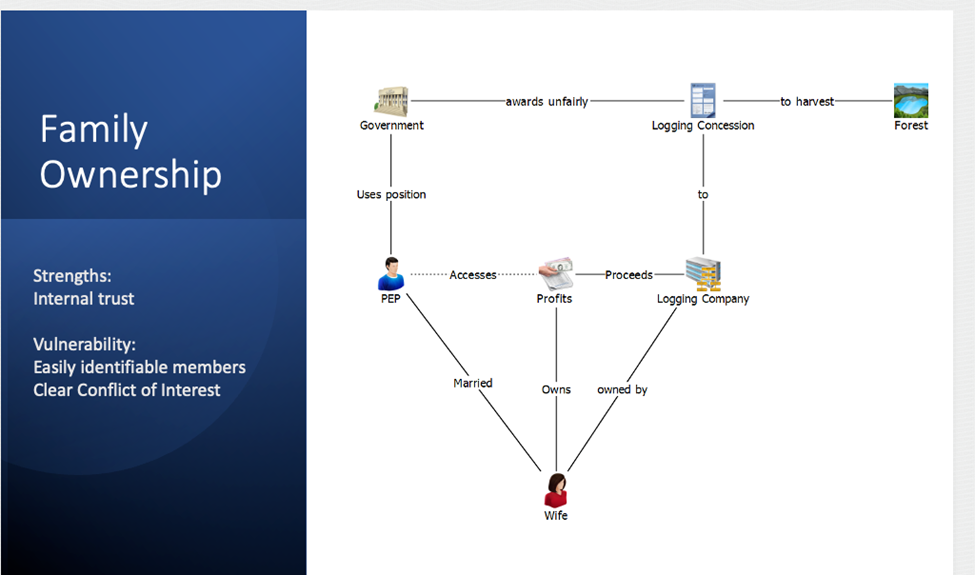
That fount of all wisdom (the internet) attributes the saying that a picture is worth a 1,000 words to Napoleon (here). The self-crowned emperor was many things, but a harried anticorruption investigator or prosecutor trying to explain the links between a criminal’s wrongdoing and a corporation to a judge of less than genius caliber or a jury after the lunch break he was not. Had he ever been in such a situation, he would have realized he vastly understated a picture’s value.

The diagrams below show why. Created by Targeting Natural Resource Corruption, they explain to those responsible for enforcing laws against poaching, illegal logging, and other crimes against the earth’s resources how a corporation obscures the relationship between these crimes and those behind them. For those like me, with no visual imagination or skill whatsoever, they are a godsend. Because they are easily reproducible and not copyrighted. Thanks to Targeting Natural Resources for making them readily available.

Continue reading

Brazil’s Presidential Election: No Matter the Outcome, Corruption Wins (and Everyone Loses)

On October 2, the first round of Brazil’s presidential election failed to produce a single winner, and the two front-runners—Jair Bolsonaro, the far-right incumbent, and Luiz Inácio Lula da Silva (“Lula”), the former president and leader of the Workers Party (PT)—will face each other in the second round on October 30.

For many, particularly those in the anticorruption community, the fact that Brazil’s next president will be either Lula or Bolsonaro is a source of despair and deep concern. One only needs to take a cursory look at the corruption scandals that have mired both candidates to understand why:

Continue reading

Will the OECD Whitewash Italy’s Flagrant Violations of the OECD Antibribery Convention?

Italy’s compliance with the OECD Antibribery Convention will reportedly be reviewed this week by the OECD’s Working Group on Bribery in International Business Transactions.  The Convention’s review mechanism has been called “the gold standard” for evaluating compliance with an international agreement (here). Whether it deserves that billing will depend on what the Working Group says about Italy’s compliance.

As with all compliance reviews, the Working Group has before it a report prepared by experts from two other Convention parties documenting whether Italy has lived up to its promise to investigate foreign bribery by its nationals. From the public record alone, on which the experts were well informed (here, here, here, here, and here), it is impossible to believe their report is anything but strongly critical.

Continue reading

Accountability Time for Sri Lanka’s Rajapakse Clan?

In a groundbreaking order issued October 7, Sri Lanka’s Supreme Court ordered five members of the Rajapakse family and accomplices to answer for driving the once prosperous nation into bankruptcy.  

While Gotabaya was president and three brothers and a nephew ministers, the government took on ever greater levels of foreign debt while recklessly cutting taxes and pursuing unsustainable monetary policies. The result: the economy is expected shrink by 8.7 percent this year, inflation recently exceeded 60 percent, and an additional 2.7 million Sri Lankans will likely fall into abject poverty (here and here).

As economic conditions deteriorated in late spring, the four Rajapkse ministers resigned, and Gotabaya later fled the country as protesters stormed the presidential residence (here). But though out of office, the Rajapakses are not out of power. They still control parliament, and it picked a Rajapkse crony to serve the remainder of Gotabaya’s term as president.

With parliament unlikely to hold the Rajapkses accountable for economic mismanagement and the corruption that underlay it, civil society turned to the one institution in the country that remained largely untouched during the Rajapakse’s misrule: the judiciary.  Last June Transparency International Sri Lanka and three prominent Sri Lankans asked the nation’s highest court to hear their claim that the result of the Rajapakses’ economic mismanagement their constitutional rights to equal treatment, freedom to pursue gainful work, and access to government information had been denied. The petition further asks that:

  • the Central Bank, Finance Ministry, and other agencies be required to produce documents chronicling the mismanagement,
  • a committee be empaneled to examine the documents and compile a report, and
  • the Attorney General be directed to investigate and prosecute any wrongdoing disclosed.

For those fortunate enough to live in functioning democracies, this action would be extraordinary.  A request that a court assume the powers of a legislature and hold those in charge of the government accountable for their actions.

But given the power the Rajapakses accumulated during their long period in office, it appears to be the only path to accountability.  And to the restoration of the democratic freedoms Sri Lanka’s constitution promises all citizens.  Citizen activists, believers in the rule of law, and democrats everywhere will be hoping Sri Lanka’s judiciary can meet this unprecedented challenge.

Prompting Procurement Law Reform: The World Bank’s Benchmarking Public Procurement Series

No government activity is as vulnerable to corruption as public procurement. The procedures governments employ when deciding what to buy, how much of it to buy, and from whom to buy it provide countless opportunities for greedy officials and their private sector accomplices to profit at citizens’ expense. No serious effort to curb corruption can therefore avoid a careful scrub of a nation’s procurement law.

The best scrubbing tools are found in the World Bank’s series Benchmarking Public Procurement.  As the name proclaims, each report in the series provides standards against which the quality of a nation’s or even a province or local government’s procurement law can be gauged. Begun with a 2015 pilot examining public-private partnership contracts in a handful of countries, the most recent volume, published in 2020, assays the rules for letting PPPs in 140 jurisdictions and the rules in 40 for the award of infrastructure contracts from public funds (a 2017 report covers publicly-funded procurement contracts in 180).

Procurement is a devilishly complex area of policy. Untutored anticorruption advocates looking for corruption-reducing reforms can quickly find themselves stymied by the maze of rules governing procurement decisions and the status quo-bias of procurement staff and government suppliers. Benchmarking offers a way around these obstacles. A way to open a discussion about procurement policy and where laws or practices need changing between anticorruption reformers and the procurement community.

The 2020 edition examines how countries fare against standard practice on 160 plus areas. Not everyone will agree that all 160 plus benchmarks are best practice, and many will wish for explicit anticorruption benchmarks like those described here were included. But the critical step is to begin a dialogue on reforming a nation’s procurement law, and the Bank’s Benchmarking series is the best vehicle yet for sparking one. I hope a new updated and expanded edition is in the cards.

Accountability Key Words

No other word is associated more with fighting corruption than “accountability.”  Google turns up 43 million references to the phrase “accountability corruption references” in less than a second (!). There are 177 articles with the word accountability in the title in the latest version of Matthew’s bibliography.

Thanks to Andreas Schedler, we know accountability is not unidirectional. It can go from down to up, as when voters hold politicians to account, and side-to-side, as when a government audit agency reports on the performance of another government entity. As Dale Brinkerhoff explains, the meaning of accountability ranges from nothing more than having to provide information, as when an agency must fille an annual report on its activities, to a politician or administrator having to explain why something is being done or not done, to the imposition of sanctions on someone or some agency for doing or not doing something.

The failure to curb corruption is almost always attributed to a lack of accountability, and prescriptions for reducing corruption inevitably recommend strengthening accountability. But as Schedler, Brinkerhoff, and many others have shown, “accountability” is really a complex of ideas. And that is before trying to parse what ideas lie behind its rough equivalents in other languages: rendición de cuentas in Spanish; bibinka in Filipino; and tanggung gugat sosial in Bahasa. To name but a few

Thanks to American University’s Accountability Research Center, we now have a guide to the many concepts buried in the English term “accountability” and similar ones in Arabic, Chinese, Hindi, and a half a dozen other major tongues. Its title is Accountability Keywords; it’s a web site with a monograph of the same name and some 40 posts to date that expound on how the term is used in different ways in different circumstances in different places. An invaluable resource for advocates, policymakers, and scholars.