November 2 OSCE Webinar: Asset Recovery and the Concept of Social Reuse

The OSCE Polish Chairpersonship and the Office of the Coordinator of the OSCE Economic and Environmental Activities are holding a series of three webinars on the contribution of the OSCE in preventing corruption and promoting transparency and good governance as part of resilient economic recovery.

The first webinar is entitled:  Innovations in Asset Recovery in the OSCE: The Concept of Social Reuse was held today November 2, 2022, 3:00 to 4:15 pm CET via Zoom webinar.

Opening remarks 

Ms. Courtney Austrian, Deputy Chief of Mission, United States Mission to the OSCE 

Ambassador Igli Hasani, Co-ordinator of OSCE Economic and Environmental Activities 

Ambassador Alena Kupchyna, OSCE Co-ordinator of Activities to Address Transnational Threats 

Speakers: 

Mr. Tristram Hicks, OSCE Asset Recovery Advisor 

Mr. Andrea D’Angelo, Senior Project Manager, Balkan Asset Management Interagency Network (BAMIN) Secretariat  

Ms. Melika Sahinovic, OSCE Expert on Social Re-Use in BiH 

Moderator: Prof. Anita Ramasastry, Special Representative of the OSCE Chairmanship on Combating Corruption 

Asset recovery is a powerful anti-corruption tool ensuring that stolen assets and proceeds of criminal activities are given back to societies and victims of crime.  It remains one of the most effective ways to disrupt serious and organized crime as organized crime groups survive and thrive through illicit financial gains. 

Since 2019, OSCE has been implementing a cross-dimensional project that aims at building the capacities of national authorities and civil society organizations (CSOs) in Southeast Europe and improving regional collaboration in the seizing, confiscating, managing and re-using of criminal assets. Phase II of the project that has just been launched has also been extended to Eastern Europe (Moldova and Ukraine). The project adopts a comprehensive approach to asset recovery and includes three areas of intervention: i) financial investigations, asset seizure and confiscation; ii) asset management; and iii) asset re-use. 

Details for connecting —

Continue reading
Twentieth International Anticorruption Conference December 6-10 in Washington, D.C.

One mark of the progress in putting the fight against corruption on the global agenda is the size and scope of this year’s International Anticorruption Conference. The first one drew less that 200 people, mostly law enforcement personnel from the United States and 12 other nations (here). Organizers expect this year’s — December 6 through 12 in Washington — to attract more than 2,000 representatives of government, civil society, and the private sector from 135+ nations with many more attending virtually.

Jointly organized by Transparency International and the the U.S. government, speakers include: Delia Ferreiro, Chair of the Transparency International Board of Directors; David Malpass, President of the World Bank; Adesina Akinwumi, President of the African Development Bank; Ghada Waly, Executive Director of the United Nations Office on Drugs and Crime; Samantha Power, Administrator for the United States Agency for International Development; the heads of the Open Government Partnership, the Financial Action Task Force, CIVICS, and the chief executives of several multinational corporations.

The theme of this year’s conference is “Uprooting Corruption, Defending Democratic Values.” Plenary sessions will address the “grand issues:” global security, defending the defenders, kleptocracy and illicit finance.  There will be over 60 workshops, and multiple special thematic events and social gatherings.

More on who is coming, workshop and thematic events, and how to register is here.

OECD Denounces Italy’s Failure to Enforce the Antibribery Convention

GAB readers know that Italy has repeatedly failed to meet its obligations under the OECD Antibribery Convention (herehere, and here). That in recent high-profile cases where evidence Italian companies bribed officials of foreign governments was overwhelming, the companies, their executives, and accomplices were all acquitted.  And that civil society organizations in Italy, Nigeria, and the United Kingdom have urged the OECD in no uncertain terms to condemn the Italian government’s blatant violation of its obligation to levy “effective, proportionate, and dissuasive criminal penalties” on those who bribe foreign public officials (here).  

Last Friday, the OECD did exactly that. In a comprehensive, well-reasoned report, a model for future compliance reviews, its Working Group on Bribery in International Business Transactions fingered both the legislature and the judiciary for Italy’s noncompliance. The legislature because the sanctions for foreign bribery are too low to deter anyone or any company from paying a bribe, the judiciary for interpreting the rules of evidence in ways that almost invariably end in acquitting defendants.

Indeed, it is hard to read the Working Group’s analysis of the decisions in recent cases without concluding as I have that underneath the strained reasoning in the recent acquittals is some mix of bribery, favoritism, or threats.

Continue reading

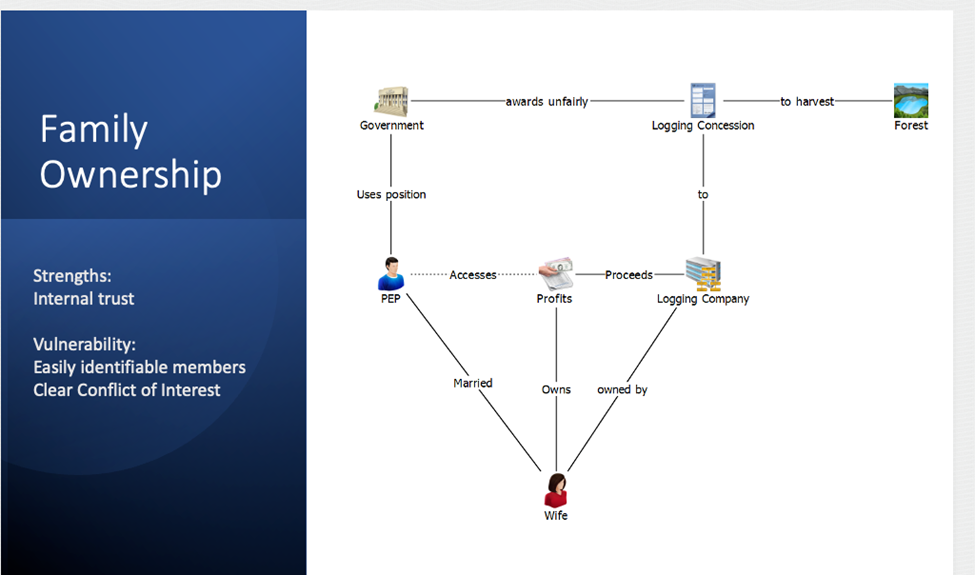
Pictures are Worth More than a Thousand Words: Especially in Financial Crime Cases

That fount of all wisdom (the internet) attributes the saying that a picture is worth a 1,000 words to Napoleon (here). The self-crowned emperor was many things, but a harried anticorruption investigator or prosecutor trying to explain the links between a criminal’s wrongdoing and a corporation to a judge of less than genius caliber or a jury after the lunch break he was not. Had he ever been in such a situation, he would have realized he vastly understated a picture’s value.

The diagrams below show why. Created by Targeting Natural Resource Corruption, they explain to those responsible for enforcing laws against poaching, illegal logging, and other crimes against the earth’s resources how a corporation obscures the relationship between these crimes and those behind them. For those like me, with no visual imagination or skill whatsoever, they are a godsend. Because they are easily reproducible and not copyrighted. Thanks to Targeting Natural Resources for making them readily available.

Continue reading

Will the OECD Whitewash Italy’s Flagrant Violations of the OECD Antibribery Convention?

Italy’s compliance with the OECD Antibribery Convention will reportedly be reviewed this week by the OECD’s Working Group on Bribery in International Business Transactions.  The Convention’s review mechanism has been called “the gold standard” for evaluating compliance with an international agreement (here). Whether it deserves that billing will depend on what the Working Group says about Italy’s compliance.

As with all compliance reviews, the Working Group has before it a report prepared by experts from two other Convention parties documenting whether Italy has lived up to its promise to investigate foreign bribery by its nationals. From the public record alone, on which the experts were well informed (here, here, here, here, and here), it is impossible to believe their report is anything but strongly critical.

Continue reading

Accountability Time for Sri Lanka’s Rajapakse Clan?

In a groundbreaking order issued October 7, Sri Lanka’s Supreme Court ordered five members of the Rajapakse family and accomplices to answer for driving the once prosperous nation into bankruptcy.  

While Gotabaya was president and three brothers and a nephew ministers, the government took on ever greater levels of foreign debt while recklessly cutting taxes and pursuing unsustainable monetary policies. The result: the economy is expected shrink by 8.7 percent this year, inflation recently exceeded 60 percent, and an additional 2.7 million Sri Lankans will likely fall into abject poverty (here and here).

As economic conditions deteriorated in late spring, the four Rajapkse ministers resigned, and Gotabaya later fled the country as protesters stormed the presidential residence (here). But though out of office, the Rajapakses are not out of power. They still control parliament, and it picked a Rajapkse crony to serve the remainder of Gotabaya’s term as president.

With parliament unlikely to hold the Rajapkses accountable for economic mismanagement and the corruption that underlay it, civil society turned to the one institution in the country that remained largely untouched during the Rajapakse’s misrule: the judiciary.  Last June Transparency International Sri Lanka and three prominent Sri Lankans asked the nation’s highest court to hear their claim that the result of the Rajapakses’ economic mismanagement their constitutional rights to equal treatment, freedom to pursue gainful work, and access to government information had been denied. The petition further asks that:

  • the Central Bank, Finance Ministry, and other agencies be required to produce documents chronicling the mismanagement,
  • a committee be empaneled to examine the documents and compile a report, and
  • the Attorney General be directed to investigate and prosecute any wrongdoing disclosed.

For those fortunate enough to live in functioning democracies, this action would be extraordinary.  A request that a court assume the powers of a legislature and hold those in charge of the government accountable for their actions.

But given the power the Rajapakses accumulated during their long period in office, it appears to be the only path to accountability.  And to the restoration of the democratic freedoms Sri Lanka’s constitution promises all citizens.  Citizen activists, believers in the rule of law, and democrats everywhere will be hoping Sri Lanka’s judiciary can meet this unprecedented challenge.

Prompting Procurement Law Reform: The World Bank’s Benchmarking Public Procurement Series

No government activity is as vulnerable to corruption as public procurement. The procedures governments employ when deciding what to buy, how much of it to buy, and from whom to buy it provide countless opportunities for greedy officials and their private sector accomplices to profit at citizens’ expense. No serious effort to curb corruption can therefore avoid a careful scrub of a nation’s procurement law.

The best scrubbing tools are found in the World Bank’s series Benchmarking Public Procurement.  As the name proclaims, each report in the series provides standards against which the quality of a nation’s or even a province or local government’s procurement law can be gauged. Begun with a 2015 pilot examining public-private partnership contracts in a handful of countries, the most recent volume, published in 2020, assays the rules for letting PPPs in 140 jurisdictions and the rules in 40 for the award of infrastructure contracts from public funds (a 2017 report covers publicly-funded procurement contracts in 180).

Procurement is a devilishly complex area of policy. Untutored anticorruption advocates looking for corruption-reducing reforms can quickly find themselves stymied by the maze of rules governing procurement decisions and the status quo-bias of procurement staff and government suppliers. Benchmarking offers a way around these obstacles. A way to open a discussion about procurement policy and where laws or practices need changing between anticorruption reformers and the procurement community.

The 2020 edition examines how countries fare against standard practice on 160 plus areas. Not everyone will agree that all 160 plus benchmarks are best practice, and many will wish for explicit anticorruption benchmarks like those described here were included. But the critical step is to begin a dialogue on reforming a nation’s procurement law, and the Bank’s Benchmarking series is the best vehicle yet for sparking one. I hope a new updated and expanded edition is in the cards.

Guest Post: Is UNCAC Article 35 a “Dead Letter” in the United States?

Today’s Guest Post is by Craig R. Arndt, an international lawyer living in Bangkok. In the course of a long career, he advised multinational clients on a range of corruption-related matters and has represented those injured by corruption in actions to recover damages.

The drafters of the United Nations Convention Against Corruption recognized that corruption was a transnational disease. And that accordingly, no country could fight it on its own. Hence, in its very first article the Convention makes it clear that states ratifying it are obliged to “promote, facilitate, and support international cooperation and technical assistance in the prevention of and fight against corruption.”  

Article 35 of the Convention sets forth one of the ways states are required to work together to curb cooperation. It provides that each party must “ensure that entities or persons who have suffered damage as a result of an act of corruption have the right to initiate legal proceedings against those responsible . . . to obtain compensation.”

Rick has documented the sorry state of civil recoveries by bribery victims in transnational cases (here, here, here, here, here, here, here and here). That state is now even sorrier thanks to two recent decisions by American federal courts of appeal. In the words of one commentator, the two “gut” article 35.

Continue reading

Accountability Key Words

No other word is associated more with fighting corruption than “accountability.”  Google turns up 43 million references to the phrase “accountability corruption references” in less than a second (!). There are 177 articles with the word accountability in the title in the latest version of Matthew’s bibliography.

Thanks to Andreas Schedler, we know accountability is not unidirectional. It can go from down to up, as when voters hold politicians to account, and side-to-side, as when a government audit agency reports on the performance of another government entity. As Dale Brinkerhoff explains, the meaning of accountability ranges from nothing more than having to provide information, as when an agency must fille an annual report on its activities, to a politician or administrator having to explain why something is being done or not done, to the imposition of sanctions on someone or some agency for doing or not doing something.

The failure to curb corruption is almost always attributed to a lack of accountability, and prescriptions for reducing corruption inevitably recommend strengthening accountability. But as Schedler, Brinkerhoff, and many others have shown, “accountability” is really a complex of ideas. And that is before trying to parse what ideas lie behind its rough equivalents in other languages: rendición de cuentas in Spanish; bibinka in Filipino; and tanggung gugat sosial in Bahasa. To name but a few

Thanks to American University’s Accountability Research Center, we now have a guide to the many concepts buried in the English term “accountability” and similar ones in Arabic, Chinese, Hindi, and a half a dozen other major tongues. Its title is Accountability Keywords; it’s a web site with a monograph of the same name and some 40 posts to date that expound on how the term is used in different ways in different circumstances in different places. An invaluable resource for advocates, policymakers, and scholars.    

South African NGO to U.S. Department of Justice: Please Investigate Bain and Company for FCPA Violations

In a Guest Post Monday, Nicole Fritz of South Africa’s Helen Suzman Foundation recounted Boston consulting guru Bain and Company’s role in the massive corruption that infected her country during the reign of its now deposed president Jacob Zuma. Today, she asks the Department of Justice to investigate the Company for “potential breaches of the U.S. Foreign Corrupt Practices Act of 1977.”

As she explains in a letter sent to the head of the FCPA unit, the evidence of violations is “not mere opinion.” Rather, it is drawn

from reports produced by two separate judicial commissions of inquiry, chaired by eminent South African judges: first, the Judicial Commission of Inquiry into State Capture Report (“State Capture Report”); second, the final report of the Commission of Inquiry into Tax Administration and Governance at the South African Revenue Services, colloquially referred to in South Africa as the ‘Nugent Commission Report.’  

The full text of her letter is here.