The UK’s Promised War on Kleptocracy: Reinforcements Needed

Putin’s invasion of Ukraine has created a new-found resolve among the world’s financial centers. They are now committed to seizing the money Putin and oligarchic cronies have stolen from the Russian people and hidden in their territories. Given the enormous media attention on where it is stashed (examples here, here, and here), that may sound straightforward.

It is not.  Even bad guys have rights, and as Radha Ivory reminds, that includes the right to their property. To confiscate the assets Putin and cronies have squirrelled away outside Russia will require proof that (a) no matter what ownership records show, the assets really do belong to one of them and (b) the assets were acquired with the proceeds of corruption or other criminal activity.

London has been one of the premier destinations of dirty Russian money. James Mather, a barrister of the U. K’s Serle Court, explains below what the British government must do to fulfill its pledge to confiscate every shilling of stolen Russian money hidden in its territory.

The gloves have come off in the United Kingdom’s effort to cleanse itself of ‘dirty money’, or so we are told.  To signal its commitment, the UK government has sped up new legislation, but its contents seem unlikely to advance matters very far.  There is amendment of the legislation for Unexplained Wealth Orders (totemic but misunderstood powers that are of quite limited practical use) and new requirements to register the beneficial ownership of property (as always easily evaded by clever structuring or simple lies).  What has really been lacking all these past years is harder to legislate for: the adequate enforcement of the asset recovery laws that exist. 

Continue reading

Guest Post: Did Putin Invade Ukraine to Expand State Corruption?

Today’s guest post is from Matthew Murray, currently Adjunct Professor at Columbia University, who previously served as U.S. Deputy Assistant Secretary of Commerce for Europe, the Middle East, and Africa.

When President Putin began Russia’s expanded military invasion of Ukraine on February 24, the imprisoned Russian anticorruption activist and political opposition leader Alexey Navalny was on trial once again over fabricated charges of embezzlement. Though Mr. Navalny faces another 15 years in a penal colony, he seized the opportunity during his February 24 hearing to publicly state his opposition to Russia’s war on Ukraine. “This war between Russia and Ukraine was unleashed to cover up the theft from Russian citizens and divert their attention from problems that exist inside the country,” he said.

Mr. Navalny’s statement reflects a deep understanding of the causes of war. Throughout history rulers have started wars to divert and distract attention of their citizens from growing domestic problems and restiveness. And this pattern fits the Russian situation well. In recent years, Putin’s popularity has declined due to failure to modernize Russia’s economy, his flawed management of the Covid-19 pandemic, and—not least—the corruption of his regime and his inner circle. Indeed, last February, when Russian courts initially sentenced Navalny to over two years in prison, tens of thousands of Russian citizens from 109 cities across the country went to the streets to demonstrate against Putin’s rule. In ordering the invasion of Ukraine, Putin may well have been seeking to divert attention from failures at home, including his autocratic control of the political economy for the benefit of himself and the Russian oligarchy.

But it’s more than that: Putin’s aggression may also be aimed at legitimizing his rule at home by installing a new state-sponsored oligarchy in Ukraine. He may be seeking to kill the idea, which took hold in Ukraine during the 2014 Revolution of Dignity at the Maidan. The Maidan Revolution started when Ukrainians took to the streets of the Maidan in central Kyiv to protest then-President Victor Yanukovych’s sudden decision to reverse the nation’s course to join the European Union and engage in free trade with the world’s largest economic bloc. But the Maidan Revolution was not just about one decision or one administration. The Maidan uprising was a revolution against the system of corrupt rule of Yanukovych and the oligarch class that was choking the nation’s potential—and it was also about the idea: the idea that every individual should have the freedom, the right, and the path to fulfill their human potential. This idea fundamentally threatens Putin’s personal authority and autocratic rule. As Ukraine’s reformers have begun to take concrete steps to embed this idea in independent institutions, they set an example for Russian citizens, who may be inspired by Ukraine’s example to demand that their government suppress official corruption and respect for human rights. Continue reading

New Podcast Episode, Featuring Oksana Huss and Joseph Pozsgai-Alvarez

A new episode of KickBack: The Global Anticorruption Podcast is now available. During the ongoing emergency in Ukraine, as Russia’s unprovoked military aggression throws the region and the world into crisis, my colleagues at the Interdisciplinary Corruption Research Network (ICRN) and I are going to try as best as we can to feature on our podcast experts who can shed greater light on how issues related to corruption relate to the war, the larger political context, and the international response. In this episode, I had the opportunity to speak to two ICRN members: Oksana Huss, a research fellow at the University of Bologna, and Joseph Pozsgai-Alvarez, Associate Professor at Osaka University. Our conversation begins with Oksana explaining Ukraine’s transformation since the Maidan Revolution in 2014, particularly democratic and anticorruption reforms under President Zelensky’s administration, and the cultural, political, and economic threat that developments in Ukraine posed to Russian elites and the Putin regime. Joseph then discusses Russia’s use of so-called “strategic corruption” to extend Russian influence in the West. Then, after recognizing the heroism of the Ukrainian army in slowing the Russian advance, our conversation turns to the impact of sanctions on Russia and Russia’s political and economic elites, and the extent to which cracking down on the dirty money may help counter Russian aggression. You can also find both this episode and an archive of prior episodes at the following locations: KickBack is a collaborative effort between GAB and the Interdisciplinary Corruption Research Network (ICRN). If you like it, please subscribe/follow, and tell all your friends! And if you have suggestions for voices you’d like to hear on the podcast, just send me a message and let me know.

Transparency International Ukraine’s Call on International Companies to Stop Working in Russia

Transparency International’s Ukraine Chapter (on whose Board I serve) recently posted the following message on its social media accounts, which I am reposting here:

📢 We call for international companies to stop working in Russia and stop financing the war in Ukraine.
Economic sanctioning of Russia is already imposed by governments of the EU, US, Canada and other countries. However, fighting Putin’s aggression is not only the matter of national governments. International businesses have to make their contribution.
☝️ Every tax penny that international companies pay to the Russian budget costs Ukrainians lives. This money is being spent for weaponizing the Russian army, which attacks both Ukrainian military and civilians.
😢 Over four days 352 civilians were killed, over 1600 wounded. Russians hit apartment buildings, daycare facilities, buses with civilians and ambulances. Hundreds of thousands of people are forced out of their homes to stay alive.
Supporting the russian regime is unacceptable for companies that value human lives.
Facing financial risks connected with dismissal of the Russian market is nothing in comparison with reputational losses.
🙌 You can also tell businesses that you are against their work in Russia!
🔹 We prepared a list of well-known companies so you could address them publicly https://bit.ly/sbir_companies
We will update it
🔹 And with regard to some of the companies, we have explicitly explained how doing business in Russia affects the civilian population https://bit.ly/sbir_photos
🔹 Select the company that you would like to appeal to and tag it in posts on Twitter, Instagram and Facebook. For example,
@CompanyX, your taxes in #russia goes for the shelling of civilians in Ukraine. It’s time to stop doing business there, isn’t it?
Templates of the text for such posts you can find here: https://bit.ly/sbir_texts
The more people we are, the louder our voice is! Join us💪

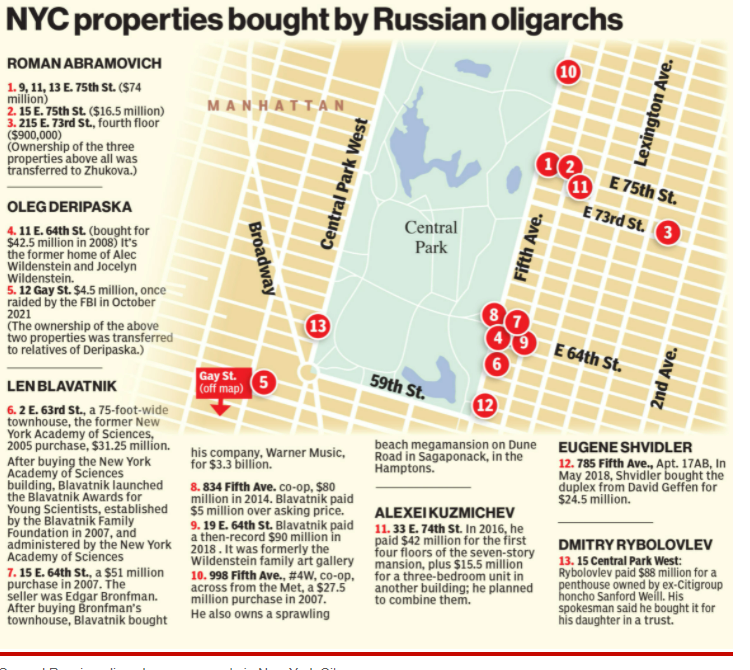
New York Real Estate Owned by Putin’s Buddies

Source: Jennifer Gould, Here’s where Russian oligarchs and their families own property in NYC, New York Post, February 27, https://nypost.com/2022/02/27/heres-where-russian-oligarchs-and-their-families-own-property-in-nyc/

Several media reports suggest sanctioning Putin’s supporters won’t be that easy because their ownership is hidden under layers of corporate vehicles. As Jennifer Gould’s story in the New York Post shows, thanks to the work of many investigative reporters and NGOs. we do know where many of Putin’s buddies have stashed their wealth in the Big Apple. Click here for a similar guide to London properties TI-UK has drawn up.

A Brief Note on Russia’s War Against Ukraine

Russia’s invasion of Ukraine (or, more accurately, the dramatic escalation and expansion of the invasion that Russia already started eight years ago) is horrifying. As I type this, Russian forces are moving against Kyiv, and Ukrainian defense forces and reservists are preparing to defend their capital city against overwhelming odds, while the Ukrainian army elsewhere in the country is doing its best to resist Russian advances from all directions. I have nothing useful to say about this terrible situation. I am not a military analyst, an expert in geopolitics, or even terribly knowledgeable about aspects of this crisis closer to my own areas of expertise (such as questions regarding the efficacy of sanctions the West is imposing, or could impose). I’m just a professor, not terribly well known outside my fairly narrow areas of academic specialization, who runs a blog about anticorruption. But this morning, I can’t really think of anything else to write about.

Maybe at some point I’ll be able to collect and organize my thoughts and say something coherent about how this war relates to the global fight against corruption. There most certainly is a connection–probably several connections–even though corruption/anticorruption is only one part of the story. For now, let me just share scattered thoughts and reactions: Continue reading

Fighting Corruption Isn’t Rocket Science

Space, the final frontier, sure is expensive to explore. Every launch, every mission, can cost billions of dollars in research, materials, and overhead. And partly because of this, government space agencies may be especially susceptible to corruption. After all, these agencies are responsible for enormous projects with thousands of moving parts (literally and figuratively), but are monitored principally by committees that lack the scientific knowhow to conduct effective oversight. Embezzlement, overspending, bribery, and other crimes are easy to miss. Not only is corruption easily buried by bureaucratic or technical minutiae, it’s also extremely costly, as mistakes can result in the loss of valuable equipment or even human life. Even when corruption causes things to go wrong, the fact that space missions are inherently risky and complex may make it difficult to recognize when a malfunction is due to malfeasance.

Roscosmos, the Russian state corporation responsible for space flights, serves as a cautionary tale. For years, Roscosmos funds have been embezzled though contracting bids— officials were bribed to make fake deals and artificially inflate costs, allowing hundreds of millions of dollars to evaporate and a few Soyuz rockets to accidentally explode. (In 2014 alone, corruption and other malfeasance caused Roscosmos to lose roughly US$1.8 billion.) After Russian anticorruption activist Alexei Navalny called out the “astronomic” levels of corruption and mismanagement at the Vostochny space center (one of President Putin’s pet projects), multiple criminal investigations resulted in the conviction and sentencing of fifty-eight officials for fraud and abuse of office.

Though the record of the U.S. National Aeronautics and Space Administration (NASA) is not nearly as egregious, neither is it pristine. Suspicions regarding bribes by private contractors to NASA officials have existed for decades. For instance, back in the mid-1990s, a controversial FBI sting operation implicated dozens of contractors that allegedly paid bribes to NASA employees in hopes of determining which commercial experiments would be selected for the International Space Station. Representative John Conyers, who chaired the Committee on Government Operations in the House of Representatives at the time, pinned the blame on “NASA’s dismal record of contract mismanagement and faulty financial controls.” And the problems haven’t gone away: just last year, NASA’s associate administrator for human spaceflight Doug Loverro resigned amid allegations for improper contacts with Boeing regarding the contracts for NASA’s moon lander program. NASA’s Office of the Inspector General (OIG) has raised numerous concerns about NASA’s procurement system, and NASA attributed the Taurus XL launch failures, worth $700 million, to faulty materials provided by a contractor that falsified thousands of certifications for their aluminum products.

Though NASA has since taken some measures to curb against the potential for this sort of corruption (such as the installation of a Chief Financial Officer and the Acquisition Integrity Program), the risks are still significant, especially as NASA ponders a return to crewed missions by way of billion dollar contracts. These risks are further exacerbated by the agency’s even greater reliance on private sector contractors to compensate for the decline in the agency’s budget. There are therefore several additional steps that NASA can and should take to further safeguard integrity in the procurement process.

Continue reading

Corruption Should Be a Laughing Matter

Corruption is a serious matter—it sucks away public finances, undermines good governance, ends livelihoods, and consumes lives. It’s therefore understandable that many anticorruption activists center much of their work on getting people to take corruption seriously. But despite the underlying gravity of the problem, sometimes a surprisingly effective way to fight against corruption is to make people laugh about it.

Consider Alexei Navalny, the Russian activist whose attempted assassination, arrest, and imprisonment underscore just how much Moscow has recognized his power. One of the striking things about the explosive videos that Navalny has released to expose the Putin regime’s corruption is that the videos aren’t just shocking—they’re funny. People enjoy watching them because of their biting humor—and while they’re laughing, they also learn about Putin’s siphoning of public funds for his own benefit.

There are plenty of other examples of anticorruption activists effectively using humor as part of their campaigns. To mention just a few:

  • Last summer, Lebanese activists staged a fake—and deliberately comical—“funeral” for the Lebanese currency (the lira), as a protest against the cronyism and mismanagement that “killed” the Lebanese lira and tanked the country’s economy. A video of the “funeral” gathered over 10,600 views on Twitter and brought renewed international attention to an anticorruption protest movement that at that point was approaching its seventh month without much success.
  • A Chinese artist known as Badiucao has used satirical art to bring attention to the ruling party’s political corruption, including a famous “promotional poster” for the TV series House of Cards, with Xi Jinping sitting on the throne instead of series villain Frank Underwood. His art helped spark renewed criticism of the regime and is credited with inspiring political cartoons throughout Hong Kong’s democratic uprising against China’s controversial 2019 extradition bill.
  • In Ukraine, Volodymyr Zelensky was elevated from comedian to President of Ukraine by campaigning on an anticorruption platform. Comedy was a key part of his 2018 campaign—instead of traditional rallies, he held performances by comedy troupes skewering the corruption of the incumbent regime.
  • Back in 2004, the then-mayor of Bogota Antanas Mockus pushed back against the city’s petty corruption through antics like inducting 150 “honest” taxi drivers into a fictional club called the “Knights of the Zebra.”

These and other examples illustrate an important lesson for anticorruption activists: Notwithstanding the seriousness of corruption and the harm that it causes, humor can be a powerful tool in spreading an anticorruption message. As a rhetorical device, humor has a few distinctive strengths:

Continue reading

Guest Post. Corruption Victims: Law and Practice in Italy, Russia, other European States

Earlier this month, I asked readers for help on a UNODC project examining the compensation of corruption victims.  UNCAC article 35 requires states parties to ensure those injured by “an act of corruption” can initiate “legal proceedings. . . to obtain compensation.” In 2017, the UN Office on Drugs and Crime reported that virtually all 187 convention parties say their laws permit those injured by corruption to bring an action to recover damages. Yet few cases appear to have been brought.  The project seeks answers to three questions: Are there really few cases? If so, why? And what can be done to increase the number?

My thanks to the several readers who replied.  Thanks especially to Mjriana Visentin. An Italian lawyer with a Master’s Degree from the International Anticorruption Academy, Mjriana has been working on human rights and anticorruption for several years, most recently in Russia. She was kind enough to respond to my query with a thoughtful analysis reflecting both her experience representing victims of human rights abuses and corruption in Russia – categories which often overlap in practice – and current law on recovery of damages for corruption in Italy, other European states, and the European Court of Human Rights.  A valuable contribution to the global discussion on corruption victim compensation, it is below.  

Probably it would be useful to differentiate between types of corruption before discussing if victims did (or could) claim compensation.  If we are talking for example of extortion by a public official, I think that an analysis of the national case law will likely show a large number of individuals who were granted victim status and sought compensation.  [Editor’s note: a point I had not appreciated. I have subsequently learned that upon a conviction for extortion in Sri Lanka, defendants reportedly are required to return the bribe to the victim.  Example cases solicited from there or other jurisdictions.

As for other types of corruption, the situation may be more blurred.

Reviewing the laws of a number of European state members, I have seen that corruption still tends to be framed either as a victimless crime or crime against the state. This affects the view that potential victims have of themselves.

Continue reading

The Trump Administration and Corruption: A Preliminary Retrospective

As of yesterday at 12 noon, U.S. East Coast Time, Donald Trump is no longer the President of the United States of America.

First, let’s all breathe a collective sigh of relief.

OK, now we can start thinking about what we’ve learned from this traumatic experience. There is no shortage of political and cultural commentary on the Trump era and its implications, and I have little of substance to add to that general discussion. But, given that this is a blog specifically focused on corruption, let me offer a few reflections on the implications of the last four years for corruption and anticorruption in the United States.

At the risk of self-indulgence, I’ll frame this preliminary discussion in terms of my own guesses, as of four years ago, about how the Trump Administration would affect U.S. corruption and anticorruption policy. Immediately after Trump’s election, I wrote a despondent post about why I thought that Trump’s election would be a disaster for the fight against corruption on many different dimensions. Roughly a year later, I did a follow-up post assessing my own predictions, concluding that on some issues my pessimistic forecasts proved inaccurate (for reasons I did my best to assess), while on other dimensions the Trump administration was as bad or worse than I had feared. Now that Trump is finally out of office, it’s a good time for another retrospective assessment—both to understand where things stand now with respect to U.S. policy and leadership on anticorruption issues, and also to see what lessons we might be able to draw from the experience of the past four years. Continue reading