Guest Post: The Forgotten History of Anti-Money Laundering Law: Where Did It Go Wrong?

Anton Moiseienko, Senior Lecturer and Research Director at the Australian National University Law School, introduces GAB readers to his new book on AML with the following observation —

The contemporary anti-money laundering (AML) regime effectively prevents criminal infiltration of the economy and delivers value for money. Said no one, ever.

Critiques of AML efforts abound among practitioners, policymakers and scholars alike. This near-universal lack of confidence in today’s financial crime rules is the starting point of my new book Doing Business with Criminals: Between Exclusion and Surveillance, which explores the objectives, unintended consequences, and history of the global AML regime.

The sheer degree of discontent with the existing framework begs the question of what went wrong. There has been no shortage of literature seeking to provide an explanation or proffer a solution. Seminal works include Peter Alldridge’s What Went Wrong with Money Laundering Law?(2016) and Nicholas Gilmour and Tristram Hicks’s The War on Dirty Money (2023). A valuable recent contribution is the article ‘How Well Does the Money Laundering Control System Work?’ by Mirko Nazzari and Peter Reuter, published in Crime and Justice and reviewed by Rick Messick on this blog.

These books and articles make varied and useful contributions, as do many other studies. Still, several further avenues need to be pursued to advance the debate on how to address the problem. They include revisiting the history of AML to understand why today’s widely criticised regime has evolved in the way it has – and, crucially, how that history has defined its current objectives.

Continue reading

Are Money Laundering Laws of Any Value?

Not really.  That’s the answer Mirko Nazzari and Peter Reuter provide at the conclusion to their comprehensive review of the evidence on the impact of the global AML scheme.

Nazzari, a postdoctoral research fellow in Political Science at the Università degli Studi di Sassari, and Reuter, a Distinguished University Professor in the School of Public Policy and Department of Criminology, University of Maryland, find no evidence antimoney laundering laws have deterred the laundering of the proceeds of crime. For one reason, the U.S. and other wealthy countries, which pushed the poorer nations of the world to follow them in enacting complex, expensive AML controls, have failed to implement critical elements of the control system themselves (inclusion of lawyers and real estate professionals in the U.S. for example). Another reason: banks, especially large, multinational ones, have failed to comply (flouted?) the laws and national regulators done little to see they do.

The one redeeming factor is the help AML regimes provide law enforcement agencies when making cases against those whose crimes generate huge sums of money. The authors summarize findings from the U.S. that show that the suspicious transaction reports banks, casinos, and other institutions must file frequently support investigations of drug traffickers, human smugglers and other criminals who launder large sums, providing additional details of their activities or corroborating evidence.

The 86-page article (here) appears in the journal Crime and Justice but unfortunately behind a paywall. It is likely to be made public shortly given the importance of the article to so many around the globe. In the meantime, the abstract and a few notable highlights are below.

Continue reading

Why The FATF-Based Anti-Money Laundering System Fails to Catch the Proceeds of Corruption

Today’s Guest Post is by Robert Barrington, Professor of Anti-Corruption Practice at the Centre for the Study of Corruption, University of Sussex (UK) and formerly the Chair of Transparency International’s International Council.

In recent years, anticorruption campaigners and policymakers have directed increased effort towards improving the global Anti-Money Laundering (AML) system.

Imagine this system were operating perfectly. Would it stop kleptocracy?

Of course not, no more than AML systems stop heroin production. AML laws and regulation are not designed to stop the acts that generate dirty funds; they are designed to stop the proceeds of crime from being disguised (laundered) and thus freely circulating around the world.

The more difficult question involves monies kleptocrats steal: if the global AML system were operating perfectly, would it stop these funds – the proceeds of corruption – from circulating around the world?

Two recent reports in the UK — from the Taskforce on Business Ethics and the Legal Profession and Spotlight on Corruption — answer the question with a resounding NO: when the proceeds of corruption derive from kleptocracy, when crooks have captured the state, the UK’s AML system is not capable of addressing these funds.  To be clear, even if the current global AML system were operating perfectly, the UK would be unable to deal with the proceeds of corruption arising from state capture.

To date the research is confined to the UK context and UK law; it has yet to extend to other jurisdictions. But given what is known about the globalised nature of illicit financial flows, we might conclude that other jurisdictions are no better at this than the UK.

Continue reading

Why Is There No Zurichgrad? Protectionism in Swiss Real Estate

Anonymous investments in foreign real estate markets have become a popular way to launder money and evade taxes. Opaque offshore structures now control a substantial share of high-end real estate in many major cities across the world. While the international sharing of financial data has made it harder to hide assets in offshore accounts, overseas property remains an easy target for illicit actors due to a lack of equivalent cross-border reporting. The city that has come to symbolize this problem is London—sometimes derisively referred to as “Londongrad” due to the extent to which Russian oligarchs own many of the city’s luxury homes.

Many might be surprised to learn that Switzerland, despite its longstanding reputation as a haven for illicit financial funds, has no major problem with money laundering in real estate. This is all the more surprising given that the Swiss property market would seem to be an exceptionally attractive target for dirty money in a number of ways. Swiss law affords extensive anonymity to individuals behind the corporate veil and does not require any licensing in the real estate sector. Furthermore, unlike many other countries, Switzerland still does not subject real estate agents, lawyers, or notaries – the key actors in property acquisition – to its anti-money laundering laws, as long as the property transaction in question does not involve a payment of more than the equivalent of about $110,000 in cash. At the same time, real estate prices in Switzerland are high and have risen dramatically in recent decades, especially in the cities and tourist areas. Illicit actors, who already roam financial centers such as Zurich, should thus have an easy time parking their assets in Swiss real estate. So why is there no “Zurichgrad”? Continue reading

Pictures are Worth More than a Thousand Words: Especially in Financial Crime Cases

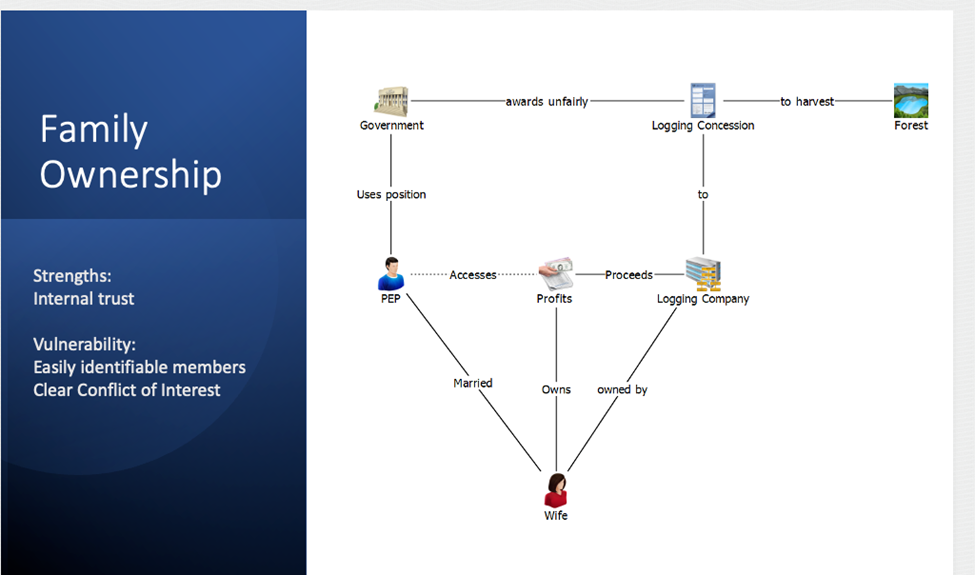
That fount of all wisdom (the internet) attributes the saying that a picture is worth a 1,000 words to Napoleon (here). The self-crowned emperor was many things, but a harried anticorruption investigator or prosecutor trying to explain the links between a criminal’s wrongdoing and a corporation to a judge of less than genius caliber or a jury after the lunch break he was not. Had he ever been in such a situation, he would have realized he vastly understated a picture’s value.

The diagrams below show why. Created by Targeting Natural Resource Corruption, they explain to those responsible for enforcing laws against poaching, illegal logging, and other crimes against the earth’s resources how a corporation obscures the relationship between these crimes and those behind them. For those like me, with no visual imagination or skill whatsoever, they are a godsend. Because they are easily reproducible and not copyrighted. Thanks to Targeting Natural Resources for making them readily available.

Continue reading

Cleaning up Corruption in Lebanon’s Central Bank

Riad Salameh, the governor of Lebanon’s Central Bank (the Banque du Liban, or BdL), was once hailed as a “financial wizard” for his stewardship of the Lebanese banking system. But a flurry of recent investigations, led mainly by French and Swiss prosecutors, have implicated Salameh in a variety of corruption schemes. These investigations found, among other things, that Salameh illicitly moved over $300 million of public funds from the BdL into his brother’s company, Forry Associates, between 2002 and 2015 and that Salameh laundered millions in Europe through luxury real-estate purchases. And in March 2022, after Swiss prosecutors asked Lebanese authorities to carry out a separate investigation into embezzlement and money laundering by Salameh and his associates, a Lebanese district court judge charged Salameh and his brother with illegal enrichment and money laundering.

Though Salameh denies all allegations, many Lebanese citizens consider the accusations against him unsurprising. Indeed, if anything is surprising about the case against Salameh, it’s that he is being prosecuted in Lebanese courts. Government elites in Lebanon—including the BdL’s leaders—have long benefited from a culture of impunity. It is encouraging to see Lebanese prosecutors and courts taking steps to hold corrupt actors at the BdL accountable. But cleaning up the BdL, and ensuring that in the future cases like Salameh’s are detected early or prevented altogether, will also require more structural reforms to address the institutional and regulatory problems at the BdL that have enabled such corrupt practices. Three reforms to the BdL are especially important:

Continue reading

The U.K. Must Legislate to Combat Money Laundering in Its Universities

Parents from developing countries have long sought to provide their children with a world-class university education in wealthy Western countries, such as the US and the UK. There is nothing inherently wrong with this—indeed, universities ought to take pride in their ability to provide an elite education to talented young people from around the world. There is, however, a dark side. In 2021, media reports revealed that nearly fifty UK universities had accepted upwards of £52 million in direct cash payments for tuition and fees from students hailing from countries known to be “high risk” for money laundering—most notably the West African countries of Ghana and Nigeria. A Carnegie Endowment Report on this topic observed that although “[t]he overwhelming majority of West African students in the United Kingdom pose little or no corruption risk, … many West African [politically exposed persons (PEPs)] appear to be using unexplained wealth to pay for UK school and university fees.” Indeed, many of West Africa’s nouveau riche made their money through illicit channels, and they may view an elite UK education for their children as a way to launder their reputations as well as their wealth. As Matthew Page, the author of the Carnegie Report, explained, any university that accepts tuition and fee payments in cash—especially from PEPs in countries with high corruption risk—is essentially “putting out a welcome mat for the world’s kleptocrats and money launderers.”

Although most UK universities acknowledge that they have basic anti-money laundering (AML) responsibilities under Sections 327 and 329 of the 2002 Proceeds of Crime Act, universities are not clearly covered as “regulated entities” under the UK’s Money Laundering Regulations. And while some universities have responded to recent high-profile scandals and government warnings by adding basic AML provisions to their fee-collection and admissions policies, this is not the sort of problem that is likely to be solved through unilateral action on the part of universities. The incentives to turn a blind eye to the provenance of tuition and fees from international students—which many UK universities have come to rely on as a revenue stream—are simply too strong. (It’s worth noting here that international students typically pay more than three times the fees paid by students from the UK or the European Union, and many UK universities encourage advance cash payments by offering international students discounts of 20-30% if they can pay their fees in advance.) Solving this problem will therefore require the UK to amend its AML legislation to address the particular vulnerabilities in the university sector. Three such reforms would be particularly prudent: Continue reading

For Goodness Sakes, Buy this Man a Cup of Coffee!

If you don’t know whom this post’s headline is talking about, you don’t know who Ray Todd is.  And if you don’t know who Ray Todd is, you don’t know about the eponymously named raytodd.blog.  And if you don’t know about the blog, you don’t know about what I think is the single best aggregator of news and information on corruption, money laundering, economic sanctions, and related topics. 

From a blurb flagging FATF’s recent evaluation of Albania’s money laundering regime to a note on GAB contributor Frederick Davis’ important new Columbia Journal of Transnational Law article “Judicial Review of Deferred Prosecution Agreements: A Comparative Study,” to a link to an English language summary of the just released 2021 annual report of the French Anticorruption Agency, you are missing out. On a lot. Ray’s blog is indispensable source of news for those in the anticorruption community.

All he asks in return is that readers occasionally make a small contribution.  Enough to buy him a coffee. Given the blog’s value added, he deserves much more.  But hey readers, how about starting by financing his morning java?    

New Podcast Episode, Featuring Frederik Obermaier

A new episode of KickBack: The Global Anticorruption Podcast is now available. In this week’s episode, we are pleased to welcome back to the podcast the Pulitzer Prize-winning investigative journalist Frederik Obermaier of the German publication Süddeutsche Zeitung, who is also affiliated with the International Consortium of Investigative Journalists. We’ve been fortunate enough to have Mr. Obermaier on the podcast twice before, first in 2019 to discuss the Panama Papers, and then in 2020 to discuss the FinCEN Files. In this week’s episode, my ICRN colleague Christopher Starke talks with Mr. Obermaier about the work he and has collaborators have done on a set of stories based on another major leak, the so-called Suisse Secrets documents–files on thousands of customers of the Swiss Bank Credit Suisse, leaked by an anonymous source, which revealed that many Credit Suisse companies were extremely suspicious figures, including numerous corrupt politicians, as well as other organized crime figures and human rights abusers. The conversation highlights the systemic problems that continue to persist in the Swiss banking system, and more broadly. You can also find both this episode and an archive of prior episodes at the following locations: KickBack is a collaborative effort between GAB and the Interdisciplinary Corruption Research Network (ICRN). If you like it, please subscribe/follow, and tell all your friends! And if you have suggestions for voices you’d like to hear on the podcast, just send me a message and let me know.  

Guest Post: Do Governments Have a Clue About the Money Laundering Risks They Face? UPDATE

UPDATE: the World Bank hosts a discussion on the report that is the subject of this post May 30, 12:00 noon EDT. Link to register here.

Today’s guest post summarizes an April World Bank study of money laundering risk assessments. The first step in preventing money laundering is identifying where it occurs and how likely it is to occur. In short, the risks of money laundering. The Bank study evaluated risk assessments eight governments had conducted in accordance with the methodology prescribed by the Financial Action Task Force. For reasons that will become plain, the post’s author has chosen to remain anonymous.

The title from a new World Bank report on money laundering risks could scarcely be blander: National Assessments of Money Laundering Risks: Learning from Eight Advanced Countries’ NRAs.  The content is anything but. Authored by Joras Ferwerda of Utrecht University and Peter Reuter of the University of Maryland, the report concludes that not a one of the eight money laundering risk assessments examined, all done as the report’s title advertises by “advanced” countries, is worth a damn. Not a one merits a passing grade from the two professors, both highly regarded money laundering experts. What’s worse, despite close to a decade of experience doing such assessments, the two find that no government seems to have learned a thing from the mistakes of others.

This raises a fundamental question about the existing AML regime. How can it be effective if national authorities lack an understanding of the money laundering risks their countries face?

Continue reading