Combating Money Laundering in Africa: John Hatchard’s Latest Guide for African Corruption Fighters

The war on corruption is being fought on many fronts. One where victory is especially critical is the battle to prevent leaders of poor countries from robbing their citizens blind, and nowhere will a victory be more welcome or more hard-fought than in Africa.   Seventy percent of the world’s poor live on the continent while, thanks first to colonialism and then to Cold War machinations, Africans are saddled with governments ill-equipped to keep greedy leaders in check.  Courts, legislatures, and other accountability institutions are weak; the media and civil society hobbled by repressive, non-democratic measures.

Not that in recent years there have not been promising developments. South Africa’s once powerful leader Jacob Zuma was forced to resign the presidency over corruption allegations for which he is now on trial.  Former Guinea Minister of Mines Mahmoud Thiam forfeited $8.5 million and was sentenced to seven years in prison for corruptly granting virtually the whole of his nation’s mineral sector to a Chinese conglomerate.  The son of former Mozambique President Armando Guebuza is one of over a dozen members of the country’s ruling circle facing trial for his role in the “hidden debt” scandal.

What will be required to continue this progress is the theme of John Hatchard’s latest book,  Combating Money Laundering in Africa: Dealing with the Problem of PEPs. Like his earlier ones on African anticorruption laws and institutions (here, here, and here), it’s a must have for African corruption fighters.

Continue reading

New Podcast Episode, Featuring Jack Goldsmith

A new episode of KickBack: The Global Anticorruption Podcast is now available. In this week’s episode, I interview my Harvard Law School colleague Jack Goldsmith about what the Trump Administration has taught us about the strengths and weaknesses of the U.S. system for constraining corruption, conflicts of interest, and other forms of wrongdoing by the President and senior members of the executive branch, as well as what kinds of institutional reforms and policy changes would help prevent such wrongdoing going forward. The conversation centers on Professor Goldsmith’s new book, After Trump: Reconstructing the Presidency, co-authored with Bob Bauer. Jack and I discuss the importance of norms in constraining wrongdoing and maintaining the independence of law enforcement bodies, various approaches to addressing financial conflict-of-interest risks in the context of the U.S. president, the challenges (but also the necessity) of relying on political checks, and the debates over whether to prosecute a former president, such as President Trump, for crimes allegedly committed while in office. You can find this episode here. You can also find both this episode and an archive of prior episodes at the following locations: KickBack is a collaborative effort between GAB and the ICRN. If you like it, please subscribe/follow, and tell all your friends! And if you have suggestions for voices you’d like to hear on the podcast, just send me a message and let me know.

When Anticorruption Begets Corruption: A History Lesson from the Roman Republic

Most readers of this blog are likely to support rigorous anticorruption laws. But a modicum of caution is necessary: If poorly designed, even anticorruption laws adopted with the best of intentions can be weaponized by bad-faith actors. This is not only a modern problem. Indeed, a troubling illustration of how overly ambitious anticorruption laws can spectacularly betray their core purposes can be found some two thousand years ago, in the dying days of the Roman Republic.

The Roman Republic had a comprehensive and complex legal code, with multiple statutes (lex) prohibiting the general crime of ambitus. It is frustratingly unclear what precisely constituted ambitus, but at its core, ambitus (which shares the same linguistic root as modern-day “ambition”) covered electoral bribery and other forms of electoral fraud and corruption. That said, the line between legal electioneering and illegal ambitus was often blurry, and ambitus was sometimes used as a general pejorative accusation for when a candidate’s ambition “went too far.” (In that sense, Roman debates over the definition of ambitus may parallel modern debates over the definition of “corruption.”)

A handful of ambitus laws were passed during the Middle Republic. For example, an ambitus law from 358 BC prohibited political candidates from canvassing on market days, and a 314 BC law created a commission to investigate election rigging. Yet such laws were relatively rare, and ambitus does not seem to have been a prominent concern during this period. During the Late Republic, however, the problem of rampant electoral bribery prompted the Senate to enact a flurry of new ambitus legislation. Many of these laws were direct responses to specific incidents of ambitus, and exhibited a pattern of increasingly harsh punishments and prosecution-friendly procedural changes. Despite addressing a very real problem, these reforms to the ambitus laws of the Late Republic ended up being not only ineffective, but actively exacerbated the decline of the Republic.

Continue reading

Will Donald Trump Put Vanuatu on the Map?

Few Americans could find the Pacific island nation of Vanuatu on a map. Fewer still know anything of its constitutional jurisprudence. Donald Trump could change all that if he exercises the right he claims to have to pardon himself (here). Vanuatu is the only country whose courts have ruled on the validity of a presidential self-pardon, and the merits of their ruling would surely be fodder for editorials, op-eds, and cable television’s blabbers  learned commentators.

Vanuatu’s courts had the unprecedented case thrust upon them thanks to the action of Marcellino Pipite. Speaker of the Vanuatu legislature, in accordance with the country’s constitution he served as acting president whenever the sitting president was abroad. During one period of service a long running trial where he and 13 other parliamentarians were on trial for bribery ended in a guilty verdict against all fourteen.  Pipite then promptly exercised the president’s constitutional pardon power, excusing himself and the other defendants from any criminal wrongdoing. 

The validity of a Trump self-pardon would surely come before the Supreme Court, and it has long looked to decisions of foreign courts when deciding its cases (here). Indeed, one of the most influential justices of the 20th century, whose acolytes include the current Chief Justice, was a firm believer in looking to decisions of foreign courts for guidance when deciding constitutional issues. Nor did then Chief Justice Rehnquist limit what foreign court decisions should be examined. 

“Now that constitutional law is solidly grounded in so many countries, it is time that the United States courts begin looking to the decisions of other constitutional courts to aid in their own deliberative process” (here).

Continue reading

The OECD Rightly Rejects Claims that U.S. FCPA Enforcement Is Improperly Politicized

Earlier this month, the OECD Working Group on Bribery released its Phase 4 Report on U.S. compliance with the OECD Anti-Bribery Convention. For those readers unfamiliar with the process, this report is part of the peer monitoring system that the OECD Convention establishes for promoting adherence to the Convention. (The Convention lacks “hard” sanctions, though in extreme cases it’s possible a country could be expelled. Rather, the Convention relies on “soft” peer pressure, facilitated through the extensive and detailed investigations and reports carried out by the Working Group.) The lengthy and detailed report, produced under the leadership of experts from the UK and Argentina, assesses U.S. performance on a range of issues related to the prevention and prosecution of foreign bribery. For purposes of this post, I want to zero in on one narrow but important issue, which gets just over a couple of pages in the report: whether U.S. enforcement of the Foreign Corrupt Practices Act (FCPA) is improperly influenced by national political or economic interests.

This question is important, both legally and politically. As a legal matter, Article 5 of the OECD Convention explicitly states that decisions regarding the investigation and prosecution of foreign bribery offenses “shall not be influenced by considerations of national economic interest, the potential effect upon relations with another State or the identity of the natural or legal persons involved.” The OECD has in the past raised concerns about Article 5 violations by other member states, including the United Kingdom, and, more recently, Turkey and Canada. More broadly, as a political matter critics have alleged that the U.S. government’s enforcement of the FCPA is biased against foreign companies, and have sometimes gone so far as to accuse the U.S. of deliberately designing FCPA enforcement actions so as to secure economic advantages for U.S. companies at the expense of foreign rivals. A particularly sensationalistic version of the claim appeared in a book written by a French executive who was convicted and jailed on FCPA charges; that book became a best-seller in China, where the view that U.S. prosecutorial decisions are made to advance national economic interests is widespread. But the notion has been around for a while. (To give one personal example, last year I had a conversation with a journalist from a leading Brazilian news organization who asked for my views on the claim, which he’d apparently heard from several Brazilian sources, that the U.S. FCPA prosecution against Odebrecht was motivated by a desire to eliminate or cripple a company that competed with U.S. firms.) The U.S. government may have further contributed to this narrative in a 2018 press release on the Department of Justice’s “China Initiative”; that press release listed, as one component of the initiative, the “identif[ication of FCPA] cases involving Chinese companies that compete with American businesses.”

While it may be that the U.S. officials charged with enforcing the FCPA have their own biases and blind spots, the strong claim that the FCPA was some kind of a neo-mercantalist/neo-protectionist tool always struck me as far-fetched. (And this is true notwithstanding the FCPA passage in the China Initiative press release, which seemed more like something that got thrown in without much thought or vetting, rather than a substantive change in policy.) And it seems that the OECD Bribery Working Group’s review team came to the same conclusion. As the report states, “the lead examiners … have found no basis to consider that any FCPA decisions have been made for improper reasons.” Continue reading

It’s Time for the United States to Mandate Enhanced Scrutiny of Domestic Politically Exposed Persons

In February, former Baltimore mayor Catherine Pugh became the latest in the long line of Maryland politicians sentenced to prison for corruption-related crimes. According to the Department of Justice, Pugh sold copies of a self-published children’s book series to a variety of local organizations that already had or were attempting to win contracts with the city and state governments. Over eight years, Pugh and her longtime aide failed to deliver, re-sold, and double-counted the orders, squirrelling away nearly $800,000 into bank accounts belonging to two shell corporations registered to Pugh’s home address. Pugh, who did not maintain a personal bank account, used the funds to purchase and renovate a private home as well as fund her re-election campaign, among other activities.

These facts are classic red flags in the anti-money laundering (AML) world. Pugh would have had more difficulty executing this corrupt scheme, and might have been brought to justice much earlier, if the banks handling her illicit revenues had conducted the sort of enhanced customer due diligence and monitoring that financial institutions are required to perform on so-called “politically exposed persons” (PEPs), as well as their immediate family and close associates. While there is no uniform definition, PEPs are typically understood to be someone who holds a powerful government position, one that provides greater opportunities for engaging in embezzlement, bribe-taking, and other illicit activity. (Defining a PEP’s “close associates” is more challenging, but the category is generally thought to include someone like Pugh’s aide, who has the requisite status and access to carry out transactions on behalf of the PEP.) But U.S. financial institutions were not required to subject Pugh or her aide to enhanced scrutiny, because under the U.S. AML framework, such scrutiny is only obligatory for foreign PEPs, not domestic PEPs.

For many years, that was the standard approach internationally. But a new consensus is emerging that financial institutions should subject all PEPs, both domestic and foreign, to enhanced scrutiny. This position has been embraced by the Financial Action Task Force (FATF), the international body which sets standards for combating corruption in the international financial system, by the Wolfsberg Group, an association of the world’s largest banks, and by the European Union’s Fourth AML Directive. But far from joining the growing tide of domestic PEP screening, the United States seems to be swimming against it. The United States is one of the few OECD countries that does not require domestic PEP screening, and this past August, the Financial Crimes Enforcement Network (FinCEN), the primary U.S. agency tasked with investigating financial crimes, reiterated that it “do[es] not interpret the term ‘politically exposed persons’ to include U.S. public officials[.]”

This is a mistake. It’s time that the United States joined the international consensus by formally requiring enhanced scrutiny of domestic PEPs as well as foreign PEPs. Continue reading

How Rampant Corruption Has Brought Peru to its Current Political Crisis

Earlier this week, Francisco Sagasti was sworn as the new president of Peru. He is the 87th president in the country’s 200-year history, the fourth president in the current five-year presidential term, and the third president in a week.

The unusual chain of events that led to Sagasti’s presidency comprise one of Peru’s biggest political crises in recent history. On Monday, November 9th, Congress voted to remove President Martín Vizcarra for “moral incapacity” and appointed the president of Congress, Manuel Merino, to serve as interim president. This move incensed the Peruvian public; Vizcarra had enjoyed a public approval rating of nearly 60% even after Peru suffered one of the worst Covid-19 outbreaks in the world. Peruvians took to the streets, protesting Vizcarra’s removal and demanding the resignation of Merino, who was the driving force behind the impeachment proceedings. Police violence against protestors left two dead, more than forty missing, and at least ninety injured. Merino resigned five days into his tenure, and Congress named Sagasti – one of the minority of Congressmen who voted against Vizcarra’s impeachment – as interim president until the April 2021 elections.

This crisis represents the culmination of several growing tensions in Peruvian political life, including an increasingly antagonistic relationship between the executive and legislative branches, a widespread rejection of the political establishment and embrace of populism, and the enormous toll of COVID-19. But no issue is more central to this story than that of endemic corruption. Indeed, the intractable problem of corruption in Peru has been largely responsible for the current political crisis.

Continue reading

Anticorruption Bibliography–November 2020 Update

An updated version of my anticorruption bibliography is available from my faculty webpage. A direct link to the pdf of the full bibliography is here, and a list of the new sources added in this update is here. As always, I welcome suggestions for other sources that are not yet included, including any papers GAB readers have written.

Three Measures to Put Corruption Enablers Out of Business

The most common way corrupt officials hide money is by stashing it in an “offshore vehicle.” The “vehicle” will be a corporation, trust, or other legal person. It is termed “offshore” because it will be organized under the laws of another country. Stolen funds and assets purchased with them can then be listed in the name of the offshore entity.

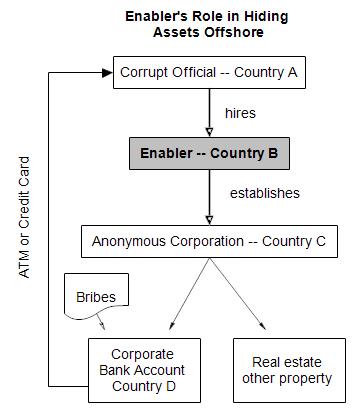
To create an offshore vehicle, the official will turn to someone with expertise in creating offshore entities and disguising their ownership: a lawyer, accountant or other professional who knows corporate and trust law and how to use it to hide the owner’s identity. The anticorruption community has dubbed these intermediaries “enablers,” for they enable corruption by providing corrupt officials with a way to enjoy the proceeds of their corruption.   A typical scheme is shown in the diagram below.

An official in country A wanting to hide assets first hires an enabler.  Although the enabler could be a professional in country A, hiring one located in another state makes it that much harder for local authorities to uncover wrongdoing. The enabler, shown in the diagram as located in country B (most often a wealthy country), then creates the offshore vehicle.  The enabler could have created the vehicle, in this case a corporation, in the enabler’s own country.

 But again, to make it harder for investigators to trace assets, the enabler will usually form the vehicle in still another country, here labelled C. As the diagram shows, to further frustrate efforts to track money flows the anonymous corporation (or shell or letter-box company — the terminology differs in different jurisdictions) will then open a bank account and buy real estate and perhaps art works or other personal or moveable property in still a fourth country.

Continue reading

New Podcast Episode, Featuring Daniel Freund

A new episode of KickBack: The Global Anticorruption Podcast is now available. In this week’s episode, my collaborators Nils Köbis and Jonathan Kleinpass interview Daniel Freund, a German representative in the European Parliament, where he serves on the Committee on Budgetary Control and co-chairs the Parliament’s Anti-Corruption Intergroup. Mr. Freund discusses the risks of corruption (or other forms of misappropriation) of EU funds and how to close these loopholes, as well as the use of conditionalities to promote the rule of law. Much of the interview focuses on the challenges posed by states like Hungary, where the Orban regime’s suppression of media freedom and judicial independence has created a situation in which Orban and his cronies are looting the state and enriching themselves to the tune of over one billion Euros per year, as well as entrenching their own power through a system of favoritism and crony capitalism. Mr. Freund discusses the challenges that the Hungarian situation poses for the EU, and the institutional mechanisms that the EU might use to respond this and similar situations.

You can find this episode here. You can also find both this episode and an archive of prior episodes at the following locations:

KickBack is a collaborative effort between GAB and the ICRN. If you like it, please subscribe/follow, and tell all your friends! And if you have suggestions for voices you’d like to hear on the podcast, just send me a message and let me know.