Guest Post: An Anticorruption Agenda for the Biden Administration

Today’s guest post is from Lucinda A. Low and Shruti Shah, respectively Acting Chair and President of the Coalition for Integrity, a U.S. based non-governmental organization focused on fighting corruption. The opinions expressed here are those of the authors, and should not be attributed to the organization..  

The United States has a long history, across administrations of both parties, of showing leadership internationally in the fight against corruption. The passage and enforcement of the Foreign Corrupt Practices Act (FCPA) has served as an example for other countries to adopt their own transnational anti-bribery laws. Additionally, the United States has championed international anti-bribery efforts in multilateral organizations and worked to build coalitions to root out all types of corruption. For the last several years, however, U.S. has faltered. In order to reestablish the U.S. as a global leader against corruption, and to get its own house in order, the Biden Administration and the new Congress should embrace an ambitious agenda that includes the following elements: Continue reading

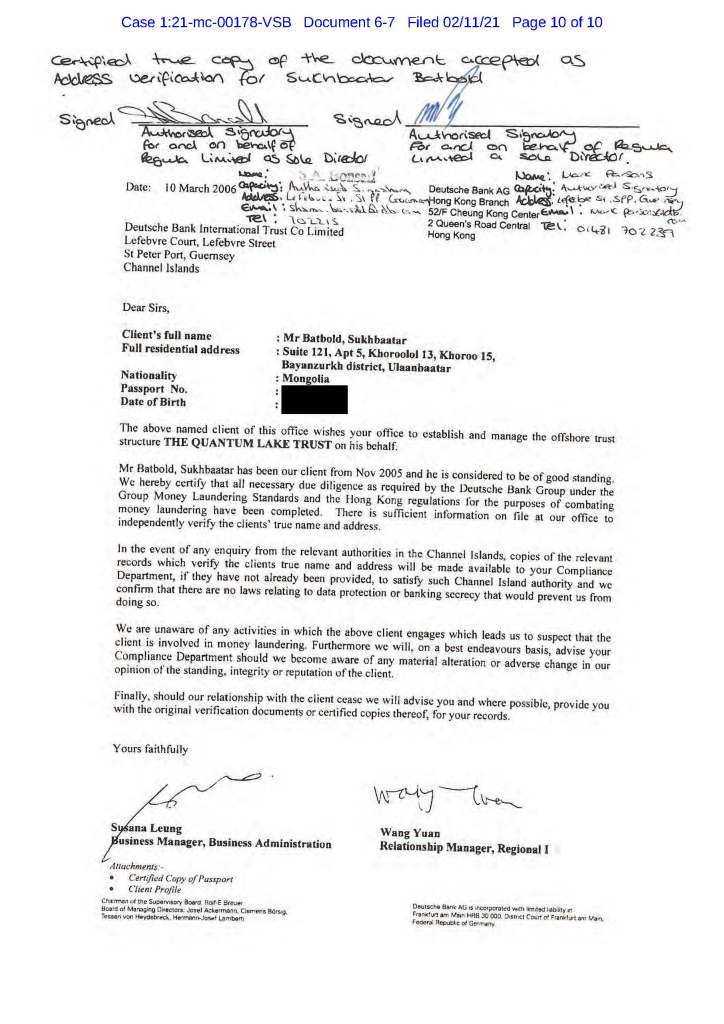
Kleptocracy in Mongolia: Deutsche Bank As Batbold’s Enabler

To the left is a document showing how Deutsche Bank helped Mongolian politician Sukhbaatar Batbold hide assets offshore (full-size copy here). Written by Deutsche Bank executives in Hong Kong, it asks the bank’s Guernsey Island office to “establish and manage the offshore trust structure The Quantum Lake Trust on [Batbold’s] behalf.” The authors assure their Guernsey colleagues that there no reason to be suspicious about the request:

“We are unaware of any activities in which the above client [Batbold] engages which leads us to suspect that the client is involved in money laundering.” In fact, on the day the letter was written Batbold was a Member of Parliament and between 2004 and 2006 was Cabinet Minister of Trade and Industry (here). In money laundering terms he was a “politically exposed person.” As a consequence, Deutsche Bank was required to scrutinize his past activities before creating the trust and to closely monitor all future transactions with the bank or the trust to ensure they were lawful. There is no evidence Deutsche Bank ever conducted what the money laundering law terms this “enhanced due diligence.”

Two weeks ago Batbold denied ever having “any open or hidden accounts, money, apartments or property in the offshore zone” (here), but as the letter and other documents made public last Friday show, he is at least prevaricating if not lying. He has or has had numerous accounts and properties offshore. Batbold’s representative ducked questions GAB has asked (here) about the trust and Batbold’s offshore properties, issuing a short, blanket denial reprinted below.

Continue reading

New Podcast, Featuring Gary Kalman

A new episode of KickBack: The Global Anticorruption Podcast is now available. In this week’s episode, we’re delighted to welcome back to the podcast Gary Kalman, the Director of Transparency International’s United States office. I was fortunate to be able to interview Gary a little over one year ago, just before he stepped into his new role as TI’s U.S. Director. In our more recent conversation, we had the opportunity to discuss how his first year in this position has gone, touching on some major successes–most notably the passage of the Corporate Transparency Act, which requires companies to provide the government with information on their true beneficial owners–as well as ongoing challenges. Gary discusses some of the advocacy strategies that proved effective on the corporate transparency issues, and suggests how similar strategies might be deployed to advance other aspects of the anticorruption agenda. He also lays out what he sees as the highest priorities for TI’s advocacy work in the United States, and what vulnerabilities have been exposed by the experience with the Trump Administration and how those might be addressed. You can also find both this episode and an archive of prior episodes at the following locations: KickBack is a collaborative effort between GAB and the ICRN. If you like it, please subscribe/follow, and tell all your friends! And if you have suggestions for voices you’d like to hear on the podcast, just send me a message and let me know.

The New FCPA Resource Guide Wisely Suggests a More Flexible Approach to Successor Liability

When a company subject to the jurisdiction of the U.S. Foreign Corrupt Practices Act (FCPA) merges with or acquires another company that is also covered by the FCPA, should the former company also acquire the latter’s potential FCPA liability? In other words: Suppose Company A acquires Company B, and evidence later comes to light that prior to the acquisition, Company B’s employees paid bribes to foreign government officials, in violation of the FCPA. Can or should Company A be subject to a post-acquisition enforcement action for these earlier FCPA violations? This is known (in the FCPA context and elsewhere) as the question of “successor liability.” In U.S. law, the general rule is that successors inherit the acquired company’s civil and criminal liabilities. The U.S. Department of Justice (DOJ) and Securities and Exchange Commission (SEC), which share responsibility for enforcing the FCPA, have long argued that there is no reason to make an exception to this general rule for FCPA cases. Yet critics have argued that successor liability in the FCPA context “can kill deals.” Numerous transactions have fallen through or decreased in value because of corruption-related concerns, and other transactions became costlier due to such risks.

The DOJ and the SEC’s traditional response to such concerns—as laid out in the first edition of their FCPA Resource Guide, published in 2012—is that companies should conduct pre-acquisition due diligence to identify red flags and potentially undertake various forms of remediation. Furthermore, the agencies have stated that they might decline to pursue enforcement actions against an acquiring firm on a successor liability theory if that firm’s pre-acquisition efforts were adequate. The problem, though, is that pre-acquisition due diligence on possible FCPA violations is often difficult or impossible to conduct properly. In some cases, laws in foreign countries known as blocking statutes may prevent the acquiring firm from getting the information it needs from the target company (see, for example, here and here). More generally, there are numerous practical reasons why pre-acquisition due diligence on possible FCPA violations may not be possible, including time-sensitivity, the difficulty of accessing data stored or located in distant places, and the target company’s reluctance to cooperate with external investigations that could result in the target’s personnel facing criminal exposure. These factors can make pre-acquisition due diligence impractical.

The DOJ and SEC appear to have acknowledged and responded to that concern in the second edition of the FCPA Resource Guide, published this past July. While the second edition’s treatment of successor liability seems mostly the same as in the first edition (save for some wording adjustments and references to more recent cases), the second edition also includes one short but potentially crucial additional paragraph, which reads as follows:

DOJ and SEC also recognize that, in certain instances, robust pre-acquisition due diligence may not be possible. In such instances, DOJ and SEC will look to the timeliness and thoroughness of the acquiring company’s post-acquisition due diligence and compliance integration efforts.

Although subtle, this passage represents a potentially important shift, as it indicates that the DOJ and SEC will consider not only pre-acquisition due diligence, but also post-acquisition measures, when deciding whether to pursue enforcement actions against a company on a successor liability theory.

Continue reading

How Ethno-Religious Divisions Stymie Anticorruption Reform in Malaysia–and What to Do About It

In 2018, Malaysia surmounted the biggest test of its democracy since gaining independence from Britain in 1963—the first democratic transfer of power in the country’s history. That change in leadership occurred in the wake of the 1MDB scandal—one of the largest kleptocracy schemes ever uncovered—which implicated former Prime Minister Najib Razak. The repudiation of Najib and his party, UNMO, in the 2018 election was seen by many as a hopeful sign that the Malaysian people were no longer willing to tolerate the systemic corruption that had long been seen as business as usual. To be sure, the leader of the victorious coalition in the 2018 election—nonagenarian Mahathir Mohamed, who had previously served as Prime Minister from 1983 to 2001—was an unlikely champion of anticorruption and good governance reform. Yet in 2018, Mahathir’s victory was cause for hope that there would finally be genuine systemic reform.

Within two years, that hope had all but vanished. Prime Minister Mahathir was forced to resign in the middle of his first term in office and was replaced by UMNO politician Muhyiddin Yassin, who had served as Deputy Prime Minister under Najib. What went wrong? In an earlier post, I explored how a free press and multi-party government may have contributed to the failure of Mahathir’s coalition. But that is not the whole story. Those democratic institutions were susceptible to manipulation because of the deeply embedded ethnic and religious divisions that have been a defining feature of Malaysian politics since independence. By exacerbating racial and religious tensions, UMNO managed to convince key voting blocs that the biggest threat they faced was not corrupt politicians, but rather their neighbors who look and pray differently. In short, the reformist coalition ultimately failed because the Malaysian populace lost sight of their common enemy: the corrupt system of governance robbing them all.

Continue reading

Guest Post: Obstacles in Establishing Whistleblower Regimes in Small Developing Countries—From The Bahamas to Kosovo

Today’s guest post is from Lemarque Campbell, a Policy and Legislative Development Specialist for the International Development Law Organization (IDLO), and Vlora Marmullakaj, a Senior Project Officer for the Project Against Economic Crime implemented by the Council of Europe. The views and analysis expressed in this post are those of the authors and are not attributable to the IDLO or the Council of Europe.

Encouraging whistleblowing is one of the most important tools for detecting and deterring wrongdoing in public sector organizations. Especially in small developing countries that lack strong institutions, insiders may be the best or only source of accurate and reliable information about malfeasance. Moreover, whistleblowers not only help expose corruption, but they also play a significant role in providing information that could lead to the recovery of assets derived from corrupt practices. And in this time of global pandemic, when opportunities for corruption abound and the normal oversight and accountability processes are weakened, whistleblowers are even more crucial—a fact emphasized by, among others, GRECO and Transparency International.

Unfortunately, many developing countries lack an adequate system for encouraging and protecting whistleblowers. Even those countries that have substantially overhauled their whistleblower laws continue to face significant problems of implementation. Considering the recent experience of the Bahamas and Kosovo—two very different small developing countries that have recently overhauled their whistleblower laws—helps illustrate some of the obstacles to achieving effective reforms. Continue reading

Why Won’t Sweden Punish Swedes for Bribing Foreign Government Officials? UPDATE

Last week a Swedish appellate court issued an opinion confirming the anticorruption community’s worst fear. The decision stems from a 2017 U.S. prosecution of Swedish telecommunications giant Telia for bribing the Uzbekistan president’s daughter. The evidence showed Telia’s then CEO and two other executives countenanced the bribery, and Swedish prosecutors promptly charged the three with bribing a foreign official. To the surprise and shock of both prosecutors and observers, all three were acquitted at a 2019 trial (here).  

It was widely assumed the Stockholm Court of Appeals, the nation’s oldest and most prestigious appeals court, would reverse the trial court’s decision.  Instead, in a February 4th opinion it affirmed it.

UPDATE. Chief prosecutor Kim Andrews termed the decision “offensive,” telling OCCRP in a statement that the decision means “Swedish companies can jump queues” by bribing, that Sweden “is failing to live up to its international obligations, . . . and that we leave it up to other European countries and the United States to clean up our mess.”

Former South African MP Andrew Feinstein once asked a senior Swedish official about foreign bribery. His reply:

“All bribes are illegal but if a Swedish company paid bribes in another country, I can’t say we would do anything about it.”  

The Telia acquittal is the latest sign that this attitude continues to prevail. That the anticorruption community’s worst fear about Sweden is true. That to protect the export earnings of Swedish multinationals and to shield the Swedish elites who run them, the government will condone the bribery of foreign public officials no matter how egregious.  Indeed, the first and still most appalling example of the lengths Sweden will go to derail a foreign bribery investigation was in a case that implicated its now prime minister.

Continue reading

New Paper: “A Proposal for a Global Database of Politically Exposed Persons”

My former student (and former GAB contributor) Ruta Mrazauskaite and I have a new paper, in the Stanford Journal of International Law, entitled “A Proposal for a Global Database of Politically Exposed Persons.” Here’s the abstract:

As part of the global effort to combat public corruption, anti-money laundering laws require financial institutions and other entities to conduct enhanced scrutiny on so-called “politically exposed persons” (PEPs)–mainly senior government officials, along with their family members and close associates. Unfortunately, the current system for identifying PEPs–which depends entirely on a combination of self-identification, in-house checks, and external private vendors that rely on searches of publicly available source material–is both inefficient and in some cases inaccurate. We therefore propose the creation of a global PEP database, organized and overseen by an inter-governmental body. This database would be populated with data compiled by national governments, drawing primarily on the data those governments already collect pursuant to existing.financial declaration systems for public officials. A global PEP database along the lines we propose has the potential to make PEP identification more accurate and more efficient, reducing overall compliance costs and allowing compliance resources to be used more productively.

I hope readers will find the paper and the proposal to be of interest, and we welcome comments, criticisms, and further ideas about how to address the problem that our proposal is meant to ameliorate.

In Mexico, Justice Will Remain a Family Matter

Judicial corruption in Mexico is a pervasive problem. And while high-level scandals tend to grab the headlines (see, for example, here, here, and here), much of the corruption is more pedestrian. While the causes of Mexico’s judicial corruption problem are various and complex, one persistent contributing factor is the endemic nepotism throughout the judiciary.

Of the more than 50 types of position in the judicial branch (including both judgeships and various administrative positions), only two—federal circuit and district court judgeships—use a competitive merit-based hiring process. For the rest, judges can choose whom they please, with little oversight. Moreover, once hired, these individuals have an insurmountable advantage in promotion in the judiciary, given that most job postings (and, informally, judgeships) require that the candidate have previous experience in the judicial branch. And even with respect to circuit and district judgeships, which are supposed to be filled through an open and merit-based competitive selection process run by a body called the Federal Judicial Council (CJF), in practice the CJF often creates “special” vacancies with different criteria (in effect, lower standards).

As a result of all this, nepotism in judicial hiring and promotion is pervasive, as judges are able to secure positions for friends and family. At least 51% of Mexico’s judges and magistrates are related to someone else working in the judiciary, with that number as high as 80% in some states. (To take one particularly egregious but not totally anomalous example, in one judge’s chambers, 17 employees were related to the judge.) This nepotism is not only corrupt in itself, but it also contributes to other forms of corruption. For one thing, corrupt judges can appoint those who will participate in, or at least be complicit in, corrupt practices—in some cases appointing individuals recommended by organized crime groups. But even when such deliberate wrongdoing is not the issue, untrained or unprofessional judicial bureaucrats and judges are more susceptible to corruption, and more likely to create the kinds of delays and inefficiencies in the system that both invite and obscure corrupt actions.

There hadn’t been much appetite in the Mexican Government to address the judicial nepotism problem until reform-minded President Andrés Manuel López Obrador and Chief Justice Arturo Zaldívar took office. Since February 2020, both men have been enthusiastically lobbying for a judicial reform package deemed the most ambitious since 1994. This bill, overwhelmingly passed by the Mexican Senate and Chamber of Deputies in recent months, is a behemoth, with a variety of significant structural changes to the judicial branch. Among these many reforms are several measures designed, at least in part, to address the problem of judicial nepotism: Continue reading

Guest Post: Corruption in Covid-19 Vaccine Distribution–Early Lessons from Brazil

Today’s guest post is from Guilherme France, a legislative assistant in the Brazilian Senate

The urgency of halting the Covid-19 pandemic, combined with the limited supply of vaccines, has increased the challenges of distributing the vaccine quickly but fairly. As others have pointed out, including on this blog, there are significant risks of corruption in the vaccine distribution process. Brazil provides a troubling illustration of this problem, with instances of corruption or other improprieties related to vaccine distribution having already sparked investigations into mayors and other local officials. For example, there have been complaints that in Manaus, a Covid-19 epicenter, relatives of a local businessman in were fraudulently appointed as employees in health clinics so that they would qualify for early vaccination. And this is but one of several cases where mayors and other local officials allegedly helped their relatives or close associates cut in the line. There have also been reported attempts to pay bribes to nurses for early vaccine access.

There has been similar line-cutting behavior on a grander scale, with various groups, such as prosecutors and judicial authorities, using their political influence and leverage to attempt (without success) to get priority status for receiving the vaccine, ahead of those, like health care workers and the elderly, who need it more urgently. On other occasions, the government acceded to the use of the “priority status” for vaccine distribution as a bargaining chip. In the midst of strike negotiations, it agreed to place truck drivers and other transportation workers ahead of the general population in the vaccination line.

This behavior, while reprehensible, is understandable. Given how hard Brazil has been hit by Covid-19, access to the vaccine is a life and death matter, and the temptation to cut the line, for oneself or a loved one, is just too great. This is why increased control and transparency for vaccine distribution should be a priority for governments at all levels. Continue reading