Has Russia’s Invasion Empowered President Zelensky in His Fight Against Corruption?

A national crisis can have a wide range of effects on a country’s commitment to fighting corruption. Sometimes, the sense of crisis leads countries (for better or worse) to de-prioritize corruption, out of a sense that other matters are higher priority, or even out of a sense that tolerance for a certain degree of corruption is a price worth paying to achieve other more pressing objectives. But in other situations, a sense of national crisis can strengthen a government’s resolve to crack down aggressively on corruption. There seem to be at least two closely related reasons why this may sometimes occur. First, corruption might be seen as directly and significantly impeding the country’s ability to tackle the emergency at hand. Second, a time of crisis can strengthen the position of the nation’s chief executive (the president or prime minister)—both in the formal legal sense (in that during times of crisis the chief executive may be able to wield extraordinary emergency powers) and in the softer more political sense (in that the chief executive may enjoy a surge in popularity if the country is under threat, and the public perceives the chief executive as providing strong leadership in the crisis). If that chief executive is genuinely committed to fighting corruption (a big if), then he or she may be able to leverage this unusual power to move aggressively against corruption, in a manner that would be politically difficult or impossible in “normal” times.

My impression, based on news stories and informal conversations with actual experts (which I am not!), is that the latter characterization is more apt for what is happening in Ukraine right now. It was not obvious that things would go this way initially—particularly given that, shortly after Russia’s full-scale invasion, the Ukrainian parliament suspended the asset declaration requirement for public officials, which though justified at the time as a way to keep potentially sensitive information from the Russians, was viewed with understandable concern. But a series of developments since then has demonstrated what looks to an outsider (at least to this outsider) like a consistent and quite aggressive effort to crack down on corruption, even at the risk of some (temporary) disruption to aspects of the war effort.

At least for me, one of the most notable and encouraging signs was the arrest, earlier this month, of Ihor Kolomoisky, one of Ukraine’s most powerful oligarchs, on fraud charges. Continue reading

Guest Post: The Judicial Annulment of the Odebrecht Settlement Evidence in Brazil, and Its Implications

Today’s guest post is from Professor Gregory Michener, Brazilian School of Public and Business Administration, Getulio Vargas Foundation (FGV-EBAPE) and Breno Cerqueira, a Brazilian public official. The post is based on an op-ed originally published (in Portuguese) in the Folha de São Paulo newspaper.

Earlier this month, a single Justice on Brazil’s Supreme Court invalidated, on dubious procedural grounds, the plea bargain that prosecutors had reached seven years ago with the Odebrecht firm, which resolved serious corruption charges that the prosecutors had brought against the firm. The alleged impropriety concerned how the Brazilian prosecutors had interacted with their counterparts in the United States and Switzerland, which had also brought cases against Odebrecht, which ultimately pled guilty and paid penalties in all three jurisdictions. According to Justice Toffoli (who, incidentally, had been implicated in Odebrecht’s wrongdoing when he was Solicitor General, though he succeeded in suppressing reports about his alleged wrongdoing), the Brazilian prosecutors from the Lava Jato (“Car Wash”) Task Force had engaged in discussions of the case with their U.S. and Swiss counterparts without those foreign prosecutors having first filed a formal official request for international legal cooperation, and without including representatives from the Brazilian Ministries of Justice and Foreign Affairs in the discussions. Strikingly, Justice Toffoli ruled that none of the evidence obtained from Odebrecht in the plea deal—and which was used in hundreds of other cases—could lawfully be used. Tofolli’s decision thereby threatens to undo the vast majority of the convictions that the Car Wash prosecutors had secured before the task force was disbanded.

This decision is troubling for a number of reasons. For one thing, the decision put the private interests of defendants ahead of the public interest of deterring and prosecuting corruption. No one denies that due process is important. However, preserving indisputable evidence of corruption can be achieved without a wholesale dismissal of charges. The nullification of the Odebrecht case is a nullification of justice and of the public interest.

Perhaps even more troubling, the decision is unsettlingly aligned with President Lula’s promise of revenge against the Car Wash Operation—and the individual judges, prosecutors, and others involved in that operation. Lula himself was jailed for 18 months after he was convicted for taking a bribe (in the form of a luxury apartment)— a conviction that was ultimately overturned on technical grounds (principally that the case was brought in the wrong venue). Lula, his supporters, and many mainstream media outlets have characterized the conviction as a baseless and politically motivated prosecution. That Justice Toffoli, a Lula appointee, issued this sweeping ruling—and also issued a broad and highly political statement condemning the entire Car Wash operation—would certainly seem consistent with the notion that the ruling had more to do with political and personal motivations than the law. Worse still, the ruling not only invalidates the Odebrecht plea deal and all other convictions that relied on the evidence it produced, but the ruling also calls for the investigation of the Car Wash prosecutors and judges for (alleged) misconduct.

Now, it is worth noting that Justice Toffoli’s ruling is unlikely to have any effect on Odebrecht’s plea agreement with the U.S. authorities. U.S. evidentiary standards tend to be more permissive, at least in this context, about barring the use of illegally sourced evidence – especially in cases where the public interest has clearly been aggrieved. And Odebrecht is unlikely to try to use the Brazilian ruling to wriggle out of is plea deal with the U.S., especially since that deal provides that non-compliance can result in further prosecution.

One more observation may be pertinent here: The Brazilian prosecutors may have hurt their cause by not providing sufficient transparency in an official register of the crimes, including their investigation, prosecution, and ultimate plea bargain. In the U.S., the Department of Justice website provides open and transparent information about all Foreign Corrupt Practices Act plea agreements. In the case of Odebrecht, company representatives signed affidavits testifying to US$788 million in bribes to government officials in 12 countries, including US$349 million in Brazil. In all, ill-gotten gains netted Odebrecht US$3.336 billion of construction contracts, including US$1.9 billion in Brazil. By contrast, Brazilian authorities failed to provide the transparency required under Brazilian law. The Federal Public Prosecutor, which handles civil and criminal cases, disclosed nothing until, following last week’s decision, it posted the agreement’s legal framework. The Office of the Comptroller General, which handles administrative crimes, posts all plea bargains on its website but includes few to no specific details about crimes.

The issue of transparency raises a counterfactual question: to what extent would things have been different if the facts of the Odebrecht case had been made transparent, engraving outrageous corruption permanently on the public record from the very beginning? Just maybe Justice Toffoli’s decision might have been different. Transparency affects the legal and political environment in unmeasurable ways, and may have impacted subsequent judicial rulings.

The Sometimes Grubby World of Political Fundraising

The recent bribery charges levelled against New York City Building Commissioner Eric Ulrich remind of the corruption risk the private financing of political parties and candidates creates.

Ulrich raised money for Eric Adams’ successful campaign for New York City Mayor, and after his election Adams appointed him to a position in the city’s Department of Buildings. As the New York Times explained in its story on the charges, “the department regulates the construction and real estate industries, issuing permits, licensing contractors and policing construction safety and the city’s building code, and thus can have a significant impact on development.”  According to the indictment, Ulrich accepted more than $150,000 in bribes in return for granting licenses and permits.

The corruption risk private campaign financing creates arises from candidates’ search for money to win their election. One needs lots of money to get elected Mayor of New York (Adams’s raised more than $9 million.) That in turn requires people willing to help raise it from friends and associates. Some help knowing that if the candidate they are helping wins, they can use the relationship they have developed with the candidate and senior campaign staff to make money. 

Continue reading

Judicial Integrity and Judicial Independence: A Clash of Values?

This past spring, the investigative journalism site ProPublica broke a major story about ethically questionable—and previously undisclosed—relationships between ultra-wealthy (and politically active) individuals and Supreme Court justices. The reports focused in particular on Justice Thomas and Justice Alito, two of the Court’s most conservative members. According to ProPublica’s reports, in 2008 Justice Alito accepted a luxury fishing trip—which involved flights on a private jet and a stay at a lodge that charges more than $1,000 a day—from billionaire Paul Singer, whose hedge fund often had cases before the Court, including a 2014 case in which Justice Alito did not recuse himself and voted in the hedge fund’s favor. With respect to Justice Thomas, ProPublica revealed that for years—starting shortly after he joined the Court—Justice Thomas has received substantial benefits from billionaire “friends,” including private plane flights, luxury vacations, VIP passes to sporting events, and private school tuition for his nephew (whom Justice Thomas has raised like a son). Most of these gifts came from right-wing billionaire Harlan Crow, who also purchased from Justice Thomas (in a previously undisclosed deal) the house where Justice Thomas’s mother and other members of his family lived, but Justice Thomas received substantial benefits from other billionaires as well.

Many critics denounced these gifts and other transactions as evidence of blatant corruption (see here, here, here, and here). Some even drew a connection  between the Court’s jurisprudence in corruption cases—which has embraced an ever-more-restrictive definition of corruption, often limiting it to quid pro quo deals—and the Justices’ own proclivity for accepting gifts, perks, and other benefits from people with a strong ideological (and sometimes personal) stake in the Court’s decisions (see here and here). Justice Thomas and Justice Alito vigorously defended their conduct (see here and here), though they did ultimately update their financial disclosure forms for 2022 (though not earlier years) to show additional benefits they had received, and to proffer some explanations. And the Justices’ supporters have accused the accusers of using these alleged ethical issues as a pretext for attacking Supreme Court Justices whom they dislike on ideological grounds (and overlooking similar ethical lapses by Justices whose ideology they prefer).

I have my own fairly strong views about this specific controversy, but I don’t want to go into that right now. I’m not sure I have anything to add—and I’m acutely aware that, whether or not one buys the charges of pretext and selective outrage—it is very difficult to talk about this issue without being influenced by (or perceived as influenced by) one’s views on Justice Thomas’s and Justice Alito’s jurisprudence and ideology. But even putting the specifics mostly to one side, I do think the fallout from ProPublica’s reporting implicates a more general issue—one that is very difficult, and that is relevant not only in the United States but in many other countries as well: To what extent can or should the other branches of government (the executive, the legislature, or—in the countries where such entities exist—an independent anticorruption commission) impose and enforce ethical rules on the highest court (the Supreme and/or Constitutional Court)? Continue reading

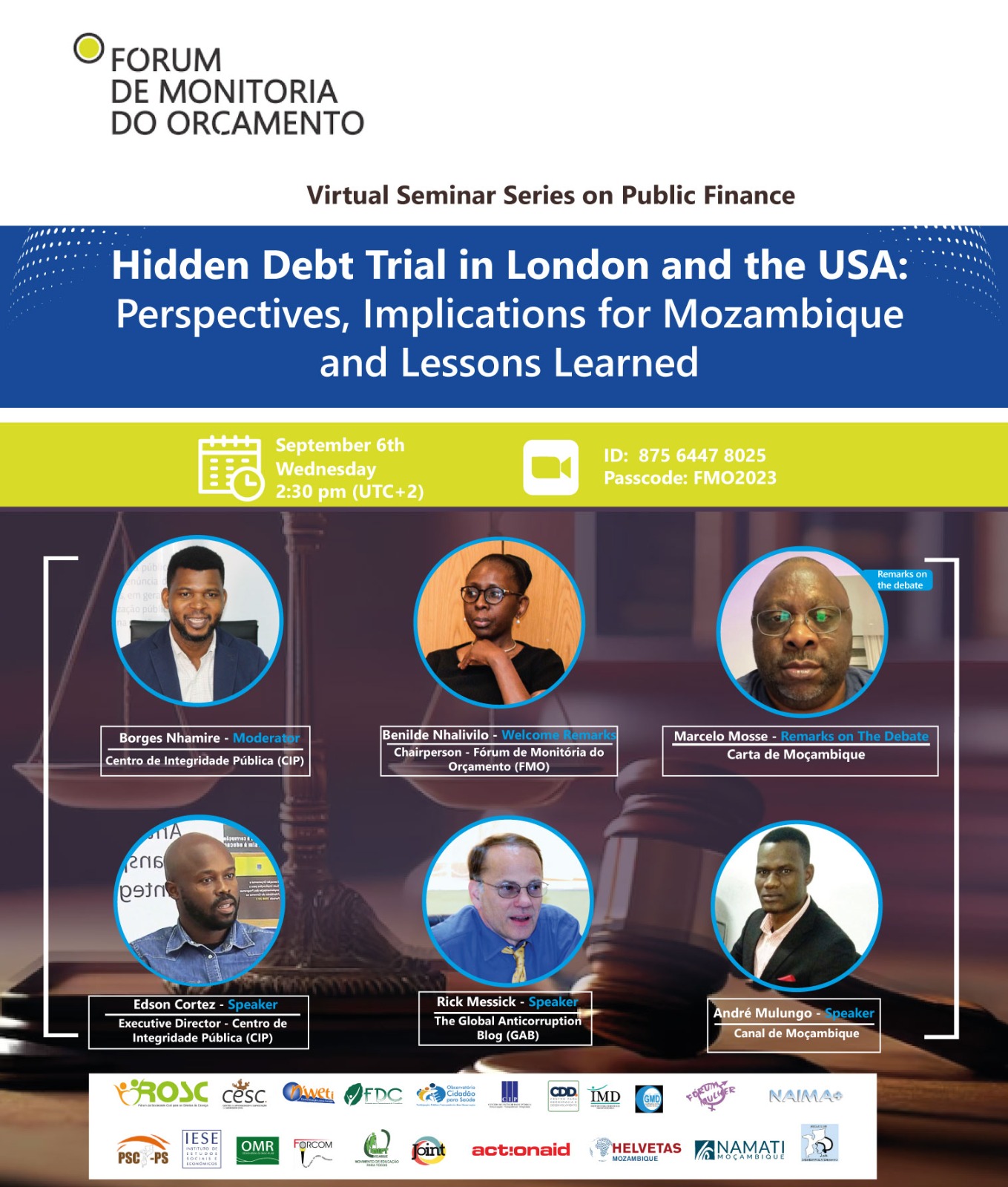
Virtual Seminar September 6: Mozambique’s Hidden Debts — Trials of Perpetrators, Lessons Learned

Wednesday, September 6, at 2:30 PM Mozambique time (UTC + 2) members of Mozambican civil society, the media, and GAB staff member (me) will discuss developments in the Mozambican “hidden debt” scandal.

Evidence introduced at the trial of Jean Boustani (here), a senior executive of the Middle East shipbuilding company Privinvest, showed the company bribed Mozambican officials to the tune of $125 million in return for government loan guarantees. The loans went for projects of little or no value. Mozambican citizens are now saddled with repaying billions in principal and interest. A joint study by Mozambique’s Centro de Integridade Pública and Norway’s Chr. Michelsen Institute estimates the scheme may have cost the nation, one of the world’s poorest,. as much as $11 billion, virtually the country’s entire GDP for 2016.

Those responsible for this enormous wrong are slowly being held to account. The Mozambique government is suing some of the perpretrators in a civil action in London, and Manual Chang, Finance Minister at the time the guarantees issued, was recently extradited to the United States to face charges for his role.

A list of speaker and details on logging in on Zoom is here.

Would the Foreign Extortion Prevention Act Help the U.S. Counter China?

The U.S. Foreign Corrupt Practices Act (FCPA) makes it a criminal offense for U.S. domestic concerns, firms that issue U.S. and any anyone acting in U.S. territory from offering or paying bribes to foreign government officials. The FCPA does not, however, apply to the foreign officials who receive those bribes. (On occasion some prosecutors have advanced the theory that a foreign government official who takes a bribe can be convicted for aiding and abetting, or conspiring in, an FCPA violation, but courts have generally rejected these theories.) Additionally, while U.S. criminal law prohibits domestic government officials from soliciting or accepting bribes, the relevant statutory provisions do not apply to foreign officials who engage in comparable conduct.

Many U.S. anticorruption activists believe that U.S. law ought to target the demand side of foreign bribery transactions (that is, the bribe-takers), not just the supply side, and have therefore advocated for the adoption of the so-called Foreign Extortion Prevention Act (FEPA). These advocacy efforts appear to be paying off: In late July, the Senate adopted FEPA as an amendment to the Senate’s version of the National Defense Authorization Act. This does not guarantee that FEPA will become law, as the House of Representatives has yet to vote on a comparable bill, and there is no guarantee that the FEPA language will remain in the bill after final negotiations conclude. But the odds have gone up significantly.

Would FEPA be a good idea? I think the answer is probably yes, though the impact is likely to be modest, and probably somewhat less than FEPA’s proponents hope. I may post again later about my own assessment of FEPA’s likely impact, should it pass in something like its current form. But for now, I want to focus on a striking argument in favor of FEPA that appeared in an op-ed a couple of weeks ago. That op-ed, coauthored by Elaine Dezenski (Senior Director at the Foundation for Defense of Democracies) and Scott Greytak,(Director of Advocacy at Transparency International’s US office), argued that FEPA would “blunt China’s malign economic influence” by countering the practice of Chinese government or government-affiliated entities using bribes to secure access to valuable resources and to expand China’s political sway over developing countries.

There are many good arguments in favor of FEPA, but I’m not sure that this is one of them. I don’t want to dismiss it outright, as it’s entirely possible that I’ve missed something. But it seems to me that FEPA would have little to no impact on corrupt overseas bribery by Chinese entities, and at least in the short term might make that problem (slightly) worse. So let me lay out the source of my confusion: Continue reading

Some Backlogged (and Very Interesting!) Podcast Episodes

As our regular readers have probably noticed, I haven’t been posting as much recently–first because I was on sabbatical (a nice perk of academic jobs) and then, most recently, for a bit of summer vacation. But I hope to be back to semi-regular posting soon! In the meantime, I wanted to mention several new episodes of KickBack: The Global Anticorruption Podcast, which came out earlier in the summer. (Sorry for failing to announce these earlier — again, I’ve been on a bit of a break.) For those of you who haven’t already heard them, they’re worth checking out!
  • The June 22 episode features and interview with journalist Michela Wrong, who is perhaps best known for her award-winning book It’s Our Turn to Eat, which tells the story of Kenyan anticorruption activist and whistleblower John Githongo (also featured in a recent KickBack episode!). In the interview, Sam Power interviews Ms. Wong about the issues raised in the book, as well as her other writing, including her most recent book, Do Not Disturb, about the abuses of power by the Kagame regime in Rwanda.
  • The July 6 episode is a bit of a change of pace from the usual episodes. Rather than featuring an interview with an expert, three of the hosts or the KickBack podcast at the Sussex Centre for the Study of Corruption (Dan Hough, Liz David-Barrett, and Sam Power) have a conversation (after some opening banter about British weather) about the leading theories for corruption analysis, including rational choice, collective action, and social norms approaches.
  • The July 28 episode returns to the interview format, featuring a conversation with Huma Yusuf, the Director of Business Integrity at the impact investing firm British International Investment. Tom Shipley interviews Ms. Yusuf about how anticorruption and business integrity fit into the global business agenda and highlighting some of the key concepts and debates in this area.
You can find these episodes and an archive of prior episodes at the following locations: KickBack was originally founded as a collaborative effort between GAB and the Interdisciplinary Corruption Research Network (ICRN). It is now hosted and managed by the University of Sussex’s Centre for the Study of Corruption. If you like it, please subscribe/follow, and tell all your friends!

Guest Post: Curbing Political Finance Abuse in Moldova

GAB is pleased to welcome this post on political finance in Moldova by the Independent Anti-Corruption Advisory Committee. Established by reformist President Maia Sandu in 2021, the committee reports regularly on Moldova’s progress in curbing corruption and what more needs to be done. Thanks to its members expertise and their independence, its work carries great weight — both within Moldova and the international community.

The most recent report addresses perhaps the most challenging issue any democracy faces: enforcement of the rules governing contributions to and expenditures by political candidates and political parties. A challenge all the greater in Moldova as post-Soviet oligarchs have yet to be fully tamed and Russia continues to pour black money into campaigns to strengthen anti-Ukraine, pro-Russian candidates.

The report is here, the committee’s summary below.

Continue reading

Ukraine’s Fight Against Corruption: Whistleblowing

Last Friday, July 7, some 50 civil society representatives, media personnel, and government policymakers spent the day discussing the law and practice of whistleblowing in Ukraine. They heard from among others National Anticorruption Prevention Committee (NAPC) officials explain how whistleblowing fit into the government’s anticorruption efforts, Anticorruption court Judge Oleksiy Kravchuk on measures for fostering respect for whistleblowers, and how the law protected Oleh Polishchuk after he blew the whistle on his employer’s corruption.

I spoke at the closing panel with TI Ukraine head Andrii Borovyk and Serhiy Derkach, Deputy Minister for Community, Territories and Infrastructure Development of Ukraine. The English version of the program is here and the slides I spoke from here. Minister Derkach’s closing remarks are below —

“Whistleblowing during the recovery process in Ukraine is even more important. It is not only about corruption but also about the security and efficiency of how funds and resources are used.

“There are three key conditions for whistleblowers to report wrongdoing:

✔️ Official channel for reporting
✔️ Confidence that the reports will be reviewed and the perpetrators brought to justice
✔️ Protection from retaliation by management

“At the Ministry of Renovation, we support a zero-tolerance culture towards corruption and are actively working to implement an effective compliance system.

Continue reading

Mitigating Corruption Risks in Ukrainian Reconstruction: Princeton University/Kyiv Anticorruption Research and Education Centre’s Joint Program

Princeton University’s Innovations for Successful Societies program and Kyiv’s Anticorruption Research and Education Centre are together helping the Ukrainian government fight corruption during reconstruction. Their first output is a four-day program that began today to share experiences elsewhere in curbing corruption in construction projects. Attending are frontline staff from the Ministry for Communities, Territories and Infrastructure Development, the State Agency for Reconstruction and Development, and other agencies and departments responsible for reconstruction.

Funded by the International Renaissance Foundation and USAID, Deputy Infrastructure Minister Serhiy Derkach opened the program. Princeton Professor Jenifer Widner, head of the Princeton program, Oskana Nesterenko, ACREC Executive Director, and representatives of AID and the Renaissance Foundation also spoke. Hamish Goldie-Scot, CoST Technical Director, and I will lead the discussions. The agenda is here, my opening remarks below.

Continue reading