Guest Post: Model Open Government Partnership Commitments for Fighting Kleptocracy

Today’s guest post is from Jodi Vittori, Professor of Practice at Georgetown University:

This past January, I authored a report, co-sponsored by the Open Government Partnership (OGP) and the National Democratic Institute, entitled “Committing to Combat Kleptocracy: A Guide for Open Government Partnership Members.” The report explains how various kleptocrats and their “enablers” move illicit assets from the country where they were stolen to the locations where they will be stored and enjoyed. The report also discusses how kleptocracy undermines not only the countries where the assets were stolen, but also the transit or destination points for kleptocratic money, people, and other resources.  While it might seem like an infusion of money, assets, and rich people into a given country might be a benefit for that country (putting aside the moral issues), it turns out that these inflows have real drawbacks for the host state, contributing to governance backsliding, facilitating real estate manipulation and industrial asset stripping, exacerbating migration challenges, and undermining national security. The role of Russia’s kleptocracy in election interference in the West, as well as the corruption associated with China’s Belt and Road Initiative, have helped put the role kleptocratic inflows play in receiving states in the spotlight.

The OGP’s open government principles—to which all OGP member governments commit—are a set of norms that, if honored and implemented, will help countries fight back against inflows of kleptocratic assets. At the most basic level, the OGP stresses the importance of making relevant, usable, and timely information on governments available to citizens and civil society to hold their governments accountable. This helps ensure that public resources are managed transparently, fairly, and equitably. The report develops this further by outlining a series of model OGP commitments for consideration by governments and citizen activists, including the following: Continue reading

Job Postings: Centre for the Study of Corruption and International Centre for Asset Recovery

Two first-rate anticorruption NGOs have openings —

The Centre for the Study of Corruption (CSC) based at the University of Sussex in the UK has recently received a multi-million dollar grant from the UK government to research Anti-Corruption Evidence (ACE) – part of the wider ACE programme run by the Foreign, Commonwealth & Development Office. It has openings with a closing date of March 25th for two positions: Programme Manager (details here) and Comms Manager (details here).

The Basel Institute on Governance is an independent non-profit organisation working across sectors to counter corruption and related financial crimes and to improve the quality of governance. Registered as a Swiss foundation with headquarters in Basel, the Institute works globally and maintains field operations around the world. The International Centre for Asset Recovery (ICAR) is a division of the Basel Institute that aims to strengthen the capacities of countries around the world to recover assets stolen through corruption. It has an opening for a (Senior) Specialist, Asset Recovery Policy (details here.)

The Fake News and Corruption Behind the Criminal Investigation of Transparency International

Transparency International and its Brazilian chapter are now the subject of a criminal investigation in Brazil. As GAB readers know (here), the investigation is part of Supreme Court Justice Dias Toffoli’s crusade to reverse the convictions handed down in Lava Jato, the landmark Brazilian corruption case. The aim is to ensure defendants escape all punishment in Brazil and are protected from prosecution in the dozen other Latin American and African countries where they paid bribes.

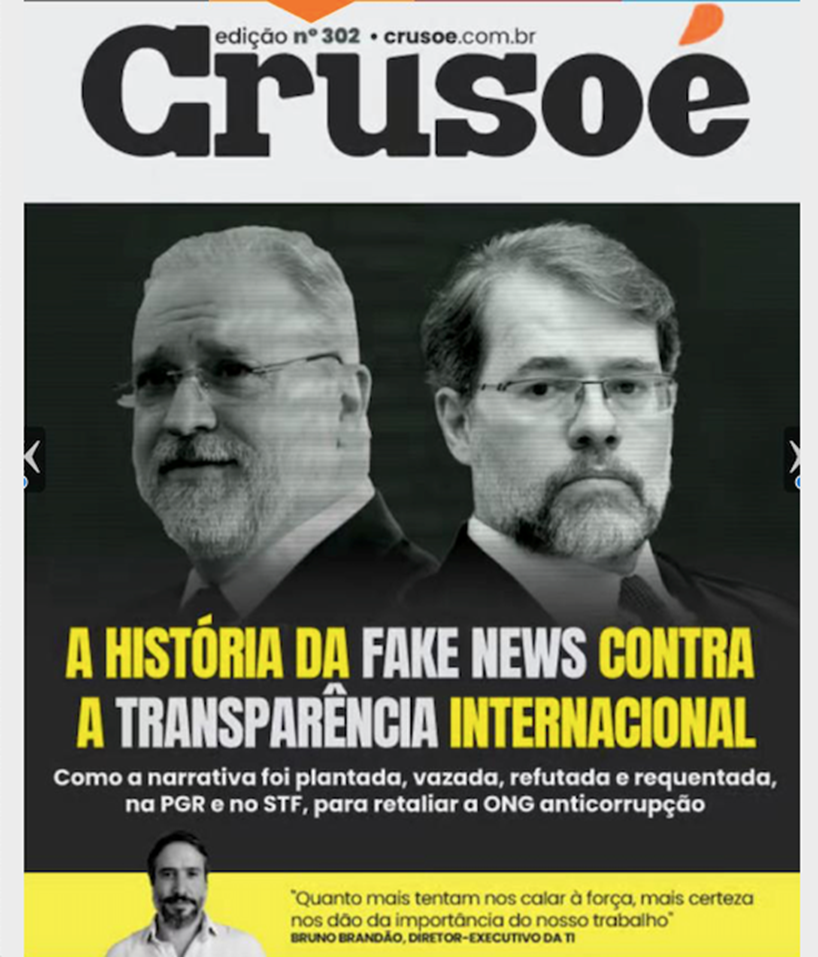
Today’s Guest Post by a Brazilian insider reveals just how groundless the investigation of TI is and Justice Toffoli’s direct conflict of interest in letting one of the Lava Jato defendants off the hook. The author explains that it starts, as the respected Brazilian journal Crusoé explains in the headline to its February 16 issue, with “A HISTORY OF FAKE NEWS AGAINST TRANSPARENCY INTERNATIONAL: How the narrative was planted, leaked, refuted and reheated in the PGR [Federal Attorney General Office] to retaliate the anti-corruption NGO.”

Continue reading

New Podcast Episode, Featuring Alison Taylor

A new episode of KickBack: The Global Anticorruption Podcast is now available. In this episode, host Dan Hough interviews Alison Taylor, a Clinical Associate Professor at NYU Stern School of Business and the author of the recently published book, Higher Ground: How Business Can Do the Right Thing in a Turbulent World. The interview, like the book, focuses on the topic of business ethics, including how the corporate sector addresses issues relating to bribery and other forms of corruption. In the interview, Alison first talks about her career path, which began focused on conducting investigations into corruption by businesses, and then broadened out to consider issues of corporate responsibility and business ethics more broadly. She then describes the impact of international anti-bribery laws on businesses, and raises some questions about the corporate compliance regimes these laws have created. You can also find both this episode and an archive of prior episodes at the following locations: KickBack was originally founded as a collaborative effort between GAB and the Interdisciplinary Corruption Research Network (ICRN). It is now hosted and managed by the University of Sussex’s Centre for the Study of Corruption. If you like it, please subscribe/follow, and tell all your friends!

ECOWAS Must Get Serious About Corruption—or the Coups Will Continue

The Economic Community of West African States (ECOWAS) was founded in 1975 to foster economic cooperation within West Africa. Over time, ECOWAS’s mission has expanded to include the promotion of democracy and political stability. And for a while, it looked like the region was indeed making progress on this front: Between 2015 and 2020, all fifteen ECOWAS member countries were democratic states. But since 2020, West and Central Africa have been hit with a wave of eight military coups, the most recent ones occurring this past July (in Niger) and August (in Gabon). ECOWAS’s response to this democratic backsliding has been unimpressive. For example, ECOWAS looked on passively when, in 2020, both Ivorian President Alassane Ouattara and Guinea’s then-President Alpha Condé ignored or circumvented constitutional limits on their terms. Just this month, Senegal President Macky Sall unilaterally delayed presidential elections for the first time in the nation’s history. Recently, ECOWAS—under pressure from the US and EU—did impose sanctions against Niger in response to the coup, but these sanctions were insufficient to get the coup leaders to step down. In fact, these sanctions were so ineffective that they caused coup-hit Mali, Burkina Faso, and Niger to withdraw from the bloc, citing “illegal, illegitimate, inhumane and irresponsible sanctions” and failure to support their fight against “terrorism and insecurity.” All this has begun to jeopardize ECOWAS’s credibility even in the eyes of local populations.

Perhaps more seriously, ECOWAS has lost credibility not only for its response to the coups, but also for its failure to address the root causes of these coups, including not only economic woes, but also endemic corruption. As a coalition of West African civil society organizations recently asserted, ECOWAS operates as “a club of Head of States, whose sole preoccupation is regime protection of the various West African leaders, and their penchant for appropriating the benefits of office to themselves, while the ordinary citizens of countries in the sub-region wallow in extreme poverty, misery, and penury.”

ECOWAS could and should take concrete steps to bolster its waning authority. One of the most effective ways it could do so is by taking a strong stand against corruption. This would not be taking ECOWAS far outside the scope of its existing mandate. The ECOWAS Protocol on the Fight against Corruption authorized ECOWAS to take action “whenever an act of corruption is committed or produces some effects in a State Party.” More generally, given the threat that corruption poses to both democracy and stability, ECOWAS is justified in more decisive action to address this scourge.

In particular, there are three things that ECOWAS ought to do:

Continue reading

New Resource Guide on Corruption Risk Assessment of Legislation

As a too-familiar cliché has it, an ounce of prevention is worth a pound of cure, and this is a message many in the anticorruption community have taken to heart. But talking in general terms about the  importance of preventing corruption is one thing; figuring out how to design specific, practical anticorruption measures is a much greater challenge. Among the preventative tools in the anticorruption toolkit, one that has shown some promise in a number of countries, and that has attracted attention in many others, is the pre-enactment analysis of proposed laws to assess the corruption risks associated with those laws. This process is sometimes referred to as “corruption risk assessment” (CRA). (It is also—rather unfortunately—sometimes referred to as the “corruption-proofing” of proposed legislation, a label that vastly oversells what this sort of assessment is capable of doing.) We have had a couple of posts on this technique on the blog previously (see here and here).

Last month, the National Democratic Institute (NDI) published a useful resource guide on CRA intended primarily for parliaments (and other legislative bodies), authored by GAB’s own senior contributor Rick Messick. (Full disclosure: I provided some comments on a very early draft of the guide, and I also worked as a consultant, though in a comparatively minor role, on a related project with the NDI’s Bangkok office.) To quote from the introduction, this guide “suggests how a CRA procedure can be incorporated into the standing rules of parliament and provides a checklist of issues the CRA should consider…. While primarily written for stakeholders in parliament, the guide can be adapted for use by anti-corruption agencies, executive branch agencies, civil society organizations (CSO) and other groups to detect and highlight the corruption risks that exist in legislative processes.”

The link above goes to the NDI page with information about the guide and related documents. You can also go directly to a PDF of the guide itself here. I hope some of our readers find this to be a useful resource.

Brazil’s Anticorruption Backsliding

In a recent post I discussed the positive legacy of Brazil’s Car Wash Operation and argued that this operation, for all its missteps, strengthened the country’s legal and institutional framework against corruption. The operation not only increased public awareness of corrupt practices but also inspired the development of effective tools for corruption prevention, investigations, and case resolution, significantly contributing to a more transparent, honest, and efficient business and political environment. Nevertheless, actions taken by Brazilian leaders in the past year have intensified concerns—already present under the previous Administration—about the government’s commitment to sustaining and expanding this legacy. Transparency International (TI) raised some of these concerns in its recent comment on Brazil’s worsening performance on TI’s Corruption Perception Index (CPI). Now, there are well-known reasons to be cautious about drawing strong conclusions from the CPI or other perception-based international indexes, but in Brazil’s case, there are good reasons to be alert. Senior leaders in both the political and judicial branches have made a series of worrisome decisions that seem likely—indeed, may be intended—to set back Brazil’s fight against high-level corruption. Among those setbacks, the following are the most serious and troubling: Continue reading

Brazilian Supreme Court Justice Orders Investigation of Transparency International

Six days after it reported in its annual survey of corruption perceptions that the fight against corruption in Brazil was losing steam, Transparency International was placed under investigation by Supreme Court Justice Dias Toffoli (here). The ostensible reason is that the internationally renowned corruption fighting organization, headquartered in Berlin with a Brazilian chapter, misused public funds.  According to the justice, the group is a “foreign” organization and thus funds received in Brazil for its anticorruption work should have been allocated to the national treasury.

TI immediately issued a statement denying all wrongdoing. In the statement it pointed not only to the close connection between release of the 2023 CPI and Justice Toffoli’s decision to open an investigation, but to the criticisms the international organization and its Brazilian chapter have levelled against Justice Toffoli’s continuing efforts to gut Lava Jato, the case where a cartel led by the Brazilian engineering and construction firm Odebrecht bribed some 415 politicians and 26 political parties in Brazil as well as dozens officials in ten Latin American and two African countries (here).

Last September the justice tore up 2017 cooperation agreement between prosecutors and Odebrecht, making it difficult if not impossible for prosecutors in other nations to pursue charges against the company and those it bribed in their countries (here). Last week, as the Financial Times reported in breaking the investigation story, Toffoli issued another ruling letting Odebrecht off the hook; this one suspends a multimillion-dollar fine the company had been ordered to pay.

Brazilian citizens, opposition parties, and Brazil’s friends in the international community have all begun to speak against this effort to undo one the largest — and for its faults (as rehearsed on this blog (latest post here)) — one of the most important steps forward in recent years in the fight against corruption. In Brazil, its neighbors, and indeed globally.  

Let’s hope Brazilian authorities hear them.

Should Officials’ Asset Declarations Be Public? Why I Changed My Mind About Sierra Leone

Many countries have some form of asset declaration requirement for public officials, but there is substantial country-by-country variance as to the actual design of the process. There is especially wide variation with respect to the public accessibility of the disclosed information. In Sierra Leone, under current law, government officers’ asset declarations are kept confidential. Before I was appointed head of Sierra Leone’s Anti-Corruption Agency (ACA), I was part of a civil society consortium that called for making all of these declarations public. A few months after my appointment, I was asked if I would support changing the law to make asset declarations public, in line with what I had advocated as a member of civil society. In reflecting on this question, I found that I had changed my mind.

Part of the reason I did not advocate changing the law to make asset declarations public was simply that there was no way our Parliament would pass such an amendment in the short-to-medium term. It did not seem sensible to waste political capital on such a controversial proposal—especially since doing so might provoke a backlash and jeopardize other important reforms. But the reasons for my change of view were not merely pragmatic political calculations. I have also come to believe that, at Sierra Leone’s current stage of development, making asset declarations public could do more harm than good. Continue reading

Does Congress Really Want to Relax Corruption Controls on U.S. Arms Sales?

Today’s Guest Post is by Colby Goodman, a Senior Researcher with Transparency International US and Defence and Security. His research focuses on corruption risks within the international arms trade and other forms of defense sector corruption. 

That corruption permeates the international arms trade is no surprise to readers of Transparency International reports (here), business executives (here), or investigative reporters (here, here, and here). What is a surprise is that the U.S. House of Representatives is considering weakening the measures the U.S. government has put in place over the past decades to prevent U.S. companies from becoming entangled in corrupt dealings.

This Tuesday, February 6, the House Foreign Affairs Committee will discuss a bill to significantly decrease the number of proposed U.S. arms sales that would require congressional review before proceeding. The bill would increase the dollar threshold that require  the Defense and State Departments to notify Congress of a planned sale. It follows a US defense industry lobbying campaign to speed up the process in delivering U.S. weapons and so make their purchase more commercially attractive. But at the cost of weakening key U.S. government efforts to curb corruption in U.S. arms sales.

To its credit, in early 2023 the Biden Administration  updated the government’s Conventional Arms Transfer policy to “ensure that arms transfers do not fuel corruption or undermine good governance, while incentivizing effective, transparent, and accountable security sector governance.”  This policy followed its Countering Corruption Strategy, where  the U.S. government pledged to start “reviewing and re-evaluating criteria for government-to-government [security] assistance, including around transparency and accountability.”  These actions recognized the significant harm to U.S. national security that comes from pervasive corruption in partner countries and the need to mitigate corruption risks within the U.S. defense industry.  

Detailed below are four key critical corruption checks that would be undermined by the proposed bill.

Continue reading