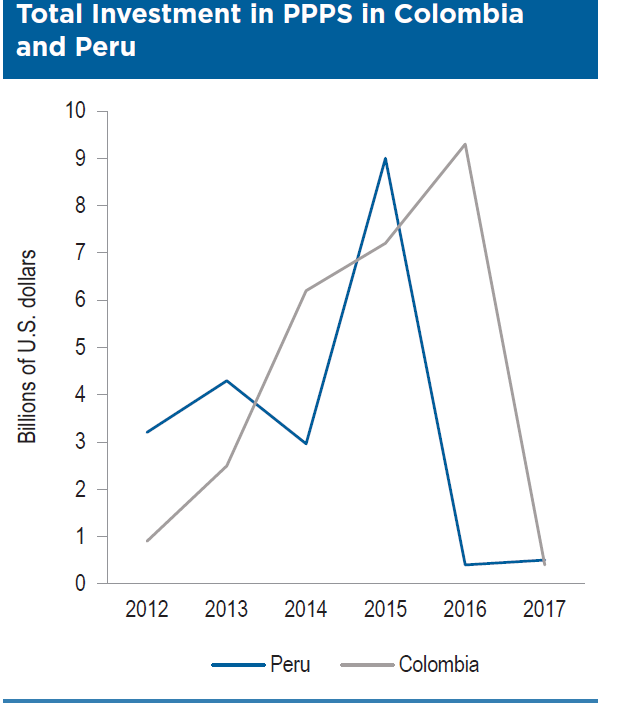
The Consequences of Zero Tolerance

The chart above shows what happens when policy is based on a slogan. In this case “Zero Tolerance.” Procurement rules in both Peru and Colombia require that any public contract tainted by corruption be terminated immediately. As the Brazilian investigation into construction giant Odebrecht unfolded, it became clear that many projects to build highways, power plants, and other infrastructure projects in the two countries had been corruptly awarded.  Authorities in both countries then did what the law told them they must: cancel the contracts.

Most large infrastructure contracts in Peru and Colombia are in the form of Public-Private Partnerships (PPPs), and the immediate termination of a PPP can be enormously costly.  Not only to the firms that paid bribes to secure the contract, but to lenders, suppliers, and the hundreds of other contractors on the project who had no knowledge or involvement in the bribery scheme.  The greatest costs are likely be felt by the citizens of Colombia and Peru.  For as the chart shows, the consequence of zero tolerance is a halt to new spending for roads, power, and other essential facilities as investors and project developers shy away from the risk future contracts will be terminated for the tiniest of infractions by anyone associated with the project.   

Colombians and Peruvians may today be proud their governments are so tough on corruption neither one will tolerate a speck of it in any contract for infrastructure.  Tomorrow citizens of the two countries may have a different view: when power shortages mean the lights won’t come on and the failure to build new roads and maintain old ones produces horrendous traffic jams.  

Last week the World Bank hosted a presentation by Inter-American Development Bank staff where the issue of why “zero tolerance” is a good slogan but a bad policy was examined and means for addressing infrastructure corruption without producing the results shown in the chart was discussed.  A paper the IDB presenters recently published, the source of the figure above and the basis of their presentation, is here.   A video of the session here.  

The Bolsonaro Administration is Quietly Reducing Transparency in Brazil

Right-wing populist Jair Bolsonaro was inaugurated President of Brazil on January 1, 2019. As a candidate, Bolsonaro promised that his regime would break with the large-scale graft of Brazil’s former leaders and would ruthlessly pursue the corrupt and bring them to justice. At the end of January, Justice Minister Sergio Moro released, with much fanfare and press attention, a sweeping anti-crime legislation package that addresses both white collar crime and violent organized crime, and that incorporates some, though not all, of the anticorruption measures proposed by Transparency International. So does this mean that the Bolsonaro Administration is following through on its promise to make the fight against corruption a major priority, and to end the culture of impunity that has shielded Brazilian political elites?

Alas, no. While the anti-crime package (and other high-profile pieces of legislation, like tax reform) have been highlighted by the administration and attracted most of the media attention, less prominent yet equally consequential pieces of legislation related to corruption are being passed with little to no warning or public debate. Here are two examples of major events that have occurred within the first month of the regime that should give anticorruption scholars and the international community pause in their evaluation of the Bolsonaro government’s fight against corruption:

Continue reading

Kyrgyzstan’s Elimination of Immunity for Ex-Presidents is No Win for Anticorruption

Last October, the Supreme Court of Kyrgyzstan ruled that Kyrgyzstan’s law granting legal immunity to ex-presidents was unconstitutional on the grounds that Article 16 of the Kyrgyz Constitution makes all people equal before the law. Because the Kyrgyz immunity law was one of the broadest and most protective in the world, those of us who care about corruption might cheer this ruling as a win in Kyrgyzstan’s fight against corruption. However, viewed in context, the ruling portends problems for Kyrgyzstan’s nascent democracy and may even be counterproductive in the fight against corruption itself.

Many countries have ex-presidential immunity regimes. The downside of such laws—which exist throughout Central Asia and in countries as diverse as Burundi, France, and Uruguay­—is that, by making it difficult or impossible to prosecute a former president, these laws eliminate one of the most important deterrents to executive corruption. Kyrgyzstan’s law was especially problematic in this respect, as the immunity granted to ex-presidents was unusually broad—covering not merely conduct related to the former president’s exercise of her or his official duties, but any act committed during the term of office, with no exceptions even for high treason or other grave crimes. The Kyrgyz immunity law also protected an ex-president’s property, and it blocked searches and interrogation in addition to prosecution, thus stymying investigations even where the ex-president was just a witness. For these reasons, getting rid of the immunity law might seem like a step forward in the fight against corruption.

However, laws that grant immunity to ex-presidents also have an upside, especially in authoritarian states or fragile democracies. These laws may ease and encourage peaceful political transitions, because with no threat of prosecution, a sitting president may be more willing to peacefully cede power. One might therefore be worried about the impact of the Supreme Court’s decision on Kyrgyzstan’s fledgling electoral democracy. Those worries would be well founded given the political context in which the Supreme Court rendered its decision.

To understand why requires understanding recent events in Kyrgyz politics, and in particular how the Supreme Court’s invalidation of the ex-presidential immunity law appears to be part of a larger campaign by the current President to suppress political opposition led by his predecessor:

Continue reading

Swedish Court’s Stunning Acquittal of ex-Telia Executives for Bribery

A Stockholm District Court’s acquittal of three former executives of Swedish telecom giant Telia of bribery shocked the global anticorruption community and has smirched Sweden’s reputation as a clean government champion (original decision; English translation).  Despite overwhelming evidence, the court refused to find the three guilty of paying Gulnara Karimova, daughter of the then president Uzbekistan, over $300 million in bribes for the right to operate in the country.

E-mails showed defendants directed the money to a Karimova shell company, hid their dealings with her from Telia’s board, and knew paying her violated American antibribery law. (Telia subsidiary’s Statement of Facts in the U.S. prosecution.)  Though defendants argued Karimova had no official role in telecom licensing, the evidence showed her father had given her de facto control of the telecom licensing agency.  Perhaps most damning, the court had the sworn statement Telia made in settling the FCPA case arising from the bribery. It there admitted “Executive A . . . a high-ranking executive of Telia who had authority over Telia’s Eurasian Business Area” and “certain Telia executives” had been the principals behind the bribery scheme (Statement of Facts,  ¶s 12, 17, 19, 26, 30, and 34).

The court defended its acquittal of Tero Kivisaari, apparently Telia “Executive A,” Lars Nyberg, CEO when the bribes were paid, and the lawyer who counseled them on two grounds. One, the prosecutor had not provided “hard evidence” of bribery, and two, even if he had, the law then in effect did not reach defendants’ conduct.

Google’s translation of the decision is rough (mutanklagelser, Swedish for bribery, is rendered as “manslaughter”) but not too rough to see through the court’s skewed findings of fact and flimsy legal reasoning. Continue reading

The CICIG Crisis in Guatemala: How the Trump Administration Is Undermining US Anticorruption Leadership

Back when Donald Trump was first elected, a lot of people—me included—worried about the implications of his presidency for US leadership in the global fight against corruption. Some of the dire predictions have not (yet) come to pass; for example, so far US enforcement of the Foreign Corrupt Practices Act (FCPA) does not seem to have abated despite Trump’s well-documented and ill-informed hostility to that statute. But even if US enforcement of the FCPA has proceeded without much discernible effect (so far), there are other, less easily measurable respects in which the Trump Administration’s foreign policy, and its own cavalier disregard for ethics, may be undermining US leadership on anticorruption issues, and consequently undermining anticorruption efforts and bolstering those who would seek to undermine such efforts.

As just noted, much of this effect is diffuse and hard to observe directly, but there are a few examples where the Trump Administration and its allies are undermining the global fight against corruption is more evident. Perhaps the most striking and disheartening is the situation unfolding in Guatemala, ably documented in a compelling piece by Colum Lynch on Foreign Policy’s FP Blog earlier this month. Long story short: The Trump Administration and its allies in Congress appear to be supporting, or at least tacitly accepting, the efforts of Guatemalan President Jimmy Morales to shut down Guatemala’s UN-sponsored anti-impunity commission, known by its Spanish acronym CICIG, which has proved instrumental in fighting high-level corruption in Guatemala, and forced the resignation of President Morales’s predecessor, Otto Perez Molina. President Morales campaigned on an anticorruption platform, but he now wants to shut CICIG down, apparently because it’s investigating his own family members and associates. And the US, which had supported CICIG in the past and pressured President Molina to renew its mandate when he was inclined to terminate it to protect himself, seems to be backing Morales rather than CICIG.

I won’t go into all the details here, as the story is ably laid out in Mr. Lynch’s excellent piece. I’ll just highlight some themes that emerge from the reporting that Mr. Lynch and others have done, which illustrate connections—some direct, some indirect—between the Trump Administration’s approach to government and the dissipation of US leadership on anticorruption issues, as illustrated by the CICIG debacle. Continue reading

Fighting Corruption in Brazil Requires More Than Tough Talk—Does the New President Have the Necessary Skills?

Much has already been written, on this blog and elsewhere, about the what the election of Jair Bolsonaro as President of Brazil means for the future of the anticorruption agenda in that country. (See, for example, here and here.) Bolsonaro’s appeal rested in part on the Brazilian electorate’s disgust with the entrenched corruption of the Brazilian political elite in all the major parties. Bolsonaro promised a rejection of “old politics,” positioning himself both as a “disruptive” figure and as someone who would and could “get tough” on corruption—a new sheriff in town, as it were, who would put the bad guys behind bars.

Yet fighting corruption is not just about “toughness” or making fiery speeches or enforcing laws (though strong enforcement is certainly necessary). In a country like Brazil—a complicated multiparty democracy desperately in need of significant institutional reform—an effective anticorruption agenda requires the President and his senior ministers not only, or even primarily, to be the merciless watchdogs cracking down on wrongdoing, but rather the country’s political leaders need to take the lead in articulating a coherent vision, mobilizing and coordinating with multiple stakeholders both in and out of government, and negotiating with other power centers in order to ensure not only the independence and cohesion of law enforcement efforts, but also to promote the necessary legal and institutional reforms. Promoting public integrity requires a broader set of skills, ones that have unfortunately become associated with “old politics” in a negative way: building coalitions, negotiating with different interest groups, and coordinating multiple stakeholders.

There are at least three sorts of coordination, engagement, and negotiation that Brazil’s new president must undertake if his purported commitment to fighting corruption is to yield results:

Continue reading

The EU Needs a Centralized AML Authority

The European Union had a tough year. As if the refugee crisis, the rise of nationalist and far-right parties, and the Brexit affair weren’t enough, the 2018 headlines of European newspapers were crowded with a seemingly endless parade of money laundering scandals. Perhaps the most egregious was the case of Danske Bank, the largest bank in Denmark and a major retail bank in northern Europe. According to Danske Bank’s own report, between 2007 and 2015 the bank’s Estonian branch processed more than US$230 billion in suspicious transactions. The investigation, which is still ongoing, has already been dubbed the largest money laundering scandal in history. And there are plenty of others. In September 2018, for example, the Dutch bank ING Groep NV admitted that criminals used its accounts to launder money and agreed to pay a record US$900 million in penalties. And then in October 2018, after a string of scandals, Malta became the first EU Member State to receive an official European Commission (EC) order to strengthen enforcement of its anti-money laundering (AML) rules. By the end of 2018, it became apparent that the EU’s entire AML system needed a major overhaul.

The EU’s current AML legal framework is comprised of several components:

  • The first element is the set of so-called AML Directives, the most recent of which (the sixth) was adopted in 2018. These Directives require Member States to achieve certain legal results, but do not specify the particular measures that Member States must adopt.
  • Second, following the AML Directives, all EU Member States have adopted national AML laws and regulations that provide detailed guidance on a variety of topics, including the specification of different entities’ AML responsibilities, the sanctions for AML system breaches, and so forth.
  • The third important component of the EU’s AML framework is the EU Regulation on information accompanying transfers of funds, which is meant to harmonize across Member States the provision of payers’ and payees’ information when persons are transferring and receiving funds. In contrast to the AML Directives, this EU regulation, like other such regulations, has a direct legal effect on all Member States. Therefore, the information accompanying transfers of funds is identical in all Member States.

Taken together, these various instruments comprise one of the most stringent AML systems in the world, at least on paper. Perhaps for that reason, many commentators, including EU and EC officials themselves, attribute the spate of money laundering scandals plaguing EU countries not so much to weaknesses in the substantive regulations but rather to poor implementation—in particular, the fragmentation of AML oversight. Last October, Bruegel, an influential European think tank, presented a report calling for the establishment of a new centralized European AML authority—one that would work closely with national law enforcement agencies and be empowered to impose fines. ECB Chief Supervisor Danièle Nouy, who is intimately familiar with the problem, seems to agree at least to some extent. After one of last year’s many money laundering scandals, she suggested that “we need a European institution that is implementing in a thorough, deep, consistent fashion this legislation in the Euro area.” In fact, the proposal to create a more centralized EU AML architecture has been around for a while. It seems that the EU has finally decided that the time has come to do something like this, as the European Central Bank (ECB) announced last November that it would set up a central AML supervision office.

To understand the justification for creating a new centralized EU AML agency, one must first understand the extent to which, under the current system, supervisory and enforcement responsibility for the EU’s AML system is divided among several institutions, and the problems that this can create: Continue reading

Are Corporate Anticorruption Compliance Programs Effective?

Requiring business corporations to institute an anticorruption compliance program should be a part of any national strategy to fight corruption.  The argument is simple.  Corporate employees or their agents are always on the paying side of a bribery offense and often a facilitator of conflict of interest and other forms of corruption.  Making it against company policy for employees or agents to participate in any corrupt act with stringent sanctions up to and including termination for a violation will help shut down the supply side of the corruption equation.

Even where a company’s compliance program is a sham, established simply to comply with the law, it can still help in combating corruption.  A sham program would be a violation of law, and were the company investigated, the existence of a sham program would be easy for investigators to spot, easing their task of determining wrongdoing.  So there seems to be no reason why lawmakers shouldn’t insist that firms subject to their law, whether state-owned or privately-held, establish a program.  And between the many guides published by international organizations (examples here and here), NGOs (here and here), academics, the burgeoning compliance industry, and the issuance of an international standard for such programs, there is no dearth of information on how to create and operate an effective one.

I have argued the case for a compliance requirement in several posts (examples here and here), as have many other GAB contributors (examples here and here).  My most recent plea for mandating private sector compliance programs came in this one noting such a requirement in Vietnam’s new anticorruption law.  But one thing I have not done is address two obvious questions about compliance programs that Matthew posed in a comment to the Vietnam post: How are compliance requirement laws enforced? How effective are they in practice?

It turns out these obvious, innocent sounding questions (the kind law professors always seem to ask) aren’t all that easy to answer.  What I have found so far follows.  Readers with more information earnestly requested to supplement it. Continue reading

Ownership Transparency Works: Geographic Targeting Orders in the US Real Estate Market

The anticorruption community, along with those concerned about tax evasion, fraud, and other forms of illicit activity, has made anonymous company reform a high priority on the reform agenda. It’s not hard to see why: Kleptocrats and their cronies, as well as other organized criminal groups, need to find ways to hide and launder their assets, and to do so in ways that are difficult for law enforcement authorities to trace. Moreover, those whose legitimate sources of income would be insufficient to obtain luxury assets would like to conceal their ownership of such assets, as the ownership itself could arouse suspicion, and might make the assets more vulnerable to forfeiture.

So-called “know-your-customer” (KYC) laws in the financial sector have made it much more difficult—though, alas, far from impossible—for account owners to conceal their identities from the banks and government overseers, at least in the US and most other OECD countries. But it is still far too easy for criminals to purchase substantial assets in wealthy countries like the United States while keeping their identities hidden. All the bad actor needs to do is, first, form a company in a jurisdiction that does not require the true owner of the company to be disclosed and verified to the government authorities, and, second, have this anonymous shell company purchase assets in a transaction that is not covered by KYC laws. Step one is, alas, still far too easy. Though we often associate the formation of these sorts of anonymous shell companies with “offshore” jurisdictions like the British Virgin Islands, in fact one can easily form an anonymous shell company in the United States. Step two, having the anonymous company purchase substantial assets without having to disclose the company’s owner, is a bit trickier, because you’d need to avoid the banking system. But you can get around this problem by having your anonymous company purchase assets with cash (or cash equivalents, like money orders or wire transfers), so long as no party to the transaction is under obligations, similar to those imposed on banks, to verify the company’s true owner.

One of the sectors where we’ve long had good reason to suspect this sort of abuse is common is real estate, especially high-end real estate. Though money laundering experts had long been aware of the problem, the issue got a boost from some great investigative journalism by the New York Times back in 2015. The NYT reporters managed to trace (with great effort, ingenuity, and patience) the true owners of luxury condos in one Manhattan building (the Time Warner Center), and found that a number of units were owned by shady characters who had attempted to conceal their identities by having shell companies make the purchases.

The US still hasn’t managed to pass legislation requiring verification of a company’s true owners as a condition of incorporation, which would be the most comprehensive solution to the anonymous company problem. Nor has the US taken the logical step of extending KYC laws to real estate agents across the board. But starting back in 2016, the US Treasury Department’s Financial Crimes Enforcement Network (known as FinCEN) took an important step toward cracking down on anonymous purchases of luxury real estate by issuing so-called Geographic Targeting Orders (GTOs). And thanks to some excellent research by the economists C. Sean Hundtofte and Ville Rantala (still unpublished but available in working paper form), we have strong evidence that many purchasers in the luxury real estate market have a strong interest in concealing their true identities, and that requiring verification of a company’s ultimate beneficial owners has a stunningly large negative effect on the frequency and aggregate magnitude of anonymous cash purchases. Continue reading

The UK Parliament Should Broaden and Sharpen the Legal Advice Privilege in Order to Encourage More Internal Investigations into Corruption

On September 5, 2018, the compliance departments and outside counsel of large corporations operating in the UK breathed a collective sigh of relief. In a much anticipated ruling, the Court of Appeal of England and Wales overturned a trial judge’s order that would have compelled a London-based international mining company, Eurasian Natural Resources Corporation Limited (ENRC), to hand over documents to UK prosecutors investigating the enterprise for bribery in Kazakhstan and Africa. Those documents were the product of an investigation that ENRC’s outside legal counsel had conducted following an internal whistleblower report that surfaced in late 2010. In conducting that internal investigation, lawyers from the law firm interviewed witnesses, reviewed financial records, and advised ENRC’s management on the company’s possible criminal exposure. Though the company tried to keep everything quiet, the UK’s Serious Fraud Office (SFO) came knocking in mid-2011. The SFO agreed to let ENRC and its lawyers continue to investigate on their own, periodically updating the SFO on their progress. In 2013, ENRC’s legal counsel submitted its findings to the SFO in a report arguing that, on the basis of the facts presented, the company should not be charged. The SFO disagreed and launched a formal criminal investigation. But the SFO then also demanded that ENRC turn over all of the files and documents underpinning its report—including presentations given by the lawyers to ENRC’s management and the lawyers’ notes from their interviews with 184 potential witnesses.

ENRC refused to comply, claiming that these documents were covered by two legal privileges under UK law: the “litigation privilege,” which guarantees the confidentiality of documents created by lawyers for the “dominant purpose” of adversarial litigation (including prosecution) that is “in reasonable contemplation,” and the “legal advice privilege,” which protects communications between lawyers and clients exchanged for legal advice. The trial court rejected ENRC’s privilege claims, a decision that sent shockwaves through the English defense bar and spurred much criticism on legal and policy grounds. But the Court of Appeal reversed, holding that ENRC’s lawyers didn’t have to share the documents. The Court’s ruling relied on the litigation privilege, holding, first, that documents created to help avoid criminal prosecution counted as those created for the “dominant purpose” of litigation, and, second, that criminal legal proceedings were in “reasonable contemplation” for ENRC once the SFO contacted the company in 2011.

Many commentators have hailed the Appeal Court’s decision (which the SFO declined to appeal) as a “landmark ruling” and a “decisive victory” for defense lawyers. The reality is a bit more nuanced. The Court of Appeal’s fact-specific ruling was very conservative in its legal conclusions, and it’s unlikely that its holding regarding the litigation privilege is sufficient to create the right incentives for companies and their lawyers. It’s also unlikely that further judicial tinkering with the scope of the litigation privilege will resolve the problem promptly or satisfactorily. The better solution would involve a different institutional actor and a different privilege: Parliament should step in and expand the scope of the legal advice privilege to cover all communications between a company’s lawyers and the company’s current and former employees. Continue reading