Guest Post: Guidelines for Settling Foreign Bribery Cases

The OECD Antibribery Convention requires parties to impose “effective, proportionate, and dissuasive criminal penalties” on those found guilty of bribing an official of another nation. As GAB readers know, most prosecutions for foreign bribery end not with a trial but with a settlement (here). GAB readers also know that a vigorous debate has ensued on this blog (here and here) and elsewhere (here, here and here) as to whether these settlements have met the “effective, proportionate, and dissuasive” test. In response, and with the assistance of the private bar, the OECD has been developing guidelines to help prosecutors and defense counsel ensure that future settlements do.

 GAB is delighted to welcome this guest post by Peter Solmssen, a leader in this effort from the private bar, in which he describes where the guidelines project stands.  As General Counsel of Siemens AG, Mr. Solmssen negotiated its settlement of foreign bribery cases with, among others, the Federal Republic of German and the United States.  He now chairs the Non-trial Resolutions of Bribery Cases Subcommittee of the International Bar Association (IBA).

Work on international guidelines for the settlement of foreign bribery cases is accelerating. The IBA made its latest submission to the OECD Working Group on Bribery January 22. It there urged the Working Group to move quickly with its anticipated international guidelines on settling transnational bribery cases and to resolve those aspects of settlements that remain contentious. As described here, the IBA has been pushing the OECD to issue guidelines that will encourage prosecutors to cooperate internationally and programmatically to increase the use of settlements, or non-trial resolutions as they are formally referred to internationally.

Continue reading

Guest Post: For Whose Benefit? Reframing Beneficial Ownership Disclosure Around User Needs

GAB is pleased to publish this post summarizing a recent paper on beneficial ownership disclosure by Anton Moiseienko (Research Fellow) and Tom Keatinge (Director) of the London-based Centre for Financial Crime and Security Studies at the Royal United Services Institute.  In the paper, the authors examine current standards governing disclosure of beneficial ownership data, the challenges of ensuring the data’s accuracy, and the needs and interests of the data’s different users. It will be of particular interest to American policymakers given enactment of the Corporate Transparency Act.

Beneficial ownership disclosure – the collection and sharing of information on genuine (rather than formal or nominee) owners of assets – has become a central issue in the fight against corruption and other financial crimes. To whom to disclose it can be controversial, as the very public spat between the United Kingdom, and several of its Overseas Territories shows. Moreover, even countries committed to full public disclosure face challenges in ensuring implementation meets promise as continuing discussions among EU member states shows.  

Arguments over the extent of disclosure and verification can obscure an equally important issue, ensuring the ownership data meets the needs of domestic and foreign law enforcement agencies, tax authorities, regulated businesses, and the public at large. In our paper, we examine not only to whom the information should be provided and how to guarantee it is accurate but how to be sure what is collected and disclosed serves the interests of different types of users. It is based on a review of publicly available sources and over 40 interviews, including more than 25 with experts based in British Overseas Territories and Crown Dependencies, jurisdictions where the lack of information on beneficial ownership has been a major concern internationally.

Continue reading

Kleptocracy Strikes Mongolia? Further Reply from Batbold’s Advisor

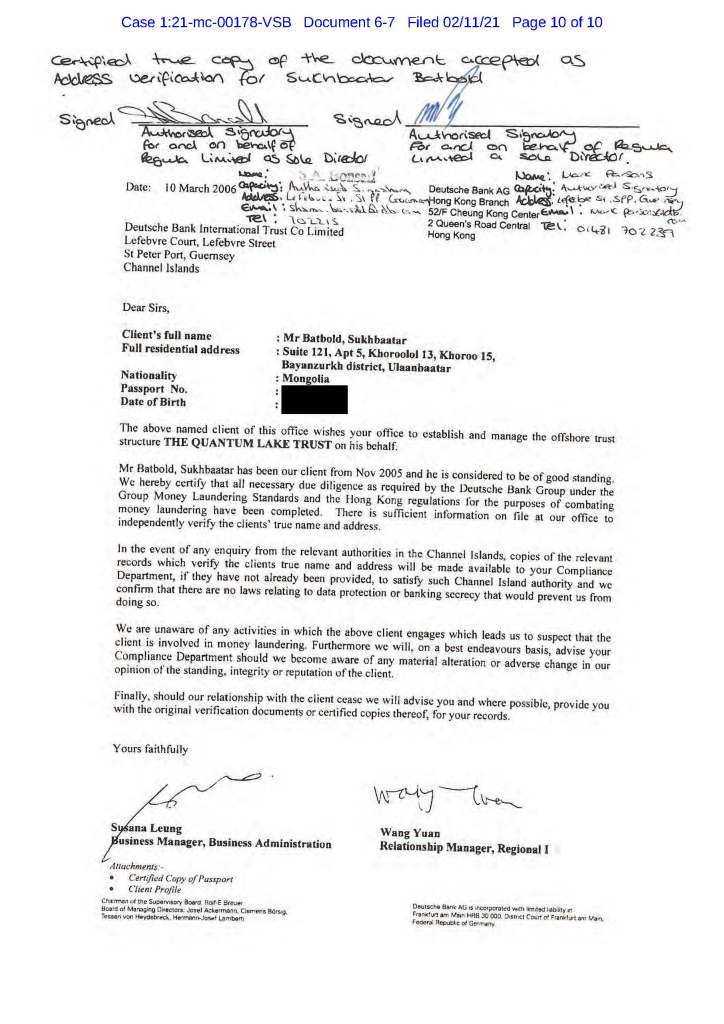
Faithful readers know that last December 8 GAB reported on a New York case alleging that while in office former Mongolian Prime Minister Sukhbaatar Batbold conspired with a South Korean couple to embezzle hundreds of millions of dollars from his government.  Brought by three Mongolian government agencies, the complaint seeks to prevent the sale of two New York condominiums the agencies say are registered in the couple’s name but beneficially owned by Batbold until a case in Mongolia is resolved. In that case, the three agencies plus the Metropolitan Prosecutor’s Office ask that Batbold, the Korean couple, and others compensate the government for the damages it suffered from their corrupt acts.

The December 8 post and a second one December 23 drew a considerable number of comments. About half said the charges were fabricated and half said it was about time Batbold was held accountable.  But none addressed the facts alleged. It was only on January 5 GAB received any substantive comment on the charges — in the form of a letter from Batbold advisor Batbayar Sh. He there denied Batbold had done anything wrong, asserted the Mongolian case was politically motivated, and asked that the posts be taken down. Although Batbayar claimed the two posts were riddled with errors, as GAB explained in its January 6 post reprinting his letter, he identified no inaccuracies in either the December 8 or December 23 post.

Batbayar has now sent a second letter. It again denies Batbold has done anything wrong and, unlike the earlier letter, adds some facts to back up the denial. The text of this second letter along with GAB’s comments on the points it raises follows.

Continue reading

Guest Post: Every Bank Robber Needs A Getaway Car; Banker Held Accountable For Money Laundering

GAB is pleased to publish this analysis by Emile J. M. Van Der Does De Willebois, Coordinator of the World Bank/UNODC Stolen Asset Recovery Initiative, of the significance of a decision of the Gerechtshof Den Haag, the Dutch appeals court in The Hague. As he explains, for too long authorities in the developed world have ignored the role lawyers, bankers, and other “enablers” play in facilitating corruption in the developing world.  Let us hope that the court’s decision marks a turning point in holding them accountable for their role in corruption crimes.  

Last month, a Dutch appeals court ordered the public prosecutor to initiate the criminal prosecution of the former CEO of the nation’s largest bank. The court directed that Ralph Hamers be put on trial for money laundering and other crimes the Amsterdam-based banking giant ING committed during his sevenyear tenure as its chief executive. Financial and legal professionals are rarely prosecuted for crimes they facilitate, and it is even rarer that senior executives, as opposed to the institution they run, are targeted. Until this decision, the indictment of Goldman Sachs bankers for their role in the 1MDB scandal was a notable exception.

The culpability of those who, like the driver in a bank robbery, facilitate a crime is not particularly controversial. We all know that the corruption that happens “over there” needs the services of bankers, lawyers, accountants and other facilitators “over here.” We like to pay lip service to the idea that “it takes two to tango” and acknowledge, at least verbally, that the financial and corporate services in the financial centers of the developed world facilitate the corruption found in large parts of the developing world.

But whether those working on anti-corruption always act upon that notion is another matter. A quick look at the Transparency International corruption perceptions index helps maintain the illusion that the rich developed world is doing well on corruption, and that, looking at the bottom of the table, corruption is really a developing-country problem. We have not really internalized the lessons of the Panama Papers, 1MDB, Danske Bank and, most recently, the FinCEN files, which shone a spotlight on the services provided by banks, lawyers and other professionals in making corruption possible.

Continue reading

Kleptocracy Strikes Mongolia? A Batbold Advisor Replies

GAB’s December 8 “Kleptocracy Strikes Mongolia? The Batbold Case” prompted dozens of reader comments. The post recounts a recently filed New York civil case where it is alleged that, while he was Prime Minister, Sukhbaatar Batbold worked with a South Korean couple to embezzle hundreds of millions of dollars which went in part to buy real estate in New York and elsewhere registered in the couple’s name. Although the couple appears to have no experience in international commodity markets, they bought large quantities of ore from Mongolian state-owned or controlled mines during Batbold time in office on questionable terms. Batbold’s children now live in or use properties registered to the couple.

Dozens of readers commented on the post, roughly half claiming the charges were fabricated and half saying it was past time to hold Batbold accountable. No one addressed the substance of the allegations however, and hence in a follow up post December 23 readers were invited to do so. To date the one response has been a letter from a Batbold advisor asking GAB to delete the two posts. GAB Editor-in-Chief Matthew Stephenson wrote in reply that while GAB does not remove a post because someone believes it unfair, GAB will correct it if it is inaccurate.

The advisor’s letter contains a blanket denial of wrongdoing by Batbold and a claim the case is politically motivated. It points to no inaccuracies, however. It does note that subsequent to the first post’s appearance the government of Mongolia voluntarily discontinued the case against Batbold.  The letter implies this was because the court exonerated him. That is not correct. The court has not ruled on any of Mongolia’s allegations. Likely Mongolia decided to discontinue its case against Batbold for technical reasons having to do with his claim that as a public official he is immune from all court action. In any event, the South Korean couple remain parties.The letter is below. 

Continue reading

A GAB’s Eye View of 2020

Thanks to WordPress, the free, open-source, amazing software that runs GAB, Matthew and I know something about our readers.  Don’t worry. It doesn’t tell us who you are or what your email addresses are, but WordPress does show us where you live and what posts you find of greatest interest.  As 2020 comes to its welcome end, we thought you would be interested to know where you come from and what topics most interest you.

GAB readers live in all but five of the 193 members of the United Nations and in one prominent non-member state.  Pope Francis himself may not be one of GAB’s Vatican City readers, but we would like to think that GAB posts chronicling the impact of corruption on less developed nations has in some way contributed to his forceful denunciation of corruption and the harm it wreaks on the least fortunate.

The five UN member states where not a single citizen read even one GAB post this past year are:

Continue reading

Kleptocracy Strikes Mongolia? The Batbold Case Part II — UPDATE

There is little doubt GAB’s Mongolian readers feel strongly about their former Prime Minister and possible 2021 presidential candidate Batbold Sukhbaatar. A December 8 post summarizing Offshore Alert’s December 7 revelations of charges he masterminded a massive corruption scheme sparked an avalanche of comments.  By contrast an earlier post recounting charges his likely rival, the current president, was corruption and had abused of power to control judicial appointments drew nary a word.

Comments on the Batbold case split roughly 50-50.  Half claimed the charges were fabricated with several seeing unnamed “foreign interests” behind them, and half believed every word of the government’s case and hoped Batbold would soon be brought to justice. Unfortunately for GAB readers neither from Mongolia nor schooled in developments there, none of the commentary offered any facts in support of their passionately asserted views.  Indeed, the only fact about the case that has appeared since the Offshore Alert article, at least in the English language press, is a story in today’s Times of London.

Continue reading

A Breaththrough in Recognizing Who is a Corruption Victim

A decision of the U.S. District Court for the Eastern District of New York ruling shareholders of a company damaged by bribery are “corruption victims,” and its order affirming $135 million in damages establish an important precedent. The decision and order were handed down in a case arising from the prosecution of OZ Africa Management for violating the Foreign Corrupt Practices Act. OZ, a subsidiary of a U.S. hedge fund, had pled guilty to participating in a bribery scheme Israeli billionaire Dan Gertler engineered to gain control of the Democratic Republic of the Congo’s mineral resources.  As the case was about to close, shareholders in Africo, a Canadian company whose mining rights had lost value thanks to the bribery, filed a claim for damages under the Mandatory Victim Restitution Act, a statute requiring criminal defendants to compensate victims of their crimes.    

OZ and the prosecutors in the case both opposed the shareholders’ claim. Under the act, those claiming they were injured by a criminal offense must show they were “directly and proximately harmed” by it. Several events occurred between OZ’s bribes and the injury Africo’s shareholders sustained that blurred the causal link between the two. Both the government and OZ asserted that these intervening events made the shareholders at best indirect victims of corruption. And in any event the injuries were so far removed from the bribery that it could not be said the bribery proximately caused them.  Finally, OZ argued the damage the shareholders suffered, loss of the chance to develop the mine, could not be readily quantified, making any award “speculative” and “hypothetical.”

The difficulty in showing the harm from corruption is “direct” and “proximately” caused, and the challenge of precisely calculating the damage are not just hurdles to those seeking compensation for corruption under American law. They are commonly cited as reasons why, though virtually all nations permit corruption victims to sue for damages in accordance with article 35 of the UN Convention Against Corruption (here), virtually no one has (here, here [21ff], and here). While the court in OZ Africa Management was only construing a U.S. law, its reasoning offers courts in other jurisdictions precedent for awarding damages when their citizens are injured by corruption.  

Continue reading

Guest Post: IMF General Counsel Rhoda Weeks-Brown on the Fund’s Role in Promoting Governance, Transparency and Accountability

Since 2018 the IMF has laid greater stress on governance and corruption issues in its annual reviews of member countries’ economic performance and when extending loans to stabilize their economies and restore economic growth. GAB is delighted to publish this post by Fund General Counsel Rhoda Weeks-Brown explaining why the organization strengthened its focus on governance and corruption and what it is doing to help member countries promote good governance and combat corruption.

The COVID-19 pandemic is a crisis like no other. It has brought about tragic human loss and suffering, coupled with disruptions in the social and economic order on a scale that we have not seen in living memory. The IMF’s response to help its member countries manage the crisis and save lives and livelihoods has been similarly unprecedented, including in the sheer speed and size of that effort. In only seven months, the institution has provided lending assistance of more than US$100 billion to over 80 countries, including over US$31 billion in emergency financing to 78 countries (as of December 4, 2020). We can all agree that the dire economic effects projected to result from the COVID crisis—including declines in living standards, increases in inequality, and a reversal of the decades-long declining trend in global poverty—have made the fight against corruption more urgent now than ever before.

Despite the speed of the IMF’s response, we have focused on safeguards to ensure that appropriate governance, transparency and accountability measures are in place even for our rapid emergency financing. This financing supports countries’ commitments to level up healthcare spending and provide income support for affected households and businesses. Our advice to countries has been “spend what you need, but keep the receipts.” Governments in turn have made firm commitments to address governance, transparency and accountability.

The IMF is also providing technical assistance to countries to help them make progress on these commitments. This reflects a clear understanding that improvements in transparency and accountability are driven by changes in institutional practices across multiple institutions involved in budgeting, spending, monitoring the use of public financial resources and responding to instances of misappropriation and misbehavior.

Governancekey to economic success

Continue reading

Kleptocracy Strikes Mongolia? The Batbold Case

Offshore Alert yesterday revealed the Mongolian government has charged former Prime Minister Batbold Sukhbaatar with receiving hundreds of millions of dollars from kickbacks and fraudulent and illegal transactions in deals involving the nation’s two largest mines. The case against the former prime minister, senior member of the ruling Mongolian People’s Party, and the party’s likely 2021 presidential candidate, is spelled out in a November 23 filing in a New York court.  The New York case together with similar ones in Hong Kong and London seeks a freeze on assets Batbold holds until the main case, brought in Mongolia, is decided.  There plaintiffs — the agency responsible for overseeing Mongolia’s natural resources and the state-owned companies that operate the two mines – ask that agreements between the two operating companies and shell companies they say Batbold secretly owns be invalidated and Batbold and accomplices disgorge all profits made on secret deals and as well as pay damages. The total could run into the hundreds of millions if not billions of dollars.  

Documents submitted in the New York case paint a picture familiar to students of kleptocracy.  With assistance from lawyers, accountants, and other enablers, Batbold allegedly established some 100 shell companies in at least ten countries to conceal his actions and hide his wealth.  Two things make the case worthy of careful study by all seeking to end the massive theft of a nation’s assets by its rulers:

i) the political will the governing party has shown in pursuing one of its own, and

ii) the quantum of information on an alleged kleptocrat’s wrongdoing that can be gleaned from a painstaking search of the public record.

Continue reading