Unknown's avatar

About Matthew Stephenson

Professor of Law, Harvard Law School

Guest Post: How a Social Movement Changed Spanish Attitudes Toward Corruption

Today’s guest post is from Elisa Elliott Alonso, who works at the OECD Water Governance Program:

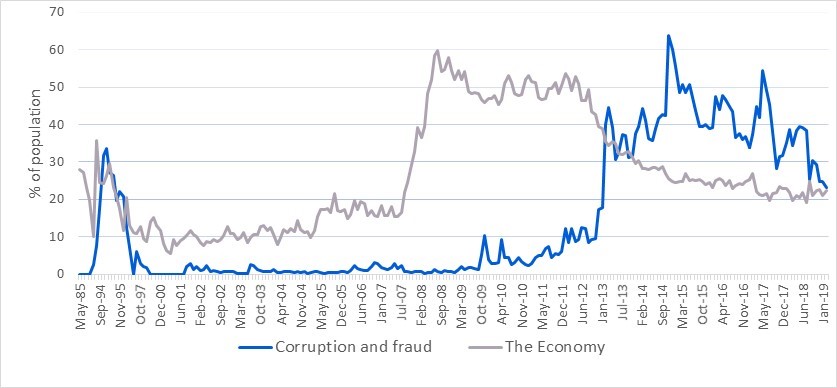
The graph below chronicles the percentage of Spanish Citizens who named the economy (grey line) and fraud/corruption (blue line) as one of the three most important problems facing the country, during the period leading up to and following the economic downturn of 2008. Unsurprisingly, after the Spanish economy crashed, some 50% of the citizens of Spain noted that the economy was one of the most important issue affecting them, and this concern remained predominant for the next three years, though it started to decline a bit after 2011. As for corruption and fraud, prior to the crash concerns about these issues hardly registered, except for a brief spike in 1993, an uptick came in the immediate aftermath of a slew of highly publicized corruption scandals, and dissipated quickly) Even after the 2008 crash, concern about corruption rose only slightly increased from 2008 to 2012. That big change came in 2013, when the news broke that important members of the conservative PP party were allegedly involved in the Gürtel case, one of the most serious recent corruption scandals to rock Spain. More interesting is the fact that Corruption has remained a top concern of Spanish citizens ever since. There’s been a bit of tapering off since concern over corruption reached its peak in late 2014, but more than 20% of Spanish citizens still list corruption as one of the country’s most serious problems, roughly the same number of name the economy.

Why is this? Or, to put the question more generally, what kind of changes need to take place within a collective society’s ethos in order to bring about engaged citizen awareness and opposition to corrupt activities? Continue reading

Guest Post: Expert Interviews on Corruption Control in Latin America

Today’s guest post is from Columbia University Professor Paul Lagunes, who this year is also a Visiting Fellow at Rice University’s Baker Institute for Public Policy:

Elections in Latin America are freer and fairer than they used to be, and, with rare exceptions, political power in the region is no longer monopolized by a single individual, junta, or party. From Chile to Mexico, legal reforms have promoted higher levels of government transparency and citizen participation. But in spite of these improvements, the region continues to grapple with systemic corruption. Not only are individuals asked to pay bribes by lower-level government officials, but scandals such as Lava Jato (“Car Wash”) in Brazil, La Estafa Maestra (“The Master Fraud”) in Mexico, and La Línea (“The Line”) in Guatemala have revealed grand corruption at the most senior levels, making the fight against corruption a top priority for the region.

Prompted by these concerns, I contributed to organizing a conference at Rice University’s Baker Institute for Public Policy on corruption control in Latin America, which has already been featured (with links to the conference videos) on this blog. Some of the conference panelists stayed long enough that we were able to interview them about their important work. Tony Payan, my colleague at the Baker Institute and an expert on U.S.-Mexico border issues, agreed to conduct the interviews.

The videos of these interviews are now publicly available, and are well worth viewing for those interested in hearing a diverse range of perspectives on the corruption challenges currently facing Latin America. In this post I will provide links to the interviews as well as a brief summary of their content. (There’s also an online website, where you can find all the interviews, here.) Continue reading

Guest Post: An Austrian Political Corruption Scheme was Caught on Video–But Most Probably Aren’t

Today’s guest post is from Jennifer Kartner, an anticorruption researcher who recently received her Ph.D. in political science from Arizona State University:

On Friday, May 17, 2019, the German newspapers Der Spiegel and the Die Sueddeutsche Zeitung released an explosive video showing two key politicians of the far-right Austrian Freedom Party (FPÖ), Heinz-Christian Strache and Johann Gudenus, scheming with a woman who claimed to be a wealthy Russian citizen. Their meeting took place in July 2017, a few months before the October 2017 Austrian parliamentary elections. In the video, Strache and Gudenus discuss how, with the help of the woman, they could ensure that the FPÖ wins the upcoming elections. The plan was that the Russian would buy 50% of the Austrian newspaper Die Kronen Zeitung—a newspaper reaching a third of all Austrian news consumers—before the elections, and then she would ensure that the already-populist newspaper would drum up more support for the FPÖ. (Mr. Strache estimates in the video that the newspaper takeover would help push the FPÖ’s expected vote share from 27 to 34 percent.) Once the FPÖ won the election, FPÖ elected officials would return the favor by helping the oligarch win contracts for public construction projects; all she had to do was to establish a construction company that could plausibly compete with the Austrian firm Strabag. The three meeting participants also talked about the possibility of privatizing the Austrian public broadcast station ORF, and Mr. Strache spoke of wanting to build a media landscape “just like Viktor Orbán built in Hungary.” But the deal never actually came together. Die Kronen Zeitung didn’t change owners, the FPÖ came in third in the parliamentary elections and ended up entering into a coalition government with the center-right ÖVP, and Strabag continues to win the majority of public construction contracts in Austria.

The political backlash in response to the publication of the video was swift and severe. An estimated 5,000 people came out to protest on the streets. A day after the publication, Mr. Strache resigned from his Vice-Chancellorship, as well as his other political and party positions, and issued a public apology, and a couple of days after that, all remaining FPÖ ministers in the government were fired or resigned in protest. While Austrian authorities are still debating whether they can charge Mr. Strache for any criminal activities, the public’s response shows that, regardless of the legal ramifications, ordinary citizens view this behavior as corrupt.

But perhaps one of the most disturbing things about this affair is that if the parties had gone through with their plan, and the secret video had never been leaked, neither the authorities nor the public would likely have ever had any reason to suspect a complex corruption scheme behind it. To see this, suppose for the moment that the scheme went ahead as planned. Would anyone have caught on? The answer is likely no: Continue reading

New Podcast Episode, Featuring Frederik Obermaier

A new episode of KickBack: The Global Anticorruption Podcast is now available. This week’s episode features an interview with Pulitzer Prize-winning investigative journalist Frederik Obermaier (of the German publication Süddeutsche Zeitung), best known for his work on the Panama Papers investigations, and more recently for the story on the secret videos that exposed leading figures in one of Austria’s major political parties engaging in corrupt negotiations with someone they thought was the relative of a Russian oligarch. In the interview, Frederik and I discuss both of these high-profile stories, as well as broader questions regarding the role of investigative journalism in the fight against corruption and some of the challenges facing the independent media today.

You can find this episode, along with links to previous podcast episodes, at the following locations:

KickBack is a collaborative effort between GAB and the ICRN. If you like it, please subscribe/follow, and tell all your friends! And if you have suggestions for voices you’d like to hear on the podcast, just send me a message and let me know.

Video: CAPI Panel on “Anti-Corruption Efforts in Latin America”

Recent developments in the fight against corruption across Latin America seem to have prompted an increasing number of conferences, workshops, and similar events that focus on this issue. (I was able to participate in one such event at Rice University’s Baker Center a few months back.) Last month, Columbia University’s Center for the Advancement of Public Integrity (CAPI) held another, similar event that may be of interest to those who follow these developments (indeed, perhaps of even greater interest to those who haven’t been following them, but would like to get up to speed). The panel, entitled “Anti-Corruption Efforts in Latin America: Perspectives from Brazil, Argentina, Colombia, and Mexico,” was moderated by Daniel Alonso (Managing Director of Exiger), and featured four senior lawyers from the region: Eloy Rizzo Neto (Brazil), Gustavo Morales Oliver (Argentina), Diego Sierra (Mexico), and Daniel Rodriguez (Colombia). The video of the discussion can be found here. And here’s a quick overview of the discussion, with corresponding time markers for the video: Continue reading

Anticorruption Bibliography–May 2019 Update

An updated version of my anticorruption bibliography is available from my faculty webpage. A direct link to the pdf of the full bibliography is here, and a list of the new sources added in this update is here. As always, I welcome suggestions for other sources that are not yet included, including any papers GAB readers have written.

Guest Post: France’s New Asset Recovery Bill Is an Important Step Toward Achieving Victim Compensation

GAB is delighted to welcome back Mat Tromme, Director of the Sustainable Development & Rule of Law Programme at the Bingham Centre for the Rule of Law, who contributes the following guest post:

Where asset recovery is concerned, France is probably best known for the conviction of Teodorin Obiang—the Vice President of Equatorial Guinea and son of the President—for money laundering (the first time that a French court has convicted a serving senior official of a foreign government), which resulted in the court ordering the forfeiture of some of Obiang’s assets, worth around USD 150 million. The decision is still under appeal, and the next hearing is scheduled for December 2019. But even if the conviction and associated forfeiture order are upheld, under existing French law those assets will go to the French state. (It is unclear whether other plaintiffs who can also establish a valid claim on the assets could also benefit from them in any way.) The forfeited funds will not go to the true victims of Obiang’s corruption—the people of Equatorial Guinea.

There are obviously a number of moral and practical questions coming out of this, not least the fact that the French state keeps the looted assets, as French courts remarked. Some countries and commentators argue that in cases of grand corruption like this, the forfeited assets should go back to the country from which the funds were stolen. But in the Obiang case, it would seem nonsensical to suggest that the forfeited assets be transferred to the government of Equatorial Guinea, as that would be tantamount to returning those assets to the Obiang family itself. The challenge, which many have struggled with, is how to return assets to a country in a way that benefits the victim populations when the country’s government is controlled by a kleptocratic political elite and where there is no rule of law. Related to this, it also raises questions about who ought to be considered the victim (the state, or the population?), and, if the latter, how to go about making appropriate compensation.

Earlier this month, the French Senate agreed on a new asset forfeiture bill that would address this problem by amending existing law so that when a French court orders the forfeiture of the illicit assets of a foreign public official or other politically exposed person (PEP), those assets, rather than being forfeited to the State, would instead go into a special fund that seeks to improve living standards of victim populations, improve the rule of law, and fight against corruption in the country where the offenses took place. (The state would, however, be able to retain a portion of the assets, up to a specified limit, to cover the costs of bringing the case in the first place.) Under the proposed bill, assets would be forfeited to the French state only in those cases where it is “absolutely impossible” to return the assets to the victim populations. The bill also calls for greater “transparency, accountability, efficiency, solidarity, and integrity” in the asset return process, principles that civil society had actively pushed for.

Of course, a great many details would still need to be worked out as the bill makes its way through the lower house of the French parliament (the Assemblée Nationale), especially as it’s not altogether straightforward to figure out how best to ensure that the seized funds will benefit the victim populations. The discussions at the Committee level in the Senate evince a preference for channeling forfeited funds through Overseas Development Assistance (ODA) on a case by case basis. But many of the practicalities still need attention, and French legislators have instructed the Conseil d’Etat (a body that provides legal advice to the government and doubles as a supreme court for administrative matters) to advise on the practical implementation of orders to return assets to victim populations. (When the Conseil d’Etat does so, this will itself be an important decision, one that the anticorruption should pay close attention to.)

And there are some other difficulties too, which Senators and their officials have openly acknowledged. As it currently stands, the French Criminal Procedure Code says that the return of assets requires the agreement of the requesting state (which, as discussed above, may not happen where a country is very corrupt), and so the Code will likely need amendments.Moreover, the offenses that would trigger asset forfeitures under the proposed bill are limited to concealment and laundering the proceeds of all crimes, though the Committee report also recognizes there may be difficulties with including any crime within the scope of offenses that can lead to forfeiture. Finally, though the bill focuses on assets seized from PEPs, that term is not actually fully defined in French law.

Despite these concerns, the bill is a significant step in the right direction, and a good illustration of how civil society organizations can inform and influence the asset return process (Transparency International France played a key role in encouraging the Senate to table the Bill, and CSOs and governments are also coming together to address the difficult questions that cases like these raise with respect to victim compensation.) Indeed, civil society involvement will be crucial to ensuring that the law is adopted by the Assemblée Nationale and implemented in a transparent way.

Guest Post: It’s Time for Plan B on Disbursing the Obiang Settlement Money to the People of Equatorial Guinea

Today’s guest post is from the civil society group EG Justice, a civil society organization that promotes the rule of law, transparency, and the protection of human rights in Equatorial Guinea. (For a longer discussion of the issues raised in this blog post, please visit the EG Justice website: www.egjustice.org.)

Last month, Professor Stephenson asked: “Whatever Happened with that Charity the Obiang Settlement Was Supposed to Fund?”  Not coincidentally, thousands of people in Equatorial Guinea have been asking themselves that same question for the last five years, and they have yet to receive a satisfactory answer. We are not entirely surprised by the impasse. When one drives into a cul-de-sac, with clear road signs warning ahead of time that there is no exit, one should only expect to return to the entry point. Likewise, when negotiating with authoritarian kleptocrats who consider themselves above the law and who are accustomed to acting with absolute impunity, it would be naïve to expect them to negotiate fairly.

The settlement between Equatorial Guinea and the U.S. appears to anticipate this impasse, laying out several options. The settlement first lays out what we might call “Plan A”:  Within 180 days, the U.S. authorities and the defendant (Teodorin Nguema Obiang) are to jointly select a charity to receive the funds realized from the sale of Nguema’s seized assets, with that charity to use the funds for the benefit of the citizens of Equatorial Guinea. But in apparent anticipation of the difficulties in reaching such an agreement, the settlement goes on to lay out a “Plan B,” according to which, if the U.S. and Nguema can’t mutually agree on a charity within 180 days of the sale of the assets, a three-member panel is to be convened to receive and disburse the funds—with one member of the panel chosen by the U.S., one by Nguema, and one, the Chair, by mutual agreement. Again anticipating the possibility that the parties will be unable to agree, the settlement has a “Plan C” (or a “Plan B-2”): If the parties can’t agree on a panel Chair, within 220 days after the sale of the property, the court retains the discretion to order the parties to participate in mediation, or the court may simply select a panel Chair directly. Continue reading

New Podcast Episode, Featuring Bo Rothstein

A new episode of KickBack: The Global Anticorruption Podcast is now available. This week’s episode features an interview with Bo Rothstein, the  August Röhss Professor of Political Science and the co-founder of the Quality of Government Institute at the University of Gothenburg. In the interview, Bo and I discuss a range of topics, including the right way to define corruption (and its opposite), how the field of anticorruption studies has changed in the past 20 years, what we’ve learned about the most effective ways of addressing systemic corruption, and what ought to be at the top of the agenda for future research.

You can find this episode, along with links to previous podcast episodes, at the following locations:

KickBack is a collaborative effort between GAB and the ICRN. If you like it, please subscribe/follow, and tell all your friends! And if you have suggestions for voices you’d like to hear on the podcast, just send me a message and let me know.

Guest Post: New OECD Report Highlights the Importance of Non-Trial Resolutions in Foreign Bribery Cases

Today’s guest post is from Senior Legal Analyst Sandrine Hannedouche-Leric, together with Legal Analysts Elisabeth Danon and Brooks Hickman, of the OECD Anti-Corruption Division.

 In December 2016, Brazilian, Swiss, and US authorities announced that the Brazilian construction giant Odebrecht would pay a combined fine of USD 3.5 billion as part of a coordinated resolution of foreign bribery allegations—the largest foreign bribery resolution in history. Like many foreign bribery cases concluded in the last decade, the Odebrecht case was resolved outside a courtroom. In fact, non-trial resolutions, also referred to as settlements, have been the predominant means of enforcing foreign bribery and other related offences since the OECD Anti-Bribery Convention entered into force 20 years ago.

The OECD Working Group on Bribery recently published a report on Resolving Foreign Cases with Non-Trial Resolutions. The report develops a typology of the various non-trial resolution systems used by Parties to the Convention, and sheds light on the operation and effectiveness of these systems. It also looks at the challenges they raise for law enforcement authorities, companies and other stakeholders in the resolution process. The data collected for the Study confirms and quantifies the widely-recognized fact that settlement, rather than trial is the dominant mechanism for resolving foreign bribery cases. The report finds that close to 80% of the almost 900 foreign bribery cases concluded since the OECD Anti-Bribery Convention came into force have been concluded through non-trial resolutions, and among the three most active enforcers of foreign anti-bribery laws—the United States, Germany, and the United Kingdom—this percentage rises to 96%. Non-trial resolutions have been responsible for approximately 95% of the USD 14.9 billion (adjusted to 2018 constant US dollars) collected from legal persons sanctioned to date. Additionally, the report finds that coordinated multi-jurisdictional non-trial resolutions have been on the rise over the past decade. Such coordination, which would not be possible through trial proceedings, has permitted the imposition of the highest global amount of combined financial penalties in foreign bribery cases. Eight of the ten largest foreign bribery enforcement actions involved coordinated or sequential non-trial resolutions involving at least two Parties to the Convention.

The study was launched last month during the OECD Global Anti-Corruption and Integrity Forum, in a panel discussion moderated by the Head of the World Bank’s Integrity Compliance Unit. Building on the Study’s key findings, law enforcement officials from Brazil, France, the United Kingdom and the United States discussed the challenges associated with non-trial resolutions based on their first-hand experience, and explained why the use of these instruments will likely continue to grow in the future. In particular, they discussed how non-trial instruments can help overcome procedural hurdles and fundamental differences between legal systems and cultures, and thus facilitate cross-country coordination in the resolution of foreign bribery cases. (The video of the session is accessible online. See the section “Watch Live” for Room 1 starting at 8:13:00).