African Countries and the Corruption Perceptions Index: Don’t Blame the Messenger

Transparency International (TI) released its annual Corruption Perception Index earlier this year. As many readers of this blog are likely aware, the CPI is quite controversial, particularly in developing countries that typically fare poorly on the index. When I was a Board Member of the African Union Advisory Board on Corruption (AUABC) and President of the Network of Anti-Corruption Institutions in West Africa (NACIWA), it seemed that every time the CPI came up in our meetings, the typical reaction ranged from disapproval to outrage, with many challenging the legitimacy and authenticity of the index. More broadly, many African government officials and business people see the CPI, as well as TI’s accompanying commentaries, as part of a Western-driven smear campaign against African countries.

I do not share this view. I agree that the CPI has significant flaws and limitations, which are familiar enough that they need not be rehearsed at length: the CPI relies on subjective and potentially unreliable perceptions, the underlying sources are not always being sufficiently transparent as to the qualifications of the “experts” who assign scores, and the CPI does not cover some of the crucial issues that antigraft fighters focus on, such as tax fraud, money laundering, and illicit financial flows. I share concerns about the way the CPI is sometimes used by TI and other parties to paint an inaccurate and sometimes unfair picture of how well anticorruption fighters are doing their job. Yet despite these shortcomings, the CPI helps put pressure on governments worldwide to do more about corruption, and the index can be helpful in guiding efforts to combat graft in Africa and elsewhere. Indeed, while many African government officials and business elites criticize the CPI, most African civil society actors appreciate it and find it a credible reflection of the situation in their countries, and it gives them a powerful rhetorical tool to call on their governments to do more on this issue.

Therefore, while it is, of course, reasonable to point out the CPI’s flaws and limitations, African government officials—particularly those who work in anticorruption agencies (ACAs)—would do better to focus their energies not on denouncing the CPI but rather on reforms that can present a better picture of their respective countries. Continue reading
U.S. Justice Department Does What Mongolia’s Government Wouldn’t

GAB readers will remember posts in late 2020 and early 2021 recounting damning evidence implicating Mongolian political kingpin S. Batbold in a massive corruption scheme (here, here, and here). Although Batbold fiercely and forcefully denied the allegations to GAB (here), the evidence that corruption during his tenure as Prime Minister netted him tens if not hundreds of millions of dollars seemed overwhelming.

So overwhelming that it prompted the Mongolian government to open a corruption investigation in Mongolia and initiate litigation in the United States to recover New York real estate press reports showed he had bought with corruption proceeds. Nothing came of either, however. Batbold runs the country’s dominant political party, the Mongolian People’s Party, and after a protégé won the June 9, 2021, presidential election, both the Mongolian and New York cases were shut down.

But the evidence did not go away. Yesterday, the U.S. Department of Justice took up what Mongolia had dropped, filing suit to seize the two New York apartments Batbold owns. As the head of the Department’s Criminal Division explained in disclosing the suit:

“Sukhbataar Batbold used his position as prime minister to award lucrative contracts to sell copper concentrates from a Mongolian state controlled mine to entities that were owned and controlled by his known associates or his son. These intermediaries, who had little to no experience in the copper trade, played no part in providing financing for the purchase of the copper concentrates or in arranging the sale or shipment of the commodities. They simply concealed the fact that Batbold and his family were violating Mongolian anti-corruption laws by benefiting from the sale of millions of dollars’ worth of Mongolian natural resources.

“The former prime minister of Mongolia abused his position as prime minister to profit from the sale of his country’s natural resources.  He and his family used the proceeds of their corrupt scheme to buy $14 million in high-end real estate in the United States.”

The Department’s Kleptocracy unit is responsible for the case, and consistent with its kleptocracy policy, the Department said it would work to see that the proceeds of whatever property of Batbold is recovered would go to the people of Mongolia, “the people harmed by these acts of corruption and abuse of office.”

Mongolians elect a new parliament June 9.  Suppose they might want to ask why it was left to the Department of Justice to do what their government should have done long ago?

Gibraltar Government on Trial for Corruption

Today’s Guest Post is by Robert Barrington, Professor of Anti-Corruption Practice at the Centre for the Study of Corruption, University of Sussex (UK); and formerly the Chair of Transparency International’s International Council.

With a population of a mere 34,000 and a parliament of 17 elected members, Gibraltar seldom attracts the world’s attention, except in the periodic spats between Britain and Spain as to its territorial status.  One of Britain’s Overseas Territories, like the Cayman Islands and British Virgin Islands, it’s part of the remnants of the Empire which never became independent.  Like those other territories, Gibraltar has become a financial centre – particularly known for online gambling – and is officially ruled by a hands-off Governor on behalf of the British crown.

Small states have a very mixed record when it comes to corruption.  Some, like Singapore and Hong Kong (prior to the recent ‘Chinafication’), have in the past successfully led crackdowns on corruption, backed up by powerful and effective anti-corruption agencies.  But small states can all too easily be captured by vested interests and go in the opposite direction – see, for example, Wouter Veenendaal’s article on ‘How smallness fosters clientelism; a case study of Malta.’

The picture in Britain’s Overseas Territories is relatively obscure.  They are so small that they do not generally feature  on global indices of corruption. There is usually a non-existent, or at best government-friendly local media and civil society; independence – in the judiciary, police, or other pillars of the state – is hard to achieve when everyone knows everyone.  Ideal conditions for state capture.

Many of the Overseas Territories dance on the edges of the FATF greylist, periodically creeping on and off. Gibraltar was added to the list in June 2022 and removed in February 2024.  The British Virgin Islands, Turks & Caicos and Cayman Islands have all had corruption scandals at the heart of government, often related to dirty money.  In fact, it is thanks to those scandals and the subsequent attention they garner (via the international media, public enquiries, and occasionally prosecutions) that we have at least a partial picture of what is going on.

So what is happening in Gibraltar? 

Continue reading

Australia Adopts a U.K.-style “Failure to Prevent Bribery” Offence, But Hits Pause on Deferred Prosecution Agreements

Australia’s current government has achieved greater anticorruption reform than its predecessor by a considerable margin. In July 2023, it delivered on a key election promise to establish a National Anti-Corruption Commission, an independent agency charged with investigating public corruption. In March 2024, it passed the Crimes Legislation Amendment (Combatting Foreign Bribery) Act 2023, the most significant reform to the Australian foreign bribery regime since its introduction in 1999. The amendment makes significant changes that broaden and strengthen Australia’s anti-foreign-bribery law. Perhaps the most significant change of these changes is the introduction of a new corporate offence of failing to prevent foreign bribery, closely modeled on a similar offense contained in the UK Bribery Act (UKBA). Once Australia’s new law comes into force later this year, a corporation can be held criminally liable if it fails to prevent an “associate” from paying a bribe to benefit the corporation. This offence is predicated on an underlying violation of the federal foreign bribery offence, which means that the prosecution must still establish that the associate acted with the intent to influence a foreign official. If the prosecution makes this showing, the burden shifts to the corporate defendant to show that it had in place adequate procedures to prevent bribery. (Unlike the UKBA, however, Australia’s new failure-to-prevent-bribery offense applies only to failure to prevent bribery of foreign officials or candidates for foreign public office; the UKBA offense applies to failure to prevent any sort of bribery, including domestic and private bribery.) Looking more closely at the details of the new offense demonstrates that the scope of potential liability is indeed quite broad: Continue reading

New Podcast Episode, Featuring Gretta Fenner and Daniel Eriksson

A new episode of KickBack: The Global Anticorruption Podcast is now available. In this episode, host Liz Dávid-Barrett speaks with Gretta Fenner, the Managing Director of the Basel Institute on Governance, and Daniel Eriksson, the CEO of of Transparency International. The episode was recorded shortly after Gretta and Daniel attended the Munich Security Conference, where they raised the issue of corruption as a key national security concern, and the podcast conversation focuses on that issue as well. The discussion touches on the new global context of heightened insecurity and the implications this has for those working to counter corruption. They also discuss the phenomenon of “strategic corruption,” defined in the U.S. Strategy on Countering Corruption as “when a government weaponizes corrupt practices as a tenet of its foreign policy,” and how addressing this sort of corruption, though essential, may raise challenging questions for anticorruption campaigners about the problem of “picking sides” in global political conflicts. You can also find both this episode and an archive of prior episodes at the following locations: KickBack was originally founded as a collaborative effort between GAB and the Interdisciplinary Corruption Research Network (ICRN). It is now hosted and managed by the University of Sussex’s Centre for the Study of Corruption. If you like it, please subscribe/follow, and tell all your friends!

Guest Post: Model Open Government Partnership Commitments for Fighting Kleptocracy

Today’s guest post is from Jodi Vittori, Professor of Practice at Georgetown University:

This past January, I authored a report, co-sponsored by the Open Government Partnership (OGP) and the National Democratic Institute, entitled “Committing to Combat Kleptocracy: A Guide for Open Government Partnership Members.” The report explains how various kleptocrats and their “enablers” move illicit assets from the country where they were stolen to the locations where they will be stored and enjoyed. The report also discusses how kleptocracy undermines not only the countries where the assets were stolen, but also the transit or destination points for kleptocratic money, people, and other resources.  While it might seem like an infusion of money, assets, and rich people into a given country might be a benefit for that country (putting aside the moral issues), it turns out that these inflows have real drawbacks for the host state, contributing to governance backsliding, facilitating real estate manipulation and industrial asset stripping, exacerbating migration challenges, and undermining national security. The role of Russia’s kleptocracy in election interference in the West, as well as the corruption associated with China’s Belt and Road Initiative, have helped put the role kleptocratic inflows play in receiving states in the spotlight.

The OGP’s open government principles—to which all OGP member governments commit—are a set of norms that, if honored and implemented, will help countries fight back against inflows of kleptocratic assets. At the most basic level, the OGP stresses the importance of making relevant, usable, and timely information on governments available to citizens and civil society to hold their governments accountable. This helps ensure that public resources are managed transparently, fairly, and equitably. The report develops this further by outlining a series of model OGP commitments for consideration by governments and citizen activists, including the following: Continue reading

Job Postings: Centre for the Study of Corruption and International Centre for Asset Recovery

Two first-rate anticorruption NGOs have openings —

The Centre for the Study of Corruption (CSC) based at the University of Sussex in the UK has recently received a multi-million dollar grant from the UK government to research Anti-Corruption Evidence (ACE) – part of the wider ACE programme run by the Foreign, Commonwealth & Development Office. It has openings with a closing date of March 25th for two positions: Programme Manager (details here) and Comms Manager (details here).

The Basel Institute on Governance is an independent non-profit organisation working across sectors to counter corruption and related financial crimes and to improve the quality of governance. Registered as a Swiss foundation with headquarters in Basel, the Institute works globally and maintains field operations around the world. The International Centre for Asset Recovery (ICAR) is a division of the Basel Institute that aims to strengthen the capacities of countries around the world to recover assets stolen through corruption. It has an opening for a (Senior) Specialist, Asset Recovery Policy (details here.)

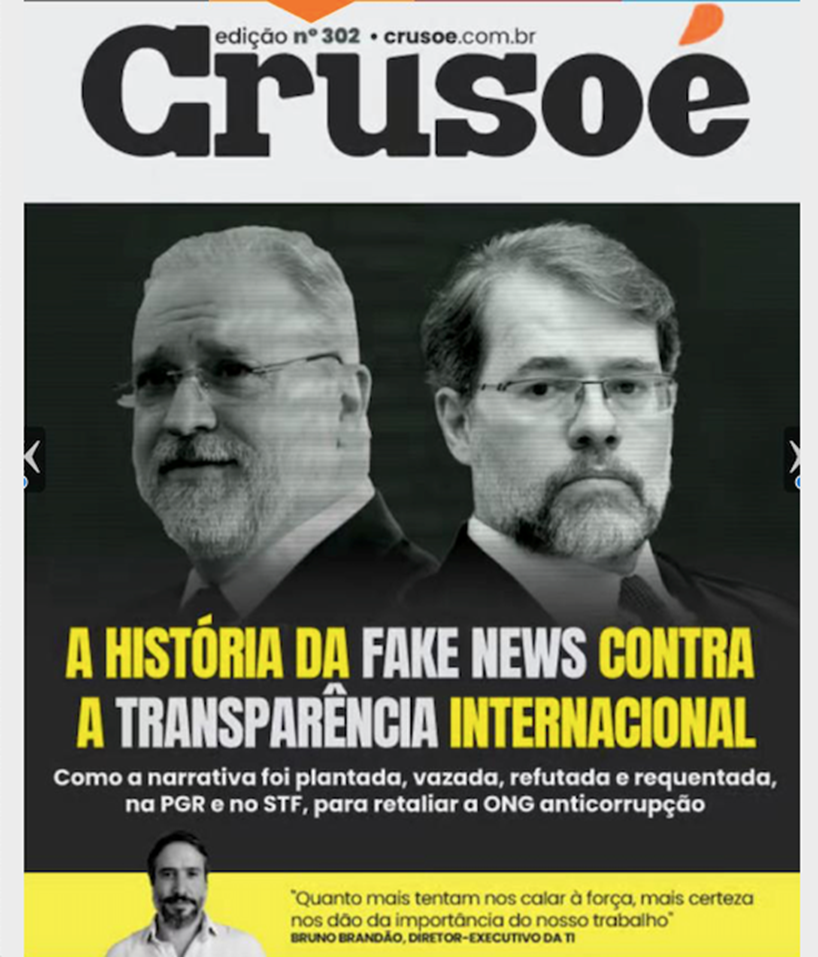
The Fake News and Corruption Behind the Criminal Investigation of Transparency International

Transparency International and its Brazilian chapter are now the subject of a criminal investigation in Brazil. As GAB readers know (here), the investigation is part of Supreme Court Justice Dias Toffoli’s crusade to reverse the convictions handed down in Lava Jato, the landmark Brazilian corruption case. The aim is to ensure defendants escape all punishment in Brazil and are protected from prosecution in the dozen other Latin American and African countries where they paid bribes.

Today’s Guest Post by a Brazilian insider reveals just how groundless the investigation of TI is and Justice Toffoli’s direct conflict of interest in letting one of the Lava Jato defendants off the hook. The author explains that it starts, as the respected Brazilian journal Crusoé explains in the headline to its February 16 issue, with “A HISTORY OF FAKE NEWS AGAINST TRANSPARENCY INTERNATIONAL: How the narrative was planted, leaked, refuted and reheated in the PGR [Federal Attorney General Office] to retaliate the anti-corruption NGO.”

Continue reading

New Podcast Episode, Featuring Alison Taylor

A new episode of KickBack: The Global Anticorruption Podcast is now available. In this episode, host Dan Hough interviews Alison Taylor, a Clinical Associate Professor at NYU Stern School of Business and the author of the recently published book, Higher Ground: How Business Can Do the Right Thing in a Turbulent World. The interview, like the book, focuses on the topic of business ethics, including how the corporate sector addresses issues relating to bribery and other forms of corruption. In the interview, Alison first talks about her career path, which began focused on conducting investigations into corruption by businesses, and then broadened out to consider issues of corporate responsibility and business ethics more broadly. She then describes the impact of international anti-bribery laws on businesses, and raises some questions about the corporate compliance regimes these laws have created. You can also find both this episode and an archive of prior episodes at the following locations: KickBack was originally founded as a collaborative effort between GAB and the Interdisciplinary Corruption Research Network (ICRN). It is now hosted and managed by the University of Sussex’s Centre for the Study of Corruption. If you like it, please subscribe/follow, and tell all your friends!