Guest Post: The Obiang Trial Suggests Innovative Approaches To Fighting International Corruption

GAB is pleased to welcome back Frederick Davis, a lawyer in the Paris office of Debevoise & Plimpton, who contributes the following guest post:

Over the past two months, the French Tribunal de Grande Instance in Paris (the principal trial court) heard evidence in the case against Teodoro Nguema Obiang Mangue (known as Teodorin), on charges of corruption and money laundering, among other allegations. Teodorin is the son of Teodoro Obiang Nguema Mbasogo, the long-time – and notoriously corrupt – President of Equatorial Guinea, a resource-rich country that also has some of the most widespread poverty in the world. Yet Teodorin, who is currently Vice President , owns vast real estate in Paris, a private jet, a yacht, and a fleet of vintage and modern automobiles, among his other known assets. This case has been discussed extensively on this blog (see here, here, here, here, here, here, here, and here), but it’s useful to recap how the case came to trial in the first place:

The case against Teodorin was primarily the result of diligent efforts by NGOs, including the French anticorruption group Sherpa and the French chapter of Transparency International (TI). In 2007, Sherpa and others filed a complaint with the Public Prosecutor in Paris alleging that the ruling families of Equatorial Guinea, Angola, Burkina Faso and the Republic of the Congo held assets in France that were not the fruits of their official salaries. After a brief investigation, the Public Prosecutor dismissed the claims. Several of the NGOs, joined in some instances by citizens of the countries in question, then used a French procedure known as constitution de partie civile to cause a criminal investigation by an investigating magistrate (juge d’instruction). This effort was opposed by the Public Prosecutor. A Court of Appeals initially upheld the prosecutor’s position and dismissed TI’s intervention, but in an important 2010 ruling, the French Cour de Cassation (Supreme Court) ruled that TI was a proper partie civile authorized to instigate the criminal investigation. Ultimately Teodorin was bound over for trial, now with the support of the Public Prosecutor (as well as the continued active participation of TI and other NGOs). A decision is expected in October.

The procedures that brought Obiang to trial are interesting because they highlight four important differences between French and US criminal procedures, and more generally illustrate several legal deficiencies, in countries like the United States, that often hinder the worldwide fight against transnational corruption: Continue reading
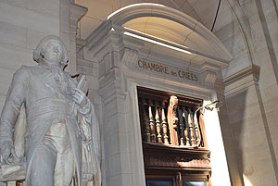
The Obiang Trial: Misstatements of Facts and Law in the Defense’s Closing Arguments

GAB is pleased to publish this account and analysis by Shirley Pouget and Ken Hurwitz of the Open Society Justice Initiative of the final arguments of Equatorial Guinean Vice President Teodoro Nguema Obiang’s lawyers at his Paris trial for what is in effect kleptocracy.

court roomTeodoro Nguema Obiang Mangue’s trial concluded July 5, 2017, with closing arguments by his defense counsel. The trial marks a major milestone in the struggle to ensure accountability for grand corruption, even when committed by those at the highest political levels.  A spicy mixture of high principle, juridical gravitas, and sophisticated argumentation on intricate issues of pressing urgency in the real world, the trial also contained moments of wrenching emotion and undignified, even scandalous, claims and insinuations.

The final day was devoted to arguments by Teodorin’s lawyers: Emmanuel Marsigny, Equatoguinean jurist Sergio Tomo, and Thierry Marembert.  In sum they claimed i) that their client didn’t steal enormous sums of money from the people of Equatorial Guinea, ii) that even if he did, the theft wasn’t illegal under Equatorial Guinean law, and iii) that even if he did steal the money and it was a violation of EG law, a French court did not have the right to try him for it.  Their arguments mixed misleading and often downright false statements of the evidence with strained and fanciful interpretations of the law, all seasoned with dark suggestions that the trial was about race and politics rather than the massive theft of resources from the citizens of Equatorial Guinea.     Continue reading

The Trade-Off Between Inducing Corporate Self-Disclosure and Full Cooperation

In discussions of appropriate sanctions for corporations that engage in bribery, much of the conversation focuses on the appropriate penalty reduction for firms that self-disclose violations, cooperate with authorities, or both. Self-disclosure and cooperation are often lumped together, but they’re not the same: Plenty of targets of bribery investigations, for example, did not voluntarily disclose the potential violation, but cooperated with the authorities once the investigation was underway.

This gives rise to a problem that is both serious and seemingly obvious, but that somewhat surprisingly is hardly ever discussed.

The problem goes like this: Enforcement authorities want to encourage self-disclosure, and they want to encourage full cooperation with the investigation; they would like to do so (1) by reducing the sanction for firms that voluntarily disclose relative to those that don’t, and (2) by reducing the sanction for firms that fully cooperate relative to those that don’t. But if the minimum and maximum penalties are fixed (say, by statute or department policy or other considerations), and the penalty reductions necessary to induce self-disclosure and full cooperation, respectively, are large enough (cumulatively greater than the difference between the maximum and minimum feasible sanction), then adjusting sanctions to encourage self-disclosure may discourage full cooperation, and vice versa.

It’s easiest to see this with a very simple numerical example: Continue reading

Does the First Amendment Protect Payment for Access?

 As many readers of this blog know, U.S. law on whether (or when) campaign donations can be proscribed by criminal anticorruption statutes is quite complicated, and to some degree unsettled. On the one hand, the Supreme Court has held that campaign contributions are constitutionally protected “speech” under the First Amendment of the U.S. Constitution. On the other hand, U.S. criminal law can and does prohibit campaign donations that are the “quid” in a classic quid pro quo bribery transaction. In other words, it would unconstitutional for the U.S. to prohibit campaign donations to politicians even if such a prohibition is motivated by the generalized worry that politicians might show special solicitude to the interests of their big donors. But it is perfectly constitutional for Congress to prohibit quid pro quo transactions in which a private interest offers a campaign donation as the “quid” in exchange for some “quo.”

It remains an open question, however, what can qualify as the “quo.” Certainly passing legislation, directing federal funding, and securing special regulatory benefits and exceptions would suffice. But what about mere access — an understanding between the donor and elected official that a campaign contribution will get the donor special access to the official? Two recent Supreme Court opinions — Citizens United v. FEC and McCutcheon v. FEC — contain language suggesting that it might be unconstitutional for U.S. law to prohibit an explicit quid pro quo agreement in which a politician offers access in exchange for campaign contributions. According to Citizens United, “[i]ngratiation and access . . . are not corruption,” while McCutcheon cautioned that “government regulation may not target the general gratitude a candidate may feel toward those who support him or his allies or the political access such support may afford” (emphasis added).

Despite this suggestive language, the Supreme Court has not yet had to confront head-on the question of whether the First Amendment protects quid pro quo payment-for-access. The closest it came was last year in United States v. McDonnell (discussed on the blog here, here, and here). In that case, Governor McDonnell helped to arrange meetings between businessman Jonnie Williams and government officials, and accepted personal gifts from Mr. Williams in exchange. By a vote of 7-0, the McDonnell Court reversed the governor’s conviction and construed the federal bribery statute at issue not to cover the governor’s conduct.

But this doesn’t resolve the constitutional question. McDonnell turned on the construction of the existing federal anti-bribery statute, which requires that the “quo” be an “official act,” which the Court construed narrowly as excluding provision of mere access. Moreover, McDonnell was not a First Amendment case, as the alleged bribes were not campaign contributions. Nonetheless, the Court did discuss the concept of corruption in a manner reminiscent of its opinions in Citizens United and McCutcheon. According to McDonnell: “[C]onscientious public officials arrange meetings for constituents, contact other officials on their behalf, and include them in events all the time. . . . The Government’s position [that McDonnell violated the law] could cast a pall of potential prosecution over these relationships if [a donor] had given a campaign contribution in the past . . . . Officials might wonder whether they could respond to even the most commonplace requests for assistance, and citizens with legitimate concerns might shrink from participating in democratic discourse.” Furthermore, McCutcheon — which was a First Amendment case — defined the sort of corruption that could justify restrictions on campaign donations as “a direct exchange of an official act for money” (emphasis added), which might imply that, at least in the campaign donation context, McDonnell’s reading of the anti-bribery statute is constitutionally required.

But is that right? Separate from the question of whether Congress should criminalize payment-for-access, and from the question of whether Congress has in fact done so in the existing federal anti-bribery statutes, is the question of whether Congress could criminally proscribe payment-for-access if it wanted to. In other words, is payment-for-access constitutionally protected? Though some of the Supreme Court’s recent language has suggested such a conclusion, I believe that proposition is wrong, for three reasons:

Continue reading

Telling Corruption’s Story, or Why is Corruption So Boring? (Part 2)

In my last post, I identified challenges inherent in creating campaigns that move laypeople to action against corruption, and I proposed solutions to these challenges. In this follow-up post, I will assess how two very different campaigns score on the factors previously proposed.

I’ll start with a less successful campaign: Transparency International’s call to “Unmask the Corrupt.” In late 2015, TI announced its Unmask the Corrupt campaign, which aimed, among other things, to “highlight the most symbolic cases of grand corruption.” The first phase of the campaign encouraged individuals to submit cases of grand corruption, from which TI would select semi-finalists to be voted on in the second phase. In the third phase TI would “look at the cases that have received the most votes and . . . openly discuss with all how the corrupt should be punished.” From 383 submissions, TI selected 15 semi-finalists, which included the “Myanmar jade trade,” “Lebanon’s political system,” and the “U.S. State of Delaware.”

In early 2016, TI announced that it had imposed “social sanctions” on the finalists (including Lebanon’s political system and Delaware). The toothiest of these sanctions were TI press releases which led to some negative coverage of the finalists in important media outlets. TI also launched #StopKadyrov, an Instagram-centered campaign against Chechen leader Akhmad Kadyrov, who had received all of 194 votes in the second phase of Unmask the Corrupt. An Instagram search for #StopKadyrov reveals that the hashtag has been used in a total of fifteen posts. When assessed against the factors I sketched in my previous post regarding the criteria for effective narratives—in particular, the importance of placing the audience in the role of potential heroes of the narrative, depicting a compelling (and repellant) antagonist against whom to struggle—these mediocre results are not surprising.

Continue reading

Tracking Corruption and Conflicts of Interest in the Trump Administration–August 2017 Update

This past May, we launched our project to track credible allegations that President Trump, as well as his family members and close associates, are seeking to use the presidency to advance their personal financial interests.Just as President Trump’s son Eric will be providing President Trump with “quarterly” updates on the Trump Organization’s business affairs, we will do our best to provide readers with regular updates on credible allegations of presidential profiteering. Our August update is now available here.

Despite all the drama and turbulence surrounding the Administration over the past month, there is relatively little new material in this month’s update. Perhaps the most notable new reports concern the President’s son-in-law, Jared Kushner. Over the past month, new reports surfaced concerning companies connected with Kushner’s family business attempting to leverage his name and position to secure Chinese investment in real estate development projects, despite previous apologies by Kushner Companies to cease such conduct; Kushner enterprises claimed no knowledge that associated promotion companies were doing this. Additionally, reports surfaced that Kushner tried and failed to secure an investment from a Qatari billionaire (and former Prime Minister) for Kushner Companies’ financially troubled property at 666 Park Avenue, and the Trump Administration’s subsequent support for the boycott of Qatar by several of its neighbors appears to have been driven by Kushner, fueling admittedly unproven speculation that the Administration’s foreign policy is being influenced by hostility born out of a failed business deal, and perhaps an interest in signaling to other foreign governments, or individuals closely associated with foreign governments, that failure to do business with Trump or Kushner companies on favorable terms will adversely affect relations with the U.S. government.

(Note: While we try to sift through the media reports to include only those allegations that appear credible, we acknowledge that many of the allegations discussed are speculative and/or contested. We also do not attempt a full analysis of the laws and regulations that may or may not have been broken if the allegations are true. For an overview of some of the relevant federal laws and regulations that might apply to some of the alleged problematic conduct, see here.)

The Obiang Trial: Prosecutor Seeks 3 Years Imprisonment, Large Fine, Asset Confiscation  

GAB is pleased to publish this account and analysis by Shirley Pouget and Ken Hurwitz of the Open Society Justice Initiative of the concluding arguments the civil parties and the prosecution made at the trial of Equatorial Guinean Vice President Teodorin Nguema Obiang.

The July 5th proceedings in the Obiang trial opened with the court rejecting the defense request that it be allowed to pursue its claim that the prosecution was unconstitutional.  It closed with the state prosecutor asking the court to find Teodorin guilty, sentence to him three years in prison, fine him €30 million, and confiscate all of his assets located in France.  In between the two civil parties – CORED, a coalition of Equatorial Guinean political parties, and Transparency International-France – presented their arguments in support of conviction.  Continue reading

The Swahili Word for Transparency, and the Fallacies of Linguistic Determinism

I recently attended a workshop where participants were debating, among other things, why reform initiatives to promote government transparency and other anticorruption measures in places like sub-Saharan Africa had such a (seemingly) poor track record. In the course of the conversation, a well-known tenured professor declared – as evidence for the proposition that cultural incompatibility explains much of this apparent failure – that “there isn’t even a Swahili word for ‘transparency.’”

I was flummoxed and expressed some confused skepticism, but this professor (who, by the way, is a white Englishman whose CV does not indicate that he speaks Swahili or has ever done any research in a Swahili-speaking country) insisted that this was not only true, but was strong evidence that government transparency was an alien concept in Swahili-speaking societies.

It wasn’t a terribly important part of the discussion — more of an aside — and the conversation swiftly moved on. But the assertion that this linguistic lacuna demonstrates a significant cultural gap–one with important policy implications–has been bugging me ever since, not least because it reminded me of Ronald Reagan’s absurd claim that “in the Russian language there isn’t even a word for freedom.” (There is, by the way: svoboda.) So just in case this specific claim about Swahili, or linguistic arguments like this more generally, are an emerging meme in the anticorruption commentariat, I thought it would be worth a quick post to try to nip this nonsense in the bud.

So, what’s wrong with the claim that there’s no Swahili word for transparency? Three things: Continue reading