Georgia at the Crossroads: The MEGOBARI Act As a Rule-of-Law Lifeline

GAB welcomes this post by Giorgi Meladze, Associate Professor at Ilia State University School of Law in Tbilisi and an invited lecturer at European Humanities University; Konstantine Chakhunashvili, PhD Associate Professor at Caucasus University; and Nadia Asaad, journalist and researcher working with the Center for Applied Nonviolent Action and Strategies and a graduate student at the Paris Institute of Political Studies (Sciences Po).

Once praised as a “Beacon of Democracy,” Georgia now faces mounting concerns over its slide towards authoritarian rule. Under the influence of oligarch Bidzina Ivanishvili, the country’s ruling elite is consolidating power through corrupt, authoritarian practices. While the United States and several European Union member states have already responded with sanctions targeting key decision-makers and their associates, Washington lawmakers are now debating legislation supported by both Republicans and Democrats to ratchet up the pressure.

The Mobilizing and Enhancing Georgia’s Options for Building Accountability, Resilience, and Independence (the MEGOBARI Act) would require the President to impose new sanctions on Georgian leaders and anyone “engaged in significant acts of corruption or acts of violence or intimidation in relation to the blocking of Euro-Atlantic integration in Georgia.” It is an essential element in defending democracy and the rule of law in Georgia. which in turn will help prevent organized crime networks operating through and in Georgia from fueling Russia’s war machine and undermining Euro-Atlantic integration.

After a decade of state capture, cosmetic “reforms”, and the consolidation of informal power networks, all documented by the Basel Institute, a sanctions regime codified by MEGOBARI Act and calibrated to the Georgian context is no longer optional: it is critical to prevent Georgia’s antidemocratic leanings from infecting its neighbors.

This post documents the Georgian state’s slide into a “cartel-state” and explains how MEGOBARI and other measures by U.S. and EU can arrest it.

Continue reading
Working Smarter, Not Harder: Using Secondary Sanctions to Strengthen the Global Magnitsky Act

Arkady Rotenberg, Vladimir Putin’s childhood judo partner, is living large. Despite using his relationship with Putin to facilitate state capture, gaining lucrative contracts for everything from constructing the bridge between Russia and Crimea to hosting spurious “anticorruption trainings” for state employees, and being subject to American sanctions since 2014, Rotenberg maintains extensive links with the global economy. He has used Deutschebank to move millions of dollars out of Russia, channeled investments through a technology firm co-owned with a member of the British royal family, and hired a well-connected Monegasque lawyer to manage his taxes and PR. Rotenberg is not alone: Corrupt officials around the world, and their cronies, use Western professional service providers to facilitate their use of corrupt funds.

The United States has a powerful and under-utilized tool to control connections between corrupt officials and the professionals service providers who enable them: the Global Magnitsky Act (sometimes shortened to “GloMag”), which authorizes the U.S. government to impose targeted sanctions on individuals engaged in serious human rights abuses and/or high-level corruption. To date, the U.S. has imposed GloMag sanctions on 299 persons deemed to have been involved in official corruption. Yet despite some high profile successes (see here, here, and here), critics have pointed out that GloMag remains too limited in scope to seriously impact many of its targets. Sanctions against corrupt officials remain mostly unilateral tools, with governments often failing to coordinate their sanctions, leaving opportunities for evasion (see here and here). And while GloMag has inspired similar efforts by 35 additional countries, many of these governments—and the European Union—use GloMag-inspired programs only to target human rights abusers, not those engaged in grand corruption (see here and here).

There have been proposals to increase the comprehensiveness of GloMag sanctions, ranging from simply listing more corrupt officials to convincing the EU to broaden its sanctions regime to cover those engaged in high-level corruption. While these are worthwhile efforts, the United States possesses an extremely powerful tool that it could use unilaterally to drastically increase the heft of GloMag sanctions, one which is already authorized by statute and executive order: secondary sanctions. Secondary sanctions are sanctions that are imposed on a set of persons or entities that transact with an individual who is subject to primary sanctions under GloMag or a comparable regime. The U.S. can and should impose secondary sanctions on the professional service providers (such as accountants, wealth managers, bankers, and real estate agents) that provide individuals covered by GloMag sanctions with the services they need to launder the proceeds of their corruption. Under such a regime, for example, if Deutchebank helps Arkady Rotenberg (already the target of sanctions) to move his money around the world, then the U.S. would also sanction Deutschebank—restricting its ability to transact using U.S. dollars, a disastrous outcome for many firms.

Continue reading

The Financial Weapon: Expanding Magnitsky Sanctions to Attack Corruption

Economic sanctions targeted at individual wrongdoers can be a potent weapon in the fight against global corruption. The United States’ 2016 Global Magnitsky Human Rights Accountability Act (GMA) authorizes the President to impose targeted sanctions on corrupt foreign officials and their associates. And the GMA has had successes in deterring corruption: As earlier posts on this blog have highlighted, the GMA has prompted countries to strengthen their anticorruption laws and has prompted businesses to cut ties with corrupt individuals. Yet despite these successes, Magnitsky sanctions remain a relatively underused anticorruption tool. The U.S. Treasury Department’s Office of Foreign Asset Control (OFAC) has only sanctioned around 200 people as part of its Magnitsky programs, and most of these individuals have been sanctioned for human rights abuses rather than corruption per se.

GMA sanctions can and should be scaled up by an order of magnitude, with a greater focus on targeting corrupt actors. The U.S. should be imposing GMA sanctions on several thousand people, not just a couple hundred. As the Biden Administration has recognized, global corruption increasingly threatens national and international security. In light of this, the Administration should use the GMA to impose sanctions on not only the most egregious of kleptocrats but those who engage in more modest—but still significant—forms of corruption. Continue reading

New Podcast Episode, Featuring Igor Logvinenko

A new episode of KickBack: The Global Anticorruption Podcast is now available. During the ongoing emergency in Ukraine, as Russia’s unprovoked military aggression throws the region and the world into crisis, my colleagues at the Interdisciplinary Corruption Research Network (ICRN) and I are going to try as best as we can to feature on KickBack experts who can shed greater light on how issues related to corruption relate to the ongoing crisis. And rather than keeping to our usual schedule of releasing new episodes every two weeks, we will release new episodes as soon as they are available. In the new episode, I had the opportunity to speak to Igor Logvinenko, Associate Professor at Occidental College and author of Global Finance, Local Control: Corruption and Wealth in Contemporary Russia. In the first part of our conversation, Igor discusses Russia’s Russia’s historical corruption and current financial integration into world business, and we then turn to the impact of the current sanctions on Russia–including government sanctions on Russia and Russian companies, actions by private companies, and the use of targeted individual sanctions and asset seizures. In addition to discussing these issues in the context of the current war, Igor also discusses more broadly the role of Western financial systems, international financial integration, and the possibility for locally-driven structural changes to fight grand corruption. You can also find both this episode and an archive of prior episodes at the following locations: KickBack is a collaborative effort between GAB and the Interdisciplinary Corruption Research Network (ICRN). If you like it, please subscribe/follow, and tell all your friends. And if you have suggestions for voices you’d like to hear on the podcast, just send me a message and let me know.

Corruption, Sanctions, and the War in Ukraine: A Short Interview in Harvard Law Today

My home institution’s in-house publication, Harvard Law Today, recently interviewed me on some of the topics we’ve been covering on this blog (see, for example, here, here, here, here, and here) and on the KickBack podcast (here and here) related to Russia’s attack on Ukraine. As I tried to emphasize in the interview itself, I am very far from an expert in many of the specific issues at the intersection of corruption and the Russia-Ukraine war, but I tried to pull together succinctly some of what I’d learned from conversations with actual expert over the last couple of weeks. For those who are interested, you can find the interview here.

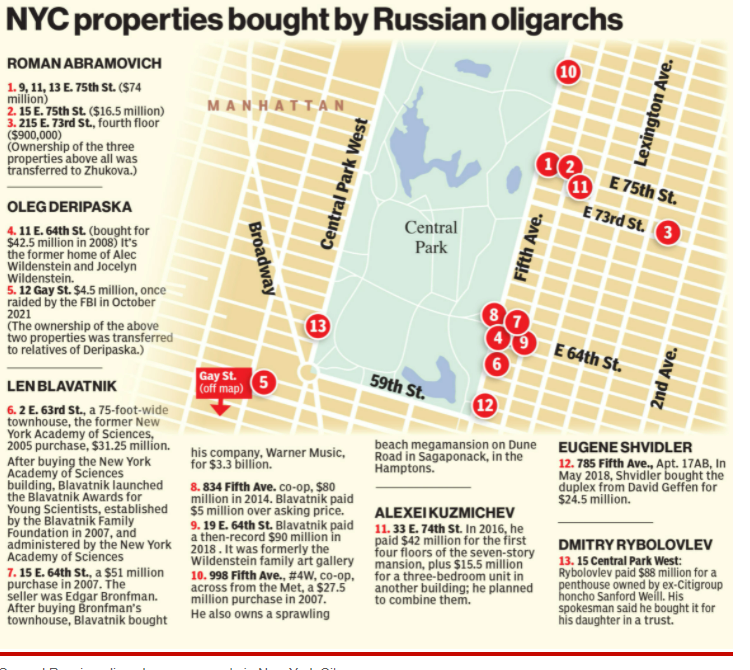
New York Real Estate Owned by Putin’s Buddies

Source: Jennifer Gould, Here’s where Russian oligarchs and their families own property in NYC, New York Post, February 27, https://nypost.com/2022/02/27/heres-where-russian-oligarchs-and-their-families-own-property-in-nyc/

Several media reports suggest sanctioning Putin’s supporters won’t be that easy because their ownership is hidden under layers of corporate vehicles. As Jennifer Gould’s story in the New York Post shows, thanks to the work of many investigative reporters and NGOs. we do know where many of Putin’s buddies have stashed their wealth in the Big Apple. Click here for a similar guide to London properties TI-UK has drawn up.

Is the Global Magnitsky Sanctions Program Working?

The 2016 Global Magnitsky Human Rights Accountability Act (GMA), inspired by the imprisonment and death of Sergei Magnitsky in Russia after his discovery of $230 million in tax fraud orchestrated by the Russian government, stands as the boldest authorization of U.S. economic sanctions in the fight against corruption. Executive Order 13818, issued in December 2017, designated the first sanctioned parties under GMA, enabling asset freezes and travel bans.

Since then, approximately 150 individuals and entities worldwide have been sanctioned for corruption under the GMA. (The GMA also allows for sanctions against human rights violators, and such authority was exercised to target 75 more individuals and entities.) The list includes current and former government officials—or those acting on their behalf—in Cambodia, China, Cyprus, Democratic Republic of the Congo, Dominican Republic, Equatorial Guinea, Gambia, Iraq, Latvia, Lebanon, Mexico, Nicaragua, Serbia, South Africa, South Sudan, Uganda, and Uzbekistan, among others. The designations include familiar names in the anticorruption community such as Gulnara Karimova, former Uzbek first daughter convicted of embezzlement and other corruption totaling more than $1.3 billion, Dan Gertler, the Israeli billionaire who earned millions of dollars through underpriced mining contracts in the Democratic Republic of the Congo, and Angel Rondon Rijo, a Dominican lobbyist central to Brazilian construction firm Odebrecht’s $4.5 billion Latin America-wide bribery-for-contracts scheme. Other sanctioned parties include the former Gambian president and first lady for misappropriating $50 million in state funds, a former Mexican judge and a former Mexican governor who took bribes from drug cartels, and a Sudanese businessman who, along with senior South Sudanese government officials, embezzled millions of dollars from a government food program.

The GMA represents a new era of so-called “smart sanctions.” Instead of limiting transactions with an entire country—as in the case of U.S. sanctions programs targeting Cuba, Iran, North Korea, and Syria—these individualized sanctions are designed to maximize harm and minimize collateral economic damage by restricting only bad actors’ access to global commerce, not that of entire populations. This approach is catching on outside the United States, with Canada, the United Kingdom, and the European Union recently announcing their own GMA-esque sanctions, while other countries, like Australia and Japan, are actively considering adopting similar programs.

Yet, a fundamental question remains: is the GMA working?

Continue reading

New Podcast, Featuring Charles Davidson

A new episode of KickBack: The Global Anticorruption Podcast is now available. In this episode, I interview Charles Davidson, currently the publisher of the American Interest magazine, and previously the co-founder of Global Financial Integrity and the Hudson Institute’s Kleptocracy Initiative. We discuss a variety of topics, including financial integrity, beneficial ownership transparency, and kleptocracy–including the threat that kleptocratic wealth from authoritarian states poses to liberal democracies, the use of targeted sanctions against individual corrupt actors, and concerns about how kleptocrats use Western institutions not only to launder their money, but also to launder their reputations.

You can find this episode, along with links to previous podcast episodes, at the following locations:

[NOTE: This episode begins with some introductory housekeeping material about future directions for the KickBack podcast. If you want to jump straight to the interview, it begins at 3:07.]

KickBack is a collaborative effort between GAB and the ICRN. If you like it, please subscribe/follow, and tell all your friends! And if you have suggestions for voices you’d like to hear on the podcast, just send me a message and let me know.

Guest Post: Targeted Sanctions and Corruption–Legal Obstacles to a Magnitsky Act for the EU

Anton Moiseienko, PhD candidate at the Criminal Justice Centre, Queen Mary University of London, contributes the following guest post:

So-called targeted sanctions—imposing travel restrictions on, or freezing the assets of, a select group of people—remain in vogue as an instrument of foreign policy and as a supplement to criminal justice in many areas, such as counterterrorism, and yet targeted sanctions have not been widely used in counteracting corruption. The United States, however, is a notable exception, with its Presidential Proclamation 7750, which authorizes the US Secretary of State to issue entry bans against corrupt foreign officials (subject to a caveat that such determinations must be informed by US national interests), and the Magnitsky Act of 2012, enacted by the US Congress in response to the death of Sergei Magnitsky, a Russian lawyer-turned-whistleblower, in a Moscow prison after he reported the embezzlement of US$230 million by high-ranked law enforcement officers. Strictly speaking, the Magnitsky Act is a human rights law rather than an anticorruption law. It authorizes the US President to blacklist (1) the individuals responsible for the prosecution and death of Mr. Magnitsky, and (2) those responsible for “gross violations of internationally recognized human rights” if committed against the persons trying to expose the illegal activity of Russian officials or against human rights activists. Yet pervasive corruption is at the heart of Magnitsky’s case, as it appears that a ring of corrupt officials was complicit in his death.

The European reaction to the Magnitsky Act was ambivalent. The OSCE Parliamentary Assembly adopted a non-binding resolution in 2012 calling upon member states to deny entry to, and freeze the assets of, the individuals on the US Magnitsky List––but to little effect. In contrast, a report by the Parliamentary Assembly of the Council of Europe (CoE) deemed US-style sanctions to be “a means of last resort” and advised against them. But despite the lack of governmental action, the public debate in Europe is not over (see, for example, here and here). With EU sanctions against Russia expanding continuously, it may be time to revisit the European debate on whether the EU should draw up its own Magnitsky List, or perhaps adopt a more general policy on targeted anticorruption sanctions.

If the EU or its individual member states proceed with Magnitsky List-style sanctions, they will have to reckon with their human rights laws—including the EU Charger of Fundamental Rights and the European Convention on Human Rights. The most important potential legal difficulties are as follows: Continue reading