Corruption has increasingly been framed as a national security priority in United States policy. This is perhaps most readily apparent in the National Security Council’s 2023 U.S. Strategy on Countering Corruption, but it is also manifest in several major pieces of legislation. One such legislative initiative is the 2019 Global Fragility Act (GFA), which tasked the State Department, Department of Defense (DoD), and US Agency for International Development (USAID) with developing a coordinated ten-year strategy for preventing conflict in fragile states. This past March, the State Department published its inaugural Strategy for Preventing Conflict in four pilot countries—Libya, Mozambique, Haiti, and Papua New Guinea—and one region, Coastal West Africa (encompassing Guinea, Cote D’Ivoire, Ghana, Togo, and Benin). Each of these strategy documents center anticorruption reform as a means to improve state legitimacy and reduce the risk of conflict, but they take quite different approaches to addressing the problem of corruption within a national security framework. Continue reading
Tag Archives: Mozambique
Mozambique Government Announcement of Settlement of Hidden Debt Claims Against UBS
Mozambique’s citizens are the victim of likely the most egregious corruption scandal of the 21st century. As explained on GAB and numerous media accounts (here, here, here, and here), employees of Swiss banking giant Credit Suisse together with Mozambique government officials, and Middle East ship-building company Privinvest put the country’s government on the hook for $2.2 billion in loans for projects of little or no value. Citizens of one of the word’s poorest nations are now stuck repaying them.
Some of the only good news to come out of this enormous crime was the Mozambique’s government decision to bring suit against Credit Suisse, Privinvest, and some of the other perpetrators in London (complaint here). A favorable judgment could not only result in cancelling the debt but an award of damages. Damages because of the enormous hit the Mozambique economy took when the loans, hidden because they were taken out in violation of an IMF bailout loan, were finally revealed.
Earlier today the Mozambique government announced it had settled with UBS, which assumed Credit Suisse’s liability when it took the bank over. On its face, the settlement appears to be a very good deal for UBS. Whether it is a good one for the citizens of Mozambique remains to be seen.
Mozambique’s Prosecutor General disclosed some of the terms in a press conference earlier today in Maputo. According to an on-scene report,
Continue readingVirtual Seminar September 6: Mozambique’s Hidden Debts — Trials of Perpetrators, Lessons Learned
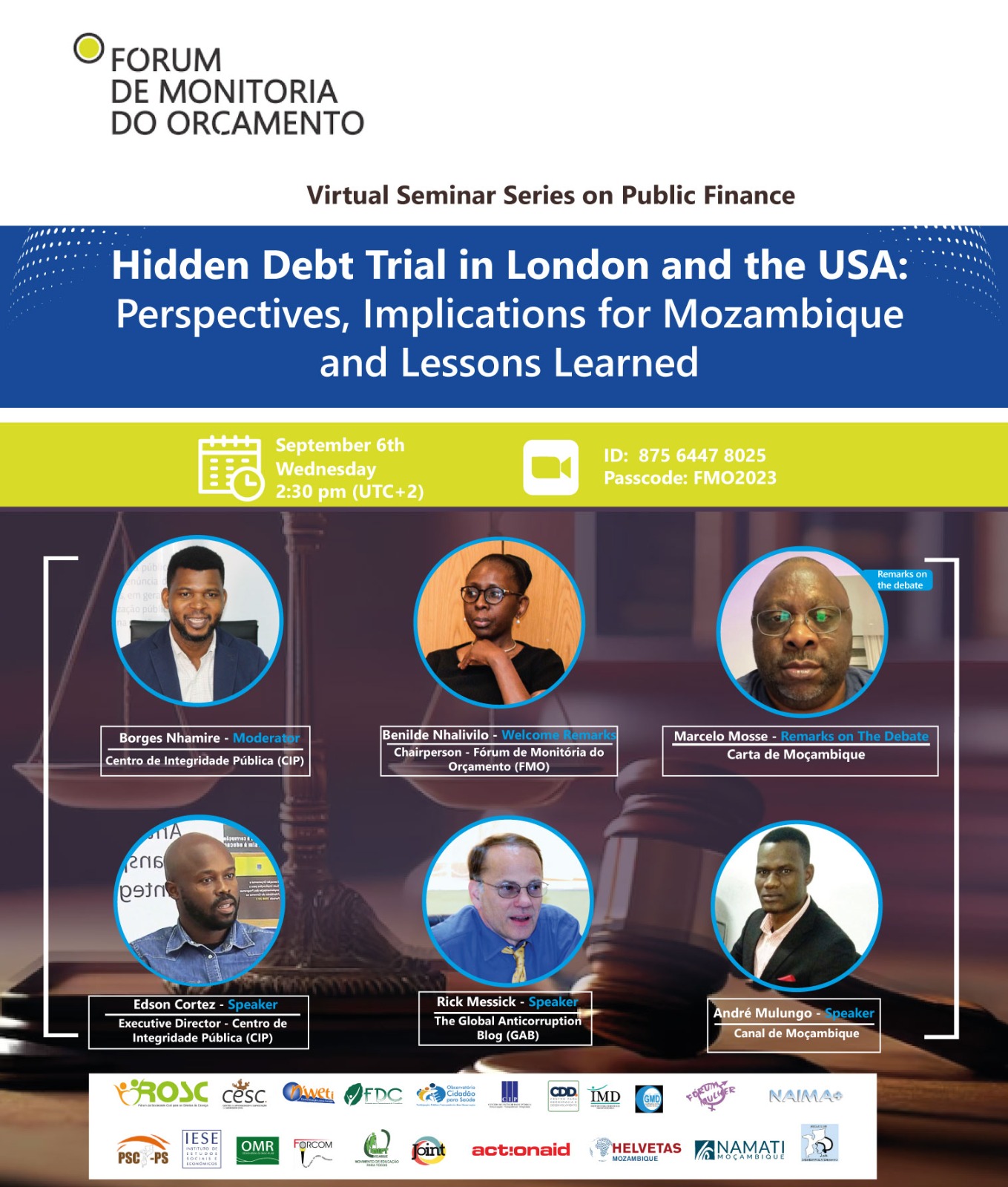
Wednesday, September 6, at 2:30 PM Mozambique time (UTC + 2) members of Mozambican civil society, the media, and GAB staff member (me) will discuss developments in the Mozambican “hidden debt” scandal.
Evidence introduced at the trial of Jean Boustani (here), a senior executive of the Middle East shipbuilding company Privinvest, showed the company bribed Mozambican officials to the tune of $125 million in return for government loan guarantees. The loans went for projects of little or no value. Mozambican citizens are now saddled with repaying billions in principal and interest. A joint study by Mozambique’s Centro de Integridade Pública and Norway’s Chr. Michelsen Institute estimates the scheme may have cost the nation, one of the world’s poorest,. as much as $11 billion, virtually the country’s entire GDP for 2016.
Those responsible for this enormous wrong are slowly being held to account. The Mozambique government is suing some of the perpretrators in a civil action in London, and Manual Chang, Finance Minister at the time the guarantees issued, was recently extradited to the United States to face charges for his role.
A list of speaker and details on logging in on Zoom is here.
Current and Former Mozambican Presidents, Other Higher Ups “Cleared” in Hidden Debt Scandal
Last week the presiding judge in Mozambique’s hidden debt trial made it plain that the country’s current and former presidents and other senior members of the country’s ruling party would not have to answer for their role in the hidden scandal. The massive corruption scheme has cost the impoverished nation billions and ended any hope millions of its citizens could escape a life of abject poverty.
Nineteen middle-level officials and accomplices are on trial in Maputo for accepting bribes to approve $2.1 billion in contracts to the Middle East shipbuilding company Privinvest and then taking more bribes to have the government secretly borrow the money to finance the projects. The economy tanked and poverty rates skyrocketed when the secret loans were revealed.
As he was finishing his testimony last Thursday, the General Director of the State Intelligence and Security Services, the highest ranking official on trial, complained to trial judge Efigénio Baptista, “I am here alone.” He said he was the only member of the Joint Command and the Operation Command, the inter-agency groups that cooked up the scheme, to be prosecuted.
“The former Minister of National Defense, Filipe Nyusi, and the former Minister of the Interior, Alberto Mondlane, should be answering. They were also part of the Joint Command.”
The judge explained that Nyusi, now the country’s president, and Mondlane, governor of an important province, were not charged because the prosecution had no evidence they had taken bribes. He also helpfully went on to add that for the same reason Armando Guebuza, president when the contracts were let and the loans taken out, was not on trial.
The above comes from the Centro para Democracia e Desenvolvimento reports on the trial. This one, recounting the state security director’s testimony, also helpfully reminded readers of the testimony of Jean Boustani at a 2018 trial in New York. There the Privinvest senior executive provided details about the bribes Privinvest paid Nyusi, Guebuza, and other officials not among the 19 on trial in Mozambique. Perhaps Judge Baptista and the Mozambican prosecutor have overlooked something?
Will FRELIMO Betray the Mozambican People to Protect Its Own?
FRELIMO, Mozambique’s governing party, is at a historic crossroads. A party once known for the integrity of its leaders and its commitment to the welfare of all Mozambicans must choose: Pursue a lawsuit to recoup damages from the “hidden debt scandal” that will expose the role of Felipe Nyusi, its leader and the country’s president, in the corruption. Or scrap the suit to protect him.
The scandal arose from some $150 million Dubai-based shipbuilder Privinvest paid Mozambican officials to approve $2.1 billion in contracts to supply it with coastal patrol vessels, tuna boats, and a shipyard to maintain them. Privinvest kicked back $50 million from the deal to Credit Suisse executives in return for their arranging financing for the purchases. The loans they secured were not disclosed: either to the Mozambique parliament, as required by law, or to the IMF, as required under the terms of an IMF bailout loan. When the Wall Street Journal revealed them, donors cut funding, foreign investors pulled out, and the economy tanked.
This hidden debt scandal may well go down as the most damaging corruption scam in modern history. According to a recent estimate by a team from Mozambique’s Centro de Integridade Pública and Norway’s Chr. Michelsen Institute, the damages from the scandal over the 2016-2019 period alone equals $11 billion, $403 for every man, woman, and child in Mozambique. At the same time, the World Bank ranks it as the world’s third poorest nation with a GDP per capita for 2020 of a little over $1200.
Mozambique’s only chance to recover the enormous damage the scandal has done is a civil law suit the government filed against Privinvest, Credit Suisse, and many of the individuals involved. Privinvest has now countered. At paragraph 22.5 of its defense, the shipbuilder claims Nyusi was “fully aware of, and/or participated, in [the corruption], and indeed was at the heart of the matters now complained of by the Republic.”
The threat is now on the table. If Mozambique continues to press the suit, Privinvest will produce in excruciating detail evidence of Nyusi’s involvement. The only way to avoid the likely discrediting of the party’s ruling elite is for Mozambique to scrap the suit.
Will a party once led by the likes of Eduardo Mondlane and Samora Machel sell out the Mozambican people to maintain its grip on power? Will those party members who were their colleagues and those whom they inspired with their dream of a free and prosperous Mozambique stand up?
The trial of Mozambique’s “hidden debt case”: the omnipresent absence of Filipe Nyusi
As the corruption trial of the decade if not the century enters its fifth day in a Mozambique court, guest commentator Marcelo Mosse, editor and publisher of the independent online outlet Carta de Mozambique, notes that the presence in the courtroom of a very large elephant remains unremarked. During the first days of the trial, witnesses have identified those responsible for a scheme saddling one of the world’s poorest nations with $2.1 billion of debt and driving millions into poverty. Mosse explains that the culprits have been identified by name and by the office held when the scheme was hatched and executed. With one exception. His own translation of his commentary from Carta de Mozambique on the significance of that exception is below.
Almost 20 years ago, at the time of the trial of the murder of journalist Carlos Cardoso, Mozambican society witnessed a judicial process that hit the presidential family to the core, due to the suspected involvement of Nyimpine Chissano [son of the then president] in the crime. This involvement was never proven. However, incriminating “nuances” of various kinds remained engraved in the imagination of the Mozambicans.
In addition, the trial was conducted within a tacit agreement among the interveners: everything was acceptable, except directly tweaking [then president] Joaquim Chissano. Bringing his name out at the hearings was like striking at the heart of the State, shattering our Mozambicanity, emptying the last stronghold of the beloved homeland, draining out its blood. Although the son ended up somewhat hit by the unraveling of his calls, the father, Joaquim, came out unscathed. Mozambicans would not be the ones to bury their own Father, even if hostile forces wanted to. Moreover, the administration of Justice was able to achieve this desideratum.
Twenty years later, history repeats itself, with the due distinctions of circumstance. The first four days of the trial of the “hidden debts” showed that we are facing the same tacit understanding: no one has yet mentioned Filipe Nyusi‘s name, but everyone mentions the Minister of Defense at the time. However, nobody asked for the name of the Minister at the time. Neither Judge Baptista nor the prosecutor Sheila Marrengula. Much less the Bar Association [participating in the case as assistant to the prosecution].
The Bar Association demanded that the former Minister of Finance, Manuel Chang, be required to come and testify as a declarant. The request followed several mentions made by the defendants Cipriano Mutota and Teófilo Nhangumele about his presence in decision-making meetings on the coastal protection project for which some of the debt was incurred.
However, just as Chang’s name was mentioned, the Minister of Defense was also mentioned several times, but never by name. We emphasize: no one wanted to know the name of this minister, much less his role in the various meetings where he would have been invested with his decision-making power on the subject. Several ministers of the time were addressed by name; the former President of the Republic, Armando Guebuza, was as well.
Why has no one mentioned Nyusi by name? Neither the judge nor the prosecutor asks about the role of this so-called Minister of defense. Why? That is the question.
The trial is still in its beginning stages. And our assertion may be refuted as the days go by, especially with the long awaited testimony of Antonio do Rosário, the second “mastermind” of the default. It is very likely that he will call a spade a spade. However, this taboo regarding Filipe Nyusi’s name shows that ultimately, and as we wrote a few days ago, we are facing the ultimate trial of Guebuzaism. And Nyusi will probably get off without being tweaked. Nyusi is still the President of Mozambique.
Editor’s note: The trial is live streaming on Mozambican public television. Links here and (Facebook link) here. Excerpts can viewed on YouTube by searching “television moçambique dividas ocultas.”
Mozambique Hidden Debt Case: South Africa Must Say Why It Thinks Chang Will Face Justice; Trial Summary
Earlier today, August 27, the South African High Court blocked the extradition of former Mozambican Finance Minister Manuel Chang to Mozambique.
The order (here) came in response to an urgent request (here) by the Forum De Monitoria Do Orçamento, a coalition of Mozambican civil society groups, raising serious doubts that were Chang, a senior member of Mozambique’s ruling party, returned he would face justice for his part in a scheme that drove millions of fellow citizens into poverty and cost the impoverished nation billions of dollars in lost GDP (here).
The United States is also seeking Chang’s extradition for participating in the hidden debt scheme, and there is a widespread belief he is far more likely to face justice if extradited there. South African law bars the government from picking Mozambique over the United States if it does not think Change will be tried, or if tried, the trial will be anything more than theatre. The court has ordered South African Minister of Justice and Correctional Services Ronald Lamola to produce the documents justifying his choice of Mozambique by August 30. A hearing on the decision is set for September 17. If the court finds the evidence supporting the decision insufficient, “irrational” in South African legal terms, it will vacate the extradition order.
Separately, Centro para Democracia e Desenvolvimento, a Mozambican civil society organization and FMO member, has released English language summaries of the first four days of the hidden debt trial. Click on the day to see: Day 1, day 2, day 3, day 4.
Mozambique Hidden Debt Scandal UPDATE: Two Presidents Implicated/Crony’s Return Temporarily Blocked
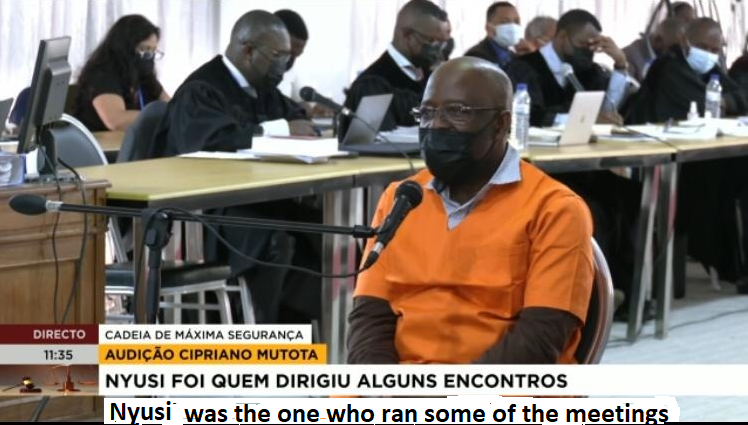
The government of Mozambique took two hits at the second day of what could well be the corruption trial of the decade. Defendant Cipriano Mutota, a former intelligence official, testified that both the country’s current president and his predecessor were deeply involved in the corruption, a scheme where officials approved $2.1 billion in secret loans for dodgy projects in return for $150 million in bribes. His gripping testimony, captured in a screen grab circulating on Mozambican social media, appears below.
Separately, the Budget Monitoring Forum, or FMO after its initials in Portuguese, has filed an emergency motion to prevent South Africa from extraditing Manual Chang, who signed off on the loans as Finance Minister, to Mozambique. Chang has been jailed in South Africa for two years pending the government’s decision on whether to extradite him to the U.S. or Mozambique. Both want him, the U.S. because American investors lost millions thanks to the secret debts, Mozambique to stand trial for his role in the corruption.

The government of South Africa has agreed to delay returning Chang to Mozambique pending a hearing on its legality Friday at 10:00 AM. Along with South Africa’s Minister of Justice, the government of Mozambique will appear and argue in support of the decision. FMO’s draft order, which the court accepted and issued, is here.
FMO filed the emergency request Tuesday evening after the South African government refused to consent to a brief delay in Chang’s return to allow an orderly consideration of whether the decision complied with South African and international law. In its filing, the group, an umbrella organization whose 22 civil society organizations serve virtually every impoverished or low income Mozambican, argues that the evidence shows the government will not really put such a senior figure on trial for corruption. Or if it does, he will get a most a slap on the wrist for a scheme that threw millions into poverty and by one estimate shaved $10 billion off the GDP.
FMO cites a previous Mozambique extradition request (here) that had every appearance of a put-up job, initiated not to bring Chang to justice but from a fear that were he sent to the U.S. he would spill the beans on cronies in return for leniency. Rumors circulating in Maputo that Chang’s relatives have planned a lavish welcome home party have only stoked concerns he has little to fear from a trial in Mozambique.
FMO chair Adriano Nuvunga has called South Africa’s decision to send Chang to Mozambique, “a victory of impunity” and has urged “all southern Africa CSO movements to come together to stop the triumph of impunity.” FMO’s papers seeking a temporary delay in Chang’s return pending a full hearing are here. The Gauteng Division of the High Court may act on the request as early as Wednesday morning South African time.
A Welcome Analysis of Where Mozambique’s Goats Eat
To say that a successful attack on corruption begins with a political economy analysis is commonplace. To declare that absent such an analysis of the political, economic, and social conditions that foster a particular type of corruption, an anticorruption policy has little chance of succeeding is hardly remarkable. What remains noteworthy is in the two decades plus since the global war on corruption began how few such analyses have been done.
Of the more than 7500 entries in Matthew’s corruption studies bibliography, titles of fewer than 50 indicate a political economy focus. The corruption and development “gray literature,” reports on corruption in developing nations commissioned by donor organizations, is little better. Perhaps a larger number of studies, but few quality ones, and perhaps surprisingly, a real dearth of analyses of petty corruption, the kind that citizens of developing nations, most often the poor, regularly encounter in their daily life.
That’s why it was a pleasure to discover Inge Tvedten and Rachi Picardo’s recent study of where Mozambican goats eat. The Mozambican expression cabrito come onde está amarado (“goats eat where they are tied up”’) refers, as they explain, to the two-legged species rather than the four-legged one. The kind that exploit their place in government to enrich themselves, friends, and supporters. The two draw upon years of accumulated research to show how, in a variety of thickly described situations, “a set of structuring principles and common schemes” lead to the “internalization” or “embodiment” of corruption. (Others might term the principles and schemes “institutions” and internalization or embodiment a “Nash equilibrium.”) An especially thought-provoking example is how traditional norms of deference to authority figures interacts with the way the District Development Fund, a program to help the poorest, is managed to keep beneficiaries marginalized.
Whether hunting for how to deprive a greedy Mozambican goat of nourishment or for a first-rate example of political economy analysis of petty corruption, readers will profit from perusing Tvedten and Picardo’s article.
Recovering Damages for Mozambican Victims of the Hidden Debt Scandal: Possible Suits in the United Kingdom
A recent post explained that Mozambicans harmed by the corruption behind the “hidden debt” scandal may well be able to sue the perpetrators for damages in the courts of many nations. Mozambique, where the harm was suffered, and most probably France, Lebanon, Russia, Switzerland, the United Arab Emirates, and the United Kingdom, countries where one or more of the alleged perpetrators is located or does business. The legal basis would be article 35 of the United Nations Convention Against Corruption. It requires convention parties to open their courts to actions by corruption victims against “those responsible” for the corruption “in order to obtain compensation.”
The U.N. Office of Drugs and Crimes reports that all 187 parties accept the principle of compensation for corruption. Suits for corruption damages are a relatively recent development, however, and in its latest review of the convention’s implementation, UNODC explains that establishing causation and proving damages remain to be elaborated through application of parties’ domestic law principles governing harm caused by intentional acts. At the same time, it noted that in corruption damage cases article 35 mandates that these principles be interpreted broadly. There need be no direct interaction between the perpetrators of corruption and the victim; nor is recovery limited to cases where the perpetrators foresaw the injury the victim would suffer.
In a just released paper, London barrister James Mather shows how English law would apply to claims Mozambicans brought for hidden debt damages in the United Kingdom. He opines that recovery could be had on the basis of an unlawful means conspiracy and perhaps too on the tort of bribery and dishonest assistance. English law, he writes, incorporates the liberal principles of causation of damages enshrined in article 35. “The approach to the award of damages for conspiracy in particular is quite liberal in English law and extends to losses which cannot be strictly proved.” English law also offers Mozambican claimants a procedural advantage. Rather than each person having to file a separate suit, a group action could be filed with a single claimant suing on behalf of all those who suffered a similar injury.
Mather, a distinguished member of Serle Court in London, cautions that while based on what has been reported it would appear Mozambicans injured by the hidden debt scandal could recover damages in the United Kingdom, much factual research is required to be sure. His paper is an important step forward in seeing that those who suffered enormous harm thanks to the corruption behind the hidden debt scandal are made whole by the perpetrators. Click on Mather paper to download a copy of his first-rate analysis.