Uzbek Civil Society on the Hazards of Investing in Kleptocracies

Tonight Uzbekistan President Shavkat Mirziyoyev will tout the benefits of investing in his country to executives of multinational firms at a swank dinner at the Onyx Room in mid-town Manhattan.  He will point to measures the government has taken since the death last year of its first president, renowned kleptocrat lslam Karimov, to open the country to foreign investment — from reforms to economic policy to steps to improve its atrocious human rights record.  But before they open their checkbooks, the execs will want to heed the warnings contained in a letter Uzbek civil society activities just sent Washington lawyer Carolyn Lamm, chair of the American-Uzbekistan Chamber of Commerce, the host of tonight’s get-together.

Reprinted below, the letter cautions that there are still many signs that Uzbekistan has yet to shed its kleptocratic past, from the appointment of one of the most notorious kleptocrats of the previous regime as prime minister to the rise to power of Mirziyoyev’s sons-in-law.  The authors remind Ms Lamm and the members of her organization what happened to those who invested in Karimov’s kleptocracy.  Not only did their investments turn out to be a bust, but the bribes the investors had to pay to do business have cost them (or more accurately their shareholders) dearly.  One firm was fined $795 million by Dutch and American authorities and a second recently told shareholders it anticipates paying over $1 billion to resolve the case against it.

The authors sent a copy of their letter to the members of Ms Lamm’s organization, a group that includes General Electric,  General Motors, Boeing, Catepillar, Coca-Cola, Honeywell, Visa, and other well-know, well-respected companies traded on American stock exchanges (and thus subject to the Foreign Corrupt Practices Act). Readers holding shares in any of these companies will want to ensure company executives pay careful attention to the letter’s warnings.

Ms Carolyn Lamm
Chair
American-Uzbekistan Chamber of Commerce
601 13th St NW # 600S
Washington, D.C. 20005

September 18, 2017

An Open Letter to the American-Uzbekistan Chamber of Commerce regarding the Situation in Uzbekistan on the Eve of its Meeting with President Mirziyoev

Dear Chairwoman Lamm:

We, the undersigned Uzbek citizens and activists, write to you on the eve of your dinner with President Shavkat Mirziyoev on September 20, 2017, to express concern that your members may be misled into believing that meaningful reform is underway in our country. We ask you to share with them this letter explaining the current conditions in Uzbekistan and the risks any firm investing or doing business in the country will face. We further ask you to urge the President to reform the judiciary and create an independent, impartial and effective body to investigate allegations of corruption. Continue reading
Upcoming Conference on “Populist Plutocrats: Lessons from Around the World” (Sept. 23, Harvard Law School)

On Saturday, September 23rd, Harvard Law School, in collaboration with the University of Chicago’s Stigler Center, will host a one-day conference entitled “Populist Plutocrats: Lessons from Around the World.” The conference will focus on an important and dangerous phenomenon: political leaders who successfully exploit anti-elite sentiment in order to achieve power, but who, once in office, seem primarily interested in enriching themselves, along with a relatively small circle of family members and cronies. Many Americans might find that this description accurately captures President Trump, who campaigned as a populist, but who is governing as more as a “crony capitalist” plutocrat—or, some would allege, as a quasi-kleptocrat.

Americans seeking to understand the challenges our country is now facing might do well to look abroad. After all, while Trump’s leveraging of the power of the presidency for personal enrichment—enabled by anti-elite sentiment among his supporters—may well be unprecedented in modern U.S. history, it is not, alas, unprecedented in the modern world. Indeed, while every country’s experience is different, and we must always be careful not to overstate the parallels, many other democracies have had leaders who could be described as populist plutocrats, or even populist kleptocrats, in something like the Trump mold. While such resemblances have occasionally been noted (see, for example, here, here, here, and here), but there has not yet been much of a sustained attempt to understand populist plutocracy/kleptocracy and closely related phenomena in comparative perspective. The September 23 conference will seek to initiate more sustained exploration of these issues, and will also provide an opportunity for experts from other parts of the world–who have more experience with political leaders who combine populist rhetoric with self-interested profiteering and cronyism–to offer a distinct perspective on the challenges the United States is currently facing.

The conference will feature the following panels: Continue reading

The Obiang Trial: Misstatements of Facts and Law in the Defense’s Closing Arguments

GAB is pleased to publish this account and analysis by Shirley Pouget and Ken Hurwitz of the Open Society Justice Initiative of the final arguments of Equatorial Guinean Vice President Teodoro Nguema Obiang’s lawyers at his Paris trial for what is in effect kleptocracy.

court roomTeodoro Nguema Obiang Mangue’s trial concluded July 5, 2017, with closing arguments by his defense counsel. The trial marks a major milestone in the struggle to ensure accountability for grand corruption, even when committed by those at the highest political levels.  A spicy mixture of high principle, juridical gravitas, and sophisticated argumentation on intricate issues of pressing urgency in the real world, the trial also contained moments of wrenching emotion and undignified, even scandalous, claims and insinuations.
The final day was devoted to arguments by Teodorin’s lawyers: Emmanuel Marsigny, Equatoguinean jurist Sergio Tomo, and Thierry Marembert.  In sum they claimed i) that their client didn’t steal enormous sums of money from the people of Equatorial Guinea, ii) that even if he did, the theft wasn’t illegal under Equatorial Guinean law, and iii) that even if he did steal the money and it was a violation of EG law, a French court did not have the right to try him for it.  Their arguments mixed misleading and often downright false statements of the evidence with strained and fanciful interpretations of the law, all seasoned with dark suggestions that the trial was about race and politics rather than the massive theft of resources from the citizens of Equatorial Guinea.     Continue reading

The Obiang Trial: Prosecutor Seeks 3 Years Imprisonment, Large Fine, Asset Confiscation  

GAB is pleased to publish this account and analysis by Shirley Pouget and Ken Hurwitz of the Open Society Justice Initiative of the concluding arguments the civil parties and the prosecution made at the trial of Equatorial Guinean Vice President Teodorin Nguema Obiang.

The July 5th proceedings in the Obiang trial opened with the court rejecting the defense request that it be allowed to pursue its claim that the prosecution was unconstitutional.  It closed with the state prosecutor asking the court to find Teodorin guilty, sentence to him three years in prison, fine him €30 million, and confiscate all of his assets located in France.  In between the two civil parties – CORED, a coalition of Equatorial Guinean political parties, and Transparency International-France – presented their arguments in support of conviction.  Continue reading

The Obiang Trial: Lessons from a Decade-long Legal Battle

The trial of Equatorial Guinean Vice President Teodorin Nguema Obiang before a French court for what is in effect kleptocracy is by any measure a giant step forward in the fight against grand corruption.  Indeed, it is such a significant milestone that GAB has, thanks to the Open Society Justice Initiative’s Shirley Pouget and Ken Hurwitz, provided readers in-depth reports of how it is unfolding (here, here, here, here, here, here).

Criminal trials are the result of a long and complex process meant to protect a defendant’s rights, and frustratingly, these human rights safeguards provide wealthy defendants, no matter their guilt, with many opportunities to derail a case.  In Teodorin’s case, not only does he have apparently limitless resources to spend on lawyers to pursue every legal defense to the nth degree, but the government of Equatorial Guinea, a family enterprise run by his father, has gone to extraordinary lengths to keep Teodorin from facing justice: naming him an ambassador to try and create a defense of diplomatic immunity, claiming that property he bought is state-owned and thus immune from legal challenge, and even filing an action against the French government in the International Court of Justice.

As Shirley and Ken draft the next installment in their series, this is an opportune time to stand back and examine how these many obstacles were overcome.   How did it come to pass that a senior official of the government of Equatorial Guinea is being held accountable before a criminal court in Paris for the wholesale theft of his nation’s wealth?  And more importantly, what can be done to ensure the Obiang trial is no fluke?  That the hundreds, if not thousands, of public officials who have stolen massive amounts from the people of their countries also find themselves in court answering for their crimes.

Thankfully, a fine paper answering these questions is now available. Authored by French attorney Maude Perdriel-Vaissière, a critical actor in shepherding the Obiang case through the French legal system, it recounts how a small, dedicated band of civil society activists overcame the many legal and political obstacles to bring Obiang before the bar of justice.  Continue reading

Day Six of the Trial of Teodorin Obiang

GAB is pleased to publish this account and analysis of the 6th day of the trial of Equatorial Guinean Vice President Teodorin Nguema Obiang by Shirley Pouget and Ken Hurwitz of the Open Society Justice.

On day six of his trial for actions arising from theft of public monies, Teodorin’s lawyers offered several legal defenses.  The most bizarre, and the one most strenuously advanced, was that in Equatorial Guinea theft of public funds is not a crime if the thief is a senior government official.  Teodorin was a government minister at the time he stole the money, and according to his lawyers, there was no law in Equatorial Guinea that made it a crime for a minister to steal public funds.

The defense also tried to lob a procedural bombshell into the proceedings.  It claimed that the way French courts have interpretred bribery as a predicate offense for money laundering is unconstitutional.  This constitutional objection, a Question Prioritaire de Constitutionalite, could have been lodged early in the proceeding.  Raising it so late in the case, would, if the court accepted the defense request, postpone the trial proceedings for many months. 

Continue reading

Day Three of the Trial of Teodorin Obiang

GAB is pleased to publish this account of the 3rd day of the trial of Equatorial Guinean Vice President Teodorin Nguema Obiang by Shirley Pouget and Ken Hurwitz of the Open Society Justice Initiative.

court room

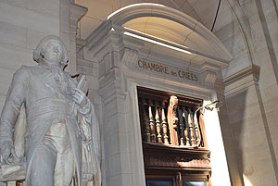
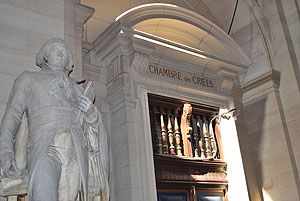
Much of the third day of Teodorin’s trial was taken up with a lengthy, and highly misleading, “explanation” by defense counsel of United States of America v. One White Crystal-Covered “Bad Tour” Glove And Other Michael Jackson Memorabilia, a civil forfeiture action the US Department of Justice filed and later settled that involved property Teodorin owned in California.  The Paris hearing began at 1:30 pm, Wednesday, June 22, with the three judges filing into the august Chambre des Crieés of the Tribunal Correctionnel of Paris.  The Presiding Judge asked the civil parties and the defense counsel to comment on the background to the case she had reviewed the preceding day.  While the civil parties’ counsel had little to say, the defense had much to say — little of which was accurate. Continue reading

Day Two of the Trial of Teodorin Obiang

GAB is pleased to publish this account of the 2nd day of the trial of Equatorial Guinean Vice President Teodorin Obiang by Shirley Pouget and Ken Hurwitz of the Open Society Justice Initiative

The defense suffered several significant setbacks at the second day of Equatorial Guinean Vice President Teodorin Nguema Obiang’s trial for theft of public funds, money laundering, and other charges that together amount to kleptocracy.  As GAB earlier reported, Obiang’s lawyers sought to delay the case on procedural grounds and to block Equatorial Guinean citizens from, as French law permits, participating in the prosecution.  The court refused both requests.

Even worse for the VP, the court displayed a detailed command of the allegations against him along with a determination to see they are presented at trial. Accusations that have appeared in the media, civil society publications, or elsewhere will now be tested in a formal, judicial proceeding.  A finding that they are true, that Obiang did indeed rob the citizens of Equatorial Guinea blind, cannot do anything but embolden courts elsewhere to pursue similar cases while confirming to the world the regime’s pariah status. Continue reading

The Trial of Suspected Kleptocrat Teodorin Obiang: Report on Day One

GAB is pleased to publish this account of the first day of the Obiang trial by Shirley Pouget, a French lawyer observing the proceedings on behalf of the Open Society Justice Initiative

The worldwide fight against grand corruption took a giant stride forward Monday June 19 with First Vice President of Equatorial Guinea Teodoro Nguema Obiang Mangue standing trial for corruptly diverting millions from the national treasury.  Known to cronies as Teodorin, the case appears to be the first ever where a high-level official, while in office, is called to account for grand corruption before a foreign court. The precedent setting case, the culmination of a decade of determined struggle by French and Equatorial Guinean civil society, is being heard before the Tribunal Correctionnel in Paris.

As the trial opened, the courtroom overflowed with journalists, civil society representatives, and Equatorial Guineans in exile: we were all there to see if indeed a powerful politician whose corrupt activities have left his nation in penury would be held to account.  The three judges hearing the case, all women, took their seats at 1:30. The presiding judge opened by recalling that the accused was before the court on charges of misappropriation of public funds, complicity in the misappropriation of public funds, misuse of corporate assets, complicity in the misuse of corporate assets, and the concealment of each of these offences.  She explained that the court had jurisdiction because each offense, or an element of each, was committed in France.  She then expressed concern that defense counsel had only provided answers to the charges a few days before the trial began.

The defense launched into a series of objections to the commencement of the trial that consumed the entire afternoon hearing.  Teodorin’s high-priced lawyers argued that 1) the case should be stayed pending a final decision by the International Court of Justice in a case between France and Equatorial Guinea, 2) the magistrates’ decision to refer the accused for trial was illegal, and 3) a coalition of Equatorial Guineans should not be permitted to participate in the case as a civil party.  They also raised an unexpected claim based on a highly technical reading of the charging document.    Continue reading

At Last: A Kleptocrat Faces Justice

This Monday, June 19, a case against Equatorial Guinean First Vice President Teodoro Nguema Obiang Mangue for looting the nation’s oil wealth opens in a Parisian criminal court. In partnership with the Open Society Foundations Justice Initiative, GAB will provide readers with regular reports on the case’s progress.  Although the Vice President is unlikely to appear in person, the case nonetheless is an important milestone in the world wide struggle to bring to justice rulers who rob their citizens on a massive scale.  It marks the first time, to GAB’s knowledge, a sitting kleptocrat has been called to account.

The case, one of several collectively known as “bien mal acquis” or “ill-gotten goods,” has gone through several twists and turns.  It is a tribute to the hard work, persistence, and dedication of CCFD-Terre Solidaire, Sherpa, TI-France and other individuals and NGOs that it is now finally set for trial.  Vice President Obiang could be sentenced to up to 10 years’ in prison and fined millions of euros if convicted.  While he would surely remain holed up in Equatorial Guinea to duck prison, conviction would likely carry an order confiscating all property he owns located in France, which today is known to include a Parisian mansion valued at 107 million euros along with a collection of Ferraris, Maseratis, and other luxury cars like worth over five million eruos.

The French case is not Obiang’s first brush with the law.  In October 2014, to settle a U.S. case based on his kleptocratic ways, he forfeited a mansion in California and other property worth $30 million.  Obiang is also under investigation in a number of other jurisdictions.

Monday’s hearing begins at 1:30, Paris time.  For those fortunate enough to be in Paris, additional hearings are scheduled for 9:00 am, June 21; 1:30, June 22; 1:30 pm, June 26; 1:30, June 28; 9:00, June 29; 1:30, July 3; 9:00 July 5; and 1:30 July 6.  For those who are not, GAB is the next best alternative.