Last week, Richard Goldstone and Robert Rotberg posted a response to Professor Alex Whiting’s critique of the proposal to create an International Anti-Corruption Court (IACC). Early in their response, Goldstone and Rotberg–both advocates for an IACC–remarked, a bit snarkily, that “[n]otably absent from [Professor Whiting’s] post is a description of what the other effective responses to combating grand corruption might be.”
That struck me as a bit of a cheap shot. Professor Whiting’s post offered a careful, thoughtful argument based on his experience and knowledge of the International Criminal Court (ICC) and similar tribunals, and not every such critical commentary on a given proposal must include a full-blown discussion of alternatives. Still, Goldstone and Rotberg’s implicit challenge to IACC skeptics to articulate alternative responses to grand corruption is worth taking seriously, for two reasons:
- First, this seems to be a common rhetorical gambit by advocates for an IACC, or for other radical measures that critics deem impractical: Rather than answering and attempting to refute the critics’ specific objections directly, the move is to say, “Well, but this is a huge problem, and there’s no other way to solve it, so poking holes in this proposal is really just an excuse for inaction. This may seem like a long shot, but it’s the only option on the table.”
- Second, and more charitably to those who make this point, grand corruption is indeed an enormous problem that needs to be addressed. And so even though not every critical commentary on a particular proposal needs to include a full-blown discussion of alternatives, those of us who (like me) are skeptical of deus-ex-machina-style responses to the grand corruption problem ought to make a more concerted effort to lay out an alternative vision for what can be done.
In this post I want to (briefly and incompletely) take up the implicit challenge posed by Goldstone and Rotbert (and, in other writings, by other IACC proponents). If the international community is serious about fighting corruption, what else could it do, besides creating a new international court and compelling all countries to join it and submit to its jurisdiction? When people like Professor Whiting (and I) suggest that lavishing time and attention on the IACC proposal might be a distraction from other, more effective approaches, what do we have in mind? What else could international civil society mobilize behind, besides something like an IACC, to address the problem of grand corruption?
Here are a few items on that agenda: Continue reading
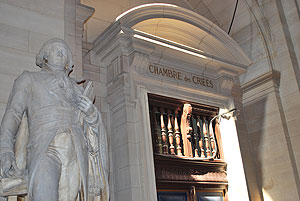 In the first ever peacetime conviction of a high-ranking, incumbent office holder by the court of another state, a Paris criminal court has convicted Equatorial Guinean First Vice President Teodoro Nguema Obiang Mangue of laundering monies from corruption in Equatorial Guinea in France. The historic decision, announced by the 32nd Chamber of the Tribunal Correctionnel de Paris on Friday, October 27, was tempered by the reality the court faced in finding a senior official of another country guilty of violating French law. While it unconditionally awarded Transparency International – France, which as a “civil party” helped investigate the case, €10,000 in moral and €41,081 in material damages, and ordered seizure of much of the €150 million in assets Teodorin holds in France, it suspended (sursis) the three- year prison sentence and €30 million fine it imposed on Teodorin so long as the VP stays out of trouble for five years. It also stayed the part of the asset seizure order confiscating the obscenely extravagant 101-room property on Avenue Foch Teodorin owns pending the outcome of proceedings before the International Court of Justice where, as explained in a previous
  Teodoro Nguema Obiang Mangue’s trial concluded July 5, 2017, with closing arguments by his defense counsel. The trial marks a major milestone in the struggle to ensure accountability for grand corruption, even when committed by those at the highest political levels. A spicy mixture of high principle, juridical gravitas, and sophisticated argumentation on intricate issues of pressing urgency in the real world, the trial also contained moments of wrenching emotion and undignified, even scandalous, claims and insinuations.
 GAB | The Global Anticorruption Blog