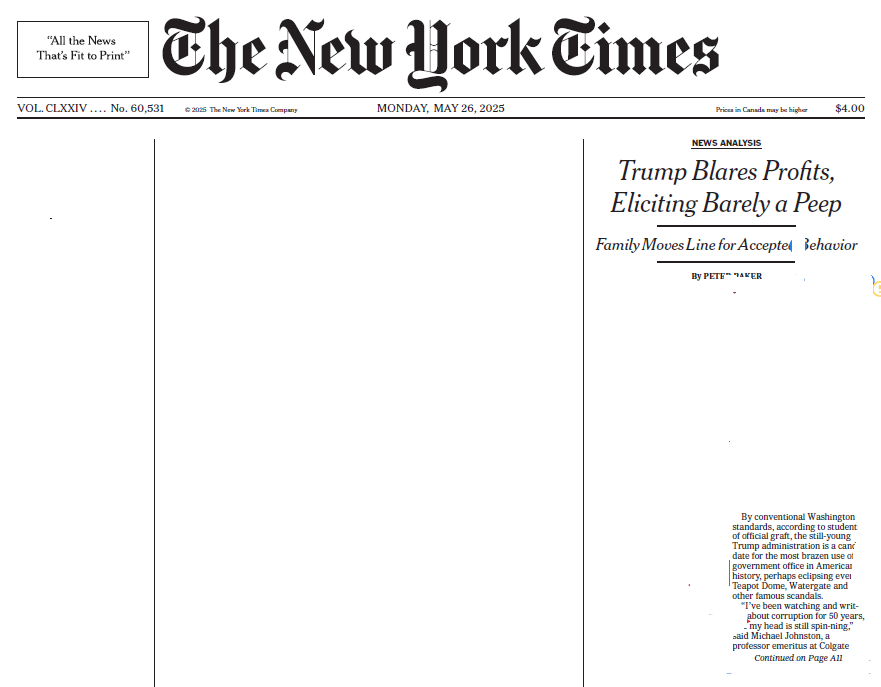
Trump Blares Profits, Eliciting Barely a Peep

That was the headline on the lead story in the May 26 New York Times.

The author, the chief White House correspondent for The New York Times and one of Washington’s most respected journalists, reports the growing view that the Trump Administration’s corruption represents “the most brazen use of government office in American history.” In support he cites anticorruption guru and GAB favorite Michael Johnston who told him–

I’ve been watching and writing about corruption for 50 years, and my head is still spinning

To quote a guru on another subject (revolution — V. Lenin), the question is now: What is to Done?

Signatures Sought on Call for More Participatory UNCAC Review Mechanism

Lincoln famously remarked that laws without enforcement are just good advice, an observation anticorruption advocates understand all too well.

For almost two decades, the UNCAC Coalition has sought to see that the world’s most important anticorruption law, the United Nations Convention Against Corruption, is something more than just good advice. Its latest effort: Gathering signatures from NGOs, individuals and other entities (companies, professional associations etc.) on an open letter to the 191 UNCAC States Parties calling for a more effective, transparent and inclusive mechanism for reviewing compliance with the Convention.

The letter is open for endorsement until 2 June. To date there are more than 230 signatories from 90+ countries.

The letter is available here in English, Spanish, French, Russian and Arabic, the list of current signatories here, the sign-up form for endorsements here.

Great Resource for Journalists and Anticorruption Activists

UNISHKA Research Service, a worldwide alliance dedicated to fostering ethics and integrity in government, business, and society, is developing directories showing for each country where to find property records, business registrations, and other information on who holds what assets. The project is adding countries at a rate of 1-2 per week.

A screenshot of the first page of the Qatar directory is below.  Link to the full page here.

Why The FATF-Based Anti-Money Laundering System Fails to Catch the Proceeds of Corruption

Today’s Guest Post is by Robert Barrington, Professor of Anti-Corruption Practice at the Centre for the Study of Corruption, University of Sussex (UK) and formerly the Chair of Transparency International’s International Council.

In recent years, anticorruption campaigners and policymakers have directed increased effort towards improving the global Anti-Money Laundering (AML) system.

Imagine this system were operating perfectly. Would it stop kleptocracy?

Of course not, no more than AML systems stop heroin production. AML laws and regulation are not designed to stop the acts that generate dirty funds; they are designed to stop the proceeds of crime from being disguised (laundered) and thus freely circulating around the world.

The more difficult question involves monies kleptocrats steal: if the global AML system were operating perfectly, would it stop these funds – the proceeds of corruption – from circulating around the world?

Two recent reports in the UK — from the Taskforce on Business Ethics and the Legal Profession and Spotlight on Corruption — answer the question with a resounding NO: when the proceeds of corruption derive from kleptocracy, when crooks have captured the state, the UK’s AML system is not capable of addressing these funds.  To be clear, even if the current global AML system were operating perfectly, the UK would be unable to deal with the proceeds of corruption arising from state capture.

To date the research is confined to the UK context and UK law; it has yet to extend to other jurisdictions. But given what is known about the globalised nature of illicit financial flows, we might conclude that other jurisdictions are no better at this than the UK.

Continue reading

Belgian and Uzbek Governments Profit from Termination of DoJ’s Kleptocracy Unit

Central Asia Due Diligence and the Uzbek Forum for Human Rights have identified the latest fallout from the Trump Administration’s destruction of American institutions devoted to fighting global corruption. The governments of Belgium and Uzbekistan have each pocketed $108 million in stolen assets that should have gone to the people of Uzbekistan.

In this just released paper, the two human rights NGOs explain how the demise of the Department of Justice’s Kleptocracy Asset Recovery Initiative allowed the two governments to ignore provisions in the UN Convention Against Corruption and the principles of the Global Forum on Asset Recovery that together bar assets stolen by a corrupt official from being kept by the government of the country where the official stashed them or returned to the official’s corrupt cronies.

Lawyers for the Initiative had designed a sophisticated process (details here) to see the $216 million in bribes to former Uzbek first daughter Gulnara Karimova found in Belgian banks DoJ would go to the UN trust fund overseeing development programs in Uzbekistan. With the Initiative’s demise, the Belgian and Uzbek governments apparently saw no reason they should not divvy up the money between them.

So thanks to the Trump Administration, Belgium, one of the world’s wealthiest countries, is now $108 million wealthier, and Uzbek’s leaders, several Gulnara’s accomplices, now have $108 million to spend keeping themselves in power. Meanwhile, the citizens of Uzbekistan, GDP per capita $3,500, scrape by.

Guest Post: Global Lessons from Sri Lankan Civil Society for Post-Crisis Governance Reform

Today’s guest post is from Nishan de Mel and Inoshini Perera of Verite Research and Nikhil Wilmink of the Open Society Foundations.

In 2022, Sri Lanka experienced the most severe economic crisis of its post-independence history. Foreign reserves were emptied as the currency depreciated by over 80% and essential imports such as fuel and medicine were curtailed. Sri Lanka was forced to default on its external debt of over USD 40 billion. In desperation, the government went to the International Monetary Fund (IMF) for assistance—the seventeenth time Sri Lanka has done so since 1965. The IMF’s rescue program, which prioritized price stabilization above all else, inflicted substantial hardship, as interest rates spiked, poverty doubled to around 30%, and the previous eight years of GDP growth were wiped out.

The crisis triggered an awakening among the Sri Lankan people about the consequences of corrupt governance. Protests proliferated and grew into an avalanche known as the Aragalaya (mass uprising), the largest democratic protest in Sri Lanka’s history. Protestors viewed Sri Lanka’s economic collapse as rooted in corruption, impunity, and the abuse of political power. The protests ultimately forced then-President Gotabaya Rajapaksa to resign and flee the country.

Given that concerns about corruption and misgovernance were so central to the discussion of Sri Lanka’s economic crisis, in early 2023 the IMF reached an agreement with the Sri Lankan government to conduct a “Governance Diagnostic Assessment” (GDA) – the first one in Asia. Civil society in Sri Lanka was not overly impressed, however. Sri Lankan civil society organizations (CSOs) were concerned that IMF consultations with civil society would be largely performative. CSOs were also concerned that there would not be sufficient accountability for implementation of the anticorruption measures that the IMF designed with the government. Leading think tanks and CSOs in Sri Lanka came together to form the Civil Society Initiative on Anti-Corruption Reform for Economic Recovery (CSI-group). The CSI-group initially requested that the IMF transcribe and publish its consultations with CSOs, but the IMF would not agree to this. Therefore, the CSI-group took an independent path by bringing hundreds of other CSOs together into a process for producing a “Civil Society Governance Diagnostic Report”. This was the first time any country’s civil society sector had ever drafted a governance report to guide the IMF’s GDA. That GDA, produced after the civil society diagnostic, was an excellent document that aligned closely with what had been produced by the CSOs. Sri Lankan CSOs also created of an independent IMF Tracker to monitor the government’s implementation of its IMF program commitments and to provide more transparency about the significant failures to comply with commitments on governance and anticorruption, even when these were not highlighted in the IMF’s reviews.

Recognizing the core governance weaknesses needed a multi-pronged approach. The Sri Lankan think tank Verité Research decided to involve bondholders as well. In June 2024, Verité Research proposed a new debt instrument: a “Governance-Linked Bond” (GLB), designed to reduce reducing the risk of repeated defaults in countries with poor governance. Through the GLB, creditors agree to reduce the borrowing country’s coupon payments if that country takes certain governance-improving actions—actions that benefit the creditors as well by reducing the risk of default. Thus, GLBs make the adoption of these governance improvements a win-win for both debtor countries and creditors. The GLB proposal was adopted by private creditors in Sri Lanka’s debt restructuring in December 2024. The final GLB issue made up about 13.5% of Sri Lanka’s new restructured debt (USD 1.44 billion) with a coupon reduction of 75 basis points, from 2028-2035 if three key performance indicators (KPIs) are met: (1) a target revenue-to-GDP ratio; (2) the publication of a fiscal strategy that complies with the new public finance management act that Sri Lanka adopted in August 2024; and (3) compliance with the information disclosure covenant in the restructured bond contracts. Notably, these KPIs were drawn from a set of sensible set of compliance actions related to the existing laws of the country, its macroeconomic targets, and stipulations on the bond contract; there was no need to link them to the IMF’s GDA.

In sum, CSOs’ engagement in Sri Lanka resulted in a number of meaningful improvements, including the IMF’s adoption of a much-improved GDA and the innovation of the GLB, a new global instrument to improve governance. With Kenya now undertaking a similar process, some key lessons from Sri Lanka include: being able to take advantage of windows of opportunity and momentum swings (such as the momentum from popular protests around corruption and the IMF program in Sri Lanka); and building diverse coalitions able to take a systemic approach (Sri Lanka’s significant achievements have come from partnerships with unusual partners including bondholders).

Guest Post: What Trump’s FCPA Enforcement Pause Means for Accountability in Europe

Today’s guest post is by the Daphne Caruana Galizia Foundation. Established following the assassination of Maltese anticorruption journalist Daphne Caruana Galizia, the foundation seeks to ensure full justice for Daphne’s murder, advance her work, support and protect investigative journalists, and promote public interest litigation. It coordinates the Coalition Against SLAPPs in Europe (CASE), administers the Public Interest Legal Network (PILN), is a Transparency International chapter-in-formation, a partner of OCCRP, and a member of the UNCAC Coalition.

Here on the little Mediterranean island of Malta, located just south of Sicily, news of a Department of Justice investigation into Texas-based Steward Healthcare was met with a collective sigh of relief – “the Americans will help to get it done” – some thought to themselves. “It” in this case refers to the act of achieving accountability for one of the biggest corruption scandals to rock the country.

The scandal centers around Steward’s takeover of a fraudulent concession to develop and manage three of Malta’s public hospitals. The hospitals were left in a state of disrepair and under-resourced, as public funds intended for their development and upkeep by-passed them almost completely, landing instead inside the pockets of a well-positioned few through a carefully organized international network of consultancy agreements and intermediaries. In Malta, these few allegedly included Maltese former Prime Minister Joseph Muscat, Minister Konrad Mizzi, and Chief of Staff Keith Schembri. In the US, Steward executives allegedly     did their best to collect all they could of the money hemorrhaging from the concession.

So what did Maltese citizens hope the result of the Department’s FCPA investigation would be?

Continue reading

So That’s Why the Kleptocracy Asset Recovery Initiative Was Abolished

Thanks to Alexis Loeb’s March 26 Lawfare post, another Trump Administration attack on the global effort to curb corruption has been revealed. Buried in Attorney General Bondi’s February 5 Memorandum making the elimination of drug cartels and transnational criminal organizations the Justice Department’s number one priority, she reports, is an order disbanding the Department’s Kleptocracy Asset Recovery Initiative.

Loeb does a fine job of explaining what a loss its dissolution will be to the international fight against corruption, recounting its efforts to help nations around the world battle kleptocracy. Among its successes: Initiative’s lawyers forced notorious kleptocrat Nguema Obiang, Equatorial Guinea’s Vice President, to forfeit nearly $30 million in assets, and their efforts resulted in the return of millions stolen by Nigerian dictator Sani Abacha and former Uzbekistan “first daughter” Gulnara Karimova to their countries. The blockbuster was 1 Malaysia Development Berhad (1MDB). With the Initiative’s assistance, Malaysia has so far recovered $6.5 billion in stolen assets from the thieves (here). Indeed, Jeff Sessions, Trump’s first Attorney General, called the 1MDB scandal “kleptocracy at its worst,” and lauded the help the Initiative provided Malaysia’s government (here).

But Loeb leaves the big question unanswered. Why in the world would AG Bondi disband such a valuable unit? Especially since, when assets are forfeited to the U.S. government, the staff time and expenses incurred were covered.

Thanks to Washington Post reporter Peter Whoriskey’s story in today’s paper, we now have the answer.

Continue reading

Conference on Global Capitalism, Trust and Accountability

Can democratic governments hold global capital accountable? What are the consequences if they fail?  

These are the questions that will be examined at an April 4 and 5 conference at Stanford University. Among the issues speakers will address are the law and politics of corruption, opacity and illicit flows, and corporate misconduct and the law.

The live streamed event is being organized by Stanford’s Program on Capitalism and Democracy and is co-sponsored by its Graduate School of Business and the Center on Democracy, Development and the Rule of Law of the Freeman Spogli Institute for International Studies . In addition to academic authorities, speakers include Judge Jed Rakoff, Kenya corruption fighter John Githongo, TI USA Director Gary Kalman, and Italian prosecutor Fabio de Paquale.  

Registration and program details here.

An Assessment of the Swiss Return of Stolen Assets to Uzbekistan

The return of assets stolen by corrupt means is “a fundamental principle” of the United Nations Convention Against Corruption, and the Convention mandates that its now 191 state parties “afford one another the widest measure of cooperation and assistance” to ensure states victimized by corruption recover the proceeds of the crime wherever they are located (article 51).

Easy enough to state the principle. And easy enough to implement where the victim state’s leaders are democratically chosen, committed to advancing citizens’ well-being, and corruption is under control. But what if those conditions don’t hold? What if the same kleptocrats who stole the assets are still in power? Even if the crooks have been purged, so long as autocrats run the government, what guarantee is there that the assets won’t simply enrich the current powerholders? Or worse yet, fund measure to further repress their citizens?

As my friend and former Soros Foundation colleague Alisher Ilkhamov describes in the current issue of Central Asian Due Diligence (here), Switzerland is working through these issues as it begins to return to Uzbekistan the several hundred million dollars the former president’s daughter Gulnara Karimova stole. Uzbekistan’s government is a step above where it was when Gulnara set the record for shaking down foreign investors, but a budding democracy it is not. By a long shot.

Alisher describes the conditions Switzerland attached to the return of a first tranche of $131 million in 2022, how they were implemented, and how that experience should inform the recent agreement between Switzerland and Uzbekistan to return another $182 million. His assessment will be of value to policymakers everywhere wrestling with the return of stolen assets to states that fall far short of democratic, good governance norms.