Guest Post: UK Bribery Prosecutions and the Rule of Law

Mat Tromme, Project Lead & Senior Research Fellow at the Bingham Centre for the Rule of Law, contribute today's guest post, which is based on discussions at a recent Bingham Center-Duke Law School FCPA Roundtable:

In the latest sign that the UK’s Serious Fraud Office (SFO) it is flexing its prosecutorial muscle, the SFO recently opened a case against British American Tobacco, and in June convicted four senior executives from Barclays Bank for conspiracy to commit fraud. This adds to the SFO’s growing list of "successes," such as cases against the ICBC Standard Bank, Tesco, and Rolls Royce. It also raises some important questions (which aren't new), on the one hand about the means used to prosecute bribery, and on the other about the extent to which ongoing economic considerations such as Brexit might put an end to what appears to be good momentum.

Despite the SFO's "wins," some critics are disappointed with the Rolls Royce deferred prosecution agreement (DPA) and questioned whether the SFO is sufficiently aggressive in prosecuting corruption. This view follows concerns that the Rolls Royce case failed to meet the interests of justice and illustrates how big companies are let off the hook where the prosecution of bribery is concerned. Such concerns echo criticisms that DPAs in the United States, which pioneered their use, undermine the rule of law by letting individuals avoid prosecution, and by allowing this area of law to develop outside of the public eye and with very little judicial oversight. This leaves the lasting impression of a two-tiered criminal system by promoting a “too big to jail” culture. DPAs, it is also been argued, undermine both the deterrent effect of the law and incentives to self-report. Continue reading
Conceptualizing Bank Robbery: A Pedantic Parable for Corruption Scholars

Some years ago, an ambitious and idealistic young social scientist decided that she would put her newly-acquired research skills to good use by trying to better understand and combat some important social problem. She settled on bank robbery. Why? Well, partly her personal interest, partly her background, and partly coincidence: She had a friend whose hometown had been hit by a rash of bank robberies, and she had been reading newspaper articles about a high-profile bank robbery, and it just seemed like a good thing to work on.

She went to see a senior scholar in the field, a former editor of the Journal of Bank Robbery and chair of the International Association of Bank Robbery Studies. They had the following exchange: Continue reading

For the Love of Money: Capitalizing on Corrupt Officials’ Opulent Spending Habits to Fight Corruption

Corruption is notoriously difficult to track and discover, not least because both sides in a corrupt exchange have strong incentives to avoid getting caught. So how can enforcement officials, journalists, and anticorruption activists catch corrupt actors? Pay close attention to flagrant and excessive spending by public officials. After all, most people who benefit from corruption, whether they are officials receiving bribes or industrialists benefitting from the government action they purchased, do it for the money. And what’s the point of taking on so much personal risk to make more money if you can’t spend it on nice things? This is why you’ll see Chinese officials wearing wristwatches worth four times their annual salary and presidents spending millions on designer clothes and shoes and other luxury goods. The additional risk of being caught seems to be outweighed by the perceived social benefits of public displays of wealth. Throwing lavish weddings and banquets seems to be a particularly common trap that captures this phenomenon. The very public nature of these events, the massive guest lists, and the attendance of well known figures all but guarantee public scrutiny. But current and former government officials just can’t seem to help themselves. For example, in the middle of India’s recent anticorruption crackdown a former government minister held a lavish wedding for his daughter at a cost of over $75 million. This is in a country where a former state chief minister and potential prime minister was recently sentenced to four years in prison, banned from politics for a decade, and fined $16 million after an investigation sparked by an astonishingly opulent wedding she hosted.

Over the past decade, the spending habits of dozens of high-ranking officials have produced a number of viral news stories and have, in some cases, led to effective enforcement actions. The fact that people are willing to spend their corruptly acquired wealth so publicly, in spite of the risks involved, provides enforcement officials and anticorruption advocates with a unique and important opportunity in three respects:

Continue reading

How For-Profit Businesses Can Reduce Corruption in Development Aid

Although for-profit businesses often are epicenters of corruption-related problems, there are opportunities for small and medium enterprises (SMEs) to reduce corruption in development aid—particularly in locales and sectors where NGOs and the government do not seem to have an impact, or where the NGOs and governments are themselves part of the problem. Development practitioners and policymakers should consider greater use of for-profit businesses, as opposed to non-profit NGOs, for implementing development projects.

There are several reasons why SMEs may be able to successfully run for-profit social ventures that are potentially more resistant to corruption: Continue reading

Anticorruption Bibliography–August 2017 Update

An updated version of my anticorruption bibliography is available from my faculty webpage. A direct link to the pdf of the full bibliography is here, and a list of the new sources added in this update is here. As always, I welcome suggestions for other sources that are not yet included, including any papers GAB readers have written.

How Corrupt Institutions Corrupt Decent People

One of the great challenges in combating corruption—particularly systemic corruption that permeates an entire organization or institution—is figuring out how and why ordinary, well-meaning people would get caught up in activities that are blatantly unethical and usually unlawful. Yes, there are some greedy sociopaths out there, but most people at least like to think of themselves as good people. And yes, sometimes the sociopaths wield so much power that they can coerce collaboration or obedience—but in most cases, systemic corruption occurs only because a large number of people who think of themselves as basically decent end up doing (or at least tolerating and implicitly enabling) grotesquely unethical conduct.

We’ve had a few posts on this topic before (see, for example, here and here), and there’s a substantial and ever-growing body of academic literature, in fields like psychology and organizational sociology, which investigates this question. I’m still working through that literature and perhaps in a future post I’ll have something to say about the research findings. But today, I just wanted to share some insights on the question that originated in commentaries on a different topic: posts by Professor David Luban and by my colleague Professor Jack Goldsmith on the question of whether people of decency and integrity should be willing to serve in the Trump Administration. (Professor Luban’s published immediately after the election, Professor Goldsmith’s published in the wake of Trump’s abrupt firing of FBI Director James Comey last May.) Professors Luban’s and Goldsmith’s pieces are not about corruption, but rather about broader issues related to the challenges of serving a President who might push a policy agenda that many prospective appointees, though politically conservative, find abhorrent. Nonetheless, in reading these two pieces, I was struck by how much their analysis could apply, with only slight modifications, to how well-meaning individuals who join a corrupt organization (whether in the public or private sector) can end up compromising their integrity.

Below I’ll simply quote the relevant passages, with only minor edits to make their observations applicable to corruption (in a public or private organization), rather than creeping authoritarianism or a radical policy agenda: Continue reading

What to Do About Corrupt Arbitral Tribunals?

Discussions of corruption in the context of international arbitration typically focus on how arbitral tribunals handle corruption allegations in the cases before them. But there is a wholly separate issue that is often glossed over or ignored: corruption in the arbitral proceedings themselves. And I’m not just talking about the concern—stressed by numerous prominent figures in the arbitration community—about potential conflicts of interest in the system for constructing the tribunals. That concern is a real and serious one, but there is also a more direct and crude problem: parties (or their lawyers) bribing, or making backdoor deals with, the arbitrators to secure a favorable outcome. Last November, Stephen Jagusch QC discussed the routine nature of certain forms of corruption in the arbitration process. He highlighted this claim by repeating a boast he had heard from a presiding arbitrator that year: the arbitrator was “[able] to deliver a good result providing the party appointing him was prepared to share the result with him.” A similar story of corruption and bribery occurred last year in Italy in an arbitral proceeding between AmTrust and Somma. The saga culminated in AmTrust using in U.S. federal court to block the arbitral award, claiming that Somma had offered on the arbitrators 10% of the final award if the one of the arbitrators found in Somma’s favor. Although the case was ultimately settled, the questions about impropriety in the arbitral process remain.

There are two avenues for handling corruption in the arbitral process, but unfortunately neither provides an adequate guard against potentially corrupt activity conducted by arbitrators: Continue reading

Stealing a City: Lessons from Bell, California

In 2010, a corruption scandal rocked the city of Bell, California, as eight top city officials were arrested for what the Los Angeles Country District Attorney called “corruption on steroids.” The officials were charged with misappropriating funds from city government to the tune of $5.5 million, and garnering salaries as high $800,000, more than quadruple the California governor’s salary. In a series of trials that stretched on for more than three years, the mayor ultimately pled no contest to 69 felonies, and the trials of the various city officials have been riddled with allegations of voter fraud, extortion of local businesses, taking of illegal loans from the city, and manipulation of the pension system. Bell officials even used (and likely tampered with) a referendum to change the city’s legal structure to a chartered city which allowed them to raise their own salaries.

The United States generally experiences very low levels of corruption convictions, around 1,000 per year across the nation. One might expect that some level of state, federal, or citizen oversight would have prevented the Bell incident. Yet this massive scandal was only uncovered due to quality investigative journalism by the Los Angeles Times, and only after five full years of consistent wrongdoing by city officials. How did this happen, and how can similar misconduct be prevented in the future?

Continue reading

Guest Post: The Obiang Trial Suggests Innovative Approaches To Fighting International Corruption

GAB is pleased to welcome back Frederick Davis, a lawyer in the Paris office of Debevoise & Plimpton, who contributes the following guest post:

Over the past two months, the French Tribunal de Grande Instance in Paris (the principal trial court) heard evidence in the case against Teodoro Nguema Obiang Mangue (known as Teodorin), on charges of corruption and money laundering, among other allegations. Teodorin is the son of Teodoro Obiang Nguema Mbasogo, the long-time – and notoriously corrupt – President of Equatorial Guinea, a resource-rich country that also has some of the most widespread poverty in the world. Yet Teodorin, who is currently Vice President , owns vast real estate in Paris, a private jet, a yacht, and a fleet of vintage and modern automobiles, among his other known assets. This case has been discussed extensively on this blog (see here, here, here, here, here, here, here, and here), but it’s useful to recap how the case came to trial in the first place:

The case against Teodorin was primarily the result of diligent efforts by NGOs, including the French anticorruption group Sherpa and the French chapter of Transparency International (TI). In 2007, Sherpa and others filed a complaint with the Public Prosecutor in Paris alleging that the ruling families of Equatorial Guinea, Angola, Burkina Faso and the Republic of the Congo held assets in France that were not the fruits of their official salaries. After a brief investigation, the Public Prosecutor dismissed the claims. Several of the NGOs, joined in some instances by citizens of the countries in question, then used a French procedure known as constitution de partie civile to cause a criminal investigation by an investigating magistrate (juge d’instruction). This effort was opposed by the Public Prosecutor. A Court of Appeals initially upheld the prosecutor’s position and dismissed TI’s intervention, but in an important 2010 ruling, the French Cour de Cassation (Supreme Court) ruled that TI was a proper partie civile authorized to instigate the criminal investigation. Ultimately Teodorin was bound over for trial, now with the support of the Public Prosecutor (as well as the continued active participation of TI and other NGOs). A decision is expected in October.

The procedures that brought Obiang to trial are interesting because they highlight four important differences between French and US criminal procedures, and more generally illustrate several legal deficiencies, in countries like the United States, that often hinder the worldwide fight against transnational corruption: Continue reading

The Obiang Trial: Misstatements of Facts and Law in the Defense’s Closing Arguments

GAB is pleased to publish this account and analysis by Shirley Pouget and Ken Hurwitz of the Open Society Justice Initiative of the final arguments of Equatorial Guinean Vice President Teodoro Nguema Obiang’s lawyers at his Paris trial for what is in effect kleptocracy.

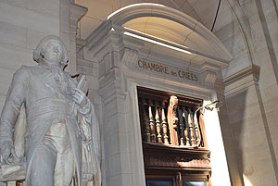
court roomTeodoro Nguema Obiang Mangue’s trial concluded July 5, 2017, with closing arguments by his defense counsel. The trial marks a major milestone in the struggle to ensure accountability for grand corruption, even when committed by those at the highest political levels.  A spicy mixture of high principle, juridical gravitas, and sophisticated argumentation on intricate issues of pressing urgency in the real world, the trial also contained moments of wrenching emotion and undignified, even scandalous, claims and insinuations.

The final day was devoted to arguments by Teodorin’s lawyers: Emmanuel Marsigny, Equatoguinean jurist Sergio Tomo, and Thierry Marembert.  In sum they claimed i) that their client didn’t steal enormous sums of money from the people of Equatorial Guinea, ii) that even if he did, the theft wasn’t illegal under Equatorial Guinean law, and iii) that even if he did steal the money and it was a violation of EG law, a French court did not have the right to try him for it.  Their arguments mixed misleading and often downright false statements of the evidence with strained and fanciful interpretations of the law, all seasoned with dark suggestions that the trial was about race and politics rather than the massive theft of resources from the citizens of Equatorial Guinea.     Continue reading