How Rampant Corruption Has Brought Peru to its Current Political Crisis

Earlier this week, Francisco Sagasti was sworn as the new president of Peru. He is the 87th president in the country’s 200-year history, the fourth president in the current five-year presidential term, and the third president in a week.

The unusual chain of events that led to Sagasti’s presidency comprise one of Peru’s biggest political crises in recent history. On Monday, November 9th, Congress voted to remove President Martín Vizcarra for “moral incapacity” and appointed the president of Congress, Manuel Merino, to serve as interim president. This move incensed the Peruvian public; Vizcarra had enjoyed a public approval rating of nearly 60% even after Peru suffered one of the worst Covid-19 outbreaks in the world. Peruvians took to the streets, protesting Vizcarra’s removal and demanding the resignation of Merino, who was the driving force behind the impeachment proceedings. Police violence against protestors left two dead, more than forty missing, and at least ninety injured. Merino resigned five days into his tenure, and Congress named Sagasti – one of the minority of Congressmen who voted against Vizcarra’s impeachment – as interim president until the April 2021 elections.

This crisis represents the culmination of several growing tensions in Peruvian political life, including an increasingly antagonistic relationship between the executive and legislative branches, a widespread rejection of the political establishment and embrace of populism, and the enormous toll of COVID-19. But no issue is more central to this story than that of endemic corruption. Indeed, the intractable problem of corruption in Peru has been largely responsible for the current political crisis.

Continue reading

Three Measures to Put Corruption Enablers Out of Business

The most common way corrupt officials hide money is by stashing it in an “offshore vehicle.” The “vehicle” will be a corporation, trust, or other legal person. It is termed “offshore” because it will be organized under the laws of another country. Stolen funds and assets purchased with them can then be listed in the name of the offshore entity.

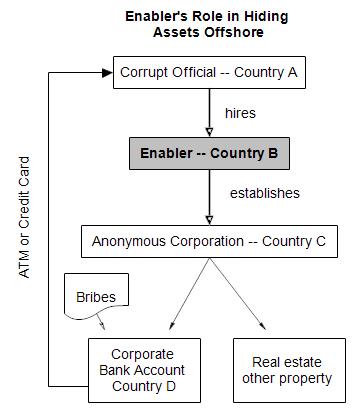
To create an offshore vehicle, the official will turn to someone with expertise in creating offshore entities and disguising their ownership: a lawyer, accountant or other professional who knows corporate and trust law and how to use it to hide the owner’s identity. The anticorruption community has dubbed these intermediaries “enablers,” for they enable corruption by providing corrupt officials with a way to enjoy the proceeds of their corruption.   A typical scheme is shown in the diagram below.

An official in country A wanting to hide assets first hires an enabler.  Although the enabler could be a professional in country A, hiring one located in another state makes it that much harder for local authorities to uncover wrongdoing. The enabler, shown in the diagram as located in country B (most often a wealthy country), then creates the offshore vehicle.  The enabler could have created the vehicle, in this case a corporation, in the enabler’s own country.

 But again, to make it harder for investigators to trace assets, the enabler will usually form the vehicle in still another country, here labelled C. As the diagram shows, to further frustrate efforts to track money flows the anonymous corporation (or shell or letter-box company — the terminology differs in different jurisdictions) will then open a bank account and buy real estate and perhaps art works or other personal or moveable property in still a fourth country.

Continue reading

South Korea’s Moment for Chaebol Reform is Now

In late 2016, South Korea’s President Park Geun-hye was impeached and removed from office following revelations of massive corruption in her government. While the scandal included plenty of sensational and salacious material, the core accusations involved improper quid pro quo relations between the Park administration and several chaebols—the massive, dynastically controlled business conglomerates that are the cornerstones of the South Korean economy. Following impeachment, President Park and several senior officials in her administration were arrested, tried, and convicted for a variety of offenses, including bribery, abuse of power, and coercion. In the aftermath of this massive scandal, new President Moon Jae-in swept into office with a commanding majority and a pledge to clean up the mess by instituting strong anticorruption reforms.

However, most of President Moon’s anticorruption initiatives have received mixed reviews at best. For example, President Moon’s proposed Anti-Corruption Agency, though authorized by parliament in December 2019, has yet to be established, and has been roundly criticized for its potential to be used to suppress political opponents. And President Moon’s attempt to exert more centralized control over prosecutors was derided by critics as a retaliatory measure against prosecutors investigating government corruption. But perhaps the greatest disappointment of the Moon administration’s approach to anticorruption is its reluctance to target the root of the country’s most serious corruption problem: the unchecked power of the chaebols. Though President Moon announced chaebol reform as a platform priority, his actions since his election have borne little fruit.

That chaebols were at the center of the Park administration scandal is neither surprising nor unusual. Indeed, chaebols have been at the center of South Korea’s most significant grand corruption cases, and they are routinely implicated in scandal after scandal after scandal. But neither the chaebols themselves nor their senior executives face a meaningful risk of significant liability. Even when prosecutors bring cases, chaebols and their executives benefit from judicial leniency, a phenomenon that has been documented both anecdotally and quantitatively. Indeed, South Korean high courts are infamous for overturning stricter lower court sentences in favor of what has come to be known as the “three-five” rule, available exclusively for chaebol executives: a guilty chaebol executive typically receives a three-year prison sentence, suspended for five years, and subsequently commuted—meaning that the executive serves no prison time. There are two likely explanations for this unusual and counterproductive judicial leniency toward chaebols and their executives. Continue reading

Fighting Corruption in Chicago Requires Fundamental Systemic Reforms to City Government

Chicago, a city with an economy larger than that of countries like Thailand and Belgium, has won the title of the most corrupt city in America, with a total of 1,750 public corruption convictions between 1976 and 2018. (Los Angeles came in second with 1,547 convictions, while New York City (Manhattan) had 1,360.) There are numerous reasons why corruption is so pervasive in Chicago, many of which have roots in the city’s complicated history. But one particular institutional feature of Chicago city government appears to play a particularly important role: the system of so-called “aldermanic privilege” that allows local municipal representatives, known as aldermen, to operate their districts like discrete fiefdoms.

Chicago is divided into 50 political wards, each of which elects an alderman to represent the ward in City Council. Chicago differs from most other cities because an alderman can control virtually every aspect of zoning, licenses, and permitting within his or her ward. If, for example, a business needs a permit to hang a sign over its store or wants a license to sell liquor, the local alderman has to approve it. The aldermen also have broad authority to determine if a city block should be zoned as residential, commercial, or manufacturing, and to change zoning designations about how big a house can be, how many patrons a restaurant can serve, and what types of commercial properties are permitted. These powers, known collectively as aldermanic privilege, are not written anywhere in the city’s charter or ordinances. Rather, aldermanic privilege is a byproduct of Chicago’s longstanding political culture of deference and reciprocity: aldermen tacitly agree not to interfere with each other’s decisions, and the mayor cedes control of local wards to aldermen in exchange for the aldermen giving the mayor a wide berth on city-wide decisions. Some defend this system on the grounds that each alderman knows what is best for his or her own ward. And to be sure, aldermanic privilege can be used for good. But this system also fosters corruption, with alderman frequently using their power to extort bribes from local businesses. A particularly egregious illustration of such abuses came to light last year, when federal prosecutors charged Edward Burke, one of Chicago’s longest serving and most powerful alderman, with extortion and related offenses in connection with Burke’s alleged shakedown of local businesses in exchange for licensing and building permits. But Burke is hardly unique.

What can the city do about this problem? Last year, in part in reaction to the Burke Scandal, Mayor Lori Lightfoot successfully ran for mayor on a campaign that called for fighting corruption and ending aldermanic privilege. Mayor Lightfoot followed through shortly after her inauguration, issuing an executive order that stripped aldermen of their authority over permits and licensing decisions, and instructing city departments to stop deferring to aldermen’s wishes. The City Council also passed Mayor Lightfoot’s ethics package, which, among other things, gave Chicago’s inspector general greater powers to investigate aldermen, and banned alderman from having any outside employment that poses a conflict of interest.

This is a good start, but it’s insufficient to root out aldermanic corruption. Succeeding in that endeavor requires more fundamental reforms to Chicago city government. Two such reforms, individually or in combination, might help achieve this end:

Continue Reading

How Grand Corruption Threatens Liberal Democratic Institutions

As regular readers may have noticed, GAB has been inactive for the past week (that is, until Rick’s post yesterday). Apologies for the lack of content – as I’m sure you can imagine, the U.S. presidential election has been consuming my attention and that of most of our regular contributors. But now that the election outcome is clear (notwithstanding President Trump’s baseless claims of election fraud and the craven complicity of his Republican Party enablers), it’s time to get back to blogging. I suspect that much (though not all) of our content over the next couple of weeks will be related to the outcome of the U.S. elections—both backward-looking evaluation of the impact of the Trump Presidency on corruption in the US and beyond, and forward-looking considerations about the anticorruption agenda under the incoming Biden Administration.

Today’s post isn’t about Trump per se, but it’s loosely inspired by both certain aspects of his presidency and his current refusal to acknowledge and accept the outcome of the election. I want to say a few words about the ways in which corruption, particularly grand corruption at the highest levels of the government, can threaten to undermine the institutions of liberal democracy (free and fair elections, formal and informal checks and balances, the rule of law, etc.). To be clear, I don’t have in mind principally the ways in which politicians might engage in corrupt conduct to help win elections (for example, vote-buying, acceptance of illegal campaign donations in exchange for favors, diverting public funds for partisan purposes, etc.), though these are of course serious and important problems. Nor do I have in mind the broader and more diffuse “institutional corruption” associated with the excessive influence of concentrated wealth, though this too is a grave concern. Rather, I want to consider how grand corruption in the highest levels of government may threaten to erode or subvert (explicitly or de facto) the basic institutional structures of liberal constitutional democracy.

Nothing of what I have to say on this topic is original; it’s all drawn from existing literature, and the arguments are likely familiar to many readers. Still, I thought it might be helpful to highlight three ways in which unchecked grand corruption may contribute to democratic backsliding: Continue reading

Can Trump Be Prosecuted?

President Trump and diehard supporters continue to maintain on Twitter, in interviews, and at press conferences that tens of thousands of votes at the November 3rd election were fraudulently cast and that once these ballots are excluded, he will be declared the winner. But under American law only a judge can invalidate a vote, and unlike Trump sympathizers, judges demand clear and convincing evidence of voter fraud — something Trump has yet to produce (here) and is quite unlikely to be able to (here). So Joe Biden will indeed take office January 20.

While President Trump’s term in office ends at noon that day, his legal problems will not.  Indeed, they are likely to accelerate.  For whatever immunity he enjoyed from prosecution as a sitting president ends too. 

By far the greatest threat Trump faces are the investigations led by Manhattan District Attorney Cyrus Vance, Jr. and Letitia James, New York’s attorney general. Both are independently investigating criminal charges related to Trump’s dealings while a New York businessman. James may also be continuing her investigation of abuses involving Trump’s now defunct New York charity. The charges both are pursuing involve violations of New York state law, meaning a presidential pardon would do him no good. It excuses only violations of federal law.  

Continue reading

Measuring the Success of Brazil’s 2014 Anticorruption Law

In January 2014, following nationwide protests prompted by concerns about widespread corruption, the Brazilian Congress enacted a new Anticorruption Law. The 2014 Anticorruption Law was a landmark in part because it represented the shift from the traditional focus on individual bribe-takers to the bribe-paying corporations. Although a few prior statutes did address the conduct of alleged bribe payers, the Anticorruption Law both authorized much more stringent penalties on bribe-paying companies (including fines of up to 20% of a company’s gross revenue in the prior year, and even mandatory dissolution of the company in extreme cases), and also adopted a revolutionary strict liability regime for corporate corruption offenses.

More than six years have passed since the Brazilian Anticorruption Law entered into force. Has the law been effective? What do we know so far about its enforcement? On the whole, the enforcement numbers seem rather disappointing, suggesting that the law has not (yet) been deployed aggressively to sanction bribe-paying corporations in most parts of Brazil. Nonetheless, there are a variety of reasons why it would be premature to conclude from these numbers that the law has not been, or will not be, effective.

Continue reading

Macro-Criticality: The International Monetary Fund’s Black Box

Back in 2018, the International Monetary Fund (IMF) promised to tackle corruption within its member states when that corruption is “macro-critical”—that is, when corruption “affects, or has the potential to affect, domestic or external [macroeconomic] stability.” The IMF’s declaration that corruption is, or at least can be, “macro-critical” was an important development, one that anticorruption professionals applauded as a “major step forward.” For those less familiar with the IMF, though, the significance of the “macro-criticality” finding may not be immediately obvious. To understand this particular piece of IMF jargon, and why it’s so important for when and how the IMF engages in anticorruption work, it’s necessary to understand a bit more about how the IMF operates.

First and foremost, the IMF is a “monetary agency, not a development agency.” In contrast to a development agency like the World Bank, the IMF does not finance specific projects, nor is its mandate to promote economic development and poverty reduction as a general matter. Rather, the IMF helps protect global macroeconomic stability by lending funds to governments in dire straits. Furthermore, the IMF often requires, as a condition for receiving these emergency loans, that the recipient governments adopt institutional or policy reforms—a controversial practice known as “conditionality.” The IMF has also sometimes forgiven loans for particularly debt-burdened countries. And in recent years, the IMF has expanded its capacity development apparatus by providing advice to countries on a wide range of issues related to a country’s macroeconomic management, including central banking, monetary and exchange rate policy, tax policy and administration, and official statistics. All these services function to protect the international monetary system from potential risks, which is the IMF’s primary task.

But although the IMF’s mission is, at least in principle, narrowly focused on macroeconomic stability, the IMF has consistently faced the question of how to distinguish economic policy (which the IMF may influence) from social or political matters that are outside the IMF’s mandate (see, e.g., here, here, and here). Recognizing that there can be a porous boundary between economic and political matters, the IMF developed the concept of “macro-criticality.” So long as an issue—even a political or social issue—affects, or has the potential to affect, the macro-economy in a significant way, the IMF may treat the topic as it would any other issue traditionally recognized to be the IMF’s bread and butter.

And that’s why it was so important that the IMF has declared that corruption is a “macro-critical” issue. Once the IMF considers corruption in a given country to be macro-critical, the IMF may place anticorruption conditions on IMF loans to that country. The macro-criticality finding also validates data collection and capacity building measures related to corruption and anticorruption—measures that would otherwise seem to fall outside the IMF’s jurisdiction.

Nevertheless, confusion persists about when the IMF will consider corruption to be a “macro-critical” issue, and what exactly the IMF promised to do in its 2018 statement. One reason it’s hard to understand what the IMF actually committed to is because there are many ways for an issue to affect domestic or external macroeconomic stability. Perhaps most importantly, it’s important to distinguish a finding that an issue, such as corruption, is globally macro-critical—in the sense that there is robust evidence that this issue can have significant effects on macro-economic stability—from a finding that this issue is macro-critical in a particular country. Even a globally macro-critical issue may not by macro-critical in a specific country, either because the country in question already has adequate safeguards in place to address the issue, or because the macroeconomic risks associated with this particular issue are minimal in comparison to other country-specific threats.

Continue reading

Review of Gemma Aiolfi’s Anticorruption Compliance for Small and Mid-Sized Organizations

For almost two decades the Basel Institute on Governance has advised corporations large and small, first in Europe and now around the globe, on how to develop a robust anticorruption compliance program. One that will prevent the company from becoming entangled in a corruption scandal while at the same time neither compromising its ability to compete nor dampening its entrepreneurial energy. Gemma Aiolfi, who has headed the Institute’s corporate compliance work for the last seven years, presents the Institute’s collective experiences in a new volume from Elgar, Anti-Corruption Compliance for Small and Mid-Sized Organizations.

What sets Aiolfi’s book apart from the many fine volumes already on the market (examples here, here, and here) is that it is leavened with literally dozens of examples drawn from the Institute’s work. How should a company establishing a compliance program handle personnel used to doing business “the old way”?  What should a manager do if she discovers police in a developing country are threatening to shut down critical operations if the company’s low-level frontline personnel don’t pay them off? How should a company deal with senior government officials’ requests for lavish travel and entertainment allowances when visiting a company’s operations? Discussions of how to handle each, with suitably anonymized case studies explaining how management actually dealt with them, is what makes the volume so useful.

Continue reading

Trump’s New Executive Order on the Civil Service Poses a Grave Corruption Threat

Last week, President Trump issued a new Executive Order that, if implemented, could dramatically change the U.S. federal civil service—and in so doing threatens to subvert one of the most important bulwarks against corruption in all of U.S. law.

First, a quick synopsis of what the order does: Federal civil service laws are complex, but simplifying a bit, the bulk of U.S. civil service positions fall under something called the “competitive service” (also known as the “merit system”), in which hiring is based on competitive examinations administered by the Office of Personnel Management. Furthermore, those holding competitive service positions can only be removed for good cause (that is, they can’t be fired at will), and removals of such officials are reviewable by an independent commission called the Merit Systems Protection Board. Also importantly, those in the competitive service are entitled to union representation. Not all federal positions have these protections; the most senior civil servants are part of a different system (the “Senior Executive Service”), and there are a number of other relatively narrowly drawn exemptions for particular classes of jobs, typically those for which hiring by competitive examination is not practical (the “excepted service”). President Trump’s new Executive Order would shift from the competitive service to the excepted service any position that has “a confidential, policy-determining, policy-making, or policy-advocating character.” If that sounds very broad, it’s because it is. The Executive Order, if implemented, could shift tens of thousands, or possibly hundreds of thousands, of federal civil service positions out of the competitive service, thus giving the President the authority to fire the holders of those positions at will, as well as the authority to replace them with political appointees.

It’s not entirely clear whether the new order is legal. The relevant statute does contain a provision that allows the President to create “necessary exceptions” from the merit system insofar as “conditions of good government warrant.” Past presidents have exercised this authority, though to the best of my (limited) knowledge, President Trump’s Executive Order is unprecedented in both the breadth of its coverage and the thinness of its proffered justifications. That might matter, because there are a handful of prior court opinions (though none at the Supreme Court level) that suggest that the President’s authority to exempt positions from the merit system is not unlimited. It’s also not certain whether the Executive Order will ever go into effect. If Joe Biden wins next week’s election, he could reverse the order as soon as he’s inaugurated, and it’s unclear whether the Trump Administration will be able effect any actual reclassifications under the order prior to inauguration day. (The order itself calls on all agencies to prepare a preliminary list of affected positions by inauguration day, but it’s possible that agencies might move faster and reclassify some positions before then.)

For purposes of the present post, I want to put those issues aside. I also will put aside, for now, broader questions of whether the Executive Order would worsen the politicization of federal agencies or undermine their overall quality (themes I’ve explored in other work). Instead, my objective here is to elaborate on why this Executive Order, if implemented, poses such a significant corruption threat. To do that, let’s consider three forms of corruption (or corruption-facilitating practices) that the civil service merit system is meant to constrain, and the impact that this Executive Order would have on each: Continue reading