Why Has Ukrainian Military Corruption Been a Non-Story in the Current Conflict?

In my post two days ago, I noted that one reason that the Russian army’s progress in Ukraine has been slower than expected—notwithstanding Russia’s overwhelming numerical superiority—may be the corruption that has been rampant in the Russian military and defense sector for years. (See, for example, here, here, and here.) While I don’t want to attach too much importance to this factor, it does seem at least plausible to me that widespread corruption has undermined Russian military effectiveness, particularly with respect to things like supplies, maintenance, and equipment quality, and possibly also with respect to training and the competence of the leadership.

But if we think that widespread defense sector corruption has played a non-trivial role in Russia’s under-performance on the battlefield in the current war, this naturally invites a question: Why haven’t we also seen reports suggesting that Ukrainian defense sector corruption has hampered the effectiveness of the Ukrainian defense against Russia’s invasion? After all, while corruption has long been recognized as a serious problem in the Russian military, many commentators—including many Ukrainian analysts—have been saying for years that the Ukrainian military also suffers from serious corruption problems, and that those problems threaten to undermine Ukrainian military effectiveness (see, for example, here, here, and here). And yet the news out of Ukraine suggests that the Ukrainian armed forces are fighting quite effectively, without reports of equipment or operational problems that might plausibly be due to corruption.

Why is this? I have no idea—so this is going to be one of those posts where I raise a question rather than trying to argue for what I think is the most likely answer. I may try to do more research and address this in a future post, but for now let me throw out three hypotheses. I would welcome comments from readers who know more about this topic as to which of these seem most plausible, or whether there might be another explanation that I have overlooked: Continue reading

The Maldives: No Safe Haven for Oligarchs’ Yachts

Contrary to recent reports (here, here), Russian oligarchs’ yachts harbored in the Maldives are by no means safe from confiscation. As a party to the United Nations Convention Against Corruption (UNCAC), the Maldives has made bribery, embezzlement, and money laundering crimes under its domestic law (here).  Pursuant to article 46, it pledges “to afford [other UNCAC parties] the widest measure of legal assistance in investigations, prosecutions and judicial proceedings” to enforce their laws against bribery, embezzlement, and money laundering.

These provisions put the oligarchs’ yachts at risk of confiscation in two ways. 

One, Maldivian authorities could initiate an action under the domestic antimoney laundering law. Given the evidence on the public record, there is certainly reason (what American law terms “probable cause”) to believe that the yachts were acquired with the proceeds of a crime, likely embezzlement from the Russian state. (Remember, there need not be a conviction for embezzlement in Russia or elsewhere to launch the related prosecution for money laundering.) The yachts’ presence in the Maldives appears to be more than sufficient grounds for its courts to assert jurisdiction under article 13 of the penal code and therefore to issue a “freeze” order which would prevent the yachts from pulling anchor until a final decision on a seizure action issued.

Alternatively, Maldivian courts have the power under UNCAC and domestic law to issue a freeze order at the request of another UNCAC party.  A country where one was built, for example, could open a case to see whether the shipbuilder was paid with the proceeds of a crime, a money laundering offense, and request that the Maldives prevent the yacht from leaving until its case were concluded. 

Some say will say that whatever the law, the Maldives is a small island nation without the guts to stand up to Russia.  Not so. During the UN General Assembly debate on the resolution denouncing Russian aggression, the government not only backed the resolution but its ambassador left no doubts where its stood: “The Maldives has always taken a principled stand on violations of the territorial integrity of a sovereign country, [a] position based on a bedrock belief in the equality of all States and unconditional respect for the principles of the United Nations Charter.”

Others will be claim that confiscating the oligarchs’ yachts is not possible legally for ownership is obscured by layer upon layer of shell of corporations headquartered in countries.  But those layers can be stripped away by the determined efforts of police and prosecutors, a determination surely stiffened by magnitudes given the yacht owners’ complicity in the appalling events daily unfolding in Ukraine.
Hooray for Corruption (in the Russian Military)

As I write this, the tragic unjustified conflict in Ukraine drags on, with anguishing reports of civilian casualties and needless destruction mixed with encouraging news of the valor of the Ukrainian armed forces and the resolve of the Ukrainian people and their leaders. I won’t pretend to have any idea what will happen. I’m just hoping that outnumbered the Ukrainian resistance can hold out long enough for the political and economic pressure to have some effect—if not in changing the Russian leadership’s policy, then at least in undermining its capacity to wage war or maintain a long-term occupation.

In trying to slow the Russian army’s advance and deny Russia control of major cities and other strategic targets, the Ukrainian military may have the help of an unexpected ally: corruption. The corruption, that is, of the Russian military and defense sector. Without taking anything away from the skill and bravery of the Ukrainian armed forces, many analysts have noted that the invading Russian force appears to have been hampered by cheap and poorly maintained equipment, shortages of fuel, rations, and other supplies, and deficiencies in training and coordination. And some of these analysts have suggested that while no one factor can explain Russia’s poor showing in the field (so far), pervasive corruption in the Russian defense sector may be an important contributing cause (see, for example, here, here, and here). Continue reading

The UK’s Promised War on Kleptocracy: Reinforcements Needed

Putin’s invasion of Ukraine has created a new-found resolve among the world’s financial centers. They are now committed to seizing the money Putin and oligarchic cronies have stolen from the Russian people and hidden in their territories. Given the enormous media attention on where it is stashed (examples here, here, and here), that may sound straightforward.

It is not.  Even bad guys have rights, and as Radha Ivory reminds, that includes the right to their property. To confiscate the assets Putin and cronies have squirrelled away outside Russia will require proof that (a) no matter what ownership records show, the assets really do belong to one of them and (b) the assets were acquired with the proceeds of corruption or other criminal activity.

London has been one of the premier destinations of dirty Russian money. James Mather, a barrister of the U. K’s Serle Court, explains below what the British government must do to fulfill its pledge to confiscate every shilling of stolen Russian money hidden in its territory.

The gloves have come off in the United Kingdom’s effort to cleanse itself of ‘dirty money’, or so we are told.  To signal its commitment, the UK government has sped up new legislation, but its contents seem unlikely to advance matters very far.  There is amendment of the legislation for Unexplained Wealth Orders (totemic but misunderstood powers that are of quite limited practical use) and new requirements to register the beneficial ownership of property (as always easily evaded by clever structuring or simple lies).  What has really been lacking all these past years is harder to legislate for: the adequate enforcement of the asset recovery laws that exist. 

Continue reading

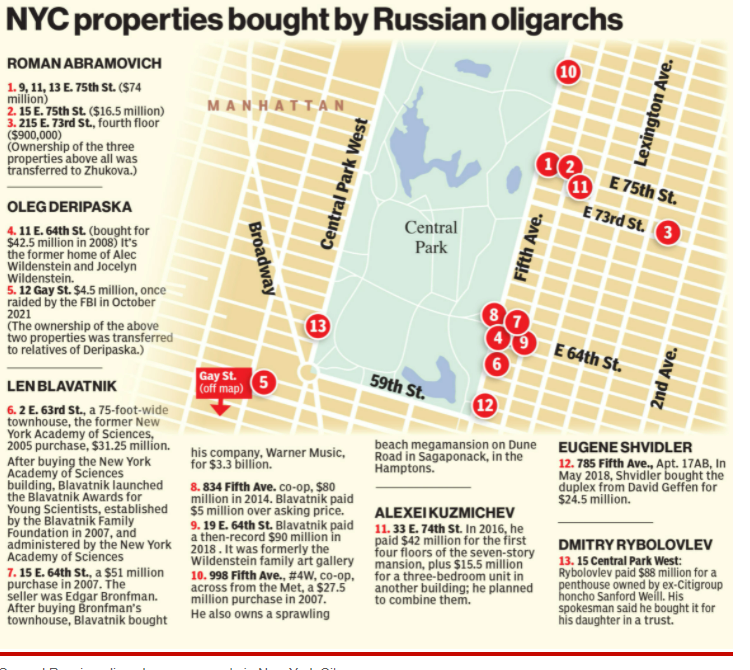
New York Real Estate Owned by Putin’s Buddies

Source: Jennifer Gould, Here’s where Russian oligarchs and their families own property in NYC, New York Post, February 27, https://nypost.com/2022/02/27/heres-where-russian-oligarchs-and-their-families-own-property-in-nyc/

Several media reports suggest sanctioning Putin’s supporters won’t be that easy because their ownership is hidden under layers of corporate vehicles. As Jennifer Gould’s story in the New York Post shows, thanks to the work of many investigative reporters and NGOs. we do know where many of Putin’s buddies have stashed their wealth in the Big Apple. Click here for a similar guide to London properties TI-UK has drawn up.

Nigerian Human Rights NGO Denounces Prosecution of Corruption Whistleblower Olanrewaju Suraju

This blog has several times reported on Nigeria’s prosecution of corruption whistleblower Olanrewaju Suraju (here, here, here). His “crime:” Helping expose massive bribery in the nation’s oil sector.

Fortunately, for both Mr. Suarju and the citizens of Nigeria, Nigerian civil society is standing behind him, demanding the farcical prosecution cease. Below is the most recent show of support.

Legal Defence & Assistance Project or LEDAP, a prominent Nigerian human rights NGO denounces the prosecution and calls not only for the government to immediately drop the charges against Mr. Suraju but investigate those behind this perversion of course of justice.

LEDAP condemns the prosecution of anticorruption crusader, Mr. Olanrewaju Suraju, Calls for investigation of Mr. Suraju’s corruption allegations in the Malabu Oil Scam.

LEDAP strongly condemns the prosecution of Mr. Olanrewaju Suraju, the chairman of the Human and Environmental Development Agenda (HEDA) for his allegations of corruption against the former Attorney General of the Federation, Mohammed Adoke, in the Malabu oil block allocation scam. Mr. Suraju has consistently made public massive bribery and abuse of power against Mr. Adoke and other foreign companies, for which some are currently facing criminal charges in Italy.  Rather than investigate the allegations raised in Mr. Suraju’s many petitions, the Attorney General has elected to prosecute him, undermining the so-called anti-corruption agenda of the regime.

Continue reading

A Brief Note on Russia’s War Against Ukraine

Russia’s invasion of Ukraine (or, more accurately, the dramatic escalation and expansion of the invasion that Russia already started eight years ago) is horrifying. As I type this, Russian forces are moving against Kyiv, and Ukrainian defense forces and reservists are preparing to defend their capital city against overwhelming odds, while the Ukrainian army elsewhere in the country is doing its best to resist Russian advances from all directions. I have nothing useful to say about this terrible situation. I am not a military analyst, an expert in geopolitics, or even terribly knowledgeable about aspects of this crisis closer to my own areas of expertise (such as questions regarding the efficacy of sanctions the West is imposing, or could impose). I’m just a professor, not terribly well known outside my fairly narrow areas of academic specialization, who runs a blog about anticorruption. But this morning, I can’t really think of anything else to write about.

Maybe at some point I’ll be able to collect and organize my thoughts and say something coherent about how this war relates to the global fight against corruption. There most certainly is a connection–probably several connections–even though corruption/anticorruption is only one part of the story. For now, let me just share scattered thoughts and reactions: Continue reading

Why Didn’t the Disclosure of the Beneficial Owners of Real Estate Make a Difference?

Anticorruption advocates have long thought that real estate and money laundering go together like a horse and carriage. At least in the United States. With a little help from a friendly lawyer, a corrupt official or other big time criminal has until recently been able to use an anonymous shell company to hide their money by buying a luxury mansion or pricey condominium. Because the real estate registry listed the company, not the crook, as the owner, the real owner’s identify was hidden. From law enforcement, the media, and civil society.

In 2016 the U.S. government made a start on ending this abuse. It began to require the disclosure of the beneficial owner of any corporation which paid cash for properties in cities where real estate purchases were likely used to hide stolen money.  Initially, and as expected, the new rule seemed to have the desired effect: all cash purchases of real estate appeared to drop significantly — indicating a gaping loophole in the antimoney laundering laws had been plugged.

But the first paper published by the Anticorruption Data Collective finds to the contrary.  Authors Matt Collin of the World Bank and Brookings Institution, Florian M. Hollenbach of the Copenhagen Business School, and David Szakonyi of George Washington University report the rule had no impact “on the number of, the total price volume, or the share of corporate all-cash purchases in targeted counties.”  Indeed, they could find “little difference in the patterns of corporate all-cash purchases versus a ‘placebo’ outcome that should not be affected by the policy.”

Beneficial ownership disclosure is a favorite reform of anticorruption advocates. One that would seem to have an obvious, immediate salutary effect. Why didn’t it here?

The authors offer two reasons, and suggest there could be others. Their paper demands careful attention. One because of the implications for beneficial ownership disclosure rules, and second, and more importantly, because it shows how important it is to carefully assay anticorruption reforms. Their paper is here and comments are welcomed.  And GAB looks forward to more work by the Anticorruption Data Collective.

Taking on the Demand Side of Foreign Bribery: How U.S. FCPA Settlements Can Facilitate Foreign Prosecutions

Laws like the U.S. Foreign Corrupt Practices Act (FCPA) target what is sometimes referred to as the “supply side” of transnational bribery transactions—the firms and individuals of offer or pay bribes to foreign officials in order to secure a business advantage. But what about the demand side? All too often, the government officials who demand or receive these bribes escape accountability—even when the bribe-paying firms are forced to pay substantial penalties for FCPA violations. Years ago, some U.S. Department of Justice (DOJ) prosecutors floated the theory that bribe-taking officials could be charged as abettors to, or co-conspirators in, FCPA violations, but that theory, though legally plausible, failed to gain traction in the courts. On occasion, the DOJ has prosecuted bribe-taking foreign officials for money laundering. And more recently, Members of the U.S. Congress have introduced a new bill, the Foreign Extortion Prevention Act (FEPA), which would make it a crime under U.S. law for a foreign public official to seek, demand, or accept a bribe. FEPA’s chances of enactment are uncertain (the vast majority of bills fail, after all); moreover, even if enacted, FEPA’s impact may be circumscribed by the practical and political difficulties of arresting and trying foreign public officials, particularly those that do not have any contact with U.S. territory.

What about the bribe-taking public official’s own government? Shouldn’t that government take the lead in prosecuting its own public officials when they behave corruptly? There would be a nice symmetry—and a great deal of practical advantage—to a system in which the supply-side government (say, the United States) goes after the bribe-paying company, while the demand-side government goes after the bribe-taking public official. But often this doesn’t happen: In the majority of cases where the U.S. government imposes FCPA sanctions on a company for paying bribes in a given country, there is no parallel or subsequent prosecution by that country’s government of the corrupt officials involved.

Sometimes the explanation is political: the public officials involved are sufficiently powerful and well-connected to escape domestic accountability in their home countries, even when their misconduct is known. That’s a big problem, and one that statutes like FEPA are designed to address. But there’s another reason that demand-side governments often fail to hold their own officials accountable: a lack of capacity and an associated lack of evidence. In a great many cases, even when a bribe-paying firm settles an FCPA case with the US government, and in doing so admits to certain facts and provides evidence about the misconduct to the DOJ, the demand-side country government does not receive sufficient evidence to identify, let along prosecute, the corrupt officials involved—either because the company did not supply that information to the DOJ, or the DOJ did not turn that information over to the demand-side official’s government. True, FCPA settlement agreements are usually public, but the official statements of facts in these agreements are often not sufficiently precise and detailed to give a foreign enforcement agency what it needs to make out a case.

The U.S. government can and should fix this problem. Doing so would not require new legislation. Rather, it could be accomplished through a straightforward and easily implementable change in DOJ policy. Continue reading

Narrowing the Scope of Brazil’s Administrative Improbity Law: Why the New Limits Will Strengthen, Not Weaken, the Law’s Efficacy

Brazil’s 1992 Administrative Improbity Law, which authorized severe sanctions on government agents who commit “acts against the public administration,” was the first Brazilian statute specifically targeted at government corruption. Last year, Brazil adopted extensive amendments to this law, many of which were controversial. In a recent post, I criticized the amendment that reduced the number of institutions responsible for enforcing the Improbity Law. But other controversial amendments to the law are, in my view, positive developments. In particular, I want to defend two other amendments that critics have asserted weaken the law:

  • First, under the original version of the Improbity Law, a public official could be sanctioned for negligent behavior that caused damage to the public treasury. Under the amended version of the law, only intentional acts can be considered administrative improbity punishable under this statute.
  • Second, the original version of the law listed ten forms of administrative misconduct that would constitute “violations of the principles of public administration,” but, importantly, that list was not exclusive. Rather, the listed forms of misconduct were presented only as examples. This meant that law enforcers could, and often did, bring an action under the Improbity Law for conduct that, in the enforcer’s view, violated a “principle of public administration,” such as morality and equity, even if the particular form of alleged improbity was not included as one of the specifically listed forms of misconduct in the statute. The amended law constrains enforcement discretion by establishing a well-defined and restricted list of acts that qualify as violations of the principles of public administration.

Critics, including many anticorruption advocates, assert that these changes unduly narrow the scope of the law, thereby undermining one of Brazil’s most important anticorruption instruments. These concerns, while understandable, are misplaced: Both of the above amendments improve the law by ensuring that it is administered fairly and used to target serious corrupt acts, rather than being wielded as a political weapon to punish partisan adversaries for good-faith mistakes.

Continue reading