New Podcast Episode, Featuring Andreas Bågenholm and Rekha Diwakar

A new episode of KickBack: The Global Anticorruption Podcast is now available. In this episode, host Dan Hough interviews Andreas Bågenholm (University of Gothenburg) and Rekha Diwakar (University of Sussex) about anticorruption political parties. These parties have proliferated in different parts of the world in the last two decades. Andreas and Rekha draw on their research in Europe and India respectively to talk about where these parties come from and what they stand for. They discuss how these parties have actually performed when they have entered into government, assessing in particular the track record of the Aam Aadmi Party (AAP) in Delhi. You can also find both this episode and an archive of prior episodes at the following locations: KickBack was originally founded as a collaborative effort between GAB and the Interdisciplinary Corruption Research Network (ICRN). It is now hosted and managed by the University of Sussex’s Centre for the Study of Corruption. If you like it, please subscribe/follow, and tell all your friends!

Victims of Corruption Focus of Today’s COSP Events

Four events at today’s meeting of the Council of State Parties to the United Nations Convention Against Corruption put the damage corruption does to individuals and organizations front and center. The subject and starting hour (U.S. East Coast time) of each:

  • 9:00: Strategic Litigation: Advocacy Tool for Policy Change (details here)
  • 13:00: Victims of Corruption, New York Meeting Room (details here)
  • 16:00: Righting the wrong: Tools for Asset Recovery in Global Corruption Cases, New York Meeting Room
  • 18:00: A Victim-Centered Approach to Anticorruption Actions, Seattle Meeting Room (details here)

Among the highlights will be a review and discussion at Victims of Corruption session of StAR’s just published volume Victims of Corruption: Back for Payback. A heroic effort to bring together the diverse sources and approaches to compensating victims of corruption (to which I was honored to contribute), it represents a major step forward in focusing the attention of UNCAC states parties, jurists, and civil society activists on article 35, UNCAC’s most overlooked provision –

Each State Party shall take such measures as may be necessary, in accordance with principles of its domestic law, to ensure that entities or persons who have suffered damage as a result of an act of corruption have the right to initiate legal proceedings against those responsible for that damage in order to obtain compensation.

Announcement: ICRN Forum — Call for Applications

The Interdisciplinary Corruption Research Network (ICRN), on whose Board of Advisors I serve, will be holding its eighth annual ICRN Forum this coming June June 27 to 29, 2024 at the Institute of Social Sciences of the University of Lisbon. The ICRN Forum is a brings together early career researchers from diverse disciplines, including but not limited to anthropology, economics, history, law, political science, psychology, and sociology. Participant will have the opportunity to present their research (at different stages), exchange ideas, and take part in co-creation sessions.

Those who are interested in submitting an application to present at the Forum (including a registration form and a 300-word abstract) may do so here. The ICRN’s instructions for applicants indicates that the Forum organizers welcome theoretical and empirical contribution on corruption, anticorruption, and/or integrity–from practitioners as well as academic researchers–and that applicants may apply for any of the three types of sessions:

  • Research Findings: In these sessions, authors will present research at a more advanced stage. (That is, where the researcher has already carried out their fieldwork, collected data, conducted some degree of analysis, produced some results, even if preliminary.) We also encourage submissions focused on the promotion of completed papers, the discussion of fieldwork challenges, and/or possible analytical pathways based on already-collected materials.
  • Work in Progress: In these sessions, researchers will present early-stage ideas, with the main objective to help these researchers get useful feedback on research design, framing, and related issues.
  • Co-Creation-: These sessions will focus on developing new research ideas and/or open collaboration projects; these may include ideas for a joint publication, teaching activities, or the organization of conference panels, as well as more innovative ideas that may advance corruption research. Applicants to a co-creation session are expected to volunteer to moderate (chair) the session. Proposals for a co-creation session must include a clear description of objectives, procedure, guiding questions, and any other elements considered relevant for the successful holding of discussions.

The deadline for submitting applications is Friday, February 9, 2024. Notification of acceptance will be sent out in March 2024. There is no registration fee, but participants will bear their own travel and accommodation expenses. Any questions can be sent to the organizing team at icrn2024@ics.ulisboa.pt

New Podcast Episode, Featuring Robert Klitgaard

A new episode of KickBack: The Global Anticorruption Podcast is now available. In this episode, host Dan Hough interviews Professor Robert Klitgaard, one of the most well-known and influential academics in the corruption field. In the conversation, Professor Klitgaard talks us through the origins of his ideas in applying institutional economic theory to understanding corruption issues, as originally set out in his 1980 book Controlling Corruption. He then discusses several other issues, including challenges related to elitism in developing and developed countries, the role of “culture” in anticorruption analysis, and his recent research in Bhutan and the lessons it might hold for other countries pursuing anticorruption reforms. You can also find both this episode and an archive of prior episodes at the following locations: KickBack was originally founded as a collaborative effort between GAB and the Interdisciplinary Corruption Research Network (ICRN). It is now hosted and managed by the University of Sussex’s Centre for the Study of Corruption. If you like it, please subscribe/follow, and tell all your friends!

Guest Announcement: New Basel AML Index Now Available

Kateryna Boguslavska, project manager at the Basel Institute on Governance, provides the following announcement:

Earlier this month, the Basel Institute on Governance released its annual Anti-Money Laundering (AML) Index; the public edition of this index, which draws on 18 separate indicators, ranks 152 jurisdictions according to each jurisdiction’s risks of money laundering and terrorist financing, and its capacity to counter those risks. (While the public edition is freely available, those interested in a more in-depth exploration of the data, for a larger number of jurisdictions, can sign up for the Expert Edition — also free for users outside the private sector.) The launch of the Basel AML Index was accompanied by a launch webinar, as well as a report. That report focuses on three important topics: virtual assets, confiscation of illicit assets, and the misuse of non-profit organizations for terrorist financing. This resource may be useful for many researchers who study corruption and illicit financial flows.

New Podcast Episode, Featuring Panel Discussion on Professional Enablers

A new episode of KickBack: The Global Anticorruption Podcast is now available.  This episode features a panel discussion on the role of so-called “professional enablers” (including lawyers, accountants, consultants, and others) in facilitating corruption, illicit financial flows, money laundering, and related activities. The panelists–Robert Barrington, Guy Beringer, Liz Dávid-Barrett, Tena Prelec–discuss the meaning of the “professional enablers” term, distinguish legal from illegal functions, and discuss the types of corruption-related activities that these service providers might facilitate. The panelists provide a variety of case examples from around the world, focusing particularly on the legal profession, and discuss potential responses, including highr professional standards.

You can also find both this episode and an archive of prior episodes at the following locations:

KickBack was originally founded as a collaborative effort between GAB and the Interdisciplinary Corruption Research Network (ICRN). It is now hosted and managed by the University of Sussex’s Centre for the Study of Corruption. If you like it, please subscribe/follow, and tell all your friends!

New Podcast Episode: In the 101st Episode, Hosts Reflect on the 100th Episode!

A new episode of KickBack: The Global Anticorruption Podcast is now available.In the previous episode (the 100th episode of the series), the KickBack hosts invited a dozen leading anticorruption experts (plus me) to offer their reactions to one or both of two big-picture questions about the field: (1) What is one thing about corruption that you’ve changed your thinking on in the past 10 years?, and (2) What is the most significant development — positive or negative — in relation to corruption and corruption studies over the past thirty years? In the most recent episode (the 101st), KickBack hosts Liz David-Barrett, Robert Barrington, Dan Hough, and Sam Power (all with the Sussex University Centre for the Study of Corruption) reflect on the wide range of answers that the various respondents gave to these questions, and more generally use this as an occasion to thing more broadly about the present and future of anticorruption–both as a practical reform agenda and as a field of study and research. You can also find both this episode and an archive of prior episodes at the following locations: KickBack was originally founded as a collaborative effort between GAB and the Interdisciplinary Corruption Research Network (ICRN). It is now hosted and managed by the University of Sussex’s Centre for the Study of Corruption. If you like it, please subscribe/follow, and tell all your friends!

Special 100th Episode of the KickBack Podcast

After a bit of a hiatus, a new episode of KickBack: The Global Anticorruption Podcast is now available. This is the 100th episode of the series, and to mark that milestone, the podcast hosts asked a dozen leading anticorruption experts (and me) to address one or both of two questions (in under three minutes):
  1. What is one thing about corruption that you’ve changed your thinking on in the past 10 years?
  2. What is the most significant development — positive or negative — in relation to corruption and corruption studies over the past thirty years?’
In case you want to jump around, here is the list of people featured in the episode, and the time stamps indicating where you can hear their response to those questions, together with a direct hyperlink:
  • Michael Johnston: 2:34
  • Leena Koni Hoffmann: 7:52
  • Alina Mungiu-Pippidi: 10:24
  • Paul Heywood: 12:51
  • Florencia Guerzovich: 15:40
  • Joseph Pozsgai-Alvarez: 18:16
  • Jorge Alatorre: 21:36
  • Delia Ferreira Rubio: 23:33
  • Matthew Stephenson: 26:55
  • Susan Rose-Ackerman: 29:43
  • John Githongo: 32:15
  • Jon Quah: 33:34
  • Laode Muhammad Syarif: 36:12
You can also find both this episode and an archive of prior episodes at the following locations: KickBack was originally founded as a collaborative effort between GAB and the Interdisciplinary Corruption Research Network (ICRN). It is now hosted and managed by the University of Sussex’s Centre for the Study of Corruption. If you like it, please subscribe/follow, and tell all your friends!

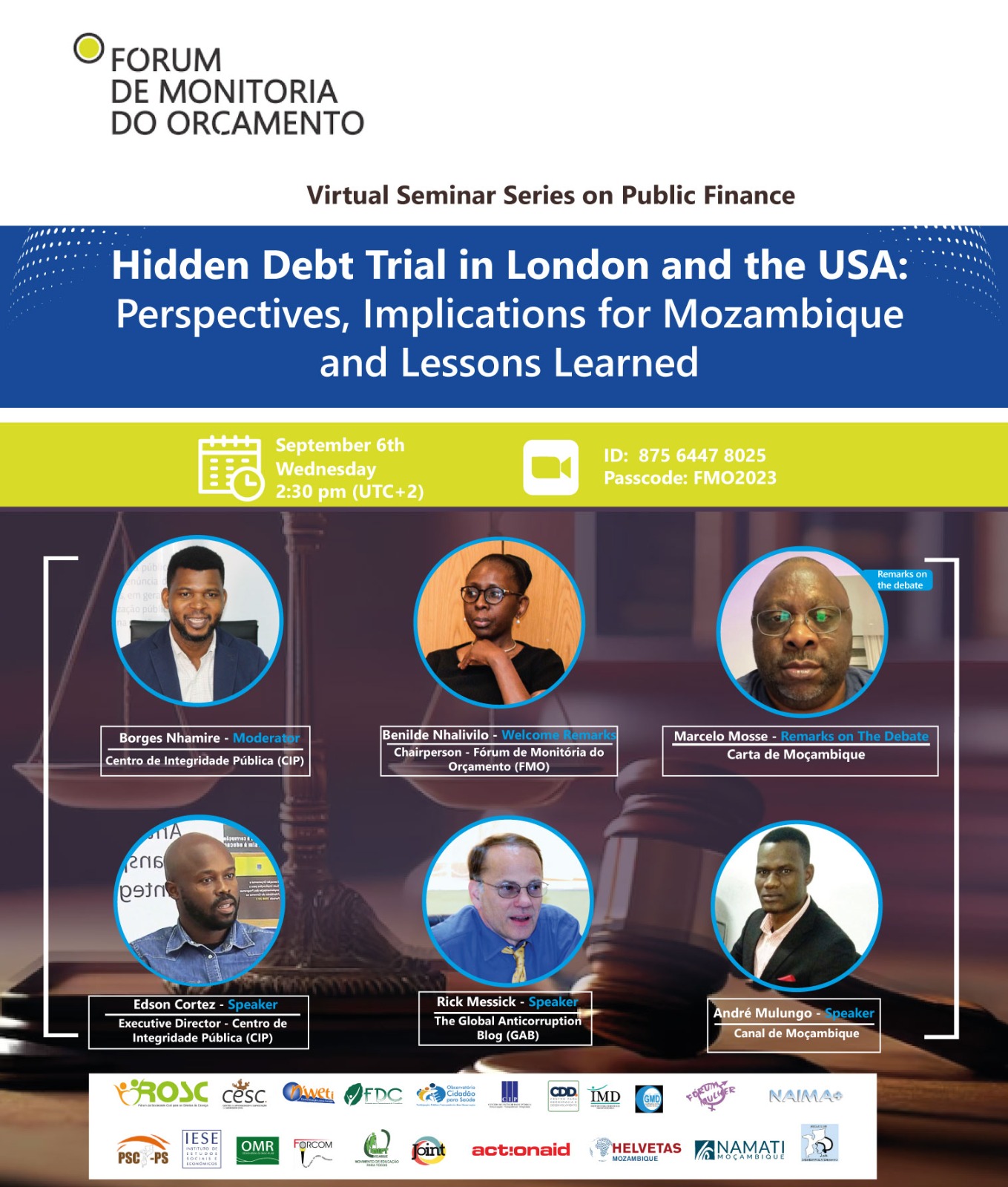
Virtual Seminar September 6: Mozambique’s Hidden Debts — Trials of Perpetrators, Lessons Learned

Wednesday, September 6, at 2:30 PM Mozambique time (UTC + 2) members of Mozambican civil society, the media, and GAB staff member (me) will discuss developments in the Mozambican “hidden debt” scandal.

Evidence introduced at the trial of Jean Boustani (here), a senior executive of the Middle East shipbuilding company Privinvest, showed the company bribed Mozambican officials to the tune of $125 million in return for government loan guarantees. The loans went for projects of little or no value. Mozambican citizens are now saddled with repaying billions in principal and interest. A joint study by Mozambique’s Centro de Integridade Pública and Norway’s Chr. Michelsen Institute estimates the scheme may have cost the nation, one of the world’s poorest,. as much as $11 billion, virtually the country’s entire GDP for 2016.

Those responsible for this enormous wrong are slowly being held to account. The Mozambique government is suing some of the perpretrators in a civil action in London, and Manual Chang, Finance Minister at the time the guarantees issued, was recently extradited to the United States to face charges for his role.

A list of speaker and details on logging in on Zoom is here.

Some Backlogged (and Very Interesting!) Podcast Episodes

As our regular readers have probably noticed, I haven’t been posting as much recently–first because I was on sabbatical (a nice perk of academic jobs) and then, most recently, for a bit of summer vacation. But I hope to be back to semi-regular posting soon! In the meantime, I wanted to mention several new episodes of KickBack: The Global Anticorruption Podcast, which came out earlier in the summer. (Sorry for failing to announce these earlier — again, I’ve been on a bit of a break.) For those of you who haven’t already heard them, they’re worth checking out!
  • The June 22 episode features and interview with journalist Michela Wrong, who is perhaps best known for her award-winning book It’s Our Turn to Eat, which tells the story of Kenyan anticorruption activist and whistleblower John Githongo (also featured in a recent KickBack episode!). In the interview, Sam Power interviews Ms. Wong about the issues raised in the book, as well as her other writing, including her most recent book, Do Not Disturb, about the abuses of power by the Kagame regime in Rwanda.
  • The July 6 episode is a bit of a change of pace from the usual episodes. Rather than featuring an interview with an expert, three of the hosts or the KickBack podcast at the Sussex Centre for the Study of Corruption (Dan Hough, Liz David-Barrett, and Sam Power) have a conversation (after some opening banter about British weather) about the leading theories for corruption analysis, including rational choice, collective action, and social norms approaches.
  • The July 28 episode returns to the interview format, featuring a conversation with Huma Yusuf, the Director of Business Integrity at the impact investing firm British International Investment. Tom Shipley interviews Ms. Yusuf about how anticorruption and business integrity fit into the global business agenda and highlighting some of the key concepts and debates in this area.
You can find these episodes and an archive of prior episodes at the following locations: KickBack was originally founded as a collaborative effort between GAB and the Interdisciplinary Corruption Research Network (ICRN). It is now hosted and managed by the University of Sussex’s Centre for the Study of Corruption. If you like it, please subscribe/follow, and tell all your friends!