Will America’s Anticorruption NGOs Hold Trump II to Account?

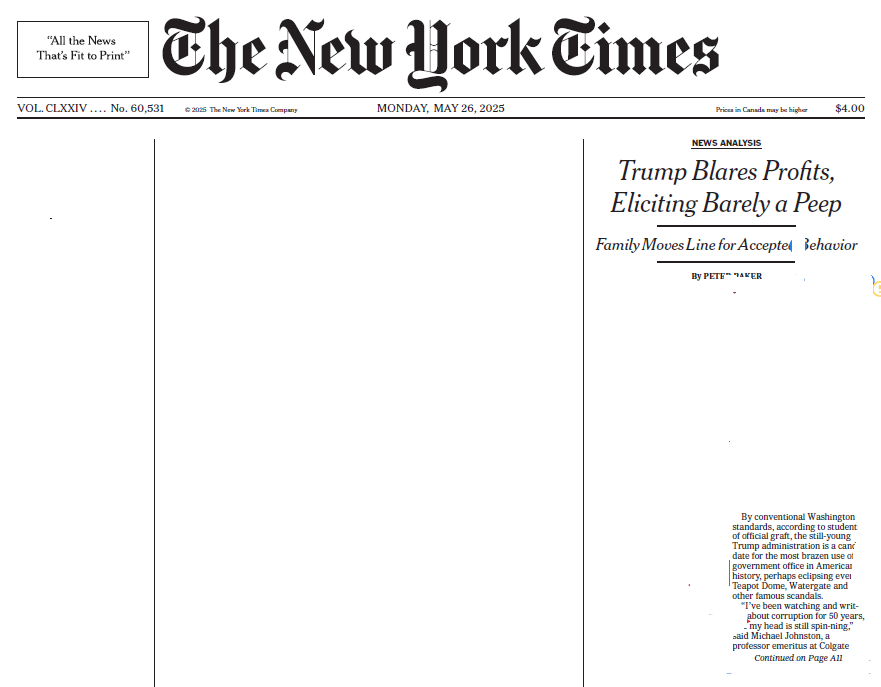
If the trend Daniel Schuman identifies in “Open-Government Nonprofits Are Dying Off Just When They’re Needed Most,” the answer is a clear if frightening NO (here). Schuman, Executive Director of the American Governance Institute, ticks of a list of U.S. watchdogs closing their doors or drastically cutting staff thanks to multiple funding crises.

Those now on the block include: OpenSecrets, which for years has shown which politicians get money from what special interests; OMB Watch, a pioneer in unearthing hard-to-find data on government spending; and the Center for Public Integrity, the scourge of those officials who have never seen an ethical line they can’t cross.

Why, just when more eyes are needed on Trump and cronies, are those with 20-20 vision finding it so hard to raise money? Schulman puts it off to the polarization now infecting the American body politic. The foundations and high-net-worth individuals that have traditionally backed organizations dedicated to “public-informing, community-building work” have, he writes, become “auxiliaries for the parties in their trench warfare over political power.”

Bad enough the funding drought coincides with the return of an Administration likely to make Grant’s second term seem a model of probity. Many of those on the ropes have done much to advance the global war on corruption, from serving as models for citizens of other nations to providing critical technical assistance to anticorruption NGOs around the globe. The fight against corruption in the U.S. is entering a critical phase with the outcome likely to affect the fight in other nations. The stakes couldn’t be higher. Will donors please reconsider their decisions?

Thanks to TheBulwark, an indispensable source for what’s happening in the U.S., for publishing Schuman’s story.

The Fight Against Corruption Is at Stake in Milan

That’s how former French magistrate and renowned corruption fighter Eva Joly sees current developments in Italy. Two prosecutors there face prison for actions taken during the bribery trial of Italy’s largest company.  Writing in the Argentine opinion journal Clarín, Mme. Joly explains that the charges have nothing to do with their conduct and everything to do with a justice system where score-settling and the protection of Italian companies has supplanted the goal of truth and justice (Spanish original here; English translation here).

The saga begins with prosecutors Fabio de Pasquale and Sergio Spadaro opening an investigation into allegations oil giants Shell and Eni paid a $1.1 billion bribe for rights to Nigerian oil field OPL 245. With overwhelming evidence of wrongdoing on the public record (here, here), the two expected they would be trying a cut-and-dried case of foreign bribery.

Even before the trial began, however, it was clear that that was not to be. The first signs: revelations of ties between the chief trial judge and a lawyer close to ENI together with a surprising lack of interest by the Italian press in the largest bribery scandal on record. During the trial, a string of rulings highly favorable to the defense heightened suspicions the fix was in. But the acquittal still came as a surprise given the massive evidence presented coupled with the flimsy reasoning the court advanced to justify its verdict (here).

Adding to the surprise was the Italian media’s new-found interest in the case. Stories claiming the trial had been a waste of public money and questioning what Italian prosecutors were doing prosecuting Italian companies for bribing foreign officials began appearing in several outlets, the same ones where ENI was a major ad buyer.

Not to risk an appellate court would undo their handy work, those behind the trial’s outcome saw to it that the state counsel appointed to appeal the acquittal was one whose public comments on the case tracked the criticisms in the press (here). She then took the extraordinary step of refusing to pursue an appeal, meaning the trial court’s acquittal remains the final word.

Those responsible for quashing one case against ENI apparently feared there was always a risk some other pesky prosecutor didn’t get the message. Hence the orchestration of the conviction of de Pasquale and Spadaro for failing to disclose exculpatory information to the defense, a case with no precedent in Italian law based on a factual claim belied by the trial record.

If the convictions are not overturned on appeal, it’s not only the future of two talented magistrates that will suffer. As Mme. Joly says, the credibility of the Italian judicial system and the future of the fight against corruption, in Italy and far beyond, will suffer as well.

COP Co-Opted: How Corruption and Undue Influence Threaten Multilateral Climate Action

The ongoing COP 29 climate summit in Baku, Azerbaijan, has been living up to the anticorruption community’s worst fears. Risks of undue influence, corporate capture, and corruption arising from yet another authoritarian petrostate hosting a UN climate conference are rampant. (See reports by Global Witness / BBC and OCCRP.)

Tomorrow, November 15, David Szakonyi, Co-Founder of the Anticorruption Data Collective, Associate Professor, George Washington University, and GAB contributor (here) will present a recent report examining the risks and outlining what the UNFCCC, the UN process for curbing climate change, can do to protect future COPs from corporate capture.

 The report was produced by the Collective in partnership with Transparency International.

The virtual event will be held 10:00 – 11:15am EST and is hosted by the Central Asia Program at George Washington University. Along with Professor Szakonyi it features, Kate Watters, Emin Bayramli, and Karl Horberg. 

Register here

Event link

Open letter to OECD Antibribery Convention’s Working Group on Italy’s Noncompliance

In a world where the fight against corruption remains an uphill struggle, the OECD Antibribery Convention is a signal achievement. The 38 members of the OECD, the world’s richest nations, have bound themselves to make it a crime under their domestic law for any person or entity subject to their jurisdiction to bribe an official of a foreign country. What was once common practice by large multinational corporations is now subject to stiff fines for the corporation and prison sentences for their executives.

To ensure their commitment is more than just words on paper, convention parties regularly review each other’s compliance. But as this blog has reported, recent decisions by the Italian judiciary and the Italian government now threaten the enormous progress made in curbing foreign bribery (here, here, and here). Italy’s compliance is being discussed this day by the group charged with reporting on compliance with the Convention. In the letter to group members reprinted below, current and former corruption prosecutors, investigators, academics, and activists urge the group to hold Italy to account for its noncompliance.

The letter remains open for signature. Those who wish to add their names should do so by submitting a comment to this post.. Italy’s noncompliance must remain at the top of the international agenda to fight corruption.

We the undersigned anti-corruption experts and practitioners are writing in the context of discussions about Italy and its resistance to recommendations contained in the Working Group’s (WG) 2022 Phase IV report on Italy. 

We wish to inform you of our immense concerns about Italy’s performance pre and post the Phase IV report issued by the WG.  In particular, we would point you to the following:

Continue reading

Opportunity for Civil Society Organizations Concerned with Corruption to Provide Input to 4th International Conference on Financing for Development

The UNCAC Coalition, a global network of close to 400 civil society organizations in over 120 countries committed to furthering implementation and monitoring of the UN Convention against Corruption, urges CSO’s working on corruption to provide input to the 4th International Conference on Financing for Development (FFD4).

UN Member States will there decide how to resource the pursuit of the Sustainable Development Goals, international development, and support reform of the international financial architecture. 

The Conference will take place from 30 June to 3 July 2025 in Spain. The consultation that will inform the negotiations is open until 15 October COB EST (find more details below).For corruption to feature prominently as a cross-cutting issue, it is crucial that as many civil society organizations and other stakeholders as possible make their own submissions.

Continue reading

Guest Post: First Country Ratifies the Asset Declaration Treaty

Requiring public official to disclose their assets, income, and other information about their personal finances can be an important tool for curbing corruption — as any number of posts on this blog have shown (examples here, here, and here. The program’s effectiveness depends crucially on the ability to verify the disclosures’ accuracy and in particular the ease with which verifiers can determine if an official has hidden assets abroad. A new Treaty greatly facilitates this task. Its ratification should be at the top of national anticorruption authorities to do list.

GAB is pleased to publish this guest post explaining the Treaty and its origins authored by Tilman Hoppe, an international expert on asset declarations, who played the critical role in the Treaty’s development.

Effective August 23, 2024, North Macedonia has ratified the “International Treaty on Exchange of Data for the Verification of Asset Declarations.” By doing so, North Macedonia has written history. The Treaty is the first and only mechanism for cross-border data exchange for the verification of asset declarations. Three more countries have signed the Treaty and will now have to catch up in ratifying. Other countries are about to sign – any country may join the Treaty, as may the European Union as a bloc.

The Treaty addresses the following gap: Corrupt public officials hide their wealth abroad. At the same time, bodies verifying asset declarations lack access to data abroad. This is the number one reason cited by verification bodies to explain why they can only unlock a fraction of asset declarations’ potential: Following wealth usually stops at domestic borders. Neither the UNCAC nor any other international treaty address this problem.

A significant advance in international efforts to curb corruption, the Treaty emerged from an unlikely set of circumstances:

Continue reading

UNCAC Coalition Seeks Input on Improvements to UNCAC Implementation Review Mechanism

GAB just learned of the UNCAC Coalition’s request for comments on a paper recommending ways to strengthen review of state’s compliance with the provisions of the UN Convention Against Corruption. Though the timeline is tight (August 8) and it’s the height of vacation season for Northern Hemisphere readers, please take a moment to examine the paper and offer thoughts. This is an important initiative by one of the NGOs leading the fight to combat corruption in all nations.

The UNCAC Coalition is launching a campaign calling for States to make the UNCAC review mechanism #FitForPurpose. The aim is for the next UNCAC Conference of the States Parties (CoSP) in 2025 to agree on a stronger review mechanism for the next review phase. We want to make sure that our campaign reflects the experiences and views of our global anti-corruption community.

The Coalition’s proposals to strengthen and improve the IRM are described in this Google Doc – please provide your input and thoughts by 8 Augustby adding comments there (including your name and organization).

We are seeking your feedback on 

  1. whether there are elements that are missing or could be better formulated, 
  2. whether you agree with the proposed measures, and
  3. which elements should be prioritized.

We will use your input and feedback to refine the priorities of our advocacy over the next one and a half years as States discuss and negotiate what the next phase of the UNCAC IRM will look like. 

There is wide agreement that the UNCAC review mechanism in its current phase has numerous weaknesses that make it ineffective in holding States to account for their anti-corruption commitments, including a lack of transparency and inclusiveness, a lengthy and inefficient review process and no structured follow-up process.

Whistleblowers in Ukraine: Successes and Challenges in Ukraine

The Anti-Corruption Research and Education Center (ACREC), Kyiv, Ukraine, and the National Agency on Corruption Prevention (NACP) are pleased to invite you to the Fourth Annual Conference “Whistleblowers in Ukraine: Successes and Challenges,” which will be held on July 10, 2024, from 10:00 AM to 6:00 PM. Kyiv time.

The event aims to bring together activists, representatives of non-governmental organizations, judges, whistleblowers, authorized officials, employees of the National Agency on Corruption Prevention (NACP), international experts, political figures, and compliance managers to discuss opportunities for improving Ukraine’s legislation on whistleblowers. The event will feature three panel discussions and two workshops.

The event will be held online via the Zoom platform, where viewers will be able to actively participate in the conference. Please confirm your participation in the event by filling in this short form: https://forms.gle/DaF6T32Jd5GXMLQa7.

International Parliaments Day June 30.  On It and Everyday Work with Parliaments to Combat Corruption

This Sunday June 30 is the International Day of Parliamentarism, dedicated to the celebration of parliaments around the world, and the work they do for democracy. Today’s Guest Post, by Franklin De Vrieze, Head of Practice Accountability, Westminster Foundation for Democracy (WFD) and Kristen Sample, Director of Democratic Governance, National Democratic Institute (NDI), reminds that parliaments can and should play an important role in taming corruption.

From June 18 to 21 more than 2,000 civil society activists, journalists, government officials and private sector actors convened at the International Anti-Corruption Conference (IACC) in Vilnius, Lithuania, to discuss lessons learned and good practices for the fight against corruption.

The Conference was an excellent opportunity to highlight the stories of courageous activists and reformers from around the world.  Lithuania’s journey from Soviet subjugation to developed democracy in just a few short decades was an inspiring backdrop for discussions covering transparency, participation, and political integrity.

In an event that was otherwise impeccably conceived and executed, there was one blind spot: the limited discussion about and participation of legislators, an omission that is unfortunately far from the exception.

Continue reading

Invaluable Guide to Fighting Corruption — at a Bargain Basement Price

Mark Pyman and Paul Heywood’s Sector-Based Action Against Corruption: A Guide for Organizations and Professionals is not for everyone. If your goal is to improve a nation’s CPI score, attack grand corruption, or realize some other broadly stated, national level objective, stop here.

But if, as the authors explain, you “need to acquire competence in recognizing, analyzing and dealing with corruption” in a particular organization or process, and if you believe that “corruption Is as much a management issue as it is a political one,” download it immediately. (And thank whoever made this must-have book open-source.)

Pyman’s and Heywood’s careers both combine hands-on work helping government agencies and corporations curb corruption with serious engagement with the learning on corruption. And it shows. From the rigor they insist be brought to bear to specify identifiable, tractable corruption problems (corruption due to a non-meritocratic civil service is not one; conflict of interest in hiring is) to the disciplined approach they present for selecting the best measures for remedying them.

They break the process for “recognizing, analyzing, and dealing with corruption” into four steps labeled SFRA:

Continue reading