Uzbekistan’s Own Donald Trump

Donald Trump owes much of his success as a real estate developer to an easy relationship with the anti-money laundering laws, and he continues to profit from his investments while President thanks to an even easier relationship with conflict of interest norms.  Reports out of Uzbekistan suggest Jahongir Artykhodjaev, mayor of the capital city Tashkent, has followed a Trumpian-like path to wealth and power.  Like Trump, Artykhodjaev has looked past how investors in his real estate projects came into their money; like Trump, while in public office he has steered government contracts to companies he owns, and like Trump, when called on his dual role as businessman and government officials, he claims to have distanced himself from his business empire upon taking office.

The main difference (besides hair color) between Trump and Artykhodjaev is that independent prosecutors are examining whether Trump broke rather than simply bent anti-money laundering and conflict of interest laws. By contrast, after accounts in the international press (here and here) exposed Artykhodjaev’s Trumpian proclivities, senior Uzbek officials called a press conference where they leapt to his defense, going so far as to deny there is any Uzbekistan law that Artykhodjaev could have broken. Continue reading

Vietnam Enlists the Private Sector in the Fight Against Corruption

Last November Vietnam approved a new anticorruption law.  Initial reports in the English language press recounted the measures cracking down on public officials: the closing of loopholes in the conflict of interest rules, the increased information officials must provide about their personal finances, stiffer penalties for engaging in corruption, and so forth.  The recent publication of an English translation of the law reveals these early reports failed to mention a critical provision. As of July 1, all firms doing business in Vietnam, whether domestic or foreign, must:

  • determine if any employee or officer has engaged in corruption and if so promptly report him or her to the competent authority;
  • train employees on the anti-corruption laws; and
  • implement a code of business conduct that must include a rule barring conflicts of interest.

By my count (nations with anticorruption compliance laws january 2019), Vietnam is now the 25th nation to require some or all of the companies that do business in its territory to have some type of anticorruption compliance program.  Like every other anticorruption policy, requiring the private sector to join the fight against corruption is not a panacea.  But it surely is a part of the solution.

What are the rest of the world’s nations waiting for?  Do they think they can win the fight on their own?  Don’t they think the private sector has something to do with corruption?  Why aren’t they enlisting it in struggle?

Who Will Get to Prosecute Mozambique’s Former Finance Minister for Corruption?

Manuel Chang must surely feel special these days. He is the first former Minister of Finance in history (or at least that history recorded on the internet) whose is being sought for corruption by two countries. As explained here, Chang was arrested in South Africa December 30 at the request of American authorities who are seeking to extradite him to the United States. Two weeks later, Mozambique filed its own extradition request.  Both countries want to bring him to trial for offenses arising from his alleged corrupt approval of government guarantees for loans taken out by state-owned firms while minster.  The companies have defaulted on the loans, costing the impoverished nation (GNI per capita $1200) as much as $2 billion and throttling the economy.

Which country will get to prosecute Chang will turn on how South African authorities construe recondite provisions in South Africa’s extradition agreements with the United States and Mozambique.  As obscure as the provisions in the two are, how South African authorities choose to interpret them will remain anything but.  For their interpretation will have significant consequences for the global fight against corruption. Continue reading

The Promise – and Risk – of Internationalizing the Corruption Fight: Prosecuting the Mozambique Loan Fraud

Manuel Chang, Mozambique’s longest serving Finance Minister, has just lost the first round in his attempt to duck U.S. charges he defrauded the Mozambique people out of some $2 billion.  A South African Magistrate ruled January 9 that Chang’s December 30 arrest in South Africa, requested by the U.S. Justice Department, was valid.  Assuming South Africa stands firm in the face of legal maneuvering by Chang and political pressure by the Mozambique government, Chang will join accomplices in a Brooklyn jail to await trial for corruption.

That the corruption trial of a former official of the one of the world’s poorest nations will be held in the courts of one of the world’s wealthiest and that whether there will be a trial turns on the strength of a third country’s legal system and the political resolve of its government shows both the promise – and the risk – of the internationalization of the fight against corruption. Continue reading

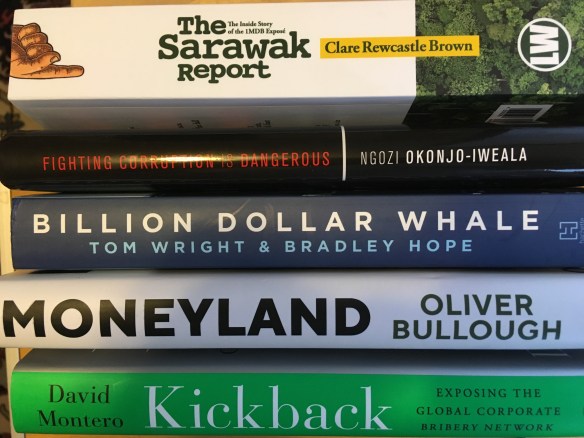
2018: Five Great Reads on Corruption


Twenty eighteen produced many fine analyses of corruption and how to fight it. The five books pictured above, four by journalists and one by a former Nigerian Finance Minister, are among the best.  Combing in-depth reporting with thoughtful analyses, all merit a place on corruption fighters’ book shelf. Continue reading

Top-Notch Advice from the Inter-American Development Bank on Combatting Corruption

To say I opened a copy of Report of the Expert Advisory Group on Anticorruption, Transparency and Integrity in Latin America, the Inter-American Development Bank’s latestadvice to Latin American and Caribbean governments on fighting corruption, with low expectations would be an overstatement. What specific, detailed, actionable and therefore useful measures could a report directed at 45 governments contain? Particularly given the diversity of the region’s governments, which range from prosperous, thriving middle-income democracies to desperately poor, repressive authoritarian regimes.  I thus assumed the report would follow the tiresome formula of so many previous attempts to spur developing nations to take meaningful steps to curb corruptions: a hodgepodge of obvious but vague generalizations wrapped around pleas for greater political will.

My subterranean expectations were only lowered given its institutional sponsor. Like the other regional development banks and the World Bank, the IDB exists to loan money and therefore strives to stay on the good side of the region’s governments to ensure they will continue to borrow.  In reports past from other development banks that consideration has often ruled out even the hint of politically controversial measures or criticism levelled at any government’s faltering anticorruption efforts.

The third strike against the report is its authors.  A distinguished collection of mostly Latin American “names” in the anticorruption field, all are busy experts whose main job is delivering high-profile lectures, authoring academic papers, and advising private sector entities and governments.  Devoting time and effort to an IDB publication that neither burnishes one’s academic credentials nor services clients was probably not high on their list of priorities. Most likely, I thought, they were asked to bless a precooked series of bromides assembled by interns and junior staff.

Boy, were my expectations off base.  Rather than a strike out, the report is a home run.  Or at least a stand-up triple. Continue reading

Holding Relatives Hostage: China’s Newest Way of Pressuring Fugitives to Return to Face Corruption Charges

China’s latest tactic in Operation Fox Hunt, its campaign to force those who have fled abroad to return to face corruption charges, has had the extraordinary, if unintended, consequence of uniting America’s bitterly divided political elite.  Last June, the American wife and children of accused fraudster Liu Changming were detained in China after a brief visit; his wife held in a “black site” and his children barred from leaving.  The ostensible the reason for holding them is because they are being investigated for “economic crimes,” but almost surely, as the family claims, the real reason is to pressure paterfamilias Liu to return to China to stand trial for corruption offenses.  Trump National Security Advisor John Bolton, avowed Trump opponents Senator Elizabeth Warren and Congressman Joseph P. Kennedy III, and leaders of Harvard and Georgetown universities are all demanding the Americans be permitted to leave China at once (accounts here and here).

Holding family members hostage to force a relative to surrender to authorities is a species of collective punishment, a patent human rights’ violation universally condemned by the world community. No wonder the Boltons, Warrens, Kennedys, Harvards and Georgetowns find themselves on the same side of the issue.

Reporting by the New York Times, however, suggests that there could be more to the case than appears at first glance.  That there may be reason for both the Chinese government and the strange bedfellows its policy has created in opposition to examine their actions in view of the global fight against corruption. Continue reading

OECD Nations Should Criminalize the Unexplained Wealth of Politically Exposed Persons

Today’s guest post is from Hamid Sharif, Managing Director, Compliance, Effectiveness and Integrity, for the Asian Infrastructure Investment Bank.  Writing in his personal capacity, he urges OECD countries to enact laws like that giving the British government the power to demand public officials from another nation explain how they acquired assets held in Britain.  If the official cannot show the assets were purchased with honestly-obtained monies, they are confiscated.  The laws Mr. Sharif advocates would provide that if the official were from a developing country, the seized assets would go to development projects in the victim state.  The views expressed in no way reflect or represent those of AIIB, its Board, or Management.

Since 1996, when then World Bank President James Wolfensohn condemned corruption as a “cancer” which stood “as a major barrier to sound and equitable development,” combating corruption has figured prominently on the international development agenda. In 1997, the OECD nations agreed to make it a crime to bribe a foreign public official, and in the early 2000s the World Bank, the African Development Bank, and the other multilateral development banks (MDBs) introduced corruption prevention policies into their procurement rules, adopted anti-corruption policies, established procedures for investigating corruption in their operations, and instituted systems for sanctioning firms and individuals found to have engaged corruption. Beyond ring-fencing their own projects against corruption, both the MDBs and bilateral development agencies have worked to strengthen institutions to prevent corruption in developing countries. Civil society in both developing and developed states has also stepped up its efforts to fight corruption.

Both the MDBs and bilateral donors have urged developing nations to operate with greater transparency and accountability and funded projects to strengthen anticorruption agencies, judiciaries, and other domestic institutions responsible for combatting corruption. Today there is far more information on corruption and how to fight it available to citizens of the developing world than 20 years ago. The result has been a multitude of reforms aimed at preventing or deterring corruption, from the spread of right to information laws to more effective anticorruption laws and agencies.

Despite this progress, in most developing countries institutions are not yet strong enough to investigate and successfully prosecute the corrupt acts of senior government officials whether elected or appointed, individuals who in antimoney laundering parlance are, along with their relatives and close associates termed “politically exposed persons” or “PEPs.”  In many countries, investigating and prosecution agencies as well as courts lack the independence, security, and institutional capacity to instill public confidence in their ability to deal with high-level political corruption perpetrated by PEPs. Continue reading

Complying with Antibribery Laws: Mike Koehler’s Strategies for Minimizing Risk Under the FCPA and Related Laws

Professor Mike Koehler is perhaps the leading critic of the Foreign Corrupt Practices Act – or at least of how the U.S. Justice Department and Securities and Exchange Commission currently enforce it.  On his FCPA Professor Blog, he regularly bemoans the way the enforcement agencies have stretched a law its authors wrote to outlaw hard core bribery to make donations to foreign charities, internships for relatives of business associates, birthday gifts to business partners, and other seemingly innocuous  conduct a serious felony under American law. Such broad interpretations of the law’s antibribery stricture could never withstand judicial review he argues, but because the costs, reputational and otherwise, of challenging an FCPA enforcement action are so great, companies facing FCPA charges quickly settle rather than contest the agencies’ interpretation in court.  The result is the agencies not only enforce the law but their interpretations in effect make it as well.

So what advice does Professor Koehler proffer businesses wanting to avoid running afoul of the FCPA or the similar laws of other nations in his new book Strategies for Minimizing Risk Under the Foreign Corrupt Practices Act and Related Laws?  Does he urge a corporation threatened with an enforcement action based on an overly broad reading of a law to fight back?  Has he produced a polemical guide to compliance?  One written for the risk-taking corporate maverick?  Is this how he separates his book from the many other compliance guides flooding the market?

Not at all. To the contrary, what distinguishes Professor Koehler’s book from many of its competitors is its straightforward, easy to read exposition of what any firm should do to minimize the chances that, thanks to the wayward act of an employee or consultant, it will face allegations it has bribed a government official. In eight tightly-written chapters, he brings his encyclopedic knowledge of FCPA cases, pre-trial settlements of enforcement actions, and the commentary on antibribery law to bear to explain how to develop and implement a sound, reasonable, cost-effective antibribery compliance program. Along the way he chucks the jargon that has grown up around antibribery compliance programs, opting instead for clearly written prose that demystifies rather obscures the process all firms should follow to develop and implement preventive measures.

Take his account in chapter six on how to conduct a risk assessment. Continue reading

Settling Foreign Bribery Cases: Suggested Guidelines

At the request of the OECD Secretary-General, a High Level Advisory Group produced a report in October 2017 on how the OECD could strengthen its work combating corruption and promoting integrity.  One recommendation was that the organization “create and publish model guidelines” for member states to follow when settling cases arising from the bribery of a foreign public official.  Noting concerns (discussed in many posts on this blog and elsewhere) that pretrial settlements can let defendants off too easy, the advisory group cautioned that the guidelines should be “consistent with the requirement for effective, proportionate and dissuasive sanctions under the OECD Anti-Bribery Convention.”

Earlier this year, Professor Tina Søreide of the Norwegian School of Economics and former Siemens General Counsel Peter Solmssen organized a multinational group of defense lawyers, prosecutors, academics, and civil society activists to suggest guidelines.  “Principles for the Implementation and Use of Non-Trial Resolutions of Foreign Bribery Cases” together with a set of explanatory notes were released last week.  The principles, the explanatory notes, and a letter transmitting the documents to the OECD are here.

Professor Søreide, Mr. Solmssen, and the others involved in developing the principles welcome reader comments.