Will Congressional Republicans Hold Trump to the Standard to Which They Are Held?

It is no surprise House and Senate Republicans are finding it difficult to defend President Trump’s mixing political business with official business in his dealings with Ukraine. From the day they are elected, members are warned to keep the two separate lest they run afoul of the federal bribery law.  Nor should it be a surprise that President Trump would mix the two, for by his own admission, as a New York City real estate developer he frequently did.

House and Senate Ethics Committee Manuals both tell members “the federal bribery statute makes it a crime for a public official . . .  to ask for . . .  gifts, money, or other things of value in connection with the performance of official duties.”  The “connection” between the request and the duty performed need not be an explicit quid pro quo — contrary to what some Trump defenders say.  Were that the standard, as Justice Kennedy explained in a landmark case, an official could easily escape sanction by resort to “knowing winks and nods.” Continue reading

DRC Government Members to Post Ethics Code on Office Wall, Resign if They Violate It

The newly installed government of the Democratic Republic of the Congo has taken a major, and for the DRC, unprecedented step in the fight against corruption.  At their September 18 swearing in ceremony, each member signed an “Acte d’Engagement,” a one-page letter to Prime Minster Ilunga Ilunkamba containing an ethics code each agrees to observe.  Although the code’s provisions are nothing out of the ordinary, what is out of the ordinary is that ministers of the DRC would publicly commit to them. This represents an important milestone in the effort of the Prime Minister and President Félix Tshisekedi to arrest the corruption that has plagued the mineral-rich but desperately poor nation for so long.

Even more out of the ordinary, the signers pledge to resign if they are found to violate any code provision. Most unusually, they agree to post a copy of the letter in their office and to circulate it to their immediate staff and the civil servant they oversee. The one-page letter with code is written in non-technical, easily understandable prose. Ministers cannot excuse a violation by claiming they did not understand it, and its wide circulation and posting in the ministers’ offices increases the chances they will be held to it.

There is no reason why the governments of other nations where corruption is endemic should not follow the DRC’s lead.  They too should require leaders to publicly commit to a strong ethics code and to post a copy of the code and their pledge to honor it on the wall of their office.  This will remind them and all who meet with them of that commitment.

A translation of the commitment letter/code that each DRC government member signed follows. Continue reading

Modernizing Legislative Ethics: Costa Rica’s Turn?

The conduct of parliamentarians has not escaped the anticorruption community’s attention.  Ethics codes and parliamentary immunities are everywhere being examined to ensure legislators adhere to the highest standards of conduct and can be held to account if they do not. In Costa Rica, for example, reform-minded parliamentarians recently launched an effort to determine whether their legislative ethics code and immunity rules, unchanged for several decades, need revision.

As a first step, the parliament’s in-house research center prepared a fine summary and analysis of legislative codes of conduct and member immunities in selected European and Western Hemisphere nations. To follow up, I met with reformers to discuss what issues to weigh when amending ethics codes or revising parliamentary immunities. The English PowerPoint Slides for my presentation are here, the Spanish version here. Points emphasized during the discussion: Continue reading

Memorandum of Conversation Between Presidents Trump and Zelensky UPDATED

America has unfortunately plunged into what is likely to be a long and divisive debate about corruption. Media reports of a conversation President Trump had July 25 with Ukrainian President Volodymyr Zelensky have swirled since allegations surfaced that President Trump had there asked President Zelensky to investigate former Vice President Biden for corruption.  In the hopes of ending speculation about what he said, earlier today President Trump released a memorandum recounting the call.  [Update: The controversy leading to release of the memorandum was sparked by reports an intelligence professional had filed a whistleblower complaint concerning President Trump and Ukraine.  That complaint, released the morning of September 2, is here].

Unfortunately, the release is likely only to fuel ever more nasty, partisan debate. One controversy certain to arise is the memorandum’s accuracy.  It is not a verbatim transcript of what the leaders said, a transcription of an audio recording of the call.  Rather, it represents what one or more staff huriedley scribbled down while the two spoke; later others reviewed it.  Did someone “scrub” more incriminating comments from the memo before its release?  Is there a better record of the call?  Will the person or persons who actually listened to the call come forward to testify to its accuracy?  Or contest the accuracy?

A more critical point of contention is whether what President Trump said during the call is on its face a crime under American law.  President Trump clearly asked President Zelensky to investigate former Vice President Biden for criminal activity.  The Federal Election Campaign Act makes it a crime for presidential candidates to receive contributions, defined as “anything of value,” from foreign citizens or governments. President Trump is a candidate for president in the 2020 election as is the former Vice President. Had Ukraine actually initiated an investigation of the Vice President, would that have been something of value under the election law?  If it would have been, was President Trump’s solicitation of such a contribution a violation of the law?  Or any other U.S. laws?

Is the fact that Mr. Biden is seeking the 2020 Democratic presidential nomination relevant to the inquiry?  That, were he to be the Democratic nominee, current polls show him decisively defeating President Trump?

Some reports allege President Trump personally held up critical military and economic assistance to the government of Ukraine, only releasing it under Congressional pressure.  That will surely be the bitterest bone of contention, for if he used a denial or delay in providing aid as leverage to force Ukraine to open an investigation, that would constitute attempted bribery under American law and thus strong grounds for impeachment and removal from office.

Was there such a threat?  As students of U.S. bribery law know, it need not have been overt; “a wink and a nod” suffices.   Expect a great deal of argument over “winks and nods,” with partisans seeing none opponents seeing them everywhere

The only bright spot in this very dismal chapter in American history is release of  memorandum of conversation.  It provides at least some uncontested facts upon which partisans can build their cases.  For those who have yet to read it, here it is Memorandum telephone conversation between Presidents Trump and Zelenskyy

Memo for SEC Chairman Clayton: Getting Other Nations to Enforce Their Antibribery Laws

In recent remarks to the New York business community, you complain that vigorous enforcement of the Foreign Corrupt Practices Act has had little effect on corruption levels “in many areas of the world.”  The blame, you argue, lies with other nations which don’t enforce their antibribery laws. When companies from these nations seek business in a third state, they are free to, and too often do, bribe their way to commercial success. Indeed, as you explain, their repeated success provides the states where they are headquartered an incentive not to enforce their antibribery laws.

Using the prisoners’ dilemma game, you show that bribery will only be brought under control when all countries with firms that do business in foreign states agree to crack down on the payment of bribes.  And you promise that whenever you speak to counterparts in these countries, you will try to persuade them of the value of “common, cooperative enforcement strategies.”  But while the prisoners’ dilemma paradox underscores why all countries where firms that may pay bribes are located must enforce their antibribery laws, it obscures another important step in the global fight against corruption. One that the Commission can do much to advance.    Continue reading

The Legacy of Guatemala’s Commission Against Impunity

The most innovative experiment in the fight against corruption in memory ended last week with the closing down of Guatemala’s impunity commission.  Known as CICIG after its Spanish initials, the commission enjoyed tremendous success over its ten plus year life, securing the conviction of dozens of senior military and political leaders, forcing a sitting president and vice president to resign over corruption charges, and most importantly, showing Guatemalans their leaders were not beyond the law’s reach. The commission ceased operating Wednesday after outgoing President Jimmy Morales, whom the commission was investigating for campaign finance violations, refused to renew its mandate.

Although Guatemala’s corrupt elite finally succeeded in killing the commission, the innovation behind the commission’s success is very much alive.  Prompted by CICIG’s success, neighboring Honduras created its own CICIG-like commission, and last Friday, less than 48 hours after CICIG shut down, El Salvador’s newly-elected president established a Salvadorian version of CICIG.  Across the Atlantic, independent of developments in Central America, Ukraine is pioneering a similar ground-breaking approach to fighting corruption which Moldovans are considering copying.

What all four countries have in common is a corrupt ruling class able to stymie the enforcement of the anticorruption laws. CICIG’s creators were the first to recognize that outside pressure alone was never going to change this dynamic.  No matter how much diplomatic and economic pressure the international community brought to bear, Guatemalan investigators, prosecutors, and judges were never going to tame grand corruption by themselves.  Some were themselves corrupt or corruptible; others were honest but unwilling to cross corrupt friends and relatives, and still others feared for their life or the lives of their families if they opened a case.   The CICIG solution? Continue reading

Legal Remedies for Grand Corruption

In too many nations, ruling elites rob the populace on a grand scale, awarding friends and relatives lucrative government contracts, siphoning off revenues from oil and other natural resources, even writing checks to themselves on the central bank.  Curbing such “grand corruption” will require much: an active, informed citizenry; coordinated international action; vigorous diplomacy; shrewd application of international sanctions.

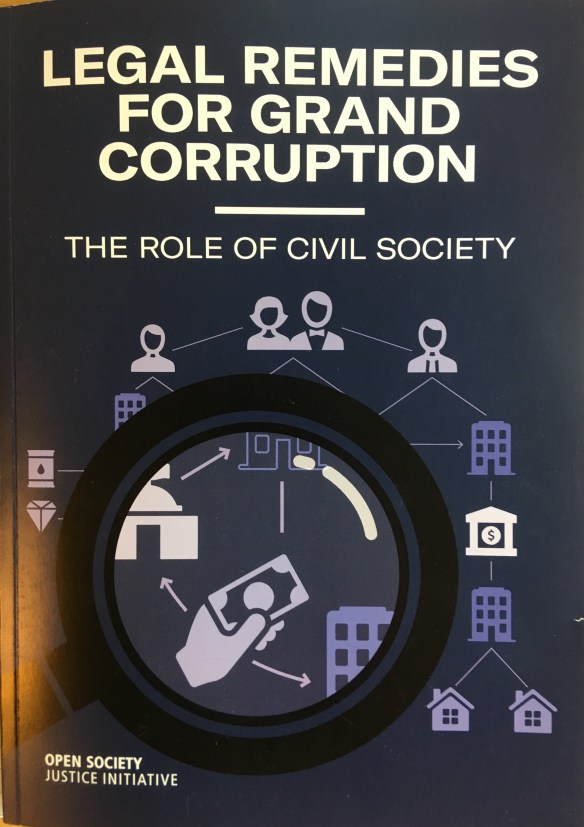
new volume from the Open Society Justice Initiative, pictured below, describes how civil society can mobilize courts of law in the struggle.  It recounts efforts that range from using international tribunals to force government to address corruption, as the Nigerian NGO SERAP’s case before the court of Justice of the Economic Community of West African States illustrates, to bringing suit against a kleptocratic ruler in a foreign jurisdiction, as Sherpa and TI-France did against Equatorial Guinean Vice President Teodoro Obiang, to the creative use of domestic law doctrines common to most legal systems to force wrongdoers to answer for their crimes in their own courts.

Grand corruption is behind many of the globe’s most pressing problems: massive environmental degradation, gross human rights abuses, large-scale emigration. Taming it must be a priority for the global community.  Legal Remedies for Grand Corruption offers an important set of tools for doing so.

Legal Remedies for Grand Corruption

“Passive Bribery”: Not a Trivial Abuse of Language At All

Yesterday Matthew wrote that using “passive bribery” to describe a public official’s acceptance of a bribe was an abuse of language.  His complaint: “passive” suggests a bribe taker is less culpable than a bribe payer: “’Passive bribery,’” he explained, “sounds less bad, and less serious, than ‘active bribery,’ even though most people would view the two parties to the bribe transaction as equally culpable.”

Calling bribe-taking “passive” is indeed an abuse of language. But it is not, as Matthew’s headline reads, “An Almost Entirely Trivial Complaint.” Nor is the abuse “No big deal” as he writes in the post.  To see why, consider two different “passive bribery” scenarios. Continue reading

Should a Kleptocrat Be Able to Bribe Her Way Out of Trouble?

Gulnara Karimova parlayed her position as daughter of Uzbekistan’s first post-Soviet ruler into an international symbol of kleptocracy.  Reviled at home and abroad for vulgar excess, after her father’s death she was sentenced to a long prison term following a sham trial.  But most of the billion or so dollars she stole remains beyond the Uzbek government’s reach, tied up in complex litigation principally in Switzerland.

Now, as she recently revealed, she is in negotiations to hand back most of what she stole – in return for her release from one of Uzbekistan’s notorious prison colonies and the right to hang onto to perhaps as much as a hundred million for herself and the lawyers and fixers negotiating the deal. Uzbek citizens and activists are in arms over this blatant attempt by a posterchild for kleptocracy to bribe her way out of prison.  In an open letter, civil society activists call on the Swiss government, which would have to accede to this unseemly bargain, to repudiate it. They ask too that other government with claims over some of the assets, and thus possibly some say over the deal, to help kill it.

Allowing a kleptocrat to bribe her way out of jail sets a terrible precedent. Is it one the international community wants to see set?  Do Swiss citizens really want their government to be the one setting it? Why is the Swiss government in such a hurry to return dirty money to the Uzbek government?  Particularly in the face of opposition from representatives of the real victims of Karimova’s crimes, the citizens of Uzbekistan.

In their letter, the activists outline an alternative to a hasty return, one that would see Karimova held accountable in a real trial for her crimes and the stolen assets returned in ways that would advance the welfare of all Uzbeks. The English version of the letter here, the Russian one here, and the French one here.

New South Wales Anticorruption Commission’s Excellent Guide to Conflict of Interest

Conflict of interest is a critical element of any government ethics program.  It is also perhaps the most difficult to implement.  The challenge comes in determining when friendships, kinship ties, and other personal relationships affect, or appear to affect, a government employee’s duty to put the interest of the public above his personal interest.  Was the contract awarded because the bidder lived in the same neighborhood as the procurement official making the award or because the bidder offered the best value? Was the individual hired because the hiring manager came from the same tribe or because she was the most qualified? Even if there were no actual conflict in the two cases, is there an appearance of one?

Rules that produce sensible answers to such questions are not easy to write, and as I have suggested in earlier posts (here and here), much well-meaning advice on how to do so is either counterproductive or impossible to implement.  A recent publication by the New South Wales Independent Commission Against Corruption is thus a welcome addition to the literature. In 26 clear and crisply written pages, Managing Conflicts of Interest in the NSW Public Sector provides a road-map for writing and enforcing practical, workable conflict of interest rules.

It offers a short, easily understandable definition of conflict of interest followed by a commonsensical approach to applying it.  The touchstone for determining when there is a conflict or an appearance of a conflict” is not the disappointed bidder or applicant or the government’s political opposition.  It is instead a “fair-minded and informed observer,” otherwise known as “a reasonable person.”  How to apply the reasonable person standard and the other standards and rules that make for a sound conflict of interest regime is illustrated throughout with real-world examples.

Written for agencies of Australia’s most populous state, a much broader audience will find the guide a valuable resource.