Can Trump Be Prosecuted?

President Trump and diehard supporters continue to maintain on Twitter, in interviews, and at press conferences that tens of thousands of votes at the November 3rd election were fraudulently cast and that once these ballots are excluded, he will be declared the winner. But under American law only a judge can invalidate a vote, and unlike Trump sympathizers, judges demand clear and convincing evidence of voter fraud — something Trump has yet to produce (here) and is quite unlikely to be able to (here). So Joe Biden will indeed take office January 20.

While President Trump’s term in office ends at noon that day, his legal problems will not.  Indeed, they are likely to accelerate.  For whatever immunity he enjoyed from prosecution as a sitting president ends too. 

By far the greatest threat Trump faces are the investigations led by Manhattan District Attorney Cyrus Vance, Jr. and Letitia James, New York’s attorney general. Both are independently investigating criminal charges related to Trump’s dealings while a New York businessman. James may also be continuing her investigation of abuses involving Trump’s now defunct New York charity. The charges both are pursuing involve violations of New York state law, meaning a presidential pardon would do him no good. It excuses only violations of federal law.  

Continue reading

Review of Gemma Aiolfi’s Anticorruption Compliance for Small and Mid-Sized Organizations

For almost two decades the Basel Institute on Governance has advised corporations large and small, first in Europe and now around the globe, on how to develop a robust anticorruption compliance program. One that will prevent the company from becoming entangled in a corruption scandal while at the same time neither compromising its ability to compete nor dampening its entrepreneurial energy. Gemma Aiolfi, who has headed the Institute’s corporate compliance work for the last seven years, presents the Institute’s collective experiences in a new volume from Elgar, Anti-Corruption Compliance for Small and Mid-Sized Organizations.

What sets Aiolfi’s book apart from the many fine volumes already on the market (examples here, here, and here) is that it is leavened with literally dozens of examples drawn from the Institute’s work. How should a company establishing a compliance program handle personnel used to doing business “the old way”?  What should a manager do if she discovers police in a developing country are threatening to shut down critical operations if the company’s low-level frontline personnel don’t pay them off? How should a company deal with senior government officials’ requests for lavish travel and entertainment allowances when visiting a company’s operations? Discussions of how to handle each, with suitably anonymized case studies explaining how management actually dealt with them, is what makes the volume so useful.

Continue reading

FACTI Background Paper: Analysis of the Different Peer Review Mechanisms for Ensuring Compliance with Anticorruption and Financial Integrity Norms

For two decades governments have been signing agreements where they promise to curb corruption and halt the international flow of illicit funds. A promise, however, is only as good as the method for enforcing it, and in the case of international conventions and treaties the only method available is the peer review.  Experts from neighboring or similarly situated nations review how well the government is keeping its promises, recommending ways it can do better and sometimes chastising it for breaking its promises. The theory is that threat of a bad review will put pressure on a government to live up to its commitments.

Peer reviews come in various shapes and sizes, and experience with ones has shown that some are more effective than others.  At the request of High-Level Panel on International Financial Accountability, Transparency and Integrity for Achieving the 2030 Agenda Financing for Sustainable Development (FACTI), Valentina Carraro, Lecturer in International Relations at the University of Groningen, and Hortense Jongen, Assistant Professor in International Relations at the Vrije Universiteit Amsterdam, reviewed the effectiveness of the peer review mechanisms of six of the most important anticorruption and financial integrity agreements:

  • the Implementation Review Mechanism of the United Nations Convention against Corruption,
  • the Follow-Up Mechanism for the Implementation of the Inter-American Convention against Corruption (MESICIC),
  • the Organization for Economic Co-Operation and Development Working Group on Bribery (OECD Antibribery Convention),
  • the Global Forum on Transparency and Exchange of Information for Tax Purposes,
  • the Inclusive Framework on Base Erosion and Profit Shifting,
  • the Financial Action Task Force and the Financial Action Task Force-Style Regional Bodies.

Their summary of their findings and recommendations is below. and their paper here.  (Background on the FACTI and a link to its interim report recommending changes in international and domestic laws to combat corruption and stem  illicit financial flows is here.)

Continue reading

FACTI Background Paper: Beneficial Ownership

The United Nations High-Level Panel on International Financial Accountability, Transparency and Integrity for Achieving the 2030 Agenda Financing for Sustainable Development (FACTI) is developing reforms to tax and anticorruption laws, asset recovery rules, beneficial ownership disclosure requirements, and other international norms to staunch the outflow of illicit funds from developing nations and speed the return of corrupt monies held abroad (preliminary report here).

A critical issue the panel will address is the reforms necessary to ensure corrupt officials cannot use a corporation, trust, or other legally created entity – a “legal person” in lawyer-speak — to hide their wrongdoing.  Those investigating corruption, money laundering, tax evasion, and other financial crimes must be able to identify the real, natural person – the beneficial owner – behind a legal person if we are to curb the massive theft of assets from poor nations. In his background paper for the panel, Andres Knobel of the Tax Justice Network explains how criminals use legal persons to shield their wrongdoing and the measures required to end these abuses.  Most importantly, his condemnation of the injustice of the current laws governing legal persons serves as a powerful prod to action. His summary of the paper is below and the full text here.

Beneficial ownership: more than transparency, it’s about justice

The Panama Papers revealed the involvement of many public figures in offshore legal vehicles causing turmoil all over the world. But the real scandal wasn’t the data that was revealed. Rather, the scandal was the fact that we needed a leak to obtain data that should have been available in the first place.

Continue reading

FACTI Background Paper: Current Trends in Foreign Bribery Investigation and Prosecution

The United Nations High-Level Panel on International Financial Accountability, Transparency and Integrity for Achieving the 2030 Agenda Financing for Sustainable Development (FACTI) will recommend reforms to tax and anticorruption laws, asset recovery rules, beneficial ownership disclosure requirements, and other international norms to staunch the outflow of illicit funds from developing nations and speed the return of corrupt monies held abroad. A link to the panel’s interim report and instructions for submitting comments is here

As explained in an earlier post, the panel’s recommendations will draw on background papers commissioned by the United Nations Department of Economic and Social Affairs, the panel’s Secretariat.  A link to the papers is here

Dr. Abiola Makinwa of the Hague University of Applied Sciences authored a very fine one analyzing trends In the investigation and prosecution of foreign bribery cases (here).  Her summary of the paper is below.

Current Trends in Foreign Bribery Investigation and Prosecution

My paper examines systemic issues, such as lack of political will, profound information asymmetries, and the overarching general insufficiency of traditional criminal punishment as a response to the ‘true costs’ of corruption. I draw attention to Article 39 of the UN Convention against Corruption which calls for cooperation between national authorities and private sector entities as an integral aspect of anti-corruption enforcement. In practice, such cooperation between alleged offenders and prosecuting authorities may result in an agreement or resolution that reduces eventual sanction or penalty. These agreements are variously referred to as non-trial resolutions (NTRs), negotiated settlements, or structured settlements.

I show in the paper how the use of NTRs in foreign bribery cases is spreading across jurisdictions and is dramatically changing the face of anti-corruption enforcement.  While NTRs may be a pragmatic, new mechanism to overcome the limitations of traditional criminal prosecution of foreign bribery, they must not be seen as a get-out-of-jail card or lead to the decriminalization of the grievous crime of foreign bribery. Nonetheless, it is clear that NTRs provide a development-friendly response to foreign bribery enforcement by overcoming historic impunity and lack of enforcement. The most important “development dividend” of NTRs, is, in my opinion, the fact that NTRs shift the focus of anti-foreign bribery enforcement to corruption prevention.

There are 4 KEY arguments that support countries buying into NTR regimes for anti-foreign bribery enforcement.

Continue reading

Comments Requested on UNOHCHR Draft Guidelines: Human Rights Framework for Asset Recovery

As readers of this blog know, the asset recovery provisions of the United Nations Convention Against Corruption sit uneasily with states’ duties under the International Covenant on Civil and Political Rights and other human rights conventions (here and here).  Most notable is the conflict between states’ obligations under UNCAC to return stolen assets in response to a confiscation order issued by a foreign court and their obligation under the ICCPR to refuse recognition to a judgment issued in violation of a defendant’s basic rights. What is a state to do if presented with an asset recovery order secured by torture?

The fair trial/judgement recognition conflict is not the only tension between states’ anticorruption and human rights responsibilities under international law. What if the state requesting return of stolen assets is guilty of rampant human rights abuses? Does UNCAC’s mandatory return provisions trump the requested state’s duties to further human rights and avoid being an accomplice to violations?

For the past year the United Nations Office of the High Commissioner for Human Rights has consulted with governments, academics, and human rights and corruption lawyers on how to reconcile the tensions between the two bodies of international law.  The resolution may not please states with poor human rights records, but the rest of global community will surely applaud the careful, scholarly approach found in its draft Guidelines on a Human Rights Framework for Asset Recovery. The OHCHR now asks Member States, intergovernmental organizations, national, regional and global human rights groups, NGOs, academic experts, and practitioners for comments on its handiwork.  Details on how and where to submit them are here. The deadline is October 30. 

FACTI: Launch of Interim Report// Background Paper on Global Anticorruption Efforts

The United Nations High-Level Panel on International Financial Accountability, Transparency and Integrity for Achieving the 2030 Agenda Financing for Sustainable Development, or FACTI, presents its interim report tomorrow, September 24, 8:00 – 10:30 a.m. Eastern Time, 12:00 – 14:30 UTC (register for webinar here). The report will identify reforms to the laws governing international tax cooperation, anticorruption, and money laundering needed to staunch illicit financial flows and hasten the return of stolen assets. As explained last week, the FACTI panel was created by the UN General Assembly and the Economic and Social Council as part of the effort to ensure developing states will have sufficient resources to meet the 2030 Sustainable Development Goals.

Professors J.C. Sharman, Daniel L. Nielson, and Michael G. Findley of Cambridge, Texas, and Brigham Young Universities respectively, prepared a background paper for the panel assaying the progress made in curbing money laundering and other abuses of the financial system that facilitate corruption. A summary of their paper is below; the full text is here.

Progress in Global AntiCorruption Efforts? Not So Fast

In April of 1989, Laurence Greenwald, a partner in the NYC law firm Stroock & Stroock & Lavin had reached the end of his patience. His firm had spent thousands of hours and tallied $1.2 million in legal fees seeking to identify and seize hundreds of millions of dollars in assets stolen from Haiti’s treasury by its notorious dictator Jean-Claude “Baby Doc” Duvalier. The successor Haitian government had retained Stroock firm to investigate and launch recovery proceedings. Yet after years of legal work by Stroock and other firms around the globe, in 1988 the new government stopped cooperating and refused to pay its legal bills.

In a letter to the Haitian government, Greenwald fumed, “The behavior of your ministers leaves us no alternative except to conclude that your ministers apparently want our efforts on behalf of Haiti to fail, are not concerned that Haiti will lose the substantial investment it has made in pursuing the Duvaliers, and want the Duvaliers to keep the money they stole.” Such frustrations commonly afflicted those seeking an end to corrupt practices in the international financial system during the late 20th Century. What progress has the international community made in the intervening decades?

Continue reading

FACTI Background Paper: To Curb Grand Corruption, Subject Lawyers and Other Professionals to the AML Laws

Last March, the President of the United Nations General Assembly and the President of the United Nations Economic and Social Council formed a panel to review global rules on financial accountability, transparency and integrity (here).  The two presidents explained that the current regime countenances a massive outflow of resources from developed nations, depriving them of the resources required to meet the 2030 Agenda for Sustainable Development.  Formally known as the High-Level Panel on International Financial Accountability, Transparency and Integrity for Achieving the 2030 Agenda Financing for Sustainable Development (FACTI), the panel will recommend how tax and anticorruption laws, asset recovery rules, beneficial ownership disclosure requirements, and other international norms can be changed to staunch illicit financial flows and hasten the return of corrupt monies held abroad.

The FACTI Panel’s interim report will be released for comment September 24. The report will draw on consultations with governments, civil society groups, interested organizations, and a series of background papers commissioned by the United Nations Department of Economic and Social Affairs, the panel’s Secretariat.  With Fatima Kanji of the International State Crime Initiative, this writer authored the paper on asset recovery. A post summarizing it is below.  Over the coming weeks GAB will publish posts draw drawn from the other papers. Readers who can’t wait can click here to access the full text of the papers now.  The page also includes links to FACTI’s extensive global consultations. FACTI members are listed here.

Accelerating and Streamlining

the Return of Assets Stolen by Corrupt Public Officials

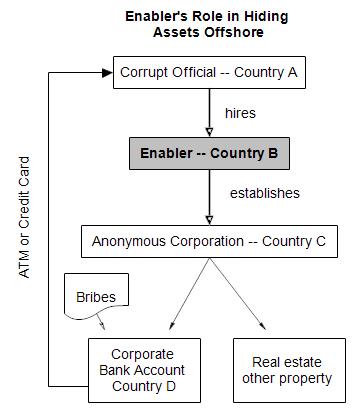
Corruption is hardly a new problem. Three centuries before the Common Era the author of the Arthaśātra advised the Maurya Empire’s rulers on ways to prevent corruption, and the first statute the English Parliament enacted made bribery a crime.  What is new is the ease with which corrupt money flows out of the victim state.  For a hefty fee, corrupt officials can today readily find a lawyer, real estate agent or other professional willing to help hide the assets they have stolen offshore.

Continue reading

Following the Money: October 21 Conference on Making Finance More Transparent

The Norwegian Branch of Publish What You Pay is bringing together a terrific group of investigative journalists, whistleblowers, bankers, government officials, and academics to discuss how to lift the veil of secrecy often surrounding illicit financial transactions. Those speaking at the free, online conference October 21 include –

* Bradley C. Birkenfeld, the individual who exposed how UBS helped ultra-wealthy Americans commit billions in tax fraud

* Jóhannes Stefánsson and Ingi Freyr Vilhjálmson. Stefánsson blew the whistle on the bribes the Icelandic company Samherji paid Namibian officials to corner the market on the country’s fishing quota while Vilhjálmson’s reporting exposed the role of Norway’s DNB bank in disguising the bribes

* William Bourdon, French avocat who has done so much to force French prosecutors, judges, and politicians to address corruption in France and abroad

* Simon Bendtsen, Danish editor and journalist with Berlingske Tidende who with colleagues exposed the Danske Bank money laundering scandal

* Linda Larsson Kakuli and Axel Gordh Humlesjö, members of the investigative team at Swedish national public television broadcaster SVT who revealed the Swedbank money laundering scandal

Information on the other speakers and how to register is here.

OECD September 23 Webinar Corporate Anticorruption Compliance Programs

By my count the laws of 25 nations either require or create strong incentives for firms doing business in their country to have an anticorruption compliance program.  Making it against company policy for employees or agents to participate in any corrupt act with sanctions ranging from demotion to termination is a no-brainer. Corporate employees, consultants, and agents are always on the paying side of a bribery offense and often facilitate conflicts of interest and other corrupt and unethical acts.  There is no reason why countries fighting corruption should not enlist the private sector in the fight.

Even when national law doesn’t require a compliance program, it makes sense for many reasons — legal, reputational, managerial — for companies to have one. The OECD has been a leader in persuading businesses large and small of the benefits of compliance programs and with the World Bank and the UNODC issued an invaluable guide to creating one.  Its latest effort to persuade businesses why they should establish a compliance program, the OECD examines why so many companies have established one even when not required to do so, how the programs work, and what companies’ experience with them has been. The study, “Corporate Anti-Corruption Compliance Drivers, Mechanisms, and Ideas for Change,” will be discussed at a September 23 webinar 15:00 Paris time. Registration will open shortly.  Details are here.