New York Conference Recommendations on the Future of Corruption Measurement

The central issue in the fight against corruption is how to measure success. Did changes in the way pharmaceuticals are procured and distributed reduce “leakage.” Did strengthening the anticorruption agency and creating fast track corruption courts reduce bribery?

How to assay these reforms were some of the many questions participants debated at a three-day conference on measuring corruption at the UN’s New York headquarters in early December.

The measurement issue starts with the most basic question: what is corruption. Are all gifts to a public official corrupt? Or just those over say $50? There is the conceptual issue: All other things equal, is corruption greater when two officials each take a $50 bribe or one a $100 bribe? Then there are the practical issues, starting with how to measure conduct like bribery and embezzlement that cannot be directly observed and that the participants go to great lengths to hide (here).

Organized by the UNDP, the International Anticorruption Academy, UNODC, the OECD, and the World Bank, the conference did not produce the definitive guide to corruption measurement. Nor is such a guide even possible, given the definitional, conceptual, and practical issues corruption measurement poses.

What the conference did achieve was more important.

Participants from governments and NGOs from rich and poor countries alike agreed that the impossibility of an all-encompassing measurement tool must not be taken as a counsel of despair. There are many ways progress in the fight against corruption can be measured and much that national governments with input from academics and civil society can do to develop ever better measures of that progress.  The statement issued by this Second Global Conference on Harnessing Data to Improve Corruption Measurement along with the recommendations for advancing the measurement agenda is here.  

Basel AML Index 2025: What Money Laundering Risk Scores Can and Can’t Tell Us

GAB is pleased to publish this guest post by Kateryna Boguslavska, Head of Financial Crime Risk and Monica Guy, Senior Specialist Communications, at the Basel Institute on Governance

It is with some trepidation that we inform GAB readers of the latest Basel AML Index Public Edition results.

That is because the Basel AML Index is widely known as a ranking of jurisdictions – 177 this year – in terms of their risks of money laundering and related financial crimes. We all know how contentious jurisdiction rankings can be, especially in hard-to-measure topics like financial crime.

So we would like to stress from the outset an important point about this year’s Index.

Continue reading

Call for Applications: 10th Interdisciplinary Corruption Research Network Forum June 2026

The ICRN invites scholars studying the intersections of corruption, anticorruption, integrity, and technology to present their work at the June 2026 Forum.  Hosted by the Research Center Trustworthy Data Science and Security, University Duisburg-Essen, in collaboration with the University of Cologne, there will be sessions on:

  1. Promotion – Present advanced-stage or completed research, share fieldwork challenges, and discuss findings.
  2. Work in Progress – Present early-stage projects, research designs, and seek constructive feedback.
  3. Co-creation – Lead collaborative sessions to develop new ideas, joint publications, teaching initiatives, or innovative methodologies.

Applications in the form of a 300-word abstract are due February 2. Details and registration form here.

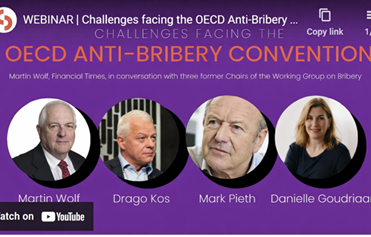
January 14 Webinar: Challenges Facing the OECD Antibribery Convention – Reflections from Three Former Working Group Chairs

The OECD Convention on Combating Bribery of Foreign Public Officials in International Business Transactions stands as the most far reaching measure to curb transnational bribery. Its member states account for anywhere between two-thirds and three-quarters of total global trade in goods and services, and each has pledged to prosecute any person or firm subject to its law that bribes an official of a foreign government.

Compliance with the Convention is overseen by the OECD Working Group on Bribery, representatives of each treaty party who meet regularly to assess how well member states are complying with their treaty obligations. As Transparency International has observed, the Group “plays an indispensable role in providing a forum for the exercise of peer pressure on governments lagging on their commitments” (here). And key to the Group’s continuing to play that role has been its chair.

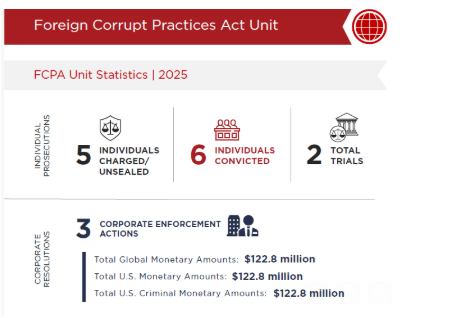
Current chair Kathleen Roussel has taken over at an especially challenging time for the Group and the Convention. The Trump Administration’s retreat from vigorous enforcement of the Foreign Corrupt Practices Act (here), which inspired the Convention, and Italy’s recent actions in foreign bribery cases (here and here) have raised questions about the effectiveness of the Convention in holding the line against bribery.

Financial Times columnist Martin Wolf will moderate a discussion with three former Working Group chairs — Mark Pieth, Drago Kos, and Danielle Goudriaan — on what the Group must do to ensure the Convention’s continued effectiveness. Organized by Corner House (UK), Hawkmoth (the Netherlands), HEDA (Nigeria), and ReCommon (Italy), the online event will be held January 14, 9:30 am US East Coast time, 3:30 pm Central Europe time.

Registration details are here.

Guest Post: Is It Worth Recognizing Integrity? Rethinking the Anticorruption Prize Ecosystem

GAB welcomes this contribution by Blair Glencorse, Co-CEO of Accountability Lab and Co-Founder of Civic Strength Partners and  Shally Baloch, Junior Networks and Partnerships Officer at Accountability Lab. Follow the Lab on Linkedin.

Global corruption costs trillions of dollars a year. Global prizes for anticorruption total just $7.5m.

If you’ve been around the anticorruption field long enough, you’ve probably seen them: the fearless reporters who uncover procurement scandals, the whistleblowers who refuse to stay quiet, the community organizers who stand up to kleptocrats and, every now and then, the spotlight moments when someone hands them a prize and says, “Thank you for your courage.”

At Accountability Lab, we lovingly call this “naming and faming” and it has been part of our DNA for almost 15 years. And honestly? It matters. Awards help bust through cynicism, amplify role models, and remind the world that integrity is alive and kicking. They energize movements and validate the people doing some of the hardest work on the planet.

But here is the thing few people talk about: the anticorruption award ecosystem itself. Who is celebrated? Who isn’t?  And who sets the rules? Is the recognition ecosystem actually aligned with today’s corruption challenges? And crucially, is it investing at a scale that matches the global corruption crisis?

As anticorruption day approaches once again, we mapped more than 40 prizes connected to integrity, transparency, journalism, rule of law, and governance to understand the landscape. (List here.) What we found is both encouraging and deeply revealing.

Continue reading

Links to Broadcast of Sessions of the 2nd Global Conference on Harnessing Data to Improve Corruption Measurement

The conference is now in progress in New York. Links to broadcasts and complete program below.

Tuesday, 2 December
Morning Sessions: https://webtv.un.org/en/asset/k12/k1293vkug5
Afternoon Sessions: https://webtv.un.org/en/asset/k1h/k1hxein4pi

Wednesday, 3 December
Morning Sessions: https://webtv.un.org/en/asset/k1v/k1vqh17p0m
Afternoon Sessions: https://webtv.un.org/en/asset/k1a/k1adqsg02k

Thursday, 4 December
Morning Sessions: https://webtv.un.org/en/asset/k1s/k1suy8jmkw
Afternoon Sessions: https://webtv.un.org/en/asset/k15/k15wx12g4l

Conference Website
https://hdcmprogramme.my.canva.site/2-4-december-2025

Cuando la corrupción nos toca

A session on corruption victims, Cuando la corrupción nos toca: participación de víctimas y organizaciones de la sociedad civil en la lucha contra la corrupción, will be held in connection with the 194th Period of Sessions of the Inter-American Commission on Human Rights. 

The session will examine how corruption directly impacts individuals and communities and will highlight the role that victims and civil society organizations can play in advancing justice and promoting comprehensive reparations. Featuring leading experts from across the Latin American region, the discussion will focus on the opportunities and challenges involved in participating in judicial processes related to corruption with human rights implications. 

The event will take place on November 19, 2025, in hybrid format in Spanish from the University of Miami. Register here.

The Failure to Limit the Corruption of Global Capital

This past April I was fortunate enough to attend a wide-ranging discussion at the Stanford Business School of what the growing power of global capital and the declining trust in government institutions means for the future of capitalism and democracy.

Not surprisingly corruption emerged as a major theme.

Speakers examined everything from the failure of multinational corporations to enforce their own ethics codes to the rise of a profession devoted to helping corrupt officials hide stolen assets to the OCED’s failure to crack down on Italy’s breach of the Antibribery Convention.

A link to the conference papers is here. My summary of what was said about the transnational spread of corruption and measures to curb it, published on the ProMarket page of the University of Chicago’s Stigler Center, is here.

An extraordinary app, NotebookLM, converted the summary into a dialogue explaining the summary and exploring its implications.  It is here.( A physicist friend had raved about how NotebookLM made his technical papers understandable to lay audiences. I didn’t believe him until I heard the dialogue it created off the summary. I am astonished at the result.) 

Georgia at the Crossroads: The MEGOBARI Act As a Rule-of-Law Lifeline

GAB welcomes this post by Giorgi Meladze, Associate Professor at Ilia State University School of Law in Tbilisi and an invited lecturer at European Humanities University; Konstantine Chakhunashvili, PhD Associate Professor at Caucasus University; and Nadia Asaad, journalist and researcher working with the Center for Applied Nonviolent Action and Strategies and a graduate student at the Paris Institute of Political Studies (Sciences Po).

Once praised as a “Beacon of Democracy,” Georgia now faces mounting concerns over its slide towards authoritarian rule. Under the influence of oligarch Bidzina Ivanishvili, the country’s ruling elite is consolidating power through corrupt, authoritarian practices. While the United States and several European Union member states have already responded with sanctions targeting key decision-makers and their associates, Washington lawmakers are now debating legislation supported by both Republicans and Democrats to ratchet up the pressure.

The Mobilizing and Enhancing Georgia’s Options for Building Accountability, Resilience, and Independence (the MEGOBARI Act) would require the President to impose new sanctions on Georgian leaders and anyone “engaged in significant acts of corruption or acts of violence or intimidation in relation to the blocking of Euro-Atlantic integration in Georgia.” It is an essential element in defending democracy and the rule of law in Georgia. which in turn will help prevent organized crime networks operating through and in Georgia from fueling Russia’s war machine and undermining Euro-Atlantic integration.

After a decade of state capture, cosmetic “reforms”, and the consolidation of informal power networks, all documented by the Basel Institute, a sanctions regime codified by MEGOBARI Act and calibrated to the Georgian context is no longer optional: it is critical to prevent Georgia’s antidemocratic leanings from infecting its neighbors.

This post documents the Georgian state’s slide into a “cartel-state” and explains how MEGOBARI and other measures by U.S. and EU can arrest it.

Continue reading

Balancing Enforcement and Anticorruption Messaging: Lessons from an Anti-Vote Buying Project in Moldova

GAB welcomes this timely and important Guest Post on vote buying by Corina Rebegea, Non-Resident Fellow at the Accountability Lab, and Katie Fox, Eurasia Deputy Regional Director at the National Democratic Institute (NDI).

A common concern in combating vote buying is the ineffectiveness of typical awareness campaigns (here). An NDI program in Moldova suggests a more successful strategy: combine robust law enforcement with tailored, empowering public messaging. Rather than relying on fear or blame, this approach centers on voter dignity and institutional integrity, offering valuable lessons for combating electoral corruption worldwide.

Although the evidence comes from a single country, the Moldovan experience offers several lessons to inform future efforts to prevent vote buying:

  • Negative messages tend to amplify distrust in elections, so the focus needs to shift from portraying elections as “stolen” to highlighting efforts to ensure their integrity.
  • Identifying trusted actors in society is essential for raising awareness of what constitutes electoral corruption and conveying deterrent messages. In Moldova, the police emerged as an increasingly trusted force, potentially due to their involvement in anti-vote buying investigations.
  • Messages that raise confidence and emphasize individual responsibility resonate better than those that blame or threaten citizens. Awareness-raising about the legal consequences will be well-received, but only among certain demographics, so an in-depth understanding of the different audiences is essential.
Continue reading