When Do Partisans Turn on One of Their Own? Reflections on the New Menendez Case

The biggest corruption-related political news in the United States over the past couple of weeks is the decision by the Department of Justice (DOJ) to indict Senator Bob Menendez (Democrat of New Jersey) for allegedly taking bribes (including cash, gold bars, and a luxury car) from several businessmen, in exchange for using his influence to help these businessmen in various ways. If you’re having a sense of déjà vu, it’s because we’ve seen this movie (at least the beginning) before: Back in 2015, the DOJ indicted Senator Menendez for accepting lavish gifts from a wealthy friend and campaign donor, allegedly in exchange for using his influence to help advance that donor’s personal and business interests. That prosecution was unsuccessful: The DOJ pursued the case, but although the prosecutors prevailed on some important issues of law, the trial, which took place in 2017, ended in a hung jury—presumably because some of the jurors did not think that prosecutors had proved, beyond a reasonable doubt, that the luxury trips and gifts bestowed on Senator Menendez were bribes, rather than personal hospitality offered by a close friend.

It remains to be seen whether the legal outcome will be different in this case (and of course, it should go without saying, Senator Menendez is entitled to the presumption of innocence in a court of law, though he is entitled to no such presumption in the court of public opinion). But there is already one notable difference between the current case and the 2015 case: the reaction of Senator Menendez’s colleagues in the Democratic party. As I write this (several days before the post will likely be published, so forgive me if this is a bit out of date), a number of prominent Democrats, including New Jersey Governor Phil Murphy, several Democratic Senators, and numerous Democratic House Members, including former Speaker Nancy Pelosi, have called on Menendez to resign. To be sure, as a critics have noted, several leading Democrats—including President Joe Biden and Senate Majority Leader Chuck Schumer—have not called on Senator Menendez to resign. But this is still a marked contrast from 2015, when to the best of my recollection (and readers should feel free to correct me if I’m wrong) no prominent Democrats called on Senator Menendez to resign. Why the difference? Continue reading

Guest Post: The Recent Brazilian Ruling on Use of Evidence from the Odebrecht Case—Setting the Record Straight

Last week, this blog featured a guest post from Gregory Michener and Breno Cerqueira on the recent decision by Justsice Toffoli of the Brazilian Supreme Court, which concerned the settlement that Brazilian prosecutors had previously reached with the Odebrecht company—and the evidence against other defendants that Odebrecht had provided prosecutors as part of that settlement. A Brazilian lawyer with first-hand knowledge of the case submitted the following guest post, which takes issue with a number of the claims made in the previous post. Although it is not GAB’s usual practice to publish anonymous posts, in this case the sensitivity of the matter and the importance of raising these issues led me to exercise my editorial judgment to publish the post below without the author’s name.

The recent guest post on this blog regarding the recent judicial ruling on the settlement in the Odebrecht case is inaccurate in certain respects.

  • The first and most important inaccuracy is that, in contrast to what the post indicates, Justice Toffoli’s ruling did not annul the settlement in the Odebrecht case. Rather, the ruling held that the evidence included in certain important Odebrecht databases contained in hard drives, obtained by the Brazilian prosecutors from Swiss authorities, may not be lawfully used in criminal or civil investigations. The guest post properly states this aspect of the ruling—that it prohibited the use of this evidence —but the suggestion that the ruling annulled the settlement itself is not accurate.(A potentially important issue is whether the ruling would apply with the same force to the evidence turned over directly to the Brazilian prosecutors by Odebrecht, rather than obtained by the Brazilian prosecutors from the Swiss authorities. But the guest post fails to make that distinction.)
  • Second, the guest post seems to treat Justice Toffoli’s decision as a surprise, or at least unanticipated. But in fact, several prior decisions by other Brazilian Supreme Court Justices (particularly Justice Lewandowsky) had reached essentially the same conclusion, though with regard only to particular defendants. Justice Toffoli’s ruling extends and generalizes those prior decisions, ruling that the evidence in question cannot be used at all, thus obviating the need for individual defendants to obtain a similar ruling by the court in their individual cases.
  • Third, the post seems to imply that Justice Toffoli decided this case because he was appointed by President Lula, and previously served in senior positions in Lula’s first administration. But this is a gross simplification, especially when one remembers that Justice Toffoli handed down several decisions that went against against Lula’s interests (including rulings against prominent members of Lula’s party in the Mensalao case, and during Lula’s time in jail). Notably, Justice Toffoli apologized for some of those earlier decisions in the more recent decision currently being discussed. Therefore, rather than favoring Lula and his party consistently, a more plausible hypothesis, based on Justice Toffoli’s record, is that he seems inclined to decide cases in favor of the interests he sees as commanding the current political agenda. This may be at least as objectionable as guest post’s suggestion that he is decides cases systematically out of loyalty to Lula, but as a matter of empirical analysis of judicial trends, it is importantly different. (And Lula himself is, or should be, attentive to that.)
  • Fourth, another inaccuracy in the post, though admittedly a less important one, is the claim that prosecutors had not made public the Odebrecht agreement’s legal framework until last week. This is not true. The agreement has been publicly available for more than five years on the Ministry of Federal Prosecution’s website, which provides easy access to several of the resolutions that the federal prosecutors have concluded.
  • Finally, it is worth addressing the suggestion at the end of the post that transparency regarding the facts reported by Odebrecht under the settlement agreement might have reduced the chance of a decision such as Justice Toffoli’s. This cannot be characterized as a factual inaccuracy, as it is inherently a speculation about what might have happened under different conditions. Nevertheless, that assertion seems too rudimentary. There may be good reasons why prosecutors (and other control agencies, such as, in the case of Brazil, the Comptroller General and the Attorney General’s office) elect not to disclose all of the facts contained in the evidence turned over by the company right away. The most obvious reason for not publicly disclosing this evidence right away is that the evidence may be relevant to ongoing investigations. And it is not true that the U.S Department of Justice (DOJ) would make public comparable factual material, if doing so would jeopardize ongoing investigations. (Some also claim that the DOJ decides on the degree of disclosure of facts in statements of facts attached to Foreign Corrupt Practices Act negotiated resolutions based more on, or at least with an eye to, strategic or geopolitical considerations than transparency concerns.) Again, though, the claim that more transparency about the settlement and the associated evidence would have helped seems reasonable, and is not strictly speaking inaccurate. There is certainly room for reasonable disagreement about the prosecutors’ approach to disclosure. But the issue is far more nuanced than the post suggests.

I want to emphasize that these comments are not meant to contradict the importance of making pointed critical assessments of judicial decisions in general and Justice Toffoli’s ruling in particular. Nor do I wish to offer any further opinion on these fraught, highly controversial legal and political issues. But given the intensity of the discussion in Brazil, and the unfortunate tendency for all sides in these debates to hurry over or oversimplify key facts, I thought it was important to advocate for subtlety and raise these problems about the recent guest post on this blog.

Has Russia’s Invasion Empowered President Zelensky in His Fight Against Corruption?

A national crisis can have a wide range of effects on a country’s commitment to fighting corruption. Sometimes, the sense of crisis leads countries (for better or worse) to de-prioritize corruption, out of a sense that other matters are higher priority, or even out of a sense that tolerance for a certain degree of corruption is a price worth paying to achieve other more pressing objectives. But in other situations, a sense of national crisis can strengthen a government’s resolve to crack down aggressively on corruption. There seem to be at least two closely related reasons why this may sometimes occur. First, corruption might be seen as directly and significantly impeding the country’s ability to tackle the emergency at hand. Second, a time of crisis can strengthen the position of the nation’s chief executive (the president or prime minister)—both in the formal legal sense (in that during times of crisis the chief executive may be able to wield extraordinary emergency powers) and in the softer more political sense (in that the chief executive may enjoy a surge in popularity if the country is under threat, and the public perceives the chief executive as providing strong leadership in the crisis). If that chief executive is genuinely committed to fighting corruption (a big if), then he or she may be able to leverage this unusual power to move aggressively against corruption, in a manner that would be politically difficult or impossible in “normal” times.

My impression, based on news stories and informal conversations with actual experts (which I am not!), is that the latter characterization is more apt for what is happening in Ukraine right now. It was not obvious that things would go this way initially—particularly given that, shortly after Russia’s full-scale invasion, the Ukrainian parliament suspended the asset declaration requirement for public officials, which though justified at the time as a way to keep potentially sensitive information from the Russians, was viewed with understandable concern. But a series of developments since then has demonstrated what looks to an outsider (at least to this outsider) like a consistent and quite aggressive effort to crack down on corruption, even at the risk of some (temporary) disruption to aspects of the war effort.

At least for me, one of the most notable and encouraging signs was the arrest, earlier this month, of Ihor Kolomoisky, one of Ukraine’s most powerful oligarchs, on fraud charges. Continue reading

Guest Post: The Judicial Annulment of the Odebrecht Settlement Evidence in Brazil, and Its Implications

Today’s guest post is from Professor Gregory Michener, Brazilian School of Public and Business Administration, Getulio Vargas Foundation (FGV-EBAPE) and Breno Cerqueira, a Brazilian public official. The post is based on an op-ed originally published (in Portuguese) in the Folha de São Paulo newspaper.

Earlier this month, a single Justice on Brazil’s Supreme Court invalidated, on dubious procedural grounds, the plea bargain that prosecutors had reached seven years ago with the Odebrecht firm, which resolved serious corruption charges that the prosecutors had brought against the firm. The alleged impropriety concerned how the Brazilian prosecutors had interacted with their counterparts in the United States and Switzerland, which had also brought cases against Odebrecht, which ultimately pled guilty and paid penalties in all three jurisdictions. According to Justice Toffoli (who, incidentally, had been implicated in Odebrecht’s wrongdoing when he was Solicitor General, though he succeeded in suppressing reports about his alleged wrongdoing), the Brazilian prosecutors from the Lava Jato (“Car Wash”) Task Force had engaged in discussions of the case with their U.S. and Swiss counterparts without those foreign prosecutors having first filed a formal official request for international legal cooperation, and without including representatives from the Brazilian Ministries of Justice and Foreign Affairs in the discussions. Strikingly, Justice Toffoli ruled that none of the evidence obtained from Odebrecht in the plea deal—and which was used in hundreds of other cases—could lawfully be used. Tofolli’s decision thereby threatens to undo the vast majority of the convictions that the Car Wash prosecutors had secured before the task force was disbanded.

This decision is troubling for a number of reasons. For one thing, the decision put the private interests of defendants ahead of the public interest of deterring and prosecuting corruption. No one denies that due process is important. However, preserving indisputable evidence of corruption can be achieved without a wholesale dismissal of charges. The nullification of the Odebrecht case is a nullification of justice and of the public interest.

Perhaps even more troubling, the decision is unsettlingly aligned with President Lula’s promise of revenge against the Car Wash Operation—and the individual judges, prosecutors, and others involved in that operation. Lula himself was jailed for 18 months after he was convicted for taking a bribe (in the form of a luxury apartment)— a conviction that was ultimately overturned on technical grounds (principally that the case was brought in the wrong venue). Lula, his supporters, and many mainstream media outlets have characterized the conviction as a baseless and politically motivated prosecution. That Justice Toffoli, a Lula appointee, issued this sweeping ruling—and also issued a broad and highly political statement condemning the entire Car Wash operation—would certainly seem consistent with the notion that the ruling had more to do with political and personal motivations than the law. Worse still, the ruling not only invalidates the Odebrecht plea deal and all other convictions that relied on the evidence it produced, but the ruling also calls for the investigation of the Car Wash prosecutors and judges for (alleged) misconduct.

Now, it is worth noting that Justice Toffoli’s ruling is unlikely to have any effect on Odebrecht’s plea agreement with the U.S. authorities. U.S. evidentiary standards tend to be more permissive, at least in this context, about barring the use of illegally sourced evidence – especially in cases where the public interest has clearly been aggrieved. And Odebrecht is unlikely to try to use the Brazilian ruling to wriggle out of is plea deal with the U.S., especially since that deal provides that non-compliance can result in further prosecution.

One more observation may be pertinent here: The Brazilian prosecutors may have hurt their cause by not providing sufficient transparency in an official register of the crimes, including their investigation, prosecution, and ultimate plea bargain. In the U.S., the Department of Justice website provides open and transparent information about all Foreign Corrupt Practices Act plea agreements. In the case of Odebrecht, company representatives signed affidavits testifying to US$788 million in bribes to government officials in 12 countries, including US$349 million in Brazil. In all, ill-gotten gains netted Odebrecht US$3.336 billion of construction contracts, including US$1.9 billion in Brazil. By contrast, Brazilian authorities failed to provide the transparency required under Brazilian law. The Federal Public Prosecutor, which handles civil and criminal cases, disclosed nothing until, following last week’s decision, it posted the agreement’s legal framework. The Office of the Comptroller General, which handles administrative crimes, posts all plea bargains on its website but includes few to no specific details about crimes.

The issue of transparency raises a counterfactual question: to what extent would things have been different if the facts of the Odebrecht case had been made transparent, engraving outrageous corruption permanently on the public record from the very beginning? Just maybe Justice Toffoli’s decision might have been different. Transparency affects the legal and political environment in unmeasurable ways, and may have impacted subsequent judicial rulings.

The Sometimes Grubby World of Political Fundraising

The recent bribery charges levelled against New York City Building Commissioner Eric Ulrich remind of the corruption risk the private financing of political parties and candidates creates.

Ulrich raised money for Eric Adams’ successful campaign for New York City Mayor, and after his election Adams appointed him to a position in the city’s Department of Buildings. As the New York Times explained in its story on the charges, “the department regulates the construction and real estate industries, issuing permits, licensing contractors and policing construction safety and the city’s building code, and thus can have a significant impact on development.”  According to the indictment, Ulrich accepted more than $150,000 in bribes in return for granting licenses and permits.

The corruption risk private campaign financing creates arises from candidates’ search for money to win their election. One needs lots of money to get elected Mayor of New York (Adams’s raised more than $9 million.) That in turn requires people willing to help raise it from friends and associates. Some help knowing that if the candidate they are helping wins, they can use the relationship they have developed with the candidate and senior campaign staff to make money. 

Continue reading

Judicial Integrity and Judicial Independence: A Clash of Values?

This past spring, the investigative journalism site ProPublica broke a major story about ethically questionable—and previously undisclosed—relationships between ultra-wealthy (and politically active) individuals and Supreme Court justices. The reports focused in particular on Justice Thomas and Justice Alito, two of the Court’s most conservative members. According to ProPublica’s reports, in 2008 Justice Alito accepted a luxury fishing trip—which involved flights on a private jet and a stay at a lodge that charges more than $1,000 a day—from billionaire Paul Singer, whose hedge fund often had cases before the Court, including a 2014 case in which Justice Alito did not recuse himself and voted in the hedge fund’s favor. With respect to Justice Thomas, ProPublica revealed that for years—starting shortly after he joined the Court—Justice Thomas has received substantial benefits from billionaire “friends,” including private plane flights, luxury vacations, VIP passes to sporting events, and private school tuition for his nephew (whom Justice Thomas has raised like a son). Most of these gifts came from right-wing billionaire Harlan Crow, who also purchased from Justice Thomas (in a previously undisclosed deal) the house where Justice Thomas’s mother and other members of his family lived, but Justice Thomas received substantial benefits from other billionaires as well.

Many critics denounced these gifts and other transactions as evidence of blatant corruption (see here, here, here, and here). Some even drew a connection  between the Court’s jurisprudence in corruption cases—which has embraced an ever-more-restrictive definition of corruption, often limiting it to quid pro quo deals—and the Justices’ own proclivity for accepting gifts, perks, and other benefits from people with a strong ideological (and sometimes personal) stake in the Court’s decisions (see here and here). Justice Thomas and Justice Alito vigorously defended their conduct (see here and here), though they did ultimately update their financial disclosure forms for 2022 (though not earlier years) to show additional benefits they had received, and to proffer some explanations. And the Justices’ supporters have accused the accusers of using these alleged ethical issues as a pretext for attacking Supreme Court Justices whom they dislike on ideological grounds (and overlooking similar ethical lapses by Justices whose ideology they prefer).

I have my own fairly strong views about this specific controversy, but I don’t want to go into that right now. I’m not sure I have anything to add—and I’m acutely aware that, whether or not one buys the charges of pretext and selective outrage—it is very difficult to talk about this issue without being influenced by (or perceived as influenced by) one’s views on Justice Thomas’s and Justice Alito’s jurisprudence and ideology. But even putting the specifics mostly to one side, I do think the fallout from ProPublica’s reporting implicates a more general issue—one that is very difficult, and that is relevant not only in the United States but in many other countries as well: To what extent can or should the other branches of government (the executive, the legislature, or—in the countries where such entities exist—an independent anticorruption commission) impose and enforce ethical rules on the highest court (the Supreme and/or Constitutional Court)? Continue reading

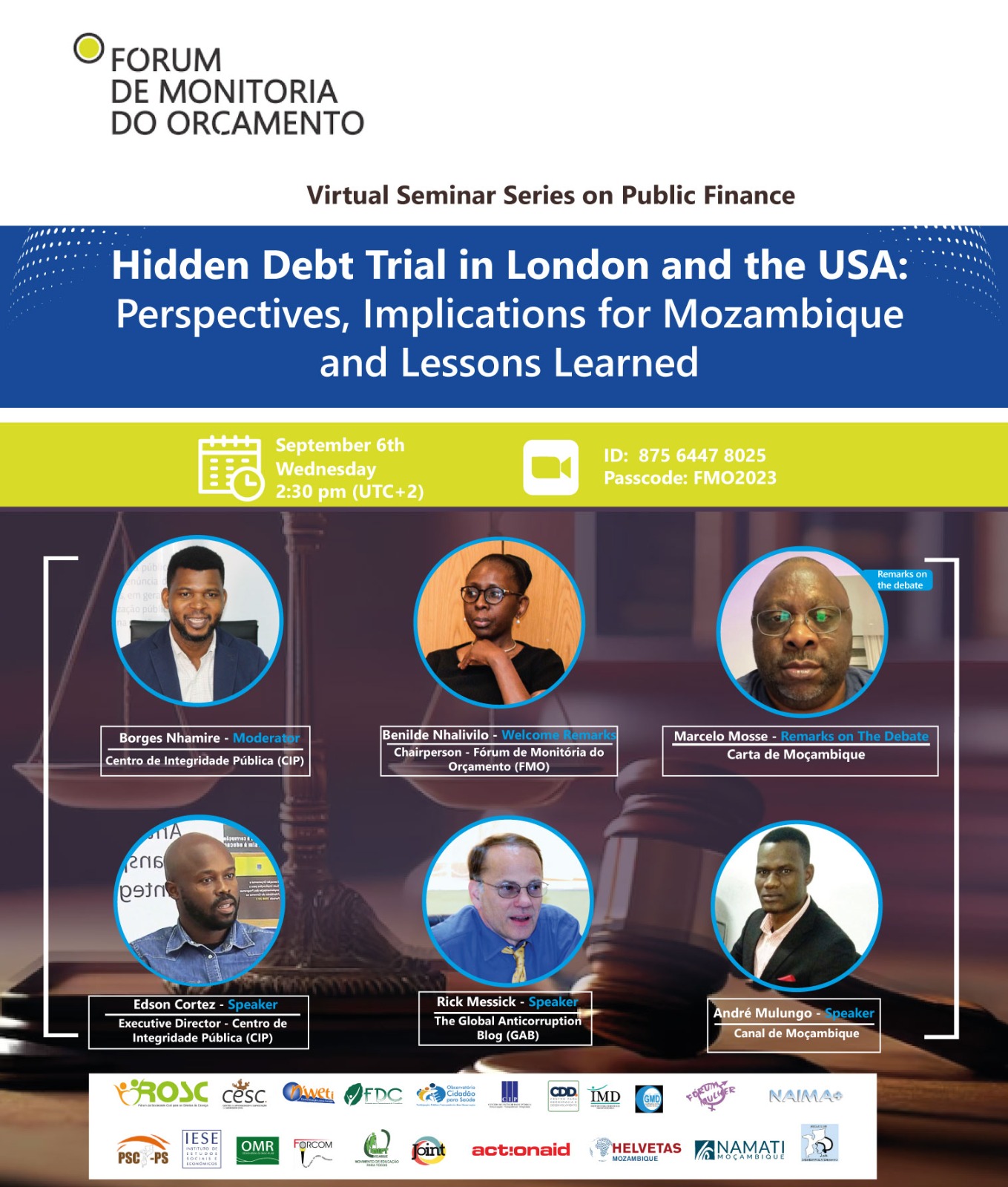
Virtual Seminar September 6: Mozambique’s Hidden Debts — Trials of Perpetrators, Lessons Learned

Wednesday, September 6, at 2:30 PM Mozambique time (UTC + 2) members of Mozambican civil society, the media, and GAB staff member (me) will discuss developments in the Mozambican “hidden debt” scandal.

Evidence introduced at the trial of Jean Boustani (here), a senior executive of the Middle East shipbuilding company Privinvest, showed the company bribed Mozambican officials to the tune of $125 million in return for government loan guarantees. The loans went for projects of little or no value. Mozambican citizens are now saddled with repaying billions in principal and interest. A joint study by Mozambique’s Centro de Integridade Pública and Norway’s Chr. Michelsen Institute estimates the scheme may have cost the nation, one of the world’s poorest,. as much as $11 billion, virtually the country’s entire GDP for 2016.

Those responsible for this enormous wrong are slowly being held to account. The Mozambique government is suing some of the perpretrators in a civil action in London, and Manual Chang, Finance Minister at the time the guarantees issued, was recently extradited to the United States to face charges for his role.

A list of speaker and details on logging in on Zoom is here.

Would the Foreign Extortion Prevention Act Help the U.S. Counter China?

The U.S. Foreign Corrupt Practices Act (FCPA) makes it a criminal offense for U.S. domestic concerns, firms that issue U.S. and any anyone acting in U.S. territory from offering or paying bribes to foreign government officials. The FCPA does not, however, apply to the foreign officials who receive those bribes. (On occasion some prosecutors have advanced the theory that a foreign government official who takes a bribe can be convicted for aiding and abetting, or conspiring in, an FCPA violation, but courts have generally rejected these theories.) Additionally, while U.S. criminal law prohibits domestic government officials from soliciting or accepting bribes, the relevant statutory provisions do not apply to foreign officials who engage in comparable conduct.

Many U.S. anticorruption activists believe that U.S. law ought to target the demand side of foreign bribery transactions (that is, the bribe-takers), not just the supply side, and have therefore advocated for the adoption of the so-called Foreign Extortion Prevention Act (FEPA). These advocacy efforts appear to be paying off: In late July, the Senate adopted FEPA as an amendment to the Senate’s version of the National Defense Authorization Act. This does not guarantee that FEPA will become law, as the House of Representatives has yet to vote on a comparable bill, and there is no guarantee that the FEPA language will remain in the bill after final negotiations conclude. But the odds have gone up significantly.

Would FEPA be a good idea? I think the answer is probably yes, though the impact is likely to be modest, and probably somewhat less than FEPA’s proponents hope. I may post again later about my own assessment of FEPA’s likely impact, should it pass in something like its current form. But for now, I want to focus on a striking argument in favor of FEPA that appeared in an op-ed a couple of weeks ago. That op-ed, coauthored by Elaine Dezenski (Senior Director at the Foundation for Defense of Democracies) and Scott Greytak,(Director of Advocacy at Transparency International’s US office), argued that FEPA would “blunt China’s malign economic influence” by countering the practice of Chinese government or government-affiliated entities using bribes to secure access to valuable resources and to expand China’s political sway over developing countries.

There are many good arguments in favor of FEPA, but I’m not sure that this is one of them. I don’t want to dismiss it outright, as it’s entirely possible that I’ve missed something. But it seems to me that FEPA would have little to no impact on corrupt overseas bribery by Chinese entities, and at least in the short term might make that problem (slightly) worse. So let me lay out the source of my confusion: Continue reading