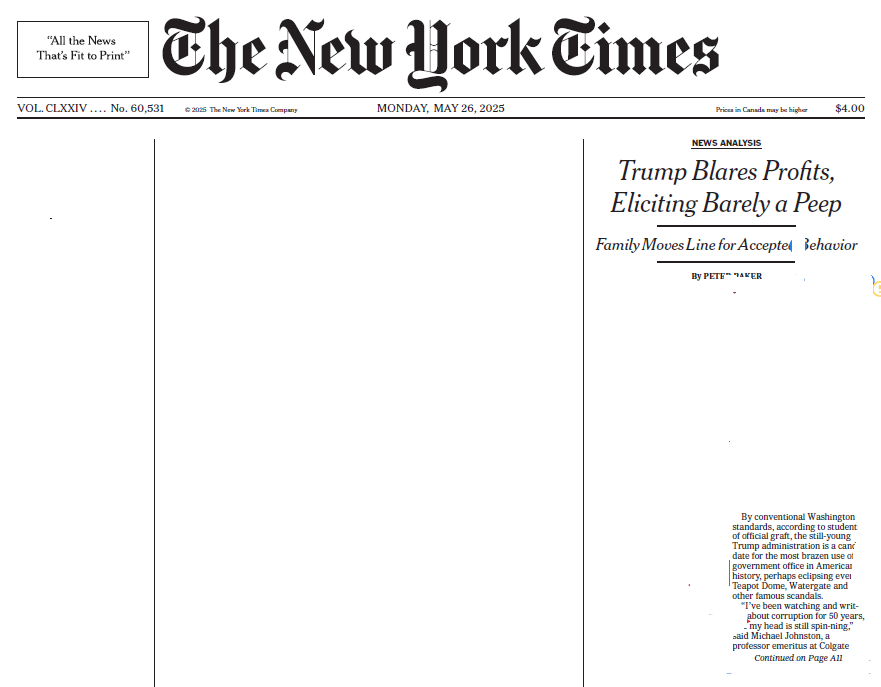
Trump Blares Profits, Eliciting Barely a Peep

That was the headline on the lead story in the May 26 New York Times.

The author, the chief White House correspondent for The New York Times and one of Washington’s most respected journalists, reports the growing view that the Trump Administration’s corruption represents “the most brazen use of government office in American history.” In support he cites anticorruption guru and GAB favorite Michael Johnston who told him–

I’ve been watching and writing about corruption for 50 years, and my head is still spinning

To quote a guru on another subject (revolution — V. Lenin), the question is now: What is to Done?

Belgian and Uzbek Governments Profit from Termination of DoJ’s Kleptocracy Unit

Central Asia Due Diligence and the Uzbek Forum for Human Rights have identified the latest fallout from the Trump Administration’s destruction of American institutions devoted to fighting global corruption. The governments of Belgium and Uzbekistan have each pocketed $108 million in stolen assets that should have gone to the people of Uzbekistan.

In this just released paper, the two human rights NGOs explain how the demise of the Department of Justice’s Kleptocracy Asset Recovery Initiative allowed the two governments to ignore provisions in the UN Convention Against Corruption and the principles of the Global Forum on Asset Recovery that together bar assets stolen by a corrupt official from being kept by the government of the country where the official stashed them or returned to the official’s corrupt cronies.

Lawyers for the Initiative had designed a sophisticated process (details here) to see the $216 million in bribes to former Uzbek first daughter Gulnara Karimova found in Belgian banks DoJ would go to the UN trust fund overseeing development programs in Uzbekistan. With the Initiative’s demise, the Belgian and Uzbek governments apparently saw no reason they should not divvy up the money between them.

So thanks to the Trump Administration, Belgium, one of the world’s wealthiest countries, is now $108 million wealthier, and Uzbek’s leaders, several Gulnara’s accomplices, now have $108 million to spend keeping themselves in power. Meanwhile, the citizens of Uzbekistan, GDP per capita $3,500, scrape by.

TI USA: Attorney General’s Memorandum Redirecting U.S. Anti-Corruption Efforts Raises Questions and Concerns

Below is the statement TI US released today in response to Attorney General Bondi’s Memorandum directing federal prosecutors “to shift focus away from FCPA and FEPA investigations that do not involve” criminal cartels and transnational crime and disbanding DoJ’s KleptoCapture Task Force and Kleptocracy Asset Recovery Initiative. Enforcement of the Foreign Corrupt Practices Act has enjoyed broad, bipartisan support. Congress passed the Federal Extortion Prevention Act by a wide margin and has regularly approved funding for the KleptoCapture Task Force and the Kleptocracy Asset Recovery Initiative. GAB shares TI USA’s concerns about the Attorney General’s Memorandum and hopes she will reconsider it as supporters in Congress, the business community, and the anticorruption community make their concerns known.

Washington, DC—On February 5, 2025, Attorney General Pam Bondi circulated a Memorandum to U.S. Justice Department employees with the subject heading “Total Elimination of Cartels and Transnational Criminal Organizations.”

The Memorandum explains the outlined changes as a step toward implementing President Trump’s January 20, 2025, Executive Order entitled “Designating Cartels And Other Organizations As Foreign Terrorist Organizations And Specially Designated Global Terrorists.”

Among the changes are directives to (1) eliminate the KleptoCapture Task Force and the Kleptocracy Asset Recovery Initiative (KARI); (2) prioritize Foreign Corrupt Practices Act (FCPA) and Foreign Extortion Prevention Act (FEPA) investigations that are related to foreign bribery that facilitates the criminal operations of cartels and transnational criminal organizations (TCOs); (3) shift focus away from FCPA and FEPA investigations and cases that do not involve such a connection; and (3) remove the “bureaucratic impediment” requiring that investigations and prosecutions under the FCPA or FEPA regarding foreign bribery associated with cartels and TCOs first be authorized by, as well as conducted solely by, the Criminal Division and the Fraud Section, respectively, of the Department of Justice in Washington, D.C.

Transparency International U.S Executive Director Gary Kalman issued the following statement:

Continue reading

Dreaming Small: Curtailing Prop Bets to Prevent Sports Corruption

Globally, sports betting has become the “number one factor fueling corruption in sports.” Although the United States has not been as affected by this problem as other countries (at least in modern times), the recent widespread legalization of sports betting in America—accompanied by a surge in sports gambling, especially online—might change that. Thirty-eight U.S. states now permit sports betting, and six more are considering following suit. In 2023, Americans placed roughly $120 billion worth of bets with legal sportsbooks, a near $30 billion increase from 2022, and the percentage of Americans who bet on sports has grown to 39%, up from 19% in 2022. As sports gambling proliferates, so too does the risk of competition manipulation for monetary gain. A slate of recent scandals provides anecdotal evidence that this is indeed a serious problem. For example, in 2024, NBA player Jontay Porter was banned from the NBA for his involvement in a gambling scheme that included tipping off certain bettors that he would exit a game early and underperform sportsbooks’ expectations. In 2023, the University of Alabama head baseball coach was fired for providing information that Alabama would lose a certain game to a gambler who then bet on that outcome.

A comprehensive, or even global, solution to this problem would be ideal, but such a solution will likely take time to enact and implement. Regulators ought not wait. Instead, in the near term, state regulators can and should target a subset of the problem by restricting forms of betting that present an especially significant risk of competition manipulation. One area that deserves particular attention is the proliferation of “prop bets” on individual athletes at the collegiate level. Continue reading

The Anticorruption Legacy of American Civil Service Reform

In the waning months of President Donald Trump’s first term, he issued an executive order that could have drastically reshaped the U.S. federal bureaucracy. The order created a new federal government job classification with far fewer civil service protections, called “Schedule F.” While most career civil servants in the U.S. federal government are protected from politically motivated firings and cannot be fired without cause, under Schedule F, employees “of a confidential, policy-determining, policy-making, or policy-advocating character” could be fired without following standard civil service procedures. With Trump now set to reassume power, Schedule F is back on the table, threatening to take away employment protections from potentially hundreds of thousands of federal employees and making it easier to fire civil servants for purely political reasons.

Commentators have pointed out the potential negative effects of Schedule F on administrative capacity, government performance, and accountability. But another key reason to be skeptical of Schedule F is that it represents a step backwards in the history of American civil service reform, which has its roots in 19th century anticorruption movements. Civil service independence and merit-based hiring came about in response to endemic corruption in the federal bureaucracy. The anticorruption history of the American civil service holds important lessons for modern civil service reformers, both in the United States and elsewhere.

Continue reading

How State Prosecutors Can Fill the Gap in U.S. Anticorruption Enforcement

It’s getting harder to prosecute federal corruption crimes in the United States. In a recent case called Snyder v. United States, the U.S. Supreme Court narrowed the scope of a key anti-bribery law. And this decision is only the latest in a series of cases over the past decade that have limited the reach of federal prosecutors in going after state and local public corruption. While Congress could always enact legislation to expand the scope of federal anticorruption laws, significant legislative action seems unlikely anytime soon.

Given the increasing difficulty of corruption prosecution at the federal level, could state prosecutors step in to pursue cases now beyond the reach of federal law enforcement? After all, federal and state prosecutors share partly overlapping responsibilities for anticorruption enforcement in the United States. Although the Supreme Court has increasingly rejected broad theories of federal criminal liability especially in the context of state and local corruption, the Supreme Court’s narrow readings of federal anticorruption laws pose no barrier to cases brought by state prosecutors enforcing state law (see, for example, here and here). To be sure, federal prosecutors have traditionally played a substantial role in rooting out state and local government corruption, and many remain skeptical that state prosecutors can take up the anticorruption role that federal prosecutors have long played. Yet while state prosecutions might not be a perfect substitute for robust federal anticorruption enforcement, there are compelling reasons to think that state prosecutors could meaningfully fill the gap that the Supreme Court has opened up in the U.S. anticorruption system.

Continue reading

Will America’s Anticorruption NGOs Hold Trump II to Account?

If the trend Daniel Schuman identifies in “Open-Government Nonprofits Are Dying Off Just When They’re Needed Most,” the answer is a clear if frightening NO (here). Schuman, Executive Director of the American Governance Institute, ticks of a list of U.S. watchdogs closing their doors or drastically cutting staff thanks to multiple funding crises.

Those now on the block include: OpenSecrets, which for years has shown which politicians get money from what special interests; OMB Watch, a pioneer in unearthing hard-to-find data on government spending; and the Center for Public Integrity, the scourge of those officials who have never seen an ethical line they can’t cross.

Why, just when more eyes are needed on Trump and cronies, are those with 20-20 vision finding it so hard to raise money? Schulman puts it off to the polarization now infecting the American body politic. The foundations and high-net-worth individuals that have traditionally backed organizations dedicated to “public-informing, community-building work” have, he writes, become “auxiliaries for the parties in their trench warfare over political power.”

Bad enough the funding drought coincides with the return of an Administration likely to make Grant’s second term seem a model of probity. Many of those on the ropes have done much to advance the global war on corruption, from serving as models for citizens of other nations to providing critical technical assistance to anticorruption NGOs around the globe. The fight against corruption in the U.S. is entering a critical phase with the outcome likely to affect the fight in other nations. The stakes couldn’t be higher. Will donors please reconsider their decisions?

Thanks to TheBulwark, an indispensable source for what’s happening in the U.S., for publishing Schuman’s story.

Corruption as a National Security Priority: How Will it Shape U.S. Policy in Fragile States?

Corruption has increasingly been framed as a national security priority in United States policy. This is perhaps most readily apparent in the National Security Council’s 2023 U.S. Strategy on Countering Corruption, but it is also manifest in several major pieces of legislation. One such legislative initiative is the 2019 Global Fragility Act (GFA), which tasked the State Department, Department of Defense (DoD), and US Agency for International Development (USAID) with developing a coordinated ten-year strategy for preventing conflict in fragile states. This past March, the State Department published its inaugural Strategy for Preventing Conflict in four pilot countries—Libya, Mozambique, Haiti, and Papua New Guinea—and one region, Coastal West Africa (encompassing Guinea, Cote D’Ivoire, Ghana, Togo, and Benin). Each of these strategy documents center anticorruption reform as a means to improve state legitimacy and reduce the risk of conflict, but they take quite different approaches to addressing the problem of corruption within a national security framework. Continue reading

The U.S. Congress Must (and Can) Right the Supreme Court’s Wrongs

This past June, in a case called Snyder v. United States, the U.S. Supreme Court dealt another blow to federal anticorruption law. The defendant in Snyder was a former mayor of an Indiana town. During his time as mayor, he helped steer a city contract to a certain company, and that company subsequently paid him $13,000 in “consulting fees.” He was convicted under a federal statute, 18 U.S.C. § 666, which makes it a federal crime for a state or local official to “corruptly solicit[,] demand[,] …or accept[] … anything of value from any person, intending to be influenced or rewarded in connection with any” federally funded program. The question in the case was whether this statute prohibits so-called “gratuities”—payments that are corruptly made to a government official in recognition of action that an official has taken or has committed to take, but without evidence that the promise of the payment was what induced the official to take that act. The Court held that § 666 does not prohibit gratuities. In other words, as long as there is no agreement beforehand, the Court held that § 666 allows people or businesses to reward their state and local officials for favorable government action. In so holding, the Supreme Court has in effect provided a blueprint for using money, gifts, and other material incentives to influence state and local government.

The Court’s Snyder decision is yet another in a string of recent cases that have undermined and impeded federal anticorruption prosecutions in the United States—a string that includes McDonnell v. United States, Kelly v. United States, and Percoco v. United States. These decisions have been criticized—often fairly—for their narrow, crabbed reading of the relevant statutes. But it is a bit too easy to make the Court the sole villain of the story. As the Court itself has emphasized, it is Congress’s responsibility to create clear laws. And Congress should not be given a free pass in light of its failure to respond to the Court’s decisions.

It is true, as noted on this blog (see here and here) and elsewhere (see here, here, and here), that Congress appears at best uninterested in, and at worst hostile to, enacting more robust anticorruption laws. Yet we should not be too quick to conclude that getting meaningful amendments to the laws that the Supreme Court has interpreted narrowly would be a political impossibility. Indeed, at the end of August three Members of Congress (two Democrats and one Republican) introduced the No Gratuities for Governing Act, which would amend § 666 to expressly prohibit gratuities, and in so doing would hold state and local officials to the same standard that applies to federal officials (codified at 18 U.S.C. § 201). Three Senators (all Democrats) introduced a parallel bill in the Senate, the Stop Corrupt Gratuities Act, in early September. Despite the understandable cynicism about the ability of the U.S. Congress to act on this matter, there are several reasons why this proposed legislation might actually have a fighting chance:

Continue reading

New Podcast Episode, Featuring Tom Firestone and Scott Greytak

After a brief late-summer hiatus, a new episode of KickBack: The Global Anticorruption Podcast is now available.In this episode, host Liz Dávid-Barrett interviews Tom Firestone, a partner at the law firm Squire Patton Boggs, and Scott Greytak, the Director of Advocacy at Transparency International US, about the Foreign Extortion Prevention Act (FEPA), a new and groundbreaking piece of US federal legislation that makes it a crime for any foreign official to demand or accept a bribe from an American or American company, or from any person while in the territory of the United States. The conversation touches on the scope of the act, how it relates to the Foreign Corrupt Practices Act (FCPA), the effects that the law may have on anticorruption enforcement efforts in other countries, and the challenges related to FEPA enforcement.
You can find both this episode and an archive of prior episodes at the following locations:
KickBack was originally founded as a collaborative effort between GAB and the Interdisciplinary Corruption Research Network (ICRN). It is now hosted and managed by the University of Sussex’s Centre for the Study of Corruption. If you like it, please subscribe/follow, and tell all your friends!