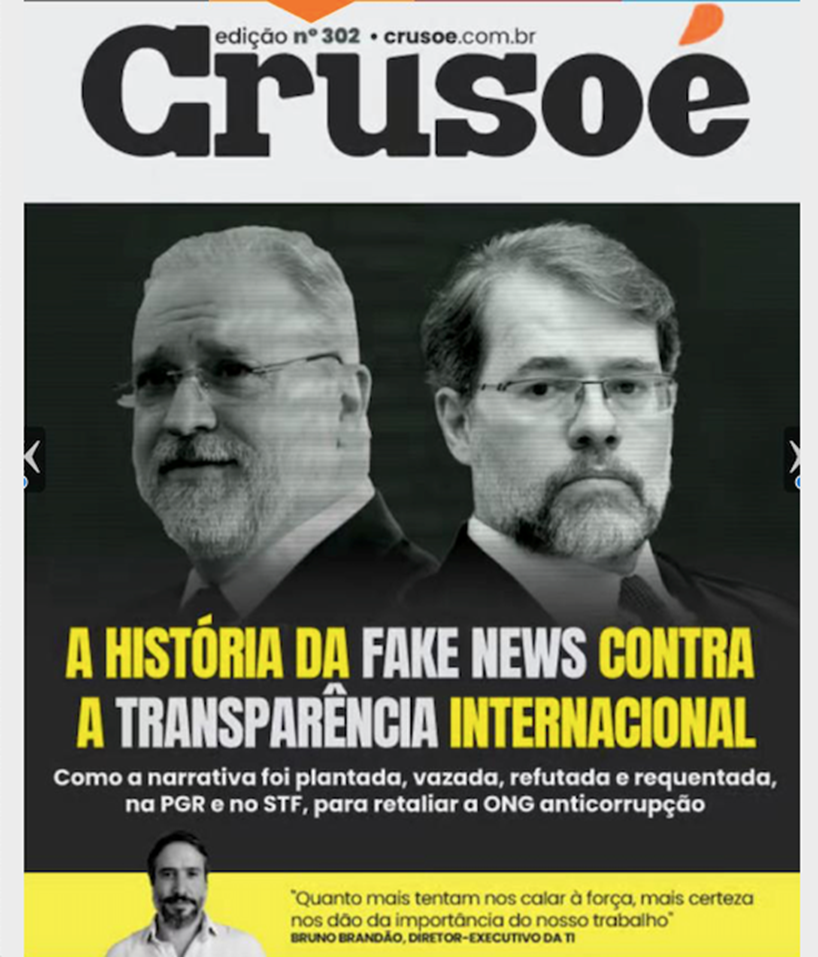
The Fake News and Corruption Behind the Criminal Investigation of Transparency International

Transparency International and its Brazilian chapter are now the subject of a criminal investigation in Brazil. As GAB readers know (here), the investigation is part of Supreme Court Justice Dias Toffoli’s crusade to reverse the convictions handed down in Lava Jato, the landmark Brazilian corruption case. The aim is to ensure defendants escape all punishment in Brazil and are protected from prosecution in the dozen other Latin American and African countries where they paid bribes.

Today’s Guest Post by a Brazilian insider reveals just how groundless the investigation of TI is and Justice Toffoli’s direct conflict of interest in letting one of the Lava Jato defendants off the hook. The author explains that it starts, as the respected Brazilian journal Crusoé explains in the headline to its February 16 issue, with “A HISTORY OF FAKE NEWS AGAINST TRANSPARENCY INTERNATIONAL: How the narrative was planted, leaked, refuted and reheated in the PGR [Federal Attorney General Office] to retaliate the anti-corruption NGO.”

Continue reading

Guest Post: A New Additional Indicator for Measuring Progress Toward SDG 16

GAB is delighted to welcome back Dieter Zinnbauer, Programme Manager at Transparency International, who contributes the following guest post:

A very interesting discussion has evolved on this blog (see here, here, here, and here), and in the wider world (for example, see here), on about the indicators that should be used to measure progress toward the Sustainable Development Goals (SDGs) goals for improving governance and reducing corruption (Goal 16). There are already some very good suggestions on the table, including the use of Transparency International’s Global Corruption Barometer (GCB) to measure progress toward Target 16.5, on reducing corruption and bribery in all their forms. (TI has used the GCB since 2005 to compile one of the largest data troves on the detailed experience with corruption of households and individuals around the world. Using a GCB-type indicator for the bribery dimension of SDG 16.5 is supported by a wide variety of stakeholders, including the World Bank, UNDP, and Save the Children.)

Yet most of the indicators proposed so far, including the GCB, speak to very specific aspects of corruption (such as bribery) and don’t quite do justice to Goal 16’s broad ambitions and its emphasis on public accountability. So to spice up this stew a bit, let me suggest another possible indicator, one that complement to some of the ideas that are already on the table. My proposed indicator of progress toward SDG 16 is as follows:

What percentage of national-level parliamentarians (and perhaps top level members of the executive) have made assets, income, and interest disclosures (AIIDs) in a format that is publicly accessible online at sufficient level of detail, in timely manner, and in a machine-readable data format.

Using AIID as an additional SDG 16 indicator might at first seem to be a step backwards, since such an indicator measures “outputs” rather than “outcomes.” But let me try to convince you that in fact AIID would be an extremely useful complementary indicator for progress toward SDG 16: Continue reading