Reconciling Tradition and Modernity in Africa’s Anticorruption Struggle

Even the most educated African citizens and public officials often have attachments to their cultural heritage. Perhaps for this reason, many African countries have retained traditional practices alongside modern governance institutions. While this has many advantages, such as increasing legitimacy and social cohesion, some of these traditional practices and attitudes are in tension with the contemporary state’s demands for accountability and transparency, and it can be challenging to differentiate acceptable and unacceptable practices at the intersection of the traditional and modern spheres.

Consider, for example, Sierra Leone. Prior to the establishment of the modern state, much of Sierra Leone consisted of chiefdoms. Sierra Leone considers the traditional institution of the chiefdom so vital that the Constitution reserves twelve seats in Parliament for Paramount Chiefs under customary law. What is the appropriate practice regarding gift-giving to chiefs who are also serving in Parliament? In traditional Sierra Leonean culture, visitors and petitioners are expected to give chiefs expensive gifts. However, under Sierra Leonean law, public officials, including Members of Parliament, are not allowed to accept gifts above a certain value. Similarly, in many of Sierra Leone’s chiefdoms, by custom, the chief would have the authority to determine land use rights, including those for activities like mining. However, under Sierra Leone’s written law, particularly the Mines and Minerals Development Act, the Ministry of Mines and the National Minerals Agency are empowered to grant licensing rights pursuant to the provisions of that Act. Mining company representatives often offer gifts to chiefs to acquire mining rights in their Chiefdoms—as tradition dictates. But offering such gifts to ministry officials would be an unlawful bribe under Sierra Leone’s anticorruption laws. More broadly, in many African societies—like most societies the world over—the traditional practice is to favor one’s family. This traditional kinship preference can create serious tensions for public servants: the expectations of their families and communities may conflict with ethical and professional rules that embrace universalism and prohibit nepotism as a form of corruption. Continue reading
Performance Over Promises: The MCC’s Formula for Fighting Corruption

Can foreign aid be used to spur anticorruption reforms? Many donor agencies have tried. The typical approach is to make aid to a recipient country conditional on the adoption of a series of substantive anticorruption or good governance reforms. Unfortunately, there is little data to suggest conditional aid buys reform. To the contrary, grants of conditional aid have been associated with increases in corruption, slower policy reform, and the deterioration of governance generally. While one might expect that, all else equal, conditional aid would result in relatively more aid flowing to more honest governments, it seems the opposite is true: after controlling for a country’s poverty level, regime type, and other factors, it appears that more aid goes to more corrupt countries.

Twenty years ago, a small U.S. federal agency, the Millennium Challenge Corporation (MCC), took a different approach to spurring anticorruption reform through foreign aid. The MCC, which provides large ($100M+) grants to low-income countries, embraced a strategy that differed from traditional aid conditionality in two ways. First, rather than selecting aid recipients on an ad hoc, case-by-case basis, the MCC determines eligibility using a uniform scorecard. As relevant here, the MCC requires that, to become eligible for MCC grants, a country must score above an absolute level on the World Bank Institute’s “control of corruption” index. (Countries must also score above the median for their income class on ten of twenty additional indicators.) The MCC provides grants to most countries that do meet those criteria. (Of the 80 countries are eligible under this scheme, at least 50 have received funding.) Second, and relatedly, once countries are deemed eligible, no further conditions are attached to MCC funding, which can be directed towards any purpose and is rarely withdrawn. On average, countries receive $160M in unconditional funding, though grants have been as large as $698M.

At the time the MCC was created, this approach was labelled “crude and dogmatic.” Critics complained that the MCC approach would divert aid away from the countries in greatest need of both aid and reform, and towards countries that already outperformed their peers. But the evidence strongly suggests the MCC’s approach has spurred meaningful anticorruption reforms, at least among countries near its eligibility threshold. Researchers have compared countries are right above the threshold to others right below the threshold, and found that up to 38% of countries just below the threshold have implemented substantive anticorruption reforms as a result of MCC’s creation (see here and here). Analysis of statements and correspondence with officials from MCC candidate countries (from, for example, leaked embassy cables, meeting transcripts, and the like) provides corroborating evidence that countries near the threshold utilized the scorecard to galvanize reform.

Why has the MCC’s performance-based approach been more successful in catalyzing anticorruption reform than traditional conditional aid? It’s impossible to say for sure, but the research to date suggests a few intriguing hypotheses: Continue reading

Should Officials’ Asset Declarations Be Public? Why I Changed My Mind About Sierra Leone

Many countries have some form of asset declaration requirement for public officials, but there is substantial country-by-country variance as to the actual design of the process. There is especially wide variation with respect to the public accessibility of the disclosed information. In Sierra Leone, under current law, government officers’ asset declarations are kept confidential. Before I was appointed head of Sierra Leone’s Anti-Corruption Agency (ACA), I was part of a civil society consortium that called for making all of these declarations public. A few months after my appointment, I was asked if I would support changing the law to make asset declarations public, in line with what I had advocated as a member of civil society. In reflecting on this question, I found that I had changed my mind.

Part of the reason I did not advocate changing the law to make asset declarations public was simply that there was no way our Parliament would pass such an amendment in the short-to-medium term. It did not seem sensible to waste political capital on such a controversial proposal—especially since doing so might provoke a backlash and jeopardize other important reforms. But the reasons for my change of view were not merely pragmatic political calculations. I have also come to believe that, at Sierra Leone’s current stage of development, making asset declarations public could do more harm than good. Continue reading

Desperate Times, Desperate Measures: Why Sierra Leone Is Right to Give Anticorruption Enforcers Broad Powers

Enforcement of the criminal law, though not sufficient to combat corruption, is an important element of an effective anticorruption strategy. Too often, corruption has low risks and high returns; it is the job of anticorruption laws, and law enforcers, to reverse that, so that corruption becomes a high-risk, low-return enterprise. Over the last several years, Sierra Leone—which has historically been perceived as one of the most corrupt countries in the world—has taken this dictum seriously. The country’s aggressive anticorruption crackdown—spearheaded by the Anti-Corruption Commission (ACC), which I lead—is already showing results. Some of the important features of Sierra Leone’s anticorruption enforcement regime are as follows:

  • Convictions for serious corruption offenses carry a minimum prison term of five years, as well as a hefty fine.
  • The ACC has the power to enter any business premises without a warrant, may conduct searches and collect evidence without a warrant, and may arrest and detain persons suspected of committing a corrupt act without a warrant. Properties alleged to be the subject matter of corruption investigation can be confiscated and kept for up to six months without a court order.
  • The ACC works with informants and undercover agents, who can sometimes be deployed to participate in illicit activity to gather evidence and build a case.
  • The ACC employs a team of specially-trained elite officers called the “Scorpion Squad,” which can conduct “militarized” raids to arrest persons engaged in brazen acts of corruption.
  • Suspects accused of economic crimes, including corruption, may be detained without bail for up to ten days.
  • Following traditional English law, Sierra Leone’s evidence law permits the use in court even of illegally-obtained evidence, so long as it is relevant. (That is, there is no “fruit of the poisonous tree” doctrine.)

The ACC has taken full advantage of its authority and legal powers to change Sierra Leone’s fortunes in the fight against corruption. Indeed, the aggressive enforcement strategy is. But some observers might be uncomfortable with some of the features of Sierra Leone’s anticorruption framework sketched above. Do these harsh laws, broad enforcement powers, and permissive evidentiary rules threaten human rights or due process values? Continue reading

Developing an Effective Corruption Prevention Strategy: Insights from Sierra Leone

It is often said that an ounce of prevention is worth a pound of cure, and this is nowhere truer than in the fight against corruption. That insight has helped shape the approach of Sierra Leone’s campaign against corruption over the last several years. In 2018, Sierra Leone’s Anti-Corruption Commission (ACC), of which I am the Commissioner (Head), made a deliberate policy decision to emphasize prevention over enforcement. The ACC created a designated “Prevention Department,” which was empowered to work, in conjunction with other oversight bodies such as the Supreme Audit Institution and the Public Sector Reform Agency, to ensure that corruption prevention systems and processes are embedded in the national administrative and governance architecture.

Of course, talking generally about “prevention” is easier than actually implementing effective corruption prevention mechanisms. So, what are some of the key tools that Sierra Leone has deployed to enhance its corruption prevention system? I will highlight five that have been especially important and effective: Continue reading

Guest Post: Sierra Leone’s Tenuous and Incomplete Anticorruption Campaign

Felix Marco Conteh, an independent research consultant based in Sierra Leone, contributes the following guest post:

Sierra Leone has a serious corruption problem. And while the importance of fighting corruption unites Sierra Leoneans—who tend to blame corruption for all the country’s socio-economic and political challenges—the citizens of this intensely polarized country remain divided on how to do so. The country seems to have fallen into a pattern in which each new administration pledges to tackle corruption, but adopts strategies that are aimed more at appealing to domestic and international constituencies in the short-term, rather than lay a foundation for longer-term success. The new administrations’ short-term strategies too often involve criminalizing politics in a way that appears to target the political opposition, contributing to deeper polarization and instability. Continue reading

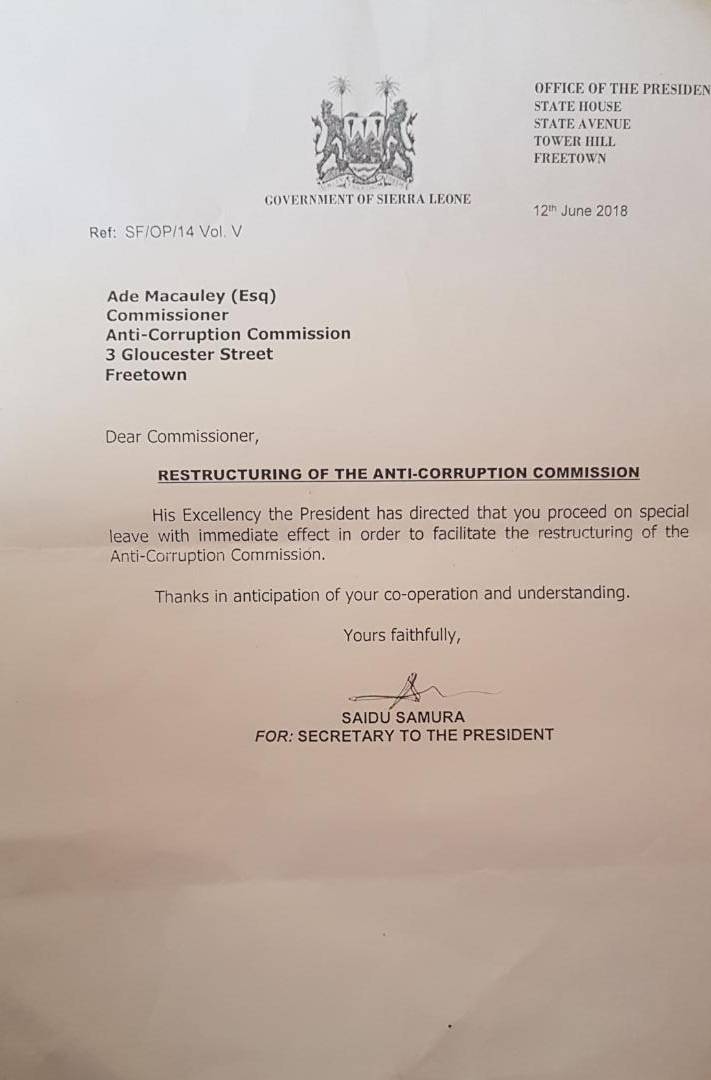
You Are Reorganized! Sierra Leone President Bio’s Ingenious Way of Firing the Anticorruption Commissioner

Leaders fearful that a corruption investigation is closing in on them or colleagues have Sierra Leone President Julius Maada Bio to thank for coming up with a most ingenious to rid himself of the pesky head of his nation’s anticorruption agency.  While the anticorruption law bars presidents from summarily firing the anticorruption commissioner, requiring first a tribunal to find him or her unfit to serve and then two-thirds of the parliament to agree, President Bio neatly cut through this cumbersome red tape with the following missive his aid sent Anticorruption Commissioner Ade Macauley —   Restructuring letter

Continue reading

The Disease of Corruption: How Distrust in Corrupt Governments Impacts Emergency Health Delivery

Corruption negatively impacts health outcomes. As noted in a previous post, corruption is associated with higher infant, child, and maternal mortality, overall poor health, the spread of antibiotic resistance, and many other problems. When we consider the reasons why corruption undermines health, the most obvious include things like theft or diversion of healthcare resources, or how demands for extra “informal” payments to healthcare providers can deprive poor communities of adequate care. There is, however, another important mechanism through which corruption undermines public health: corruption undermines trust in government and government-run services, which in turn can hinder effective health delivery and thereby escalate the spread of infectious diseases, especially in emergency situations like the recent Ebola crisis. Continue reading

Trust in Government and Public Health: Corruption and Ebola Revisited

A little while back I did a short post expressing skepticism about some claims that corruption was a significant contributor to the Ebola outbreak in West Africa. I agree that insofar as corruption diverts resources from public health and sanitation, or leads to undersupply of necessary medicines and supplies, it is likely to worsen both the frequency and magnitude of public health problems. But I was more skeptical that there was any direct evidence that the admittedly rampant corruption in places like Liberia, Sierra Leone, and Nigeria was a major contributor to that particular public health crisis.

Last month I was fortunate enough to moderate a panel on corruption and public health at the World Bank’s International Corruption Hunters Alliance meeting, and the presentations at that panel have altered my thinking about this issue somewhat. More generally, several of the presenters from countries hit hard by Ebola — including Commissioner Joseph Kamara of Sierra Leone’s Anti-Corruption Commission and Commissioner Aba Hamilton-Dolo of the Liberian Anti-Corruption Commission — made a convincing case that corruption has been, if not a primary cause, then at least a significant contributor to the extent and severity of the Ebola outbreak. Of course, there is still relatively little direct evidence, and it’s reasonable to wonder whether commissioners on anti-corruption commissions may be likely to overestimate the significance of their particular issue area for the most pressing immediate crisis facing their nations. Nonetheless, they did make a plausible case that corruption, while perhaps not a direct contributor to the outbreak, has significantly impeded the response.

On this point, Commissioner Hamilton-Dolo emphasized an important argument that I hadn’t really paid enough attention to, even though I quoted Professor Taryn Vian making essentially the same point in my earlier post: in addition to the squandering of public health resources, corruption may also impede the effective response to public health crises by undermining trust in government. The argument, as I understand it, goes something like this: Continue reading