Road Quality Guarantees in Nigeria: An Anticorruption Approach Off the Beaten Path

To say it is hard to get around in Nigeria is an understatement. Only about 30% of Nigeria’s roads are paved. And even the paved roads are in terrible condition, with crater-sized potholes, stagnant pools of water, floods of waste, and disintegrating tarmac. Everyday commuters, who often sit in traffic for up to five hours daily, regard Nigeria’s roads as “death traps,” “deplorable,” and “dilapidated.” The low quality of Nigeria’s roads not only increases insecurity but also poses a major impediment to economic progress.

The poor quality of roads is not the result of insufficient funding allocated for road construction. Indeed, the Nigerian government has spent enormous amounts of money on road construction projects (approximately $922.2 million just last year). If this money was going where it was supposed to go, Nigeria’s roads should at least be decent. But the money is not going where it’s supposed to go. Very often construction firms bribe public officials to secure road contracts, and then the firms recoup the loss of the bribe by using low quality materials and substandard construction methods, resulting in roads that do not last even up to seven years. In some cases, contractors simply pocket the government money and disappear, abandoning their projects but simply pocket the government money and disappear. To take an especially high profile example of how massive road projects can be tainted by suspicions of corruption, a recent $13 billion highway project, commenced by President Tinubu in May 2024, was awarded—with no regard for a public bidding process—to a company of whose subsidiary Tinubu’s son is a director. In fact, Tinubu’s son owned an offshore company with the son of the tycoon who received the contract. (In 2000, that tycoon was convicted of money laundering and helping the Abacha regime siphon at least $120 million from the Central Bank of Nigeria.) This road project has been criticized for its lack of transparency, alleged fraud, and risk of noncompletion.

In short, corruption is one of the most significant reasons for Nigeria’s terrible road system. But the most effective way to improve road quality in Nigeria is to focus not directly on the corruption—even though that is the root cause of the problem. Of course, corrupt acts, in this context and others, should be caught and punished. But, rather than relying primarily on detecting and punishing corruption, the more effective way to address this problem would be to establish effective mechanisms to hold contractors and public officials accountable for the quality of the roads that are ultimately built. Enforcing performance standards will reduce incentives to engage in corruption—at least the sorts of corruption that have a significant adverse impact on quality.

Continue reading
Corruption on the Northeast Corridor: Addressing Bribery in Amtrak Procurement

Under the 2021 Bipartisan Infrastructure Law (BIL), the US federal government plans to allocate upwards of $550 billion to giving America’s infrastructure a much-needed facelift. About one-fifth of these funds have been pledged for public transportation improvements. Few agencies stand to receive more money than Amtrak, which has heralded its $66 billion cash infusion as ushering in “a new era of rail.” The BIL promises to provide sufficient capital to guarantee faster and more reliable rail service in the nation’s congested Northeast Corridor. Amtrak’s track record of project mismanagement, however, raises serious questions as to whether it can execute its vision. Poor financial planning has undoubtedly contributed to Amtrak’s inability to provide service on par with its Asian and Western European counterparts. Yet there is another factor that has that has been overlooked in discussions about Amtrak’s middling quality. In recent years, the agency has been rocked by multiple bribery scandals that have inflated costs and delayed projects. For example, this past March, federal prosecutors charged a contractor with bribing an Amtrak employee to inflate the costs of repairs to Philadelphia’s 30th Street Station—a project whose costs nearly doubled before its completion. A similar corruption scheme resulted in the conviction of a Delaware-based contractor in 2021. More generally, a 2023 report from Amtrak’s internal watchdog, the Office of Inspector General (OIG), estimated that nearly 10% of all infrastructure spending by the railroad could be lost to corruption.

Given the huge infusion of federal grant money under the BIL, it is especially important that the US government gets serious right now about rooting out what appears to be an alarming culture of corruption at Amtrak: Continue reading

How Open Data Will Prevent Corruption in Ukraine Reconstruction

Ukraine is creating the world’s most transparent system for the procurement of public works. To assure citizens and donors that the billions needed to reconstruct the nation’s infrastructure will be wisely and honestly spent, it has developed DREAM, the Digital Restoration EcoSystem for Accountable Management. DREAM will provide citizens, investors, and donors access to microlevel data on every single reconstruction project — from the initial feasibility study through the procurement process to the completion of construction.

Analysis of DREAM data will show when bills of quantity are unbalanced, when bids were likely collusively prepared, and suggest if not reveal other signs of project-level corruption.  Analysis of DREAM data across all procurements will disclose if cost estimates vary too much from the bid price and the final price, suspicious patterns in initial versus actual completion date, variation orders, or subcontracting, and similar indicators of possible weaknesses in the procurement and oversight of projects.

In a talk next week I will recommend the Ukrainian government use DREAM data to conduct the analyses listed below. Surely there are more I am missing. Comments/additions welcome.

Continue reading

New Podcast Episode, Featuring Mihaly Fazekas

A new episode of KickBack: The Global Anticorruption Podcast is now available. In the new episode, my ICRN colleagues Nils Kobis and Christopher Starke interview Mihaly Fazekas, Assistant Professor of Public Policy at the Central European University. Professor Fazekas explains how he became interested in the study of corruption and describes some of his lines of research, including his work on measurement of corruption, particularly in the context of public procurement, and the challenges of scaling up the best corruption measures. The interview also covers additional topics such as the role of investigative journalism in fighting corruption, and the anticorruption potential impact of new technologies, including big data analysis and artificial intelligence.

You can also find both this episode and an archive of prior episodes at the following locations:

A quick note: We will be going on summer break, so we will not be releasing any new episodes over the next six weeks, but KickBack will return with new episodes in September. KickBack is a collaborative effort between GAB and the Interdisciplinary Corruption Research Network (ICRN). If you like it, please subscribe/follow, and tell all your friends! And if you have suggestions for voices you’d like to hear on the podcast, just send me a message and let me know.

Highway Robbery: Preventing Corruption in U.S. Infrastructure Investment

Last November, President Biden signed into law the Infrastructure Investment and Jobs Act (IIJA), a $1.2 trillion package that earmarks $110 billion for repairing and rebuilding roads and bridges. This is the single largest investment in U.S. roads and bridges since the construction of the interstate highway system in the mid twentieth century. And though it is a federal project, much of the money will be distributed to state governments, which will determine how best to use the money to address their infrastructure needs. As state governments receive the IIJA money, we can expect the states to launch a public tender frenzy.

In all the extensive discussion and debate over the IIJA, there has been relatively little focus on the corruption risks inherent in this sort of spending program—even in an affluent, reasonably well-governed country like the United States. After all, corruption in large construction projects, and infrastructure projects like roadbuilding in particular, is all too common. Unfortunately, the IIJA’s design exacerbates rather than reduces these corruption risks. While it is too late to address those flaws in the statute, there are some measures that the federal government can and should adopt now to mitigate the inherent corruption risks. Continue reading

Guest Post: Ensuring Integrity in U.S. Infrastructure Spending

Today’s guest post is from Shruti Shah, the President and CEO of the Coalition for Integrity (C4I), and Taylor Cerwinski, a consultant for C4I on various anticorruption and ethics issues.

The biggest item on the U.S. Congress’s legislative agenda right now is infrastructure. Last month, the Senate voted to pass a $1 trillion infrastructure bill focused on surface infrastructure and broadband projects, including $550 billion in funding for new projects. That bill is set for a House vote on Thursday, though the politics are complicated by the debates within the Democratic Party over the proposed $3.5 trillion federal budget bill that includes investment in “human infrastructure” via support of child care, education, healthcare, and other projects. While all eyes on Washington are focused on whether the Democrats will be able to hold together their progressive and centrist wings to pass both of these bills, there’s another important concern regarding the proposed infrastructure investment that ought to receive attention: the need for more effective oversight of how the money is spent.

While strong infrastructure is vital to ensure a healthy economy and thriving communities, the scope, complexity, and cost of the proposed infrastructure projects make it vital to ensure that there is clear and robust oversight, so that these projects are carried out in a fiscally responsible manner. Without such oversight, there is a substantial risk that infrastructure projects at the federal and state level will fall victim to waste, fraud and other abuses. Internationally, estimates of losses to bribery in construction are as high as 10 to 30 percent of construction costs. And the United States is not impervious to mismanagement and corruption in infrastructure projects. A review of prior high-profile projects such as the California High Speed train, the Central Artery Project in Boston (The Big Dig), and the awarding of contracts related to disaster relief and clean-up efforts in the aftermath of Katrina reveals cost overruns, fraud, and incidents of bribery and other forms of public corruption.

The infrastructure bill now pending before the House incorporates several measures to combat potential corruption. These include requirements that federal agencies award grants on a competitive basis, regularly publish reports on the implementation of grant programs, and fund oversight functions. While a good start, these measures do not go far enough. Assuming the infrastructure bill passes, agencies must—through implementing regulations and actual practice—go further to ensure transparency, accountability, and integrity in infrastructure spending. As a new Coalition for Integrity’s report on Oversight of Infrastructure Spending, there are a number of useful measures that would be helpful, including the following: Continue reading

What the Odebrecht Case Teaches

The anticorruption community owes the American Economic Association and Nicolás Campos, Eduardo Engel, Ronald D. Fischer, and Alexander Galetovic a debt of gratitude. The AEA for publishing their article “The Ways of Corruption in Infrastructure: Lessons from the Odebrecht Case” and making it available free to non-members (here). The four Chilean scholars for showing how much can be learned when a command of the literature on corruption is coupled with a careful, painstaking study of a single case.

In 2016, the Brazilian engineering and construction company Odebrecht admitted in a settlement with American, Brazilian, and Swiss authorities (here) to bribing 600 officials in 12 states either to secure contracts to build roads, powerplants, and other large infrastructure projects or to agree to raise the contract price during construction of the project. Information the authors pieced together from the settlement documents show the company grossed $3.3 billion in profits from paying $788 million in bribes.  These numbers confirm the obvious: the returns from infrastructure corruption are enormous, and significant resources should be devoted to preventing it.

Digging deeper into the massive amount of paper the several prosecutions of Odebrecht and its executives have generated, the authors report other findings that are not so obvious.

Continue reading

How the European Union Can Work with China To Advance Anticorruption Goals in the Western Balkans and Beyond

The European Union has traditionally imposed strict anticorruption rules for its lending and development projects. In the Western Balkans in particular, the EU’s Western Balkans Investment Framework attaches transparency and anticorruption conditions to EU investments. Moreover, the EU has made clear that progress on anticorruption reform is a main requirement for attaining EU membership, a core goal of all countries in the region. The EU’s approach, however, is under increasing pressure given competition from China, which has steadily ramped up its investment in Southeastern Europe—especially in the energy, transport, and telecommunications sectors—via its Belt and Road Initiative (BRI). China is willing to invest heavily in the region (largely via loans) without attaching any anticorruption conditions. This approach can be more appealing to many of the region’s (corrupt) public officials, who would like to build infrastructure quickly and under less scrutiny.

Because of competition from China and its demonstrated negative effects on local anticorruption efforts, the EU needs to reevaluate its approach. While last year the EU published a strategic outlook paper labeling China a “systemic rival” and toughened its overall approach to the country, the EU should actively pursue more cooperation with China when it comes to investment in Southeastern Europe. This does not mean that the EU should relax its strict anticorruption and governance conditionalities. The EU still retains considerable leverage in the region, and can and should continue to use this leverage to push an anticorruption agenda. But the EU’s efforts would be more effective if the EU directly engaged with China on this topic. Indeed, the EU may even be able to work with Chinese companies in ways that raise the latter’s integrity standards and safeguards. Continue reading

Corruption Risks in Infrastructure Projects Using Design-Build Contracts

For over a decade, state and local governments in the United States have been moving to streamline the procurement of roads, bridges, and other public works.  Traditionally, they contracted with one firm to design the project, and then, through competitive bidding, let a contract to a second firm to build it. For many projects, public authorities are now replacing this design-bid-build method of contracting with the design-build method of contracting.  One contract is awarded, competitively, to a single firm both to design and to build the facility.

Design-build contracts offer several advantages over a design-bid-build contract.  Three are most important for public procurements. One, accountability is centralized. Whereas if a problem arises during construction of a design-bid-build project, the builder can claim the fault lies not with it but with the firm that designed the project, there is no one else to blame in a design-build contract.  Two, design-build contracts are usually fixed-price, meaning the price is set before work begins.  With a design-bid-build contract, the cost varies both with the amount of materials used and as a result of problems arising during construction.  Finally, design-build projects take less time to complete.  With design-bid-build, no work begins until after the design is finished.  With design-build, preliminary construction work – clearing the site, levelling the terrain – can begin while the project is being designed.

These advantages have not been lost on less developed nations and donor organizations.  The number and size of public infrastructure projects the World Bank, the Asian Development Bank, and the other development banks are financing that use design-build are on the rise.  According to its 2018 Annual Review of Procurement Activities, the largest contract the European Bank for Reconstruction and Development funded in 2017 was a € 274 million design-build contract for an ore enrichment project in Kazakhstan.

But donors and developing countries should not ignore the major disadvantage of design-build contracts compared to design-bid-build contracts: corruption.  Blame for what many consider the most egregious public corruption scandal in American history has been attributed to the abuses that arose from a design-build contract, and indeed, corruption concerns spurred the United States to replace design-build contracts for public works with the more transparent contracting method today known as design-bid-build. Continue reading

The Consequences of Zero Tolerance

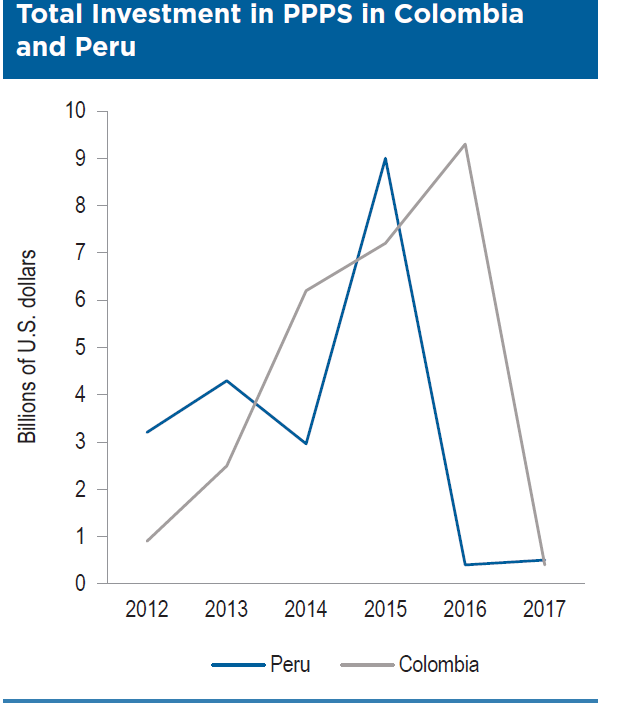
The chart above shows what happens when policy is based on a slogan. In this case “Zero Tolerance.” Procurement rules in both Peru and Colombia require that any public contract tainted by corruption be terminated immediately. As the Brazilian investigation into construction giant Odebrecht unfolded, it became clear that many projects to build highways, power plants, and other infrastructure projects in the two countries had been corruptly awarded.  Authorities in both countries then did what the law told them they must: cancel the contracts.

Most large infrastructure contracts in Peru and Colombia are in the form of Public-Private Partnerships (PPPs), and the immediate termination of a PPP can be enormously costly.  Not only to the firms that paid bribes to secure the contract, but to lenders, suppliers, and the hundreds of other contractors on the project who had no knowledge or involvement in the bribery scheme.  The greatest costs are likely be felt by the citizens of Colombia and Peru.  For as the chart shows, the consequence of zero tolerance is a halt to new spending for roads, power, and other essential facilities as investors and project developers shy away from the risk future contracts will be terminated for the tiniest of infractions by anyone associated with the project.   

Colombians and Peruvians may today be proud their governments are so tough on corruption neither one will tolerate a speck of it in any contract for infrastructure.  Tomorrow citizens of the two countries may have a different view: when power shortages mean the lights won’t come on and the failure to build new roads and maintain old ones produces horrendous traffic jams.  

Last week the World Bank hosted a presentation by Inter-American Development Bank staff where the issue of why “zero tolerance” is a good slogan but a bad policy was examined and means for addressing infrastructure corruption without producing the results shown in the chart was discussed.  A paper the IDB presenters recently published, the source of the figure above and the basis of their presentation, is here.   A video of the session here.