Guest Post: For Whose Benefit? Reframing Beneficial Ownership Disclosure Around User Needs

GAB is pleased to publish this post summarizing a recent paper on beneficial ownership disclosure by Anton Moiseienko (Research Fellow) and Tom Keatinge (Director) of the London-based Centre for Financial Crime and Security Studies at the Royal United Services Institute.  In the paper, the authors examine current standards governing disclosure of beneficial ownership data, the challenges of ensuring the data’s accuracy, and the needs and interests of the data’s different users. It will be of particular interest to American policymakers given enactment of the Corporate Transparency Act.

Beneficial ownership disclosure – the collection and sharing of information on genuine (rather than formal or nominee) owners of assets – has become a central issue in the fight against corruption and other financial crimes. To whom to disclose it can be controversial, as the very public spat between the United Kingdom, and several of its Overseas Territories shows. Moreover, even countries committed to full public disclosure face challenges in ensuring implementation meets promise as continuing discussions among EU member states shows.  

Arguments over the extent of disclosure and verification can obscure an equally important issue, ensuring the ownership data meets the needs of domestic and foreign law enforcement agencies, tax authorities, regulated businesses, and the public at large. In our paper, we examine not only to whom the information should be provided and how to guarantee it is accurate but how to be sure what is collected and disclosed serves the interests of different types of users. It is based on a review of publicly available sources and over 40 interviews, including more than 25 with experts based in British Overseas Territories and Crown Dependencies, jurisdictions where the lack of information on beneficial ownership has been a major concern internationally.

Continue reading

This Year, Let’s All Resist the Temptation to Emphasize Changes in Individual Country’s CPI Scores!

Later this week (if I’m not mistaken, a couple of days from today) Transparency International (TI) will publish its annual Corruption Perceptions Index (CPI), together with some press materials and additional discussions. And if this year is like previous years, many media outlets — and TI itself — will make much of how individual countries’ scores and rankings have changed from the previous year. Often these discussions will be situated into some narrative (usually along the lines of, “Country X’s anticorruption efforts are failing, as we can tell from its declining score”). In fact, sometimes politicians and activists will point to their country’s score changes as evidence on the question whether they are making progress on the fight against corruption.

This comparison of annual CPI scores for individual countries is, with vanishingly few exceptions, a pointless, misleading, intellectually bankrupt exercise, for reasons that I’ve tried to explain pretty much every year for the last seven years. See here, here, here, here, here, here, here, and here. To be clear, I’m a fan of the CPI and will continue to defend it as a worthwhile measurement exercise, despite its flaws. And many of the folks on the TI research team who work very hard on this index are smart, serious people who are doing their best. Indeed, if you know where to look, you can sometimes find TI research documents on the CPI that include appropriate caveats. But TI’s press releases and public comments, and most of the media commentary on the CPI, continue to treat individual changes in each country’s score as some kind of meaningful indicator.

This year, I’m going to try something new. Instead of waiting until after the CPI is published, and then sitting back in my (metaphorical) armchair in the Ivory Tower and hurling criticisms at those who portray year-to-year changes in individual countries’ CPI scores as meaningful, I’m going to try raising this issue before the CPI is published, in the hopes that this might have more of an impact in how the CPI numbers are presented, especially by the folks at TI. (And I know some of you read this blog!!!) It’s not too late! Please please please go over your press release and other materials and make sure you’re not presenting your (very important!) work as telling us anything interesting or useful about which individual counties are getting better or worse as compared to last year (or the last few years). Please please please emphasize that the CPI is not meant to be used as an indicator of policy success or failure. Please please please, at the very least, make sure that you emphasize the uncertainty (that is, the “noisiness”) of the perception estimates (which is not the same as the point that perceptions are different from reality, which TI already emphasizes), and for goodness’ sake, don’t emphasize score changes that your own data indicates are not statistically significant at conventional levels.

And in case any of you folks in the media happen to be reading this blog, you can do better too! The CPI is a great “hook” for discussing corruption-related issues in your country, but you do your readers a disservice if you cover the CPI as if it’s a league table, or try to construct a narrative around random noise.

(Oh, by the way, all of the above exhortations are premised on the validity of my critique of year-to-year country CPI comparisons. If anyone out there thinks that critique is misguided, I would also welcome a substantive rebuttal. I’m not going to restate all the elements of my critique here; anyone who is interested can click on the links above and read my posts from previous years.)

Let’s see if this preemptive strike is any more successful than past years’ after-the-fact criticisms…

The Decline of Small Newspapers Means Higher Risk of Local Corruption in the U.S.

There is widespread consensus that a free, objective press plays an important role in fighting corruption and holding public officials accountable (see here, here, and here). That’s why, when countries with high levels of public corruption seek to silence investigative journalists or shutter unbiased news outlets, anticorruption organizations like Transparency International are vocal in their opposition. It’s a bit surprising, then, that so little has been said about how the decline of small newspapers in the United States has increased the risk of local corruption.

The decline of small newspapers in the United States has been precipitous. Between 2004 and 2018, there was a net loss of nearly 1,800 papers, over 1,000 of which had circulations under 5,000. Today, around half of all counties in the United States only have one local newspaper, often circulating only on a weekly basis, while nearly 200 counties don’t have a single newspaper—resulting in “news deserts,” defined as communities “with limited access to the sort of credible and comprehensive news and information that feeds democracy at the grassroots levels.” Furthermore, in many of the small- and medium-circulation outlets that remain, newsrooms have been gutted, often due to layoffs imposed by their parent companies. For example, Digital First Media, a publisher that owns more than 50 newspapers, has eliminated two-thirds of all newspaper staff since 2011.  Between 2001 and 2016, employment in the U.S. newspaper industry decreased by more than 50%.

The decline of small newspapers is just one component of a shifting media landscape in the United States. Some of the other trends, like the rise of social media and the proliferation of unverified and sometimes apocryphal online new sources, have been at the center of political discourse. The decline of small newspapers, on the other hand, is often lamented as a regrettable casualty of changing times, but there isn’t enough appreciation of the fact that the decline of small newspapers poses a risk of increased local corruption. Continue reading

A Lesson in Democracy? The Bitter Irony of Malaysia’s Failed Anticorruption Coalition

The tools of democracy may combat tyranny, but they do not always combat corruption. That’s not to suggest that democratic values run counter to anticorruption efforts. Indeed, a free press and a competitive multi-party system remain powerful tools in ensuring corruption does not take root. However, once corruption has snaked its way throughout a government, democratic values and institutions may be too easily manipulated to fight corruption effectively. Perhaps no world leader illustrates this seeming paradox better than Malaysia’s Mahathir Mohamad, who served as Prime Minister twice. His long first tenure, from 1981 to 2003, earned him notoriety as a near-dictator whose autocratic regime contributed to a deeply-rooted culture of corruption and cronyism. During his short-lived second tenure from 2018 to 2020, Mahathir was heralded as a champion of democracy—but the liberal democratic pillars that he had suppressed during his first tenure, most notably genuine political competition and a free press, contributed to the failure of his anticorruption efforts and ultimately to the fall of his government. The bitter irony is that the suppression of both political competition and press freedom helped to create Malaysia’s entrenched corruption during Mahathir’s first tenure, while the flourishing of political competition and the free press contributed to the failure of Malaysia’s attempts to root out this entrenched corruption during his second tenure.

Continue reading

The Trump Administration and Corruption: A Preliminary Retrospective

As of yesterday at 12 noon, U.S. East Coast Time, Donald Trump is no longer the President of the United States of America.

First, let’s all breathe a collective sigh of relief.

OK, now we can start thinking about what we’ve learned from this traumatic experience. There is no shortage of political and cultural commentary on the Trump era and its implications, and I have little of substance to add to that general discussion. But, given that this is a blog specifically focused on corruption, let me offer a few reflections on the implications of the last four years for corruption and anticorruption in the United States.

At the risk of self-indulgence, I’ll frame this preliminary discussion in terms of my own guesses, as of four years ago, about how the Trump Administration would affect U.S. corruption and anticorruption policy. Immediately after Trump’s election, I wrote a despondent post about why I thought that Trump’s election would be a disaster for the fight against corruption on many different dimensions. Roughly a year later, I did a follow-up post assessing my own predictions, concluding that on some issues my pessimistic forecasts proved inaccurate (for reasons I did my best to assess), while on other dimensions the Trump administration was as bad or worse than I had feared. Now that Trump is finally out of office, it’s a good time for another retrospective assessment—both to understand where things stand now with respect to U.S. policy and leadership on anticorruption issues, and also to see what lessons we might be able to draw from the experience of the past four years. Continue reading

Kleptocracy Strikes Mongolia? Further Reply from Batbold’s Advisor

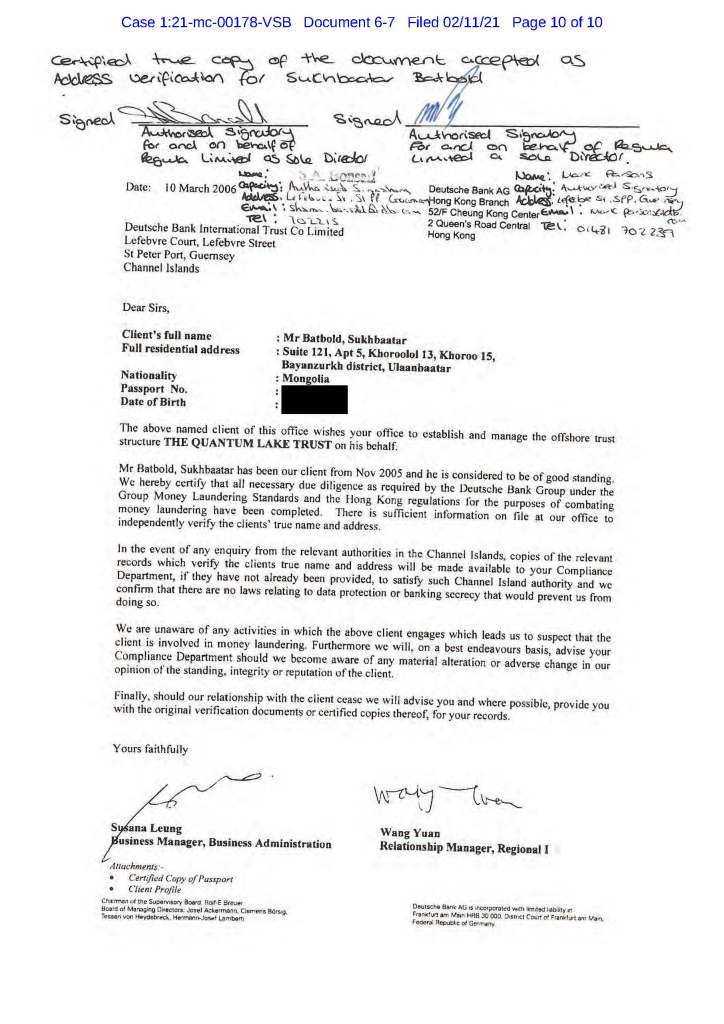
Faithful readers know that last December 8 GAB reported on a New York case alleging that while in office former Mongolian Prime Minister Sukhbaatar Batbold conspired with a South Korean couple to embezzle hundreds of millions of dollars from his government.  Brought by three Mongolian government agencies, the complaint seeks to prevent the sale of two New York condominiums the agencies say are registered in the couple’s name but beneficially owned by Batbold until a case in Mongolia is resolved. In that case, the three agencies plus the Metropolitan Prosecutor’s Office ask that Batbold, the Korean couple, and others compensate the government for the damages it suffered from their corrupt acts.

The December 8 post and a second one December 23 drew a considerable number of comments. About half said the charges were fabricated and half said it was about time Batbold was held accountable.  But none addressed the facts alleged. It was only on January 5 GAB received any substantive comment on the charges — in the form of a letter from Batbold advisor Batbayar Sh. He there denied Batbold had done anything wrong, asserted the Mongolian case was politically motivated, and asked that the posts be taken down. Although Batbayar claimed the two posts were riddled with errors, as GAB explained in its January 6 post reprinting his letter, he identified no inaccuracies in either the December 8 or December 23 post.

Batbayar has now sent a second letter. It again denies Batbold has done anything wrong and, unlike the earlier letter, adds some facts to back up the denial. The text of this second letter along with GAB’s comments on the points it raises follows.

Continue reading

New Podcast Episode, Featuring Lola Adekanye

A new episode of KickBack: The Global Anticorruption Podcast is now available. In this week’s episode, my collaborators Nils Köbis and Christopher Starke interview Lola Adekanye, a Nigerian-American lawyer who currently leads the Business Integrity and Anti-Corruption Programs in Africa at the Center for International Private Enterprise (CIPE).

After discussing her own background and how she began working on anticorruption issues, Ms. Adekanye describes the work that CIPE does at the intersection of the private and public sector, including the advocacy of market-oriented reforms to drive up the cost of corruption and drive down the cost of compliance. More concretely, she describes some concrete anticorruption initiatives that CIPE has worked on, including the Ethics First initiative in Africa, which seeks to make due diligence screening and verification in Africa more feasible and effective. CIPE’s guidance to companies as to how to deal with bribery by firm employees emphasizes what Ms. Adekanye calls the the “three Rs”: (1) Giving firm employees clear and realistic instructions on how they should RESPOND to requests for bribes; (2) Ensuring that the compliance department RECORDs the bribe request and reports it to a higher level; and (3) REPORTING bribe requests to governments and business organizations, to provide a clearer picture of how bribery is distorting markets, lowering government revenue, and undermining government projects.

You can find the episode here. You can also find this episode and an archive of prior episodes at the following locations:

KickBack is a collaborative effort between GAB and the ICRN. If you like it, please subscribe/follow, and tell all your friends! And if you have suggestions for voices you’d like to hear on the podcast, just send me a message and let me know.

The Significance of Mexico’s Upcoming Referendum on Lifting Former Presidents’ Immunity from Prosecution

Mexican President Andrés Manuel López Obrador (commonly known as AMLO) has repeatedly assailed Mexico’s former presidents as corrupt. However, despite his attacks, AMLO has said that he does not want to pursue criminal actions against his predecessors. Therefore, AMLO raised eyebrows this past September when he called for a referendum that asks citizens to vote on the question whether “the relevant authorities should, in accordance with the applicable laws and procedures, investigate and if appropriate punish, the presumed crimes committed by former presidents,” specifically naming former presidents Enrique Peña Nieto, Carlos Salinas de Gortari, Ernesto Zedillo, Vicente Fox, and Felipe Calderón. Opponents challenged the referendum as unconstitutional, on the grounds that Mexico’s Constitution prohibits popular consultations on matters involving guarantees like the presumption of innocence and due process. However, Mexico’s Supreme Court narrowly held, by a 6-5 vote, that the referendum would be constitutional, but voted 8-3 to modify it. The Court altered the language by deleting the reference to the ex-presidents and the phrase “presumed crimes” so that the referendum now reads: “Do you agree or not that the relevant authorities should, in accordance with the constitution and legal framework, undertake a process of clearing up political decisions taken in previous years by politicians, with an aim to guaranteeing justice and the rights of possible victims?” Mexico’s lower house of Congress approved the revised referendum and set the date of the vote for August 2021. AMLO, however, wants the referendum to be held in June 2021, during Mexico’s midterm elections.

Seizing on the vagueness of the referendum and AMLO’s hostility towards his predecessors, AMLO’s opponents have attacked him for attempting to undermine the judicial system and seek political revenge by having a public vote on whether to prosecute and convict former presidents. Other critics have argued the referendum, which is both vaguely worded and non-binding, will not have any real impact, and amounts to little more than political virtue signaling intended to boost AMLO’s party in the upcoming midterm elections.

To a certain extent, I agree with the latter criticism. AMLO’s primary motivation in promoting this referendum is likely political: He wants to (re)create a positive association between his party and the fight against corruption. It’s probably not a coincidence that the push for the referendum comes at a time when one of Mexico’s biggest corruption scandals is unfolding, with former President Peña Nieto accused of taking millions of dollars in bribes from the Brazilian construction company Odebrecht. It’s probably also not a coincidence that AMLO wants to hold the referendum vote on the same day as the 2021 midterm elections. Despite having won power in a landslide in 2018, AMLO and his party are currently in political trouble. Mexico continues to face economic stagnation and high crime, and AMLO’s administration has failed to control the coronavirus. As for AMLO’s promise to rid his country of corruption—a major component of his presidential campaign—he hasn’t made much progress here either. AMLO’s anticorruption credentials have been further tarnished by a leaked video showing AMLO’s brother receiving packages of money from a government functionary that were used to strengthen AMLO’s political party ahead of the 2018 election. It seems that AMLO is attempting to divert attention from his political and policy failures by introducing a referendum that will focus attention on the corruption of prior administrations.

But just because there is a political motivation behind the referendum does not mean that the referendum won’t have a meaningful impact. It likely will, whichever way it comes out.

Continue Reading

Nigeria’s Government Assistance Programs for Small Businesses: A Gateway for Corruption

Nigeria’s Small and Medium Enterprises (SMEs) are the backbone of the country’s economy, accounting for 96% of Nigeria’s businesses, 84% of its labor force, and 48% of its GDP. SMEs also provide Nigeria’s oil-dependent economy with some important economic diversification. Nevertheless, difficulties in securing startup or operational funds, among other problems, makes starting and operating a small business in Nigeria remarkably challenging. To mitigate these difficulties, the Nigerian federal government has created an assortment of agencies to support SMEs. In addition, at least 26 of Nigeria’s 36 state governments have established at least one SME development agency or office.

Unfortunately, government funds meant to help small businesses often fail to reach their intended recipients. Instead, the government’s SME programs often function as gateways for corruption, either in the form of misallocation of resources for political patronage, or as outright embezzlement of funds. This corruption problem is well illustrated by two of the most important national-level government programs meant to support Nigerian SMEs:

continue reading

Guest Post: Time for UNCAC Mark II?

GAB welcomes back international anticorruption consultant Alan Doig, who contributes the following guest post:

The United Nations Convention against Corruption (UNCAC), which came into force in 2005 and has been ratified by 187 countries, is the oldest and most comprehensive Convention solely devoted to the prevention, detection, and investigation of corruption. Yet today UNCAC, for all of its importance, is not serving as an effective blueprint or framework for promoting innovative and effective responses to corruption. There are four main reasons for this:

  • First, perhaps due to UNCAC’s genesis in the UN Convention against Transnational Organized Crime, UNCAC is skewed too heavily toward the criminal justice aspects of anticorruption, as demonstrated by the fact that nearly 80% of UNCAC’s substantive Articles relate to law enforcement, asset recovery, and related issues.
  • Second, UNCAC left too many key terms undefined or underspecified, allowing for significant interpretation (or misinterpretation) of the Articles, and some 40% of UNCAC’s substantive Articles are non-mandatory; these factors tend to undermine the efficacy of the Convention.
  • Third, UNCAC’s review mechanism is too slow and fragmented, and fails to employ a sufficiently holistic framework that assesses performance and progress in implementation and impact.
  • Fourth, and most significant, UNCAC is not amenable to updating. This has meant that issues which were only emerging back in 2005, such as political-party funding or beneficial ownership transparency, only received limited attention. Issues that were once addressed, if at all, through ad hoc references scattered throughout the Convention are assuming more importance. The difficulty of updating the Convention derives in part from the insistence of the UN Office of Drugs and Crime (UNODC) that UNCAC may be used as a legal document suitable for treaty purposes—even though other international instruments serve similar purposes and its value as a treaty has been limited (as demonstrated by, among other things, the fact that UNCAC has been used for mutual legal assistance only 17 times in over a decade).

So, with a reboot of the existing Convention unlikely, maybe it’s time for a new Convention—an UNCAC Mark II. An UNCAC Mark II— which we might perhaps call the UN Convention on the Prevention of Corruption (UNCPC)—could provide a framework that promotes innovative, flexible, and forward-looking means to address corruption challenges, going beyond technical and compliance approaches.

The main focus of the proposed UNCPC, as the name implies, should be on mainstreaming prevention of corruption, both for its own sake and as a means toward wider objectives, such as trust in public institutions, good governance, and the rule of law. Chapters of such a convention could address, for example: risk assessment, developing strategic approaches, promoting public integrity, transparency and accountability, managing the political and partisan dimensions of public life, preventing profiting from corruption, prioritizing citizen-facing public services, and developing measurable progress and performance. In particular, and largely missing from the current Convention, a UNCPC should address the roles and expectations of a wide range of named in-country public and private sector organizations, as well as in civil society, to collectively mainstream the Convention as part of their work.

Such a Convention needn’t start from scratch. Its contents and coherence would come from synthesizing and integrating the wide range of the corruption prevention initiatives, most of which post-date UNCAC. These include, for example, the Kuala Lumpur Statement on Anti-Corruption Strategies, the international standard on anti-bribery management systems (ISO 37001), the Council of Europe’s work on public ethics, the extractive industries and other transparency initiatives, and the work of organizations like the UN Global Compact and the UNCAC Civil Society Coalition. The contents of a new Convention could also draw on the empirical evidence from GRECO reviews and Transparency International National Integrity Studies. Engaging with all these organizations, who have a stake in prevention, will foster a collective sense of ownership, and they can also take a leading role in monitoring and reviewing implementation of the Convention.

In contrast to UNCAC, this proposed new Convention should not seek global membership. Rather, the UNCPC should require both serious substantive commitments and acceptance of a rigorous whole-Convention peer-review system focused on demonstrable performance and progress. At the same time, evidence from practice on the ground will inform an equally rigorous review and revision of the Convention to ensure its relevance. The overall goal is a more comprehensive and dynamic Convention that provides a collective, mutually-supportive approach to anticorruption, one that seeks to achieve meaningful results within realistic timeframes.