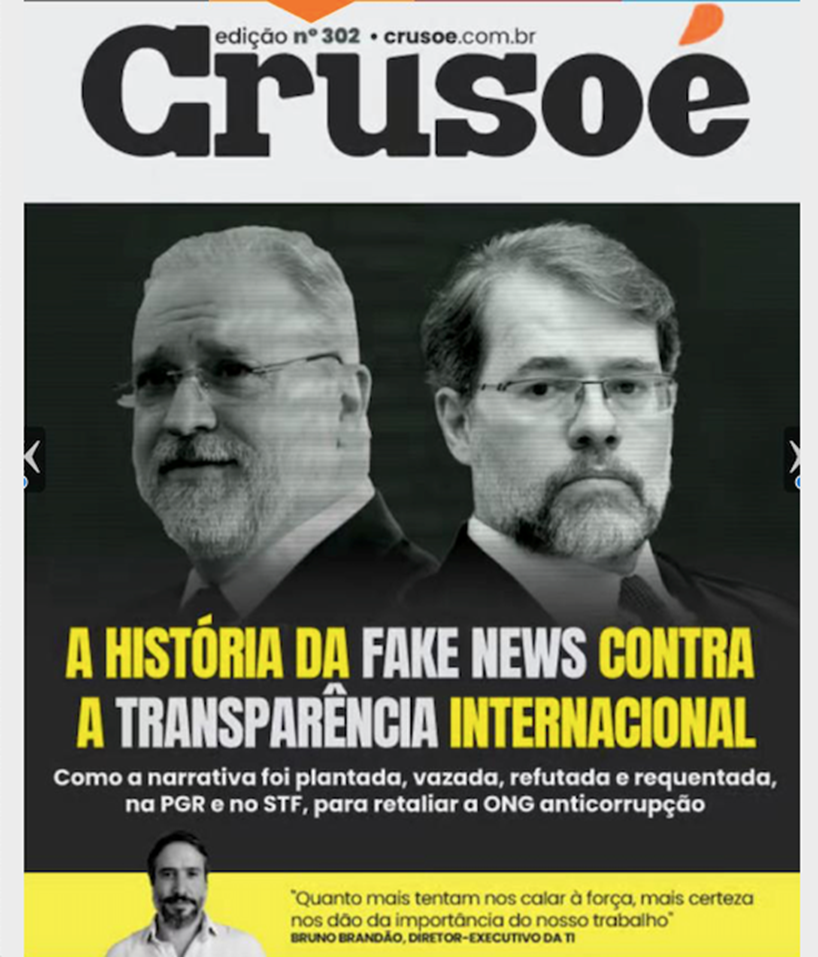
The Fake News and Corruption Behind the Criminal Investigation of Transparency International

Transparency International and its Brazilian chapter are now the subject of a criminal investigation in Brazil. As GAB readers know (here), the investigation is part of Supreme Court Justice Dias Toffoli’s crusade to reverse the convictions handed down in Lava Jato, the landmark Brazilian corruption case. The aim is to ensure defendants escape all punishment in Brazil and are protected from prosecution in the dozen other Latin American and African countries where they paid bribes.

Today’s Guest Post by a Brazilian insider reveals just how groundless the investigation of TI is and Justice Toffoli’s direct conflict of interest in letting one of the Lava Jato defendants off the hook. The author explains that it starts, as the respected Brazilian journal Crusoé explains in the headline to its February 16 issue, with “A HISTORY OF FAKE NEWS AGAINST TRANSPARENCY INTERNATIONAL: How the narrative was planted, leaked, refuted and reheated in the PGR [Federal Attorney General Office] to retaliate the anti-corruption NGO.”

Continue reading

Does Congress Really Want to Relax Corruption Controls on U.S. Arms Sales?

Today’s Guest Post is by Colby Goodman, a Senior Researcher with Transparency International US and Defence and Security. His research focuses on corruption risks within the international arms trade and other forms of defense sector corruption. 

That corruption permeates the international arms trade is no surprise to readers of Transparency International reports (here), business executives (here), or investigative reporters (here, here, and here). What is a surprise is that the U.S. House of Representatives is considering weakening the measures the U.S. government has put in place over the past decades to prevent U.S. companies from becoming entangled in corrupt dealings.

This Tuesday, February 6, the House Foreign Affairs Committee will discuss a bill to significantly decrease the number of proposed U.S. arms sales that would require congressional review before proceeding. The bill would increase the dollar threshold that require  the Defense and State Departments to notify Congress of a planned sale. It follows a US defense industry lobbying campaign to speed up the process in delivering U.S. weapons and so make their purchase more commercially attractive. But at the cost of weakening key U.S. government efforts to curb corruption in U.S. arms sales.

To its credit, in early 2023 the Biden Administration  updated the government’s Conventional Arms Transfer policy to “ensure that arms transfers do not fuel corruption or undermine good governance, while incentivizing effective, transparent, and accountable security sector governance.”  This policy followed its Countering Corruption Strategy, where  the U.S. government pledged to start “reviewing and re-evaluating criteria for government-to-government [security] assistance, including around transparency and accountability.”  These actions recognized the significant harm to U.S. national security that comes from pervasive corruption in partner countries and the need to mitigate corruption risks within the U.S. defense industry.  

Detailed below are four key critical corruption checks that would be undermined by the proposed bill.

Continue reading

Guest Post: How the Azerbaijani Government Corrupts Western Democracies with “Caviar Diplomacy”

Today’s guest post is from Aram Simonyan, a Calouste Gulbenkian Foundation Scholar at the University of Sussex.

Artsakh, or Nagorno-Karabakh, is an autonomous region primarily populated by ethnic Armenians. (That the region is part of Azerbaijan rather than Armenia is due to a 1921 decision by the USSR central government.) In 2020 Azerbaijan, with outspoken support from Turkey, gained power over notable territory in Nagorno-Karabakh. Then, in December 2022, the Azerbaijani government closed the Lachin corridor (the only land route between Nagornon-Karabakh and Armenia), thereby cutting off 120,000 ethnic Christian Armenians in the contested enclave from the outside world—and from food, medicine, and other primary goods. And in September 2023 Azerbaijani military, with the apparent support of the Turkish president, forces swept into towns and villages, killing, shelling, and bombing civilians—evoking trauma of the Armenian Genocide among the population.

Yet the reaction from the West has been shockingly muted. It’s hard to ignore the striking contrast between the round-the-clock media coverage of the Gaza conflict and the scarcity of news on Nagorno-Karabakh even when Azerbaijan was bombing Armenian hospitals, schools and beheading people. Critics have also pointed out how European institutions and Western companies have continued to do business as usual with Azerbaijan, notwithstanding its aggression.

Part of the justification for this may be that Azerbaijan helps meet the EU’s need for natural gas. (In July 2022, European Commission President Ursula von der Leyen referred to Aliyev as a “trustworthy partner” for gas supply to the EU, though since Azerbaijan imports gas from Russia, it’s not at all clear why the EU wanted to involve the Azerbaijani government in the supply chain.) But another reason is that Azerbaijan has made use of what critics have dubbed “caviar diplomacy”: the use of strategic bribery (direct and indirect) to corrupt and curry favor with Western governments and institutions. Continue reading

Guest Post: Despite Serious Flaws, U.S. Safeguards Against Political Corruption Can Serve as Model for the World

Today’s guest post is from Scott Greytak, the Director of Advocacy at Transparency International US.

As much of the world converges on Atlanta for the 10th Session of the United Nations Convention Against Corruption (UNCAC) Conference of the States Parties (CoSP), the urgent need for a renewed, reinforced, and relevant global anticorruption framework takes center stage. Among the most important issues to address concerns political finance transparency, an issue that the current version of the UNCAC does not directly cover. The United States is well-positioned to provide leadership on this issue. While U.S. laws on money in politics have failed to keep pace with America’s evolving political dynamics, aspects of these laws nevertheless can and should serve as inspirations for much of the world as it struggles with political corruption. The CoSP presents a chance for the U.S. to share its experiences and lessons learned with other countries, and to support resolutions and amendments to include commitments on political finance transparency in the UNCAC itself.

Suggesting that the U.S. can be a leader or a model on the issue of regulating money in politics may sound surprising. My colleagues and I at Transparency International US are all too aware of the many failings of American democracy, including the American approach to political finance regulation. More than in any other major developed country in the world, for example, people in the United States believe that rich people buy elections, and U.S. political finance laws are in urgent need of updating, to address persistent problems like the influence of “dark money” in elections, and the need for adequately funded public financing programs for political campaigns. But comparatively speaking, some pieces of the U.S. legal framework can serve as a useful benchmark. For instance, a survey by the Global Data Barometer Political Integrity Module and the International IDEA’s Political Finance Database revealed that of 181 countries surveyed, 100 do not have any limits whatsoever on how much money can be given to a candidate for office. In contrast, the United States has comprehensive contribution limits for candidates, political parties, and traditional political action committees (even though such limits are infamously absent when it comes to “independent” expenditure committees, or Super PACs). Emphasizing this best practice, among others, on the global stage in Atlanta could help jumpstart a much-needed exchange and collaborative approach that could raise the bar for all democratic and emerging-democratic countries.

To this end, the United States should support resolutions and amendments that require countries to enact and enforce laws that disclose campaign contributions to candidates and political parties, as well as expenditures made by those candidates and parties, in a timely and publicly accessible fashion. The U.S. can also support requirements that countries to establish and appropriately fund independent oversight bodies that monitor political spending and enforce political finance laws. The U.S. delegation can support protections for whistleblowers who call out political finance violations and can urge countries to expressly commit to sharing information, best practices, and resources in fulfillment of these commitments, and to engage with civil society closely and consistently when developing and implementing these measures.

Amidst yet another year of increasing global political unrest and accompanying anxieties, successful examples of U.S. laws can and must serve as inspirations to others. In an era of seemingly limitless challenges to democracy in all regions of the world, it is this collaboration and commitment that can fortify its foundations. A first step can and must be taken by the U.S. in Atlanta.

Guest Post: The OECD’s Report on Brazil Should Be a Wake-Up Call

Today’s guest post is from Guilherme France, the Research and Advocacy Manager at Transparency International Brazil and a PhD candidate at the Institute for Social and Political Studies at the State University of Rio de Janeiro.

The OECD Working Group on Bribery (WGB) conducts periodic reviews (in successive “phases”) on how well signatories to the OECD Convention on Preventing Bribery of Foreign Public Officials. Recently, the WGB published its Phase 4 report on Brazil. The picture it paints is rather bleak, and should be a wake-up call for Brazilian citizens and, one hopes, the Brazilian government. While the WGB also acknowledged some improvements in Brazil’s anticorruption framework (such as better inter-institutional cooperation, an increase in funding for law enforcement agencies, and efforts to enact a stronger whistleblower protections), Brazil is underperforming with respect to enforcement, and backsliding with respect to institutional independence. Continue reading

Guest Post: Corporate Transparency Is Easy

Today’s guest post is from Gary Kalman and Annalise Burkhart, who are, respectively, Executive Director and Program & Research Associate for Transparency International U.S.

Readers of this blog know well that anonymously owned companies are the go-to vehicle for laundering illicit funds. From the revelations of hidden assets exposed in the Panama Papers to the search for sanctioned assets of Russian oligarchs, anonymous corporate structures enable corrupt and criminal actors to steal, hide, launder and benefit from illicit proceeds with impunity. The anticorruption community therefore cheered when the U.S. Congress passed the Corporate Transparency Act (CTA), requiring the U.S. Treasury Department’s Financial Crimes Enforcement Network (FinCEN) to collect beneficial ownership information for U.S. companies and align with international standards.

As the Treasury Department is finalizing its rules for implementing the CTA, the law’s opponents have been engaged in a campaign of scaremongering aimed particularly at small businesses, with various memos, articles, and notices warning of a burdensome reporting process, uncertain or unclear disclosure requirements, and the risks of hefty fines and possible jail time for business owners who might inadvertently fail to file the appropriate information.

These claims are exaggerated, inaccurate, and misleading. Instead of providing helpful guidance to small businesses, these alarmists are stoking fear among business owners, likely to mobilize political opposition to the effective implementation of the CTA. Here are the facts: Continue reading

Guest Post: Forcing States to Grant Corruption Victims Legal Standing

Today’s guest post is by Carlos G. Guerrero Orozco, a Mexican litigation lawyer and partner at López Melih y Estrada Abogados. He chairs the non-profit Derechos Humanos y Litigio Estratégico Mexicano and heads the International Database Taskforce at the Working Group on Victims of Corruption of the UNCAC Coalition.

Corruption is what social scientists call a “wicked problem,” one extraordinarily difficult to solve because of its complex and interconnected nature. Governments thus need all the help they can muster to tackle it. But too many sideline a critical ally, those harmed by corruption.

Corruption’s victims are many and their injuries diverse. Journalists threatened, and too frequently murdered, for revealing corrupt schemes. Whistleblowers attacked for denouncing corruption. Citizens injured or killed when corruptly constructed buildings collapse; those denied access to education, health care, and fair courts thanks to bribery, embezzlement, and other corruption crimes.

All are victims and all have real claims for damages and strong incentives for joining with governments to fight corruption.

Continue reading

Guest Post: The Brazilian Supreme Court’s Erroneous Nullification of the Car Wash Evidence

Today’s guest post is from Eduardo Carvalho, a Brazilian prosecutor from the State of Rio de Janeiro.

There has been a great deal of commentary in the Brazilian and global anticorruption community – including on this blog (see here, here, and here) – on a recent decision by Supreme Court Justice Dias Toffoli concerning important evidence on which Brazilian prosecutors relied in securing numerous convictions in the so-called Lava Jato (Car Wash) Operation. The evidence in question—principally files stored on computer disks—was obtained from the Odebrecht company as part of settlement agreements with Brazilian, Swiss, and US authorities. Justice Toffoli, expanding on a previous ruling by Justice Lewandowski, found that this evidence was obtained in violation of Brazilian laws on international cooperation and evidence handling, and therefore could not be used in court. As a result, an enormous number of Car Wash convictions are likely to be nullified. From an anticorruption perspective, this is a disaster, undoing years of hard work and allowing scores, perhaps hundreds, of corrupt politicians to go free.

But according to Adonis Brozoza’s post last week on this blog, the responsibility for this lies with the prosecutors, not the Justices. Mr. Brozoza argues that the prosecutors, in their zeal to secure corruption convictions, ignored relevant laws and procedures on international cooperation and evidence handling. This sloppiness, he maintains, so compromised the reliability of this crucial evidence that the Justices were obligated, under the relevant Brazilian laws, to rule this evidence inadmissible.

Respectfully, this assertion is both legally questionable and factually incorrect. While I do not impugn the good faith of either the Justices or Mr.Brozoza, careful attention to the relevant laws, and to what the relevant authorities actually did, demonstrates that Justice Toffoli’s ruling ought to be overturned by the full Court. Continue reading

Guest Post: A Proposal for an Online Practical Politics Platform

Today’s guest post is from Peter Evans, who recently stepped down as Director of the U4 Anticorruption Resource Centre, and who previously led the Anti-Corruption Evidence (ACE) program at the UK’s Department for International Development.

All too often, approaches to anticorruption reform—like mainstream approaches to growth, development and governance more generally—frame the issue as a technical problem. In development agencies, multilateral organizations, and civil society organizations working on corruption issues, it is not uncommon to hear people say, “We don’t do politics,” or to mention politics only in the context of blaming the failure of a project, or non-receptiveness to technically sound advice, on a “lack of political will.” But as Stefan Dercon emphasized in his influential recent book Gambling on Development: Why Some Countries Win and Others Lose, understanding and addressing development challenges requires engaging seriously with the political economy constraints and opportunities related to power and elites. While Dercon’s book is not about corruption specifically, it is chock-full of corruption examples. And, in fairness, an increasing number of anticorruption specialists have gotten the message that “technical only” approaches often fail, and that making real progress often requires us to understand, and be brave enough to talk about, politics—and in particular the way power is distributed and used in the relevant country or sector.

But while recognizing that politics matters—and that serious anticorruption work requires serious political economy analysis—is a necessary first step, actually putting this idea into practice turns out to be hard, even for people who want to do it—because political economy analysis is hard, and much of the available information is obscure, difficult to locate, or difficult for busy practitioners to digest. Some country- and sector-specific political economy research is published, though not all of it is written in an accessible way. And some research that is highly relevant to political economy analysis doesn’t include terms in the title or abstract that would make its relevance obvious to a busy professional trying to find useful information. Some agencies pay consultants to deliver bespoke political economy analysis, or build skills through training courses, but the utility of these efforts may be limited to that particular agency. SOAS ACE takes an explicit political economy framed approach to understanding and tackling corruption, and there have been a few efforts to provide more general information, such as the U4 Centre’s a workstream on the politics of anticorruption and the UK-based Governance and Social Development Resource Centre, but global coverage of relevant political economy research remains patchy.

To address this problem, I advocate the creation of a “Practical Politics Platform” where good quality, clearly explained political economy research is collected, curated, and presented in a form that is easy to search and freely available as a public good. It would be something like Our World in Data, but for practical political economy research. (To be clear, while corruption and anticorruption would be an important element of such a platform, the platform should more broadly integrate research on related issues, such as accountability, transparency, and public sector governance.) To increase user-friendliness, the platform could include clickable maps that allow users to focus on a country, and disaggregate the information, if desired, by sector and sub-unit. Continue reading

Guest Post: The Odebrecht Ruling and Prosecutorial Transparency in Brazil–A Rejoinder

Two weeks ago, we published a guest post is from Professor Gregory Michener and Breno Cerqueira, based on an op-ed they had originally published (in Portuguese) in the Folha de São Paulo newspaper, concerning an important decision last by Justice Toffoli of the Brazilian Supreme Court. That decision nullified the evidence that Brazilian prosecutors had acquired from the Odebrecht firm as part of the agreement to settle the corruption charges against that firm; Justice Toffoli’s decision thus called into question ever subsequent corruption conviction that had relied on this evidence. That guest post prompted a response, which we published last week, from a Brazilian lawyer who took issue with many of the assertions that Professor Michener and Mr. Cerqueira had made in their piece. (The author of that post asked to remain anonymous. While GAB does not usually publish anonymous pieces, after considering the reasons for the anonymity request, I decided to grant it in that case.) Today’s guest post is from Professor Michener and Mr. Cerqueira, who offer a rebuttal to last week’s criticisms of their piece.

I realize that some readers may find this a bit excessive, especially since the issues here involve some fine technical points of Brazilian law. But in my view the issues are so important—going to the heart of one of the largest and most important anticorruption investigations in the world over the last decade (the “Car Wash” Operation)—and the legal issues are sufficiently difficult even for attentive outsiders to understand, that a thorough debate about what the most recent decision does and does not mean, that this exchange serves a useful purpose. I am grateful to all the parties involved for being willing to engage in this important conversation..

Without further adieu, here is Professor Michener and Mr. Cerqueira’s rebuttal to the criticism of their post on Justice Toffoli’s ruling:

The Odebrecht case spanned twelve countries and involved nearly a billion dollars of elaborate payments made from Odebrecht’s in-house bribery department to corrupt governments on three continents. (Perhaps the best way to understand the case is through the documents posted with the US Department of Justice press release about the settlement of the US Foreign Corrupt Practices Act charges in the case.)

The primary objective of our editorial was to discuss the deficient transparency of corruption cases in Brazil, an understudied aspect of corruption that should be of concern to citizens everywhere. Transparency of corruption cases can assign responsibility and promote accountability, deter graft among businesses and public officials, identify institutional weaknesses that need to be fixed and, perhaps most importantly, provide an important historical archive to keep the record straight – not only of crimes committed but of retributive government efforts in favor of the public interest. In the case of Brazil, we argued, a lack of transparency worked in favor of corruption and impunity, which is currently on the upswing.

We find it ironic that the critic of our article, a Brazilian lawyer (“Anonymous”), would ask for anonymity if his or her critiques were squarely fair handed and factual. (As an aside, anonymity is illegal as per the Brazilian Constitution (Article 5 IV – “the expression of thought is free, and anonymity is forbidden”). As a leading anticorruption specialist and friend commented on the Anonymous post a day after it appeared, it attempts to “muddy the waters.” Rather than “setting the record straight” it simply creates doubt where little should exist. The following explains why: Continue reading