In Mexico, Justice Will Remain a Family Matter

Judicial corruption in Mexico is a pervasive problem. And while high-level scandals tend to grab the headlines (see, for example, here, here, and here), much of the corruption is more pedestrian. While the causes of Mexico’s judicial corruption problem are various and complex, one persistent contributing factor is the endemic nepotism throughout the judiciary.

Of the more than 50 types of position in the judicial branch (including both judgeships and various administrative positions), only two—federal circuit and district court judgeships—use a competitive merit-based hiring process. For the rest, judges can choose whom they please, with little oversight. Moreover, once hired, these individuals have an insurmountable advantage in promotion in the judiciary, given that most job postings (and, informally, judgeships) require that the candidate have previous experience in the judicial branch. And even with respect to circuit and district judgeships, which are supposed to be filled through an open and merit-based competitive selection process run by a body called the Federal Judicial Council (CJF), in practice the CJF often creates “special” vacancies with different criteria (in effect, lower standards).

As a result of all this, nepotism in judicial hiring and promotion is pervasive, as judges are able to secure positions for friends and family. At least 51% of Mexico’s judges and magistrates are related to someone else working in the judiciary, with that number as high as 80% in some states. (To take one particularly egregious but not totally anomalous example, in one judge’s chambers, 17 employees were related to the judge.) This nepotism is not only corrupt in itself, but it also contributes to other forms of corruption. For one thing, corrupt judges can appoint those who will participate in, or at least be complicit in, corrupt practices—in some cases appointing individuals recommended by organized crime groups. But even when such deliberate wrongdoing is not the issue, untrained or unprofessional judicial bureaucrats and judges are more susceptible to corruption, and more likely to create the kinds of delays and inefficiencies in the system that both invite and obscure corrupt actions.

There hadn’t been much appetite in the Mexican Government to address the judicial nepotism problem until reform-minded President Andrés Manuel López Obrador and Chief Justice Arturo Zaldívar took office. Since February 2020, both men have been enthusiastically lobbying for a judicial reform package deemed the most ambitious since 1994. This bill, overwhelmingly passed by the Mexican Senate and Chamber of Deputies in recent months, is a behemoth, with a variety of significant structural changes to the judicial branch. Among these many reforms are several measures designed, at least in part, to address the problem of judicial nepotism: Continue reading

The Emoluments Clause Cases Against Donald Trump: A Post Mortem

Of the many credible corruption and conflict-of-interest allegations against former President Donald Trump, some of the most prominent concerned the income that the Trump Organization earned from parties with interests in influencing U.S. government policy. While the general conflict-of-interest rules that cover most federal officials do not apply to the President, a subset of the Trump Organization’s business dealings—in particular, those involving foreign governments and state governments—at least arguably violated the U.S. Constitution’s two so-called “Emoluments Clauses. (The Foreign Emoluments Clause prohibits any U.S. official from receiving gifts, titles, or “emoluments” from foreign governments, while the Domestic Emoluments Clause prohibits the President in particular from receiving any benefits other than his official salary from federal, state, or local governments.) President Trump’s alleged violations of the Emoluments Clauses triggered three separate lawsuits, filed by different parties in different federal courts, within Trump’s first six months in office. Those cases gradually wound their way through the legal system, with some defeats and some victories, mainly on threshold legal questions.

Last week, the U.S. Supreme Court brought that whole process to a halt, dismissing petitions for review in two of those pending cases as moot. (The third case had been dismissed by an appeals court, and the Supreme Court declined to review that case last fall.) Thought the Court’s terse, unsigned order included no explanation, the obvious inference is that the Court determined that the Emoluments Clause suits were moot because Donald Trump is no longer President. Importantly, the Court’s mootness order means not only that these suits won’t proceed, but also that the previous legal rulings in the cases under review are vacated, and thus have no precedential value. Legally speaking, it’s as if the cases never happened.

This did not sit well with everyone. Former head of the Office on Government Ethics Walter Shaub described the Court’s dismissal of the cases as “insane,” arguing that the cases are “not moot” because Trump “still has the money.” “When any other federal employee violates the emoluments clause,” Shaub observed, “they have to forfeit the money.” Others involved in the litigation against Trump tried to look on the bright side. The Citizens for Responsibility and Ethics in Washington (CREW), for example, issued a statement noting that the Emoluments Clause litigation “made the American people aware for four years of the pervasive corruption that came from a president … taking benefits and payments from foreign and domestic governments.”

I’ve been trying to figure out what I think about all this. I don’t have a clear, clean bottom line, but I do have a few scattered thoughts about what we might take away from the denouement of the Emoluments Clause controversy. Continue reading

Checked or Choked? How the Congressional Response to the Abscam Investigation Undermined the FBI’s Ability to Root Out High-Level Corruption

On February 2nd, 1980, the FBI announced the results of a massive sting operation, codenamed “Abscam,” conducted against members of the U.S. Congress. At the time, this was the largest FBI political corruption operation ever conducted: two years in the making, involving over a hundred agents and hundreds of thousands of dollars in operating costs. The details of the operation were so outlandish they sound like they could have been lifted from a Hollywood movie. The FBI recruited an international con artist named Melvin Weinberg for “creative direction” of the operation, and then had agents pose as wealthy Arab sheiks (hence the name of the operation, a contraction of “Arab scam” or “Abdul scam”) that came a-calling to Capitol Hill to purchase favors and votes. The operation took place on Key West yachts and in Atlantic City casinos, in limousines and on chartered jets, where the “sheiks” lured politicians to glitzy affairs with offers of $50,000 for a favorable licensing deal or immigration waiver. They had astonishing success. Not only were the approached targets receptive, several actively recruited other elected officials to the bribery scheme. Congressmen were caught on tape accepting paper lunch bags stuffed with cash, paired with made-for-movie dialogue such as: “Money talks in this business,” “I’m no Boy Scout,” and “I got larceny in my blood. I’ll take [the bribe] in a goddamn minute.” Weinberg and the FBI reckoned that the sting easily might have nabbed a great deal more Congressmen if the FBI hadn’t run out of bribe money and the press hadn’t scored an early scoop. What followed was a flurry of resignations, hearings, and criminal trials. After the dust settled, six representatives and one senator had been convicted of bribery and conspiracy. Despite controversy over the ethics of the FBI’s methods, every conviction was upheld on appeal.

The fact that these convictions stuck is a reflection of the fact that although the undercover FBI agents involved in Abscam got very close to the line that separates legal deception from unlawful entrapment, the FBI had been scrupulous about staying on the right side of that line: all tapes were immediately reviewed to ensure that agents had not improperly induced wrongdoing; the cash transfers were witnessed and monitored by Justice Department attorneys; and judges signed warrants and sanctioned the FBI’s methods. Nevertheless, Congress—perhaps unsurprisingly—thought that the FBI had gone too far. At hearings before House Subcommittee on Civil and Constitutional Rights and the Senate Select Committee to Study Undercover Activities, Members of Congress aired grievances over FBI undercover procedures, and argued that while undercover investigations could be valuable, the FBI had gone too far, and had engaged in a wildly inappropriate exploratory fishing expedition.

Now, Congress’s actions may not have been purely self-serving. A few years prior to Abscam, a Senate select committee, known as the Church Committee, revealed significant FBI abuses, documented in a whopping fourteen reports that laid out intelligence agency abuses in extraordinary detail. Some suggest—controversially—that Abscam was the FBI’s retaliation against Congress for this public excoriation.

Whatever Congress’s motives, in the decade following Abscam, Congress circled the wagons, pressuring the Department of Justice to implement internal reforms by way of proffering dramatic legislative packages staunchly opposed by Attorneys General. The “compromise” result was a series of restrictive guidelines for undercover and sting operations, guidelines that effectively bar the FBI from ever again conducting an operation similar to Abscam.

Continue reading

This Year, Let’s All Resist the Temptation to Emphasize Changes in Individual Country’s CPI Scores!

Later this week (if I’m not mistaken, a couple of days from today) Transparency International (TI) will publish its annual Corruption Perceptions Index (CPI), together with some press materials and additional discussions. And if this year is like previous years, many media outlets — and TI itself — will make much of how individual countries’ scores and rankings have changed from the previous year. Often these discussions will be situated into some narrative (usually along the lines of, “Country X’s anticorruption efforts are failing, as we can tell from its declining score”). In fact, sometimes politicians and activists will point to their country’s score changes as evidence on the question whether they are making progress on the fight against corruption.

This comparison of annual CPI scores for individual countries is, with vanishingly few exceptions, a pointless, misleading, intellectually bankrupt exercise, for reasons that I’ve tried to explain pretty much every year for the last seven years. See here, here, here, here, here, here, here, and here. To be clear, I’m a fan of the CPI and will continue to defend it as a worthwhile measurement exercise, despite its flaws. And many of the folks on the TI research team who work very hard on this index are smart, serious people who are doing their best. Indeed, if you know where to look, you can sometimes find TI research documents on the CPI that include appropriate caveats. But TI’s press releases and public comments, and most of the media commentary on the CPI, continue to treat individual changes in each country’s score as some kind of meaningful indicator.

This year, I’m going to try something new. Instead of waiting until after the CPI is published, and then sitting back in my (metaphorical) armchair in the Ivory Tower and hurling criticisms at those who portray year-to-year changes in individual countries’ CPI scores as meaningful, I’m going to try raising this issue before the CPI is published, in the hopes that this might have more of an impact in how the CPI numbers are presented, especially by the folks at TI. (And I know some of you read this blog!!!) It’s not too late! Please please please go over your press release and other materials and make sure you’re not presenting your (very important!) work as telling us anything interesting or useful about which individual counties are getting better or worse as compared to last year (or the last few years). Please please please emphasize that the CPI is not meant to be used as an indicator of policy success or failure. Please please please, at the very least, make sure that you emphasize the uncertainty (that is, the “noisiness”) of the perception estimates (which is not the same as the point that perceptions are different from reality, which TI already emphasizes), and for goodness’ sake, don’t emphasize score changes that your own data indicates are not statistically significant at conventional levels.

And in case any of you folks in the media happen to be reading this blog, you can do better too! The CPI is a great “hook” for discussing corruption-related issues in your country, but you do your readers a disservice if you cover the CPI as if it’s a league table, or try to construct a narrative around random noise.

(Oh, by the way, all of the above exhortations are premised on the validity of my critique of year-to-year country CPI comparisons. If anyone out there thinks that critique is misguided, I would also welcome a substantive rebuttal. I’m not going to restate all the elements of my critique here; anyone who is interested can click on the links above and read my posts from previous years.)

Let’s see if this preemptive strike is any more successful than past years’ after-the-fact criticisms…
The Decline of Small Newspapers Means Higher Risk of Local Corruption in the U.S.

There is widespread consensus that a free, objective press plays an important role in fighting corruption and holding public officials accountable (see here, here, and here). That’s why, when countries with high levels of public corruption seek to silence investigative journalists or shutter unbiased news outlets, anticorruption organizations like Transparency International are vocal in their opposition. It’s a bit surprising, then, that so little has been said about how the decline of small newspapers in the United States has increased the risk of local corruption.

The decline of small newspapers in the United States has been precipitous. Between 2004 and 2018, there was a net loss of nearly 1,800 papers, over 1,000 of which had circulations under 5,000. Today, around half of all counties in the United States only have one local newspaper, often circulating only on a weekly basis, while nearly 200 counties don’t have a single newspaper—resulting in “news deserts,” defined as communities “with limited access to the sort of credible and comprehensive news and information that feeds democracy at the grassroots levels.” Furthermore, in many of the small- and medium-circulation outlets that remain, newsrooms have been gutted, often due to layoffs imposed by their parent companies. For example, Digital First Media, a publisher that owns more than 50 newspapers, has eliminated two-thirds of all newspaper staff since 2011.  Between 2001 and 2016, employment in the U.S. newspaper industry decreased by more than 50%.

The decline of small newspapers is just one component of a shifting media landscape in the United States. Some of the other trends, like the rise of social media and the proliferation of unverified and sometimes apocryphal online new sources, have been at the center of political discourse. The decline of small newspapers, on the other hand, is often lamented as a regrettable casualty of changing times, but there isn’t enough appreciation of the fact that the decline of small newspapers poses a risk of increased local corruption. Continue reading

A Lesson in Democracy? The Bitter Irony of Malaysia’s Failed Anticorruption Coalition

The tools of democracy may combat tyranny, but they do not always combat corruption. That’s not to suggest that democratic values run counter to anticorruption efforts. Indeed, a free press and a competitive multi-party system remain powerful tools in ensuring corruption does not take root. However, once corruption has snaked its way throughout a government, democratic values and institutions may be too easily manipulated to fight corruption effectively. Perhaps no world leader illustrates this seeming paradox better than Malaysia’s Mahathir Mohamad, who served as Prime Minister twice. His long first tenure, from 1981 to 2003, earned him notoriety as a near-dictator whose autocratic regime contributed to a deeply-rooted culture of corruption and cronyism. During his short-lived second tenure from 2018 to 2020, Mahathir was heralded as a champion of democracy—but the liberal democratic pillars that he had suppressed during his first tenure, most notably genuine political competition and a free press, contributed to the failure of his anticorruption efforts and ultimately to the fall of his government. The bitter irony is that the suppression of both political competition and press freedom helped to create Malaysia’s entrenched corruption during Mahathir’s first tenure, while the flourishing of political competition and the free press contributed to the failure of Malaysia’s attempts to root out this entrenched corruption during his second tenure.

Continue reading

The Trump Administration and Corruption: A Preliminary Retrospective

As of yesterday at 12 noon, U.S. East Coast Time, Donald Trump is no longer the President of the United States of America.

First, let’s all breathe a collective sigh of relief.

OK, now we can start thinking about what we’ve learned from this traumatic experience. There is no shortage of political and cultural commentary on the Trump era and its implications, and I have little of substance to add to that general discussion. But, given that this is a blog specifically focused on corruption, let me offer a few reflections on the implications of the last four years for corruption and anticorruption in the United States.

At the risk of self-indulgence, I’ll frame this preliminary discussion in terms of my own guesses, as of four years ago, about how the Trump Administration would affect U.S. corruption and anticorruption policy. Immediately after Trump’s election, I wrote a despondent post about why I thought that Trump’s election would be a disaster for the fight against corruption on many different dimensions. Roughly a year later, I did a follow-up post assessing my own predictions, concluding that on some issues my pessimistic forecasts proved inaccurate (for reasons I did my best to assess), while on other dimensions the Trump administration was as bad or worse than I had feared. Now that Trump is finally out of office, it’s a good time for another retrospective assessment—both to understand where things stand now with respect to U.S. policy and leadership on anticorruption issues, and also to see what lessons we might be able to draw from the experience of the past four years. Continue reading

Kleptocracy Strikes Mongolia? Further Reply from Batbold’s Advisor

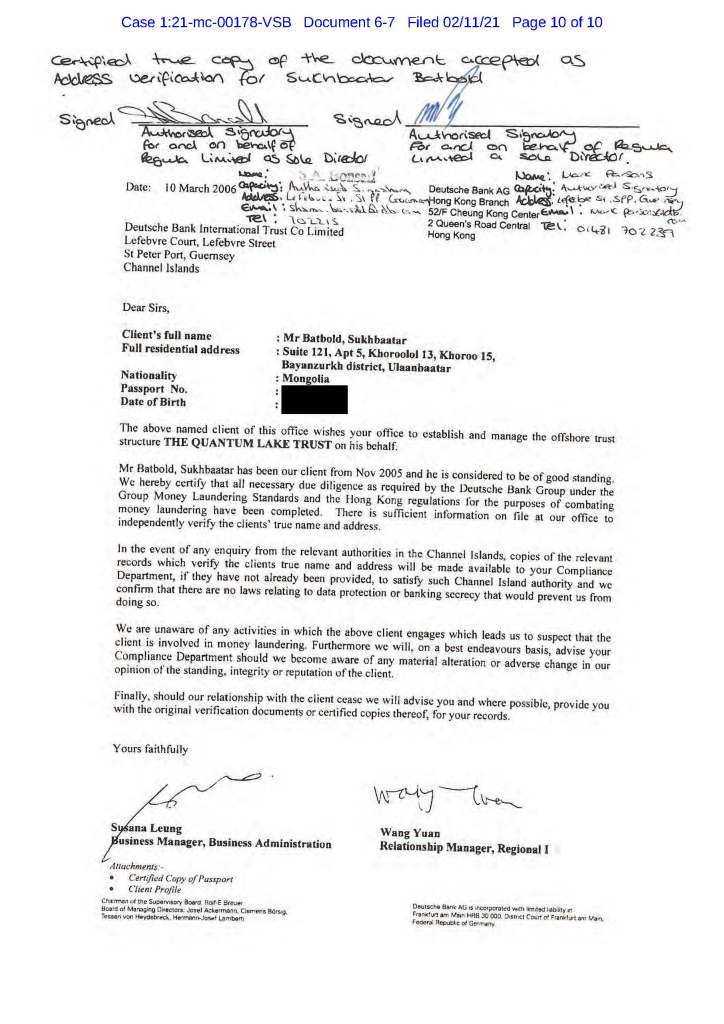
Faithful readers know that last December 8 GAB reported on a New York case alleging that while in office former Mongolian Prime Minister Sukhbaatar Batbold conspired with a South Korean couple to embezzle hundreds of millions of dollars from his government.  Brought by three Mongolian government agencies, the complaint seeks to prevent the sale of two New York condominiums the agencies say are registered in the couple’s name but beneficially owned by Batbold until a case in Mongolia is resolved. In that case, the three agencies plus the Metropolitan Prosecutor’s Office ask that Batbold, the Korean couple, and others compensate the government for the damages it suffered from their corrupt acts.

The December 8 post and a second one December 23 drew a considerable number of comments. About half said the charges were fabricated and half said it was about time Batbold was held accountable.  But none addressed the facts alleged. It was only on January 5 GAB received any substantive comment on the charges — in the form of a letter from Batbold advisor Batbayar Sh. He there denied Batbold had done anything wrong, asserted the Mongolian case was politically motivated, and asked that the posts be taken down. Although Batbayar claimed the two posts were riddled with errors, as GAB explained in its January 6 post reprinting his letter, he identified no inaccuracies in either the December 8 or December 23 post.

Batbayar has now sent a second letter. It again denies Batbold has done anything wrong and, unlike the earlier letter, adds some facts to back up the denial. The text of this second letter along with GAB’s comments on the points it raises follows.

Continue reading

The Significance of Mexico’s Upcoming Referendum on Lifting Former Presidents’ Immunity from Prosecution

Mexican President Andrés Manuel López Obrador (commonly known as AMLO) has repeatedly assailed Mexico’s former presidents as corrupt. However, despite his attacks, AMLO has said that he does not want to pursue criminal actions against his predecessors. Therefore, AMLO raised eyebrows this past September when he called for a referendum that asks citizens to vote on the question whether “the relevant authorities should, in accordance with the applicable laws and procedures, investigate and if appropriate punish, the presumed crimes committed by former presidents,” specifically naming former presidents Enrique Peña Nieto, Carlos Salinas de Gortari, Ernesto Zedillo, Vicente Fox, and Felipe Calderón. Opponents challenged the referendum as unconstitutional, on the grounds that Mexico’s Constitution prohibits popular consultations on matters involving guarantees like the presumption of innocence and due process. However, Mexico’s Supreme Court narrowly held, by a 6-5 vote, that the referendum would be constitutional, but voted 8-3 to modify it. The Court altered the language by deleting the reference to the ex-presidents and the phrase “presumed crimes” so that the referendum now reads: “Do you agree or not that the relevant authorities should, in accordance with the constitution and legal framework, undertake a process of clearing up political decisions taken in previous years by politicians, with an aim to guaranteeing justice and the rights of possible victims?” Mexico’s lower house of Congress approved the revised referendum and set the date of the vote for August 2021. AMLO, however, wants the referendum to be held in June 2021, during Mexico’s midterm elections.

Seizing on the vagueness of the referendum and AMLO’s hostility towards his predecessors, AMLO’s opponents have attacked him for attempting to undermine the judicial system and seek political revenge by having a public vote on whether to prosecute and convict former presidents. Other critics have argued the referendum, which is both vaguely worded and non-binding, will not have any real impact, and amounts to little more than political virtue signaling intended to boost AMLO’s party in the upcoming midterm elections.

To a certain extent, I agree with the latter criticism. AMLO’s primary motivation in promoting this referendum is likely political: He wants to (re)create a positive association between his party and the fight against corruption. It’s probably not a coincidence that the push for the referendum comes at a time when one of Mexico’s biggest corruption scandals is unfolding, with former President Peña Nieto accused of taking millions of dollars in bribes from the Brazilian construction company Odebrecht. It’s probably also not a coincidence that AMLO wants to hold the referendum vote on the same day as the 2021 midterm elections. Despite having won power in a landslide in 2018, AMLO and his party are currently in political trouble. Mexico continues to face economic stagnation and high crime, and AMLO’s administration has failed to control the coronavirus. As for AMLO’s promise to rid his country of corruption—a major component of his presidential campaign—he hasn’t made much progress here either. AMLO’s anticorruption credentials have been further tarnished by a leaked video showing AMLO’s brother receiving packages of money from a government functionary that were used to strengthen AMLO’s political party ahead of the 2018 election. It seems that AMLO is attempting to divert attention from his political and policy failures by introducing a referendum that will focus attention on the corruption of prior administrations.

But just because there is a political motivation behind the referendum does not mean that the referendum won’t have a meaningful impact. It likely will, whichever way it comes out.

Continue Reading

Nigeria’s Government Assistance Programs for Small Businesses: A Gateway for Corruption

Nigeria’s Small and Medium Enterprises (SMEs) are the backbone of the country’s economy, accounting for 96% of Nigeria’s businesses, 84% of its labor force, and 48% of its GDP. SMEs also provide Nigeria’s oil-dependent economy with some important economic diversification. Nevertheless, difficulties in securing startup or operational funds, among other problems, makes starting and operating a small business in Nigeria remarkably challenging. To mitigate these difficulties, the Nigerian federal government has created an assortment of agencies to support SMEs. In addition, at least 26 of Nigeria’s 36 state governments have established at least one SME development agency or office.

Unfortunately, government funds meant to help small businesses often fail to reach their intended recipients. Instead, the government’s SME programs often function as gateways for corruption, either in the form of misallocation of resources for political patronage, or as outright embezzlement of funds. This corruption problem is well illustrated by two of the most important national-level government programs meant to support Nigerian SMEs:

continue reading