A Mandatory Reporting Requirement in Israel: Maybe Not a Lost Hope?

In my last post, I discussed and critiqued a proposal, advanced in a policy paper published by the Israel Democracy Institute (IDI), for a mandatory reporting requirement in Israel’s public sector. Under the IDI paper’s proposal, a public official who, acting in his or her official capacity, formed a “substantial suspicion” that corruption has taken place or will take place could face disciplinary sanctions for failing to report this suspected corruption “as soon as possible.” I criticized this proposal on the grounds that it would both discourage reporting in those cases where a potential whistleblower is reluctant to report right away and so delays for a period of time, and would also deter employees from cooperating with investigators by sharing relevant information that they had not previously disclosed. In both of these cases—the employee who didn’t report right away but might be willing to report later, and the employee who didn’t voluntarily report but might be willing to share information when questioned by investigators—the threat of disciplinary sanctions for failure to report immediately may actually induce employees to keep silent, especially since the chances they will be caught and punished if they never reveal what they suspected are generally quite low. Instead of imposing a mandatory reporting requirement, I argued, Israel (and similarly situated countries) should strengthen positive incentives for whistleblowers, offering them more generous rewards and more effective protections against retaliation.

While many readers broadly agreed with my critique of the IDI paper’s mandatory reporting proposal in its current form, several colleagues suggested that a modified version of the mandatory reporting requirement might be effective and appropriate. In this post, I consider what seem to me the most plausible and promising revisions to the original IDI proposal, and evaluate whether these modifications would overcome my principal critiques: Continue reading

Why Do So Few Corruption Victims Seek Compensation?

The United Nations Convention Against Corruption requires state parties to open their courts to those damaged by corruption.  Under article 35, states that have ratified UNCAC must provide victims of corruption a right to “initiate legal proceedings against those responsible for that damage … to obtain compensation.” According to the United Nations Office on Drugs and Crime, virtually all 187 states parties do. Its 2017 review of the convention’s implementation found article 35 was “one of the least problematic provisions of the entire convention.” “All but seven of the reviewed states,” it reported, “have adopted measures to fully or partly implement article 35.”

The UNODC’s conclusion comes from a reading of the parties’ laws.  While only a handful of states have enacted special legislation governing recovery of damages for corruption, in the remainder national authorities assured UNODC that corruption victims could recover damages “under the general principles of civil (contract or tort) law.”  But research by UNODC, the UNCAC Civil Society Coalition, Transparency International, and surveys of practitioners belies these assurances. It finds that in most nations few if any corruption victims have sought damages for injuries suffered.

For a UNODC/Stolen Asset Recovery Initiative project, I seek answers to two questions.  One, is the research correct? Are there really only a few cases where corruption victims have been awarded damages?  My preliminary analyses of U.S. data shows only some 30 arising from public, as opposed to private, corruption; given its size, the amount of corruption, and low barriers to suit, one would expect more. What about other states, especially larger, wealthier ones?

Two, if indeed there are few corruption damage actions in any jurisdiction, what explains the paucity? Why, despite the prevalence of corruption, the damage it has wreaked, and the worldwide attention it has drawn, have so few corruption victims sought redress. I hypothesize three factors are to blame: courts’ narrow reading of legal doctrine, especially that governing causation for harm (here); shortcomings in procedure, and in some countries the threat violent retaliation.

But these are my guesses, based largely on my experience as a lawyer in a wealthy common law jurisdiction and second hand reports from those in other nations. Readers’ thoughts and comments solicited. Cases and commentary in any language Google translate reads most welcome.

Why Mandatory Corruption Reporting Requirements May Prove Counterproductive

Whistleblowers who report on and expose illegal acts in their workplaces are invaluable to fighting corruption. In Israel, as I stressed in a previous post, the recognition of the importance of whistleblowers has led to the adoption of several (unsatisfactory) legal instruments which are designed to encourage whistleblowers to step forward. These instruments are mainly about rewarding or protecting those employees who have dared to report on illegalities despite the personal and professional risks associated with their coming forward. An important example of such a positive instrument is Israel’s Protection of Workers (Exposure of Offenses and of Harm to Integrity or to Proper Administration) Law,  which establishes a whistleblower-friendly mechanism for seeking damages from employers who engage in unlawful retaliation .

But some argue that positive incentives are insufficient. In 2019, the Israel Democracy Institute (IDI), one of the country’s leading research institutes, published a policy paper in which the authors (Professor Mordechai Kremnitzer and Yazid Ershied) argued that negative incentives—that is, the threat of sanctions for those who fail to report corruption in their workplaces—should also be employed. More specifically, the authors propose that Israel’s disciplinary law include a provision that requires any public employee who, in his or her official capacity, has formed a “substantial suspicion” that an act of corruption has taken place to report on it “as soon as possible” to a newly established governmental unit which would address corruption in the public sector. The authors claim that adoption of such a mandatory reporting requirement, if backed by the credible threat of sanctions, would increase the number of reports by public officials who observe corruption. (The sanctions recommended by the authors would be disciplinary rather than criminal, as criminal sanctions in their view would be disproportionate and consequently ineffective.)

The IDI paper is the most thorough and impressive piece written on proposals to adopt a mandatory reporting requirement on corruption in Israel. But while the authors list some good reasons for adopting such a requirement, they fail to consider how their proposal would interact with the phenomenon of “delayed reporting.” Employees are often reluctant to report suspected corruption right away, but eventually become willing to report it. In other words, for entirely understandable reasons, it often takes whistleblowers some time and contemplation before they are finally ready to report on illegalities. When one takes this fact into account, it becomes apparent that the IDI paper’s proposed mandatory reporting requirement might prove counterproductive, for two reasons: Continue reading

Principles for Victim Remediation in Foreign Bribery Cases

There is a broad consensus that foreign bribery harms the citizens and governments of developing nations. But in most cases where enforcement agencies in a “supply side” jurisdiction (that is, the home jurisdiction of the companies that paid the bribes) reach a settlement with a company accused of bribing foreign officials, the settlement does not provide for any remedial payments to the government or citizens of the “demand side” country where the bribery took place. Given the inherent difficulties in setting right the harm corruption causes, this is hardly surprising. Nevertheless, scholars and activists have increasingly called for settlement agreements between supply side enforcers and bribe-paying companies to include requirements that the companies make such remediation to the victims of the foreign bribery scheme, and some prosecutorial agencies, like the U.S. Department of Justice (DOJ) and the U.K. Serious Fraud Office (SFO), have occasionally done something along these lines. They have done so, however, only intermittently, and as an exercise of prosecutorial discretion, without any overarching policy agenda or conceptual framework.

In a recent article, I proposed a framework that could achieve more consistent outcomes and be used as a benchmark for developing best practices. I do not focus on grand designs for a private right of action for the foreign victims of corruption, or on obligations under international law. Because the action is happening on the ground, through the exercise of prosecutorial discretion in negotiating settlements, that’s where I focus. In this post, I outline the factors that enforcement agencies should take into account when deciding whether to pursue remediation in any given case. Continue reading

Let’s Talk About Monaco

Monaco, the sovereign city-state on France’s Mediterranean coast, is many things. It is the second smallest country in the world, following only Vatican City. It boasts the highest GDP per capita of any country. It is a constitutional monarchy, ruled by the same family for over 700 years. It is known for its opulent casino, expensive real estate, and swaggering F1 drivers.

It is also willfully resistant to the Council of Europe’s anticorruption transparency recommendations – or any transparency measures at all, for that matter.

Perhaps due to its small size, Monaco has flown somewhat under the radar in international corruption monitoring. The city-state doesn’t feature in Transparency International’s annual Corruption Perceptions Index, and TI’s web page for Monaco is quite blank. Despite being an international tax haven and banking center, Monaco is conspicuously missing from both the World Bank’s Doing Business rankings and the Heritage Foundation’s index of economic freedom. It’s not that Monaco is a corruption-free paradise. In the few lists in which it does appear, Monaco does not score particularly well: In the RAND Corporation’s Business Bribery Risk Assessment, for instance, Monaco ranked 72nd out of 192 jurisdictions. And a number of recent corruption scandals have involved Monaco, either directly or indirectly. Last year, for example, two brothers who ran a Monaco-based consultancy called Unaoil pleaded guilty in the United States to charges involving millions of dollars in bribes paid between 1999 and 2016. Corruption alarms were also raised in July 2019, when Monaco’s justice minister abruptly blocked term renewal for a judge leading a corruption inquiry that involved a Russian billionaire, a former Monaco justice minister, senior Monaco police officials, and others. More recently, in late November 2020, former French president Nicholas Sarkozy went on trial for attempting to bribe a French magistrate with a prestigious job in Monaco.

These incidents have largely come to light because of involvement outside of Monaco: international companies, legal battles that cross borders, and foreign politicians. Monaco itself remains something of a black box. As a 2017 report from the Council of Europe’s Group of States Against Corruption (GRECO) noted, there are no records whatsoever of criminal or disciplinary proceedings related to corruption in Monaco’s parliament. This lack of reported cases, GRECO concluded, is likely due not to an absence of corruption, but to a lack of oversight. As the report noted, Monaco has “few mechanisms to ensure satisfactory transparency of parliamentary work and consultations,” and lacks a “code of conduct that would govern, among other things, the acceptance of gifts and other benefits, the management of conflicts of interest, or relations with lobbies and other third parties seeking to influence parliamentary processes and decisions.” The GRECO report further observed that although judicial proceedings are typically public, there is a carve-out for holding court behind closed doors where public proceedings “might cause a scandal or serious inconvenience.” Cases “concerning the internal operation of courts” are also not public. In practice, there is even less transparency than the official policies would indicate, as most criminal cases are in fact dealt with in France, behind closed doors.

Without a code of conduct against corruption-related activities, with no mechanisms to provide oversight, with any corruption scandals that do occur likely to be tried in secret, and with little international attention on the issue beyond infrequent GRECO reports, Monaco can keep its corruption well hidden. Although occasional scandals might pop up around Monaco, the country makes it difficult to know the nature and extent of its corruption.

Continue reading

Fighting Corruption in Nigeria’s Forestry and Fishery Industries

Although Nigeria is known mainly for oil and gas production, Nigeria’s agriculture sector, including forestry and fisheries, now accounts for over 21% of the country’s GDP. Despite the benefits of the forestry and fisheries industries to Nigeria’s development, corruption-fueled illicit activities in these sectors threaten to destabilize local communities and damage the environment. Two areas of illicit activity are of particular concern:

Continue Reading

Kleptocracy in Mongolia: Deutsche Bank As Batbold’s Enabler

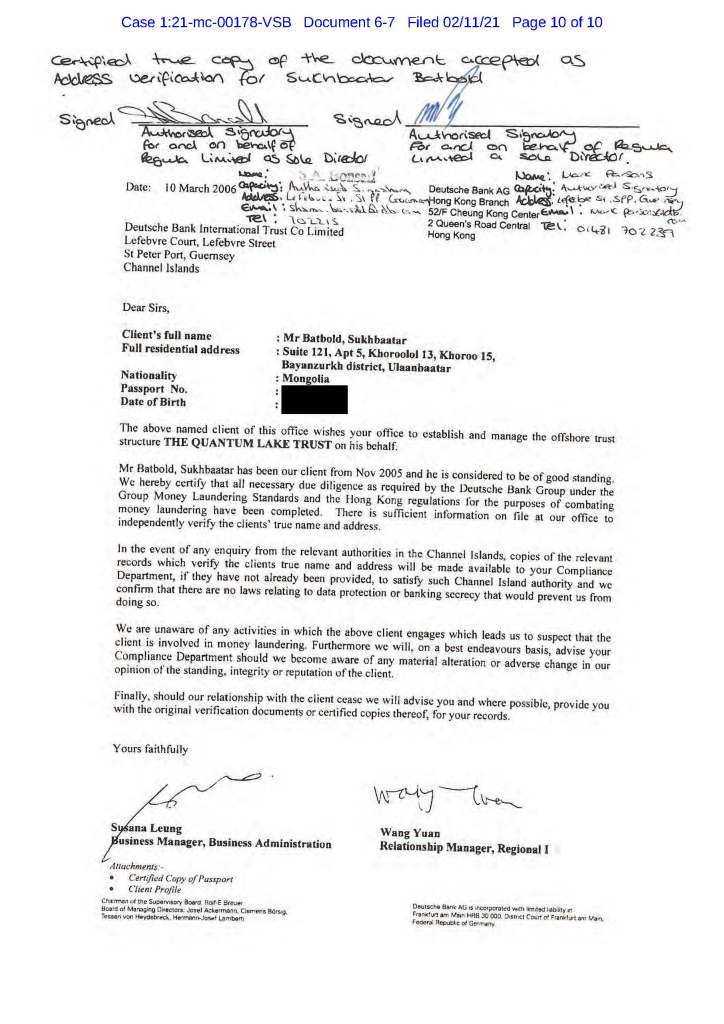
To the left is a document showing how Deutsche Bank helped Mongolian politician Sukhbaatar Batbold hide assets offshore (full-size copy here). Written by Deutsche Bank executives in Hong Kong, it asks the bank’s Guernsey Island office to “establish and manage the offshore trust structure The Quantum Lake Trust on [Batbold’s] behalf.” The authors assure their Guernsey colleagues that there no reason to be suspicious about the request:

“We are unaware of any activities in which the above client [Batbold] engages which leads us to suspect that the client is involved in money laundering.” In fact, on the day the letter was written Batbold was a Member of Parliament and between 2004 and 2006 was Cabinet Minister of Trade and Industry (here). In money laundering terms he was a “politically exposed person.” As a consequence, Deutsche Bank was required to scrutinize his past activities before creating the trust and to closely monitor all future transactions with the bank or the trust to ensure they were lawful. There is no evidence Deutsche Bank ever conducted what the money laundering law terms this “enhanced due diligence.”

Two weeks ago Batbold denied ever having “any open or hidden accounts, money, apartments or property in the offshore zone” (here), but as the letter and other documents made public last Friday show, he is at least prevaricating if not lying. He has or has had numerous accounts and properties offshore. Batbold’s representative ducked questions GAB has asked (here) about the trust and Batbold’s offshore properties, issuing a short, blanket denial reprinted below.

Continue reading

The New FCPA Resource Guide Wisely Suggests a More Flexible Approach to Successor Liability

When a company subject to the jurisdiction of the U.S. Foreign Corrupt Practices Act (FCPA) merges with or acquires another company that is also covered by the FCPA, should the former company also acquire the latter’s potential FCPA liability? In other words: Suppose Company A acquires Company B, and evidence later comes to light that prior to the acquisition, Company B’s employees paid bribes to foreign government officials, in violation of the FCPA. Can or should Company A be subject to a post-acquisition enforcement action for these earlier FCPA violations? This is known (in the FCPA context and elsewhere) as the question of “successor liability.” In U.S. law, the general rule is that successors inherit the acquired company’s civil and criminal liabilities. The U.S. Department of Justice (DOJ) and Securities and Exchange Commission (SEC), which share responsibility for enforcing the FCPA, have long argued that there is no reason to make an exception to this general rule for FCPA cases. Yet critics have argued that successor liability in the FCPA context “can kill deals.” Numerous transactions have fallen through or decreased in value because of corruption-related concerns, and other transactions became costlier due to such risks.

The DOJ and the SEC’s traditional response to such concerns—as laid out in the first edition of their FCPA Resource Guide, published in 2012—is that companies should conduct pre-acquisition due diligence to identify red flags and potentially undertake various forms of remediation. Furthermore, the agencies have stated that they might decline to pursue enforcement actions against an acquiring firm on a successor liability theory if that firm’s pre-acquisition efforts were adequate. The problem, though, is that pre-acquisition due diligence on possible FCPA violations is often difficult or impossible to conduct properly. In some cases, laws in foreign countries known as blocking statutes may prevent the acquiring firm from getting the information it needs from the target company (see, for example, here and here). More generally, there are numerous practical reasons why pre-acquisition due diligence on possible FCPA violations may not be possible, including time-sensitivity, the difficulty of accessing data stored or located in distant places, and the target company’s reluctance to cooperate with external investigations that could result in the target’s personnel facing criminal exposure. These factors can make pre-acquisition due diligence impractical.

The DOJ and SEC appear to have acknowledged and responded to that concern in the second edition of the FCPA Resource Guide, published this past July. While the second edition’s treatment of successor liability seems mostly the same as in the first edition (save for some wording adjustments and references to more recent cases), the second edition also includes one short but potentially crucial additional paragraph, which reads as follows:

DOJ and SEC also recognize that, in certain instances, robust pre-acquisition due diligence may not be possible. In such instances, DOJ and SEC will look to the timeliness and thoroughness of the acquiring company’s post-acquisition due diligence and compliance integration efforts.

Although subtle, this passage represents a potentially important shift, as it indicates that the DOJ and SEC will consider not only pre-acquisition due diligence, but also post-acquisition measures, when deciding whether to pursue enforcement actions against a company on a successor liability theory.

Continue reading

How Ethno-Religious Divisions Stymie Anticorruption Reform in Malaysia–and What to Do About It

In 2018, Malaysia surmounted the biggest test of its democracy since gaining independence from Britain in 1963—the first democratic transfer of power in the country’s history. That change in leadership occurred in the wake of the 1MDB scandal—one of the largest kleptocracy schemes ever uncovered—which implicated former Prime Minister Najib Razak. The repudiation of Najib and his party, UNMO, in the 2018 election was seen by many as a hopeful sign that the Malaysian people were no longer willing to tolerate the systemic corruption that had long been seen as business as usual. To be sure, the leader of the victorious coalition in the 2018 election—nonagenarian Mahathir Mohamed, who had previously served as Prime Minister from 1983 to 2001—was an unlikely champion of anticorruption and good governance reform. Yet in 2018, Mahathir’s victory was cause for hope that there would finally be genuine systemic reform.

Within two years, that hope had all but vanished. Prime Minister Mahathir was forced to resign in the middle of his first term in office and was replaced by UMNO politician Muhyiddin Yassin, who had served as Deputy Prime Minister under Najib. What went wrong? In an earlier post, I explored how a free press and multi-party government may have contributed to the failure of Mahathir’s coalition. But that is not the whole story. Those democratic institutions were susceptible to manipulation because of the deeply embedded ethnic and religious divisions that have been a defining feature of Malaysian politics since independence. By exacerbating racial and religious tensions, UMNO managed to convince key voting blocs that the biggest threat they faced was not corrupt politicians, but rather their neighbors who look and pray differently. In short, the reformist coalition ultimately failed because the Malaysian populace lost sight of their common enemy: the corrupt system of governance robbing them all.

Continue reading

Why Won’t Sweden Punish Swedes for Bribing Foreign Government Officials? UPDATE

Last week a Swedish appellate court issued an opinion confirming the anticorruption community’s worst fear. The decision stems from a 2017 U.S. prosecution of Swedish telecommunications giant Telia for bribing the Uzbekistan president’s daughter. The evidence showed Telia’s then CEO and two other executives countenanced the bribery, and Swedish prosecutors promptly charged the three with bribing a foreign official. To the surprise and shock of both prosecutors and observers, all three were acquitted at a 2019 trial (here).  

It was widely assumed the Stockholm Court of Appeals, the nation’s oldest and most prestigious appeals court, would reverse the trial court’s decision.  Instead, in a February 4th opinion it affirmed it.

UPDATE. Chief prosecutor Kim Andrews termed the decision “offensive,” telling OCCRP in a statement that the decision means “Swedish companies can jump queues” by bribing, that Sweden “is failing to live up to its international obligations, . . . and that we leave it up to other European countries and the United States to clean up our mess.”

Former South African MP Andrew Feinstein once asked a senior Swedish official about foreign bribery. His reply:

“All bribes are illegal but if a Swedish company paid bribes in another country, I can’t say we would do anything about it.”  

The Telia acquittal is the latest sign that this attitude continues to prevail. That the anticorruption community’s worst fear about Sweden is true. That to protect the export earnings of Swedish multinationals and to shield the Swedish elites who run them, the government will condone the bribery of foreign public officials no matter how egregious.  Indeed, the first and still most appalling example of the lengths Sweden will go to derail a foreign bribery investigation was in a case that implicated its now prime minister.

Continue reading