Guest Post: Memo to the U.S. — Central America Needs More Anticorruption and Rule of Law Support, Not Less

The Trump Administration recently decided to terminate foreign assistance to Guatemala, Honduras, and El Salvador and to abandon America’ long-standing support for the United Nations/Guatemalan commission fighting corruption in Guatemala. In today’s guest post, retired U.S. Ambassador Stephen G. McFarland explains that corrupt officials and drug lords in the region are conspiring to “capture” these nations’ governments. Their citizens are already fleeing the countries in droves. How much greater will the pressures to migrate be if a coalition of corrupt politicians and narco-trafficantes takes over one of their governments? On national interest as well as humanitarian grounds, the ambassador argues that the United States should not only restore, but increase, support for anticorruption and rule of law programs.  

The April 17 arrest of Guatemalan presidential candidate Mario Estrada and accomplice Juan Pablo Gonzalez on drug trafficking charges has major implications for U.S. policy towards Guatemala and Central America’s “Northern Triangle.”  The U.S. Department of Justice (USDOJ) asserts that in January 2019, Estrada allegedly attempted to obtain Sinaloa cartel support for the assassination of rival presidential candidates in Guatemala’s upcoming June 2019 general elections and for financing his election campaign. In return, he allegedly promised that, if elected, he would give the cartel free reign to use Guatemalan ports and airports to traffic cocaine to the U.S.

If the USDOJ’s allegations are true: Continue reading
Mozambicans To Credit Suisse: Make Good on Crooked Debt

Credit Suisse’s complicity in the $2.4 billion corruptly lent to the Mozambican government dampened festivities at its April 26 annual shareholders’ meeting.  While shareholders celebrated receipt of a fat dividend, a representative from Mozambique reminded them that some of this money comes at the expense of the citizens of Mozambique – 28 million persons, most desperately poor, saddled with repaying loans foisted off on their government through corruption.  Three senior Credit Suisse employees have been indicted for their role in the scheme, one Credit Suisse management (rewarded with a hefty pay hike at the meeting) claims cleverly circumvented its controls preventing unlawful deals.

The statement to shareholders, delivered by a representative of the civil society organization Fórum de Monitoria do Orçamento (FMO, budget monitoring forum in English), asks Credit Suisse to support restorative justice to atone for its role in the Mozambican debt crisis.  To this end, Credit Suisse is asked to: i) accept accountability for its actions in the debt issue;  ii) commit to return to Mozambique all proceeds from the Mozambican Illegal debt scandal; iii) collaborate with authorities to ensure that all responsible parties are held accountable for their roles in the scandal; iv) write off outstanding debt arising out of debt crisis; and v) help ensure the people of Mozambique do not have to make good on debts they had no part in incurring and which did nothing to benefit them.

Full text below; video here (at 2:18:50 –  2:28).

Continue reading

Will the United States Please Admit It has an Illicit Enrichment Law

United States officials have asserted for at least two decades that a law would make it a crime for a public servant to hold wealth he or she cannot show was honestly acquired would be unconstitutional. Officials say “illicit enrichment” laws reverse the burden of proof in a criminal trial, violate the presumption of innocence, and therefore infringe a criminal defendant’s right to a fair trial.  The State Department made the claim during negotiations for the 1997 Inter-American Convention Against Corruption; it surfaced most recently in a February 26 decision of the Ukrainian Constitutional Court where a majority cited the U.S. position in striking down Ukraine’s illicit enrichment statute.

The assertion is wrong. Or at best highly misleading.  Americans can be prosecuted for holding wealth greater than what their tax return shows they can afford. Like an illicit enrichment prosecution, a defendant in a tax evasion case who cannot produce evidence showing how the wealth was acquired risks conviction for a serious crime, one that today carries a fine of up to $100,000, imprisonment for five years, or both.

U.S. courts have developed a rich body of case law applying this American version of an illicit enrichment law that shows how prosecutors can convict defendants of living beyond their means without violating their fair trial rights. Prosecutors and courts in nations where illicit enrichment laws are recent additions to the statute books would find this jurisprudence instructive in obviating human rights concerns about their nations’ statute. If only they knew about it.

Would an authoritative American spokesperson please correctly state U.S. law? Or at least publicize the web site where U.S. illicit enrichment jurisprudence can be consulted? Continue reading

At Last: An UNCAC Handbook

Thanks to Oxford University Press that gaping hole in every anticorruption practitioner’s library has now been filled. With the publication of The United Nations Convention Against Corruption: A Commentary, those looking for authoritative guidance on UNCAC no longer need to sort through the voluminous literature the convention has spawned: UNODC guides, StAR publications, academic commentary, and international and municipal court decisions.  Editors Cecily Rose, Michael Kubiciel, and Oliver Landwehr have, with help from 35 other experts on international law and corruption, done the work for them.  In one volume they summarize the law and learning on each of the convention’s 71 articles.

The Commentary is much more than a digest of UNCAC’s voluminous source materials, however. Continue reading

Mozambicans Ask: Will the United Arab Emirates Enforce UNCAC?

The United Arab Emirates faces the first serious test of its commitment the United Nations Convention Against Corruption.  Will it open a case against long-time resident Jean Boustani, who the U.S. Justice Department says masterminded the bribery scheme that robbed the people of Mozambique of some $2 billion.  The “Mozambican hidden debt” scandal pitched the nation into a deep recession, depriving thousands of basic necessities and leaving government without the resources to respond to Cyclone Idai

In its latest submission in its case against Boustani, the Justice Department reveals that much of the bribery scheme was carried out in the UAE. Boustani helped one co-conspirator open an account in a UAE bank to stash bribes, facilitated the travel of others to the UAE to further the bribery scheme, and secured UAE employment permits for three under false pretenses.  Each permit, says the Justice Department, “falsely stated that the [accomplices] professions were ‘petrol engine mechanic,’ ‘diesel engine mechanic,’ and ‘hydraulic mechanic.’”  In fact, the Justice Department told the court in its filing, “all three were members of the conspiracy who would receive millions of dollars of bribes and kickbacks for their roles in the scheme.”

The Justice Department’s charges against Boustani and accomplices are here. To view the Justice Department filing describing Boustani’s alleged violations of UAE law, click on DoJ Boustani filing .  To view the e-mails and other documents that support the Department’s narrative, click on evidence of UAE offenses.

Mozambican citizens have suffered a terrible wrong, one which UNCAC is meant to right.  Will UAE authorities do their part to help right that wrong?  Will the UAE live up to its obligations under the UNODC to prosecute those who pay bribes? Those who flagrantly violate other of its laws as part of a bribery scheme?

Asset Repatriation Under UNCAC

One of the most far-reaching changes the United Nations Convention Against Corruption made to international law was the requirement that states cooperate to return assets stolen through corruption to the country where the crime was committed.  No international convention had ever before required a state where the proceeds or the instruments of the crime were found to return them to the state where the offense was committed.

The overarching principle is straightforward, but translating it into exacting, legally binding language is anything but. The drafters had to account for cases where the state requesting return and the requested state have quite different laws on transferring ownership rights by judicial decree and on the effect a decree in one state has on proceedings in another. The result is series of lengthy, complex provisions laced with a thicket of paragraphs, subparagraphs, and cross-references that may warm some lawyers’ hearts but in which many reader can easily become lost.

I mapped the provisions for a forthcoming asset return conference. As the map isn’t (at least yet!) on Google maps, a copy is below. Two experienced UNCAC guides kindly read and corrected an earlier version (thank you Queensland University Senior Lecturer Radha Ivory and Mat Tromme of the Bingham Centre for the Rule of Law).  Readers spotting any further mis-directions or errors are asked to flag them. Continue reading

To Get Serious About Asset Recovery, Get Serious About the Facts

The asset recovery provisions of the United Nations Convention Against Corruption make it one of the most consequential international agreements of the past 50 years.  Prior to UNCAC, the law of “finders keepers” applied when the proceeds of a crime committed in one state were discovered in a second.  If the second state caught thieves with a sack of cash stolen from a bank in the first state, the first state could ask that the money be returned.  But the second state had no obligation to return it.

UNCAC repeals “finders keepers” for corruption offenses.  It makes the return of assets stolen from a state party through corruption “a fundamental principle of this Convention” and obliges state parties to “afford one another the widest measure of cooperation and assistance in this regard” (article 51).  When the requesting state’s title to the assets is clear, its courts have issued a final order confiscating them, and that order has been given effect by the holding state’s courts, return is immediate (article 57(3)).  In all other cases, return is made pursuant to “mutually acceptable arrangements on a case-by-case basis” (article 57(5)).

From their first meeting in December 2006, parties to the convention have focused on how well the asset recovery provisions are working in practice.  At that meeting, they created an open-ended working group “to advise and assist” them “in the implementation of [the convention] mandate on the return of proceeds of corruption.”  At every meeting up to and including the most recent one in 2017, the parties have directed the working group to continue investigating the efficacy of the asset recovery articles with an eye on how they can be improved.  Yet at no time have the parties ordered the first and most important step in assessing their effectiveness. Continue reading

Brussels v. Bucharest: The Kövesi Case and the Future of EU Anticorruption Policy

Last week Matthew suggested that the Romanian government’s fierce opposition to Ms. Laura Cordruta Kövesi’s candidacy to head the European Public Prosecutors’ Office is a good reason why she should be chosen.  Ms. Kövesi led Romania’s anticorruption agency, the Direcţia Naţională Anticorupţie (DNA), until fired last July for what many observers believe was her refusal to back-off prosecuting senior members of the ruling party.  That her own government, one of Europe’s more corrupt, so opposes her, Matthew argued, is a sign that it knows, and fears, how effective she would be as Europe’s chief prosecutor.

In today’s guest post, Alina Mungiu-Pippidi offers a different perspective  – on why Ms. Kövesi is a candidate for the position and her government’s opposition to her selection and goes on to explain how the controversy arises from the European Union’s ham-handed intervention into Romanian politics, an intervention that has set back the country’s fight against corruption.  Professor Mungiu-Pippidi spear-headed several widely-praised anticorruption movements in Romania before becoming director of the European Research Centre for Anticorruption and State-Building and Professor at Berlin’s Hertie School of Governance. She is the author most recently of The Quest for Good Governance: How Societies Build Control of Corruption. Cambridge University Press will soon release her Europe’s Burden: Promoting Good Governance across Borders.

The Western media obsessed over Laura Codruta’s Kövesi’s firing as chief of the Romanian anticorruption agency at the demand of the Romania’s Justice Minister. It is again obsessing about her now that she is the European Parliament’s candidate for the job of European Public Prosecutor (EPP). That institution was recently created at the instance of another Romanian, former Justice Minister Monica Macovei, currently an independent Member of European Parliament who, as Romanian Justice Minister, first appointed Ms. Kövesi. Having fired Ms. Kövesi, the Romanian government is now attacking her candidacy, publicizing allegations of misconduct while she ran the agency and calling for her to be questioned about them at precisely the time she is scheduled to appear before the European Parliament on her nomination.

Whether the European Union needs a new, union-wide public prosecution office is itself open to debate. Ms. Kövesi’s selection as one of three finalists to head the office is even more questionable.  It appears to be Europe’s way of taking revenge on the Romanian government for firing her.  Continue reading

Reforming Procurement Processes: It’s About More than Law

Last week’s post explained why some Latin American nations’ crackdown on corruption was doing more harm than good.  The law in these countries gives government no choice but to terminate a public contract whenever corruption is detected. Canceling a contract just after the winning bidder has been selected, before the winner has started work, is one thing.  It is quite another to bring the construction of a power plant or road to a screeching halt mid-way through the project. Mandatory termination in these cases can impose enormous costs on those who had nothing to do with the corruption, not least of which are taxpayers stuck with a half-built project.

The post was based a recent Inter-American Development Bank staff paper. The authors showed how costly mandatory termination laws have been in Peru and Colombia and described how several Latin governments were searching for alternatives to address corruption when it is found to have tainted a public contract now underway.  As policymakers do, let’s hope they consider more than just reforming their procurement law. For as Argentine lawyer and law professor Hector Mairal writes in a first-rate analysis of what ails Argentina’s procurement law, law is but one piece of the procurement equation. Continue reading

The Consequences of Zero Tolerance

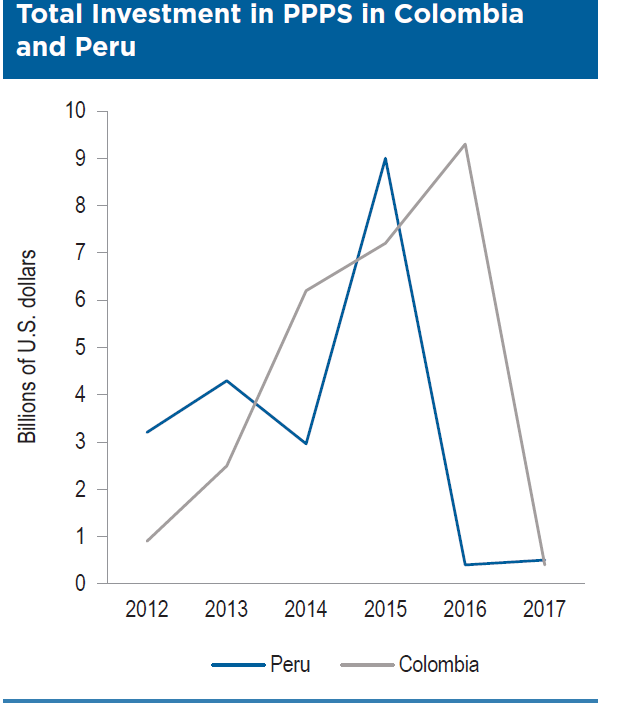
The chart above shows what happens when policy is based on a slogan. In this case “Zero Tolerance.” Procurement rules in both Peru and Colombia require that any public contract tainted by corruption be terminated immediately. As the Brazilian investigation into construction giant Odebrecht unfolded, it became clear that many projects to build highways, power plants, and other infrastructure projects in the two countries had been corruptly awarded.  Authorities in both countries then did what the law told them they must: cancel the contracts.

Most large infrastructure contracts in Peru and Colombia are in the form of Public-Private Partnerships (PPPs), and the immediate termination of a PPP can be enormously costly.  Not only to the firms that paid bribes to secure the contract, but to lenders, suppliers, and the hundreds of other contractors on the project who had no knowledge or involvement in the bribery scheme.  The greatest costs are likely be felt by the citizens of Colombia and Peru.  For as the chart shows, the consequence of zero tolerance is a halt to new spending for roads, power, and other essential facilities as investors and project developers shy away from the risk future contracts will be terminated for the tiniest of infractions by anyone associated with the project.   

Colombians and Peruvians may today be proud their governments are so tough on corruption neither one will tolerate a speck of it in any contract for infrastructure.  Tomorrow citizens of the two countries may have a different view: when power shortages mean the lights won’t come on and the failure to build new roads and maintain old ones produces horrendous traffic jams.  

Last week the World Bank hosted a presentation by Inter-American Development Bank staff where the issue of why “zero tolerance” is a good slogan but a bad policy was examined and means for addressing infrastructure corruption without producing the results shown in the chart was discussed.  A paper the IDB presenters recently published, the source of the figure above and the basis of their presentation, is here.   A video of the session here.