Zelensky’s Legislation Does Not Undo the Damage Parliament Did to Ukraine’s Anticorruption Regime

President Zelensky is proposing legislation that supporters say remedies the problem Parliament created Tuesday by enacting Law No. 4555-IX (English translation). 

As yesterday’s post explained, that law gives the Prosecutor General unchecked power to

  • order both the anticorruption agency (NABU) and the special corruption prosecutor (SAP) follow his directions,
  • review pretrial investigations,
  • reassign NABU-led cases to other law enforcement bodies,
  • close cases at the request of the defense, and
  • appoint staff to prosecution teams.

The simple way to undo the damage this law has created is to repeal it, and indeed some reports say that is precisely what Zelensky’s proposed legislation does. But an analysis by Ukraine’s Laboratory of Legislative Initiatives makes clear that that is not the case.

Rather, the analysis shows that in several ways Zelensky’s bill exacerbates the damage 4555-IX did to the two agencies. Most damaging is it perpetuates the myth that the two have been infiltrated by Russian spies. As the Laboratory’s analysis explains:

Continue reading
Undermining Ukraine’s Anticorruption Agency and Special Corruption Prosecutor: What It Means for Whistleblowers

Tuesday’s approval of a law curing the independence of Ukraine’s anticorruption agency and the special prosecutor for corruption has sparked a furious backlash from citizens, NGOs, and Ukraine’s international partners. In today’s Guest Post Oksana Nesterenko, the Executive Director of the Anti-Corruption Research and Educational Center of the National University of Kyiv-Mohyla Academy, and Andrii Biletskyi, Senior Policy Analyst at the Center, explain its impact on a critical element in the fight against corruption: Ukrainians’ willingness to blow the whistle on corrupt officials and their private sector accomplices.

The big, disappointing story in Ukraine this week was the fast-tracked passage of legislation curbing the independence of NABU, the anticorruption agency, and SAPO, the special prosecutor for corruption.

Passage of what is now Law No. 4555-IX dealt a serious blow to the independence of the two agencies responsible for tackling high-level corruption. It gives the Prosecutor General sweeping powers to control both of them: authority to issue binding written instructions to either, order inspections into specific pre-trial investigations, reassign NABU-led cases to other law enforcement bodies (including the internal security service Sluzhba Bezpeky Ukrayiny), close cases at the request of the defense, and unilaterally appoint members of prosecutorial teams.

The law triggered protests across Ukraine, with people taking to the streets nationwide to voice their opposition. Western partners — including the European Union and the Organization for Economic Cooperation and Development (OECD) — have already expressed serious concerns, casting doubt on Ukraine’s future steps toward European integration and its ability to attract needed investment.

In response to this backlash — which the Ukrainian authorities clearly did not expect, President Zelensky has submitted Bill No. 13533 to the Ukrainian Parliament aimed at restoring the independence of anti-corruption institutions (here). Some Members of Parliament have also registered an alternative bill (here). However, it’s still too early to proclaim that NABU and SAPO are out of the woods.

While we wait for the air to clear, and we hope for repeal of the law, let’s talk now about what it means for whistleblowers so long as it remains in force.

Continue reading

Guest Post: The Forgotten History of Anti-Money Laundering Law: Where Did It Go Wrong?

Anton Moiseienko, Senior Lecturer and Research Director at the Australian National University Law School, introduces GAB readers to his new book on AML with the following observation —

The contemporary anti-money laundering (AML) regime effectively prevents criminal infiltration of the economy and delivers value for money. Said no one, ever.

Critiques of AML efforts abound among practitioners, policymakers and scholars alike. This near-universal lack of confidence in today’s financial crime rules is the starting point of my new book Doing Business with Criminals: Between Exclusion and Surveillance, which explores the objectives, unintended consequences, and history of the global AML regime.

The sheer degree of discontent with the existing framework begs the question of what went wrong. There has been no shortage of literature seeking to provide an explanation or proffer a solution. Seminal works include Peter Alldridge’s What Went Wrong with Money Laundering Law?(2016) and Nicholas Gilmour and Tristram Hicks’s The War on Dirty Money (2023). A valuable recent contribution is the article ‘How Well Does the Money Laundering Control System Work?’ by Mirko Nazzari and Peter Reuter, published in Crime and Justice and reviewed by Rick Messick on this blog.

These books and articles make varied and useful contributions, as do many other studies. Still, several further avenues need to be pursued to advance the debate on how to address the problem. They include revisiting the history of AML to understand why today’s widely criticised regime has evolved in the way it has – and, crucially, how that history has defined its current objectives.

Continue reading

Ukrainian Anticorruption Agencies Under Attack

Ukraine’s National Anticorruption Bureau (NABU), the independent agency responsible for investigating corruption, was searched July 21 by agents of the State Security Office and the Prosecutor General’s Office. In a post on X, NABU says no warrant or other legal authorization was presented to justify the search (here).

On Tuesday, the day after the search, Parliament approved legislation putting both NABU and the Special Anti-Corruption Prosecutor’s Office (SAP), which is responsible for prosecuting NABU cases, under the control of the Prosecutor General of Ukraine, an appointee of the Ukrainian President (here).

Both actions come a little more than a week after security service personnel searched the home and office of Vitaly Shabunin, a leading anticorruption activist.

The searches and the legislation were justified on two grounds. First, NABU and SAP have abused their powers. Second, and more significantly and darkly, the two are alleged to have ties to Russia and are furthering its interests.

The grounds for these actions seem shaky to say the least. A July 16 letter (original here; translation here) by Ukrainian civil society organizations shows the allegations levelled at Shabunin are without foundation. It also observes that all first appeared on anonymous Telegram channels.

Close observers say there may be cases where NABU or SAP or both were overly aggressive, but that is a far cry from doing Russia’s bidding. And indeed the real fear is that it is the critics of a vigorous anticorruption campaign who are doing the aggressor’s bidding.

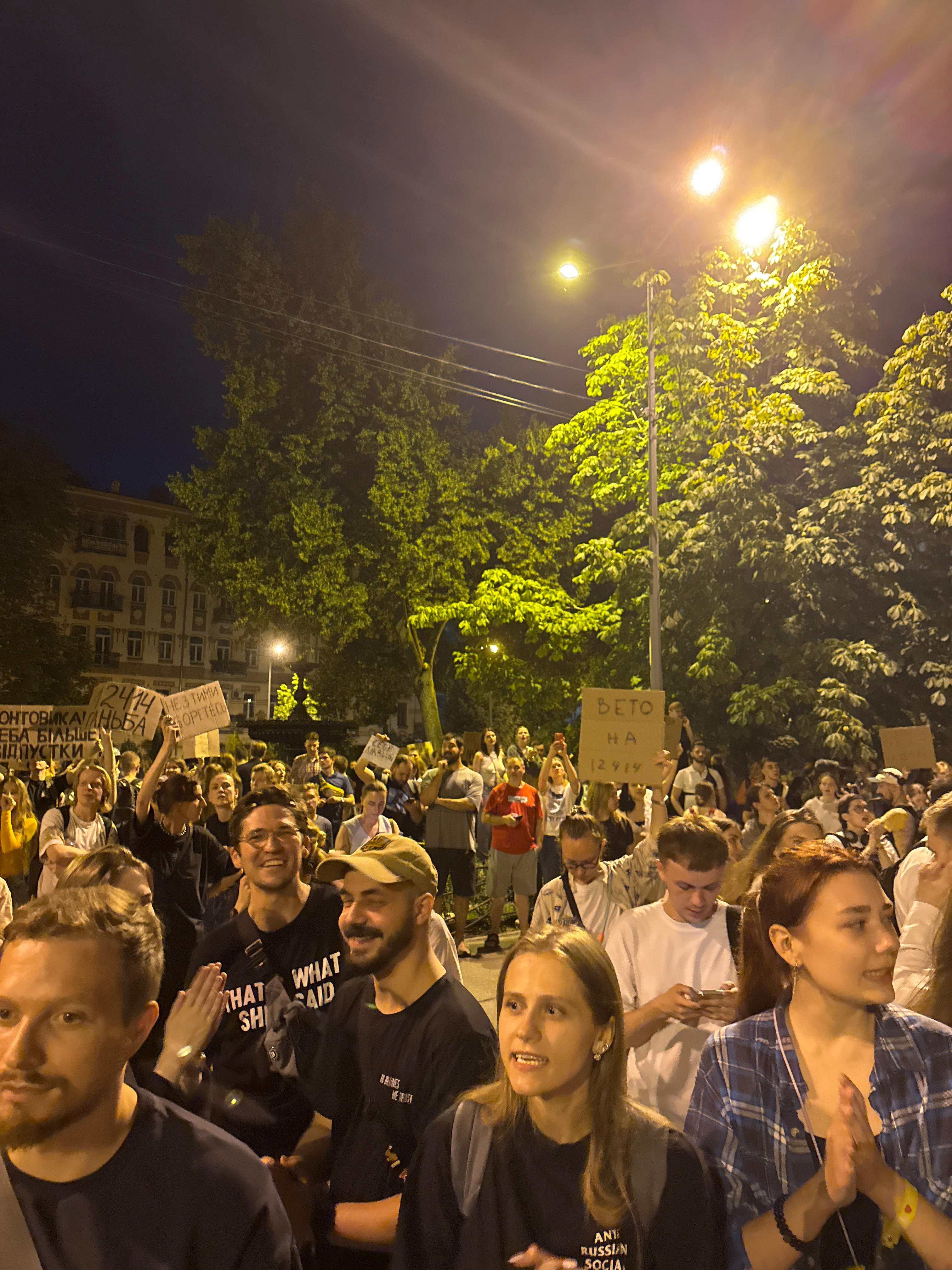
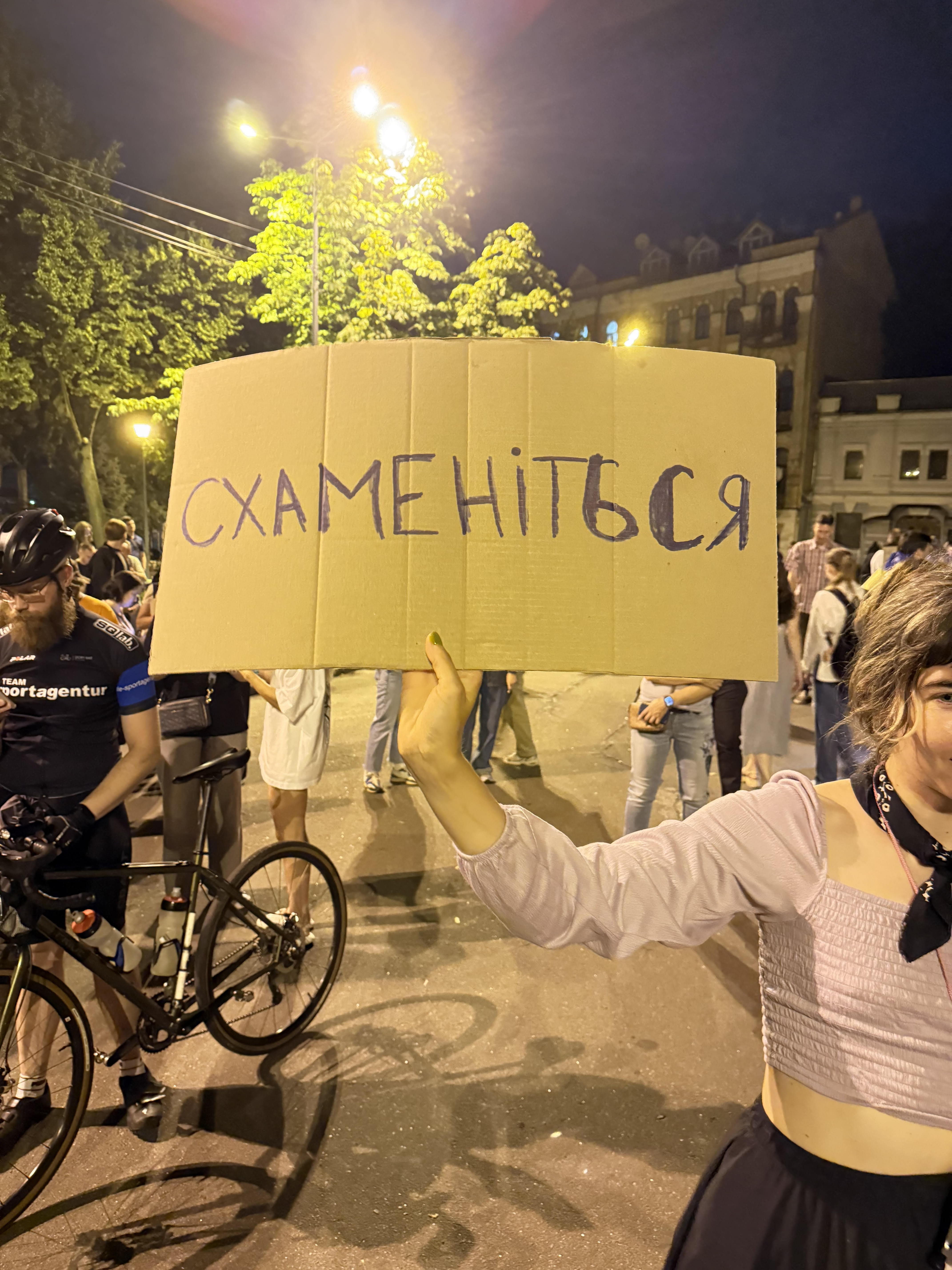
The bill curbing NABU and SAP’s independence is now before President Zelensky for signature or veto. The European Union, which made the independence of NABU and SAP a condition for continued support, have weighed in with Zelensky. Pictures from demonstrations in Kyiv urging a veto (by GAB special correspondent) are below. More demonstrations planned for Wednesday.

UN Human Rights Council: Reducing Corruption, Promoting Human Rights Inextricably Linked

On July 7 the U.N. Human Rights Council approved without dissent a resolution stressing the close link between the advancement of human rights and the fight against corruption. It unequivocally and without qualification proclaims what advocates of each have long recognized:

“the promotion and protection of human rights and the prevention of and fight against corruption are mutually reinforcing;”

U.N. Human Rights Council REsolution 59/6

Importantly, the resolution spells out how corruption fighters and human rights advocates can work together to achieve the two objectives. And to further this cooperation, it mandates:

  • A comprehensive, new study by the Human Rights Council Advisory Committee to develop concrete guidelines for implementing States’ procedural and substantive human rights obligations in the context of preventing and combating corruption, with broad consultation of stakeholders, including civil society.
  • The encouragement for Human Rights Council mechanisms to consider corruption’s impact within their existing mandates.
  • Stronger policy coherence across United Nations processes in Geneva, Vienna, and New York on corruption and its human rights implications.

The resolution’s passage is the latest effort by the UNCAC Coalition, a global network of almost 400 civil society organizations in over 120 countries, to foster ties between those working to advance human rights and those fighting corruption. Its other work towards this end includes:

Continue reading

Are Money Laundering Laws of Any Value?

Not really.  That’s the answer Mirko Nazzari and Peter Reuter provide at the conclusion to their comprehensive review of the evidence on the impact of the global AML scheme.

Nazzari, a postdoctoral research fellow in Political Science at the Università degli Studi di Sassari, and Reuter, a Distinguished University Professor in the School of Public Policy and Department of Criminology, University of Maryland, find no evidence antimoney laundering laws have deterred the laundering of the proceeds of crime. For one reason, the U.S. and other wealthy countries, which pushed the poorer nations of the world to follow them in enacting complex, expensive AML controls, have failed to implement critical elements of the control system themselves (inclusion of lawyers and real estate professionals in the U.S. for example). Another reason: banks, especially large, multinational ones, have failed to comply (flouted?) the laws and national regulators done little to see they do.

The one redeeming factor is the help AML regimes provide law enforcement agencies when making cases against those whose crimes generate huge sums of money. The authors summarize findings from the U.S. that show that the suspicious transaction reports banks, casinos, and other institutions must file frequently support investigations of drug traffickers, human smugglers and other criminals who launder large sums, providing additional details of their activities or corroborating evidence.

The 86-page article (here) appears in the journal Crime and Justice but unfortunately behind a paywall. It is likely to be made public shortly given the importance of the article to so many around the globe. In the meantime, the abstract and a few notable highlights are below.

Continue reading