New York Conference Recommendations on the Future of Corruption Measurement

The central issue in the fight against corruption is how to measure success. Did changes in the way pharmaceuticals are procured and distributed reduce “leakage.” Did strengthening the anticorruption agency and creating fast track corruption courts reduce bribery?

How to assay these reforms were some of the many questions participants debated at a three-day conference on measuring corruption at the UN’s New York headquarters in early December.

The measurement issue starts with the most basic question: what is corruption. Are all gifts to a public official corrupt? Or just those over say $50? There is the conceptual issue: All other things equal, is corruption greater when two officials each take a $50 bribe or one a $100 bribe? Then there are the practical issues, starting with how to measure conduct like bribery and embezzlement that cannot be directly observed and that the participants go to great lengths to hide (here).

Organized by the UNDP, the International Anticorruption Academy, UNODC, the OECD, and the World Bank, the conference did not produce the definitive guide to corruption measurement. Nor is such a guide even possible, given the definitional, conceptual, and practical issues corruption measurement poses.

What the conference did achieve was more important.

Participants from governments and NGOs from rich and poor countries alike agreed that the impossibility of an all-encompassing measurement tool must not be taken as a counsel of despair. There are many ways progress in the fight against corruption can be measured and much that national governments with input from academics and civil society can do to develop ever better measures of that progress.  The statement issued by this Second Global Conference on Harnessing Data to Improve Corruption Measurement along with the recommendations for advancing the measurement agenda is here.  
The Failure to Limit the Corruption of Global Capital

This past April I was fortunate enough to attend a wide-ranging discussion at the Stanford Business School of what the growing power of global capital and the declining trust in government institutions means for the future of capitalism and democracy.

Not surprisingly corruption emerged as a major theme.

Speakers examined everything from the failure of multinational corporations to enforce their own ethics codes to the rise of a profession devoted to helping corrupt officials hide stolen assets to the OCED’s failure to crack down on Italy’s breach of the Antibribery Convention.

A link to the conference papers is here. My summary of what was said about the transnational spread of corruption and measures to curb it, published on the ProMarket page of the University of Chicago’s Stigler Center, is here.

An extraordinary app, NotebookLM, converted the summary into a dialogue explaining the summary and exploring its implications.  It is here.( A physicist friend had raved about how NotebookLM made his technical papers understandable to lay audiences. I didn’t believe him until I heard the dialogue it created off the summary. I am astonished at the result.) 

Civil Society Should Have a Role in Reviewing Compliance with UNCAC

A critical if little noticed meeting on the fight against corruption took place in Vienna the first week in September (here). The Implementation Review Group of the Conference of States Parties to the United Nations Convention Against Corruption, a committee of all 191 parties to the Convention with responsibility for ensuring each party complies with its terms, discussed proposals for strengthening enforcement.

The Convention is the single most important initiative ever taken to curb corruption. Each party pledges not only to make bribery, embezzlement, and other corrupt acts a crime under their domestic law but to actively enforce these laws. Full compliance by all state parties would turn corruption from a pressing national and international priority to a subject of mainly historical interest.

That corruption is not yet the province of historians is because responsibility for ensuring states fully comply with the Convention has been left to their governments. Initially, each government simply reported how well it was meeting its treaty obligations. The review mechanism was later enlarged to include a neighboring state and second from outside the region. The expanded review is a cooperative process with the reviewed government holding a veto over the reviewers’ conclusions.

The reviews produced some progress (here), often thanks to behind the scenes cajoling by the UNODC, which provides technical support to the reviews. It hardly needs saying, however, that leaving it to a government to judge whether it is vigorously combatting corruption means full compliance with UNCAC remains a chimera.

It is for this reason that the UNCAC Coalition, a global network of almost 400 civil society organizations in over 120 countries, has been laser focused on including citizens in the assessment process. Its latest effort: a statement from UN human rights experts it coordinated. Addressed to the Implementation Review Group, the experts urge UNCAC States Parties to protect and expand civic space in national and global anti-corruption fora and strengthen the inclusiveness and transparency of the UNCAC review mechanism.

The signatories, their statement, and additional information on the review mechanism are in this letter by UNCAC Coalition Managing Director Mathias Huter.

Continue reading

The Trump Administration’s Enforcement of the Foreign Corrupt Practices Act: Interim Report

On February 10, President Trump ordered a pause in the enforcement of the FCPA. His executive order claimed that its enforcement damaged American businesses while “impeding United States’ foreign policy objectives.” The order directed Attorney General Pamela Bondi to stop enforcing the act for 180 days to provide time to assess current enforcement policy and update the Department’s enforcement guidelines.

During the pause, some cases proceeded as normal. One FCPA defendant was sentenced and trials in three cases remained at least provisionally on track (here).

Other cases were derailed. One against two former executives of Cognizant Technology Solutions was dismissed, and several FCPA practitioners reported investigations they were handling were halted.

No official data on the number of investigations or cases dropped has been released, but there are insider reports.

Continue reading

Preserving the Independence of Anticorruption Institutions Under Pressure From War, Politics, and Populism: Lessons from the Ukraine Crisis

On July 22 Ukraine’s parliament approved without debate or warning legislation sharply curbing the independence of Ukraine’s corruption fighting agencies. Nine days later it okayed a second bill largely repealing the curbs. In between were massive demonstrations by citizens protesting the July 22 law and threats by the European Union to cut financial support.

Ukraine’s Institute for Legislative Ideas today published a report offering lessons from these events. The think tank’s analysis explains who and what was behind the attempt to defang the nation’s anticorruption agency and special corruption prosecutor and how the sudden backtracking is likely to affect Ukraine’s fight against corruption. Along the way the report provides a careful legal analysis of the July 22 legislation, what the second bill repeals and what it leaves intact; the stated reason for the July 22 law (cleanse the agencies of “Russian influence”); the real reason for its passage (investigations were getting too close to those in power), and what civil society and international partners must do to ensure there is no further effort to undermine the fight.

Critical reading not only for those concerned about corruption in Ukraine but for those in other nations where a transnational coalition is working to keep the corruption fight on track.

The English text of the report is here.

Justice for Fishrot Victims Once More Delayed

Thanks to a last-minute legal maneuver, defendants in Namibia’s largest ever corruption case again escaped answering for their crimes. Set to start August 5, their trial was postponed pending a ruling on a long-shot motion to invalidate all pre-trial rulings. While unlikely to succeed, the motion opens the chance for even more delay as its denial will almost surely be appealed.

It is now approaching six years since former Justice Minister Sacky Shanghala, former Fisheries and Marine Resources Minister Bernard Esau and accomplices were arrested for their roles in a bribery scheme giving Icelandic fishing company Samherji the exclusive right to catch horse mackerel in Namibian territorial waters.

Dubbed the “Fishrot scandal,” the case initially promised much. To Namibians who lost their livelihood thanks to the scheme, the chance for compensation. To the international community, a demonstration that a young nation still consolidating democratic norms could hold the powerful to account. 

What the case has become instead is another demonstration of a principle all too common in corruption cases: justice delayed is justice denied.

Continue reading

Pressure Growing on OECD Antibribery Working Group to Review Italy’s Noncompliance

As a party to the OECD Antibribery Convention, Italy is bound by international law to investigate any Italian citizen or company alleged to have bribed an official of another government. In pursuing a case, the treaty requires that Italy “not be influenced by considerations of national economic interest. . . or the identity of the natural or legal persons involved.”

Successive Italian governments have ignored the no favoritism requirement. Economically important and politically influential Italian firms have regularly escaped punishment on the flimsiest of grounds: €10.5 million paid to a foreign public official’s cousins called not a bribe but a “consulting fee,” €197 million to well-connected insiders termed a “lobbying fee” (here).

Italy’s most recent breach of its treaty obligation: the refusal to appeal the acquittal of oil giant and partially state-owned firm Eni for paying a $1.1 billion bribe to Nigerian officials. A case where the evidence of wrongdoing was overwhelming (here); the trial court’s acquittal reeks of judicial incompetence or worse (here); and in an extraordinary, unprecedented move that will surely deter future foreign bribery cases, the prosecutors are themselves being prosecuted for pursuing the case (here).

That economic considerations or political pressure might dissuade a government from enforcing its foreign antibribery law was not lost on the drafters of the Antibribery Convention. To guard against it the included an article requiring the parties to submit to a “program of systematic follow-up to monitor and promote the full implementation of this Convention.”  That follow up takes the form of a periodic review of compliance by the Antibribery Working Group, a committee consisting of a representative from each treaty party with a senior diplomat chairing.

On its website the Working Group stresses its commitment “to global engagement on anti-bribery.” Italy’s flagrant treaty violations have sparked anticorruption activists to take the group on its promise of a global dialogue. Last October more than two dozen of them asked it to review Italy’s compliance (here); in a tightly reasoned 47-page submission this June a coalition of civil society groups laid out the case for considering Italy’s (non)compliance (a request later amended to overcome the reason the chair gave for putting off review – amended submission here).

Most recently the Federación Latinoamericana de Fiscales, a federation of national associations of prosecutors from Latin American states, has written to the court hearing the Italian prosecutors’ case to emphasize that the proceedings are “undermining the sense of security and institutional trust that all prosecutors must have” to faithfully discharge their duties (here).

Past time for the Working Group to act.

Zelensky’s Legislation Does Not Undo the Damage Parliament Did to Ukraine’s Anticorruption Regime

President Zelensky is proposing legislation that supporters say remedies the problem Parliament created Tuesday by enacting Law No. 4555-IX (English translation). 

As yesterday’s post explained, that law gives the Prosecutor General unchecked power to

  • order both the anticorruption agency (NABU) and the special corruption prosecutor (SAP) follow his directions,
  • review pretrial investigations,
  • reassign NABU-led cases to other law enforcement bodies,
  • close cases at the request of the defense, and
  • appoint staff to prosecution teams.

The simple way to undo the damage this law has created is to repeal it, and indeed some reports say that is precisely what Zelensky’s proposed legislation does. But an analysis by Ukraine’s Laboratory of Legislative Initiatives makes clear that that is not the case.

Rather, the analysis shows that in several ways Zelensky’s bill exacerbates the damage 4555-IX did to the two agencies. Most damaging is it perpetuates the myth that the two have been infiltrated by Russian spies. As the Laboratory’s analysis explains:

Continue reading

Ukrainian Anticorruption Agencies Under Attack

Ukraine’s National Anticorruption Bureau (NABU), the independent agency responsible for investigating corruption, was searched July 21 by agents of the State Security Office and the Prosecutor General’s Office. In a post on X, NABU says no warrant or other legal authorization was presented to justify the search (here).

On Tuesday, the day after the search, Parliament approved legislation putting both NABU and the Special Anti-Corruption Prosecutor’s Office (SAP), which is responsible for prosecuting NABU cases, under the control of the Prosecutor General of Ukraine, an appointee of the Ukrainian President (here).

Both actions come a little more than a week after security service personnel searched the home and office of Vitaly Shabunin, a leading anticorruption activist.

The searches and the legislation were justified on two grounds. First, NABU and SAP have abused their powers. Second, and more significantly and darkly, the two are alleged to have ties to Russia and are furthering its interests.

The grounds for these actions seem shaky to say the least. A July 16 letter (original here; translation here) by Ukrainian civil society organizations shows the allegations levelled at Shabunin are without foundation. It also observes that all first appeared on anonymous Telegram channels.

Close observers say there may be cases where NABU or SAP or both were overly aggressive, but that is a far cry from doing Russia’s bidding. And indeed the real fear is that it is the critics of a vigorous anticorruption campaign who are doing the aggressor’s bidding.

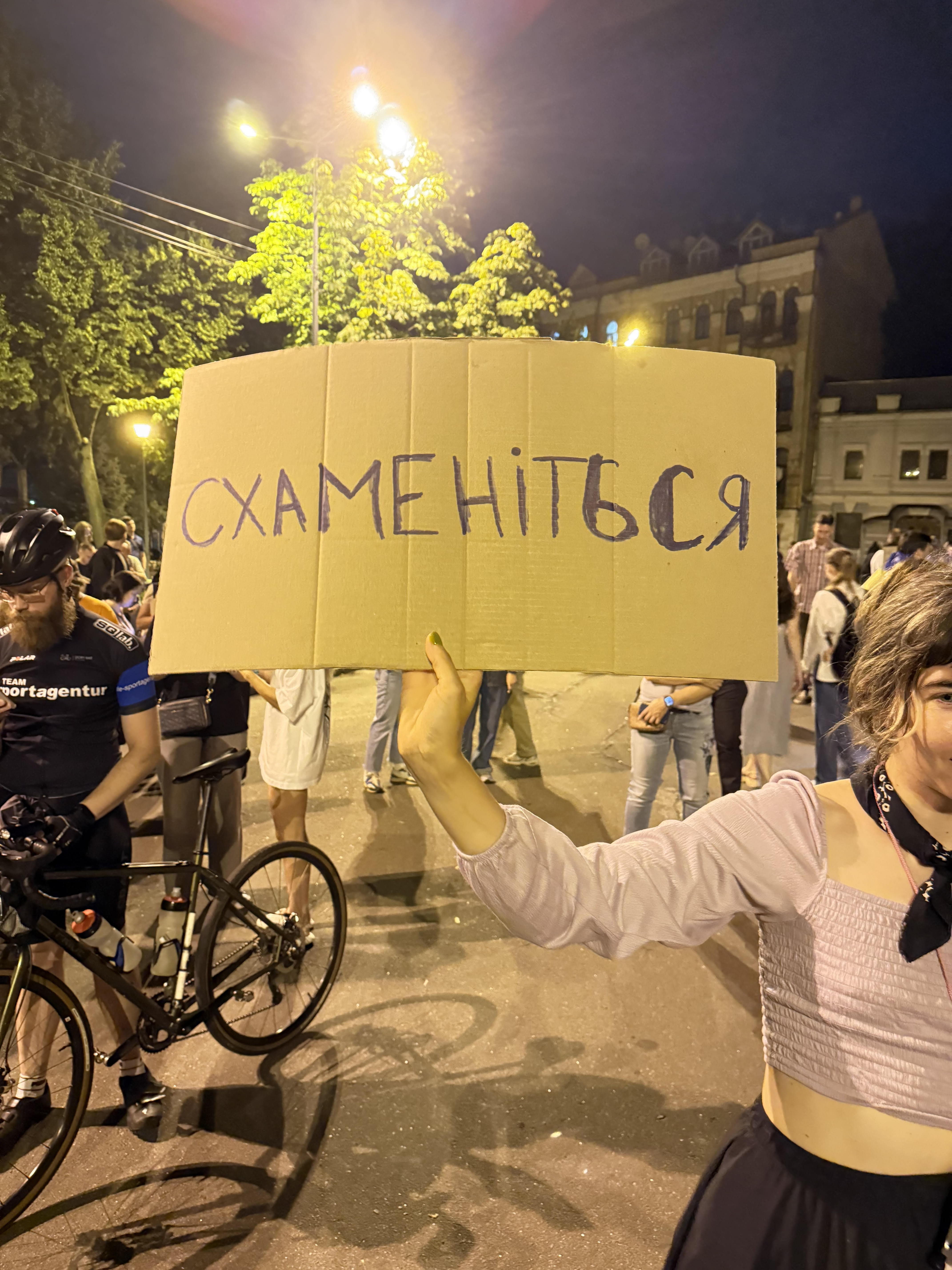
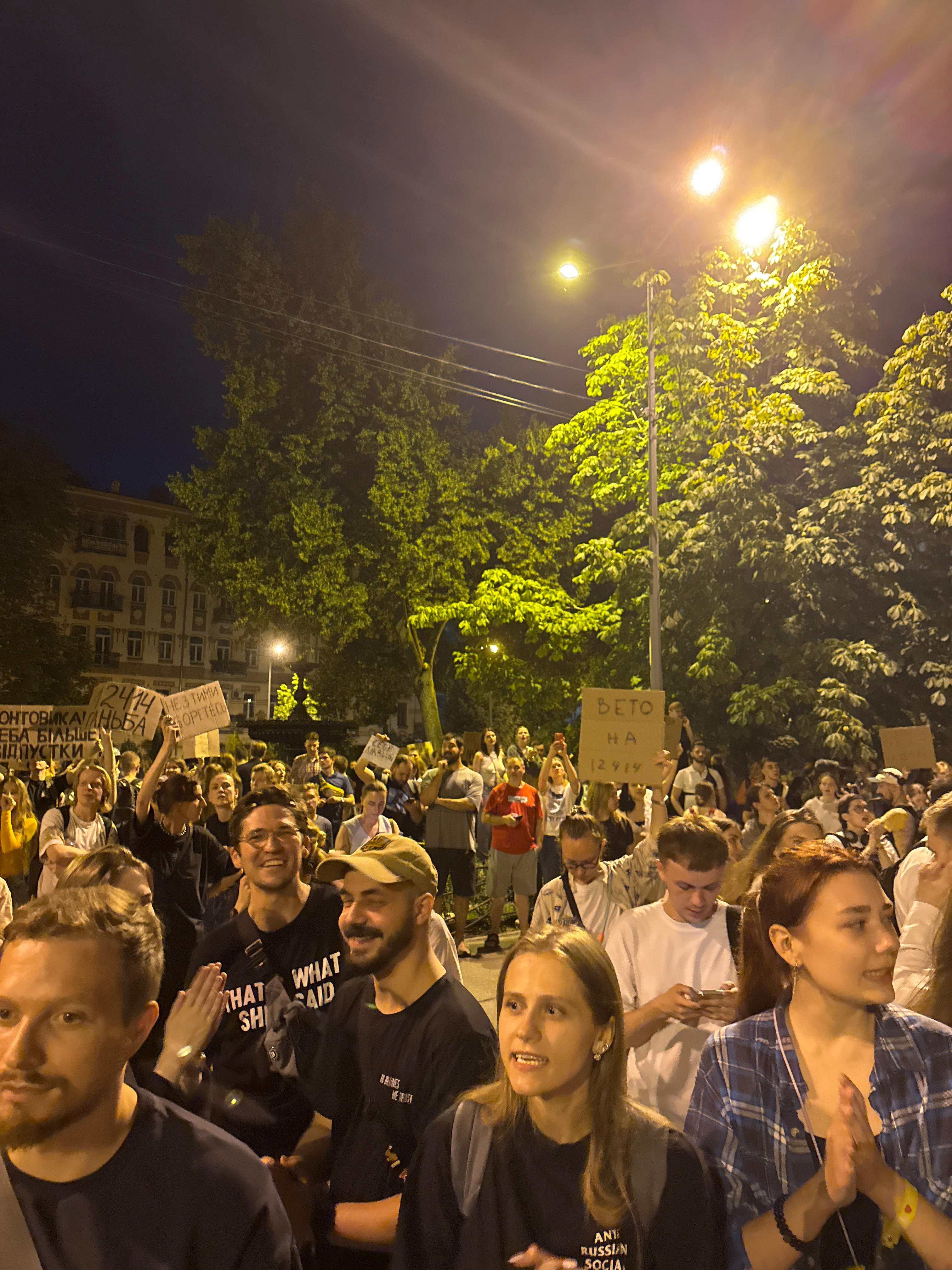
The bill curbing NABU and SAP’s independence is now before President Zelensky for signature or veto. The European Union, which made the independence of NABU and SAP a condition for continued support, have weighed in with Zelensky. Pictures from demonstrations in Kyiv urging a veto (by GAB special correspondent) are below. More demonstrations planned for Wednesday.

UN Human Rights Council: Reducing Corruption, Promoting Human Rights Inextricably Linked

On July 7 the U.N. Human Rights Council approved without dissent a resolution stressing the close link between the advancement of human rights and the fight against corruption. It unequivocally and without qualification proclaims what advocates of each have long recognized:

“the promotion and protection of human rights and the prevention of and fight against corruption are mutually reinforcing;”

U.N. Human Rights Council REsolution 59/6

Importantly, the resolution spells out how corruption fighters and human rights advocates can work together to achieve the two objectives. And to further this cooperation, it mandates:

  • A comprehensive, new study by the Human Rights Council Advisory Committee to develop concrete guidelines for implementing States’ procedural and substantive human rights obligations in the context of preventing and combating corruption, with broad consultation of stakeholders, including civil society.
  • The encouragement for Human Rights Council mechanisms to consider corruption’s impact within their existing mandates.
  • Stronger policy coherence across United Nations processes in Geneva, Vienna, and New York on corruption and its human rights implications.

The resolution’s passage is the latest effort by the UNCAC Coalition, a global network of almost 400 civil society organizations in over 120 countries, to foster ties between those working to advance human rights and those fighting corruption. Its other work towards this end includes:

Continue reading